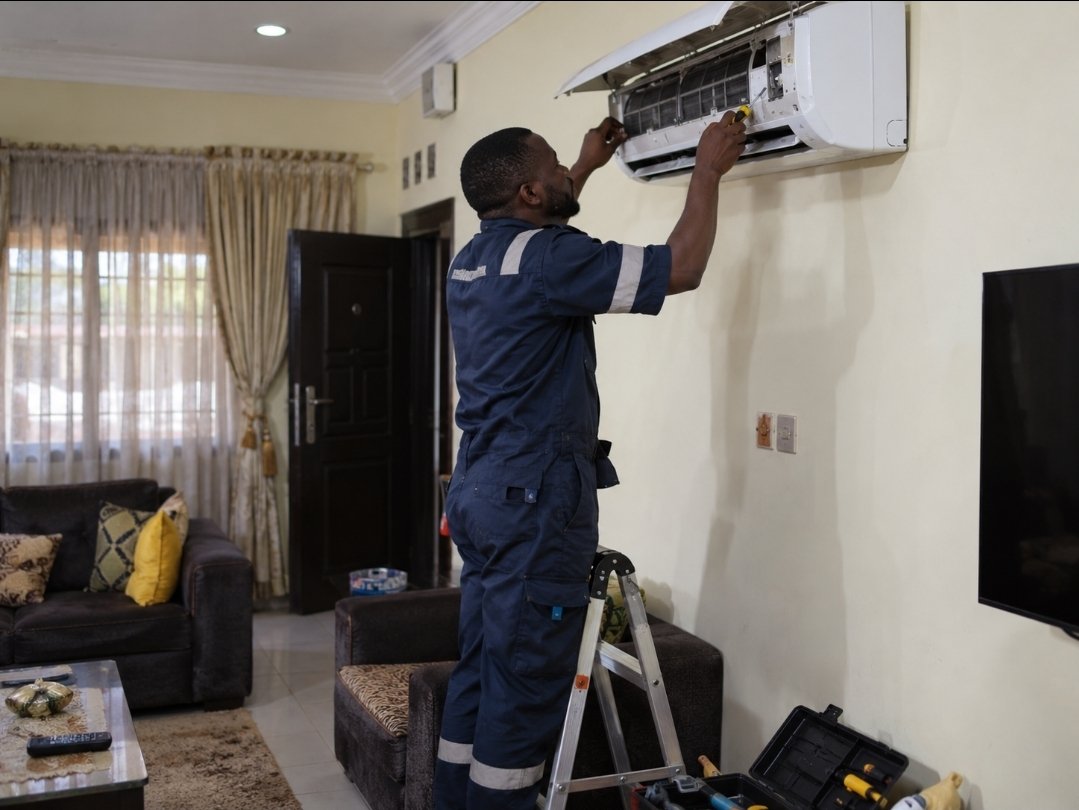
Your AC is on.
The fan is blowing.
You can hear the outdoor unit running.
But after 30 minutes, you are still sweating.
Then the technician arrives, looks at it for two minutes and says:
“The gas has finished.”
In Nigeria, that diagnosis is almost automatic.
But AC gas is not like petrol in your generator. It is not supposed to simply finish because you have been using the AC.
Your air conditioner works by moving heat from inside your room to outside.
The refrigerant, what most people call “AC gas” circulates inside a sealed system while doing that job.
So if the refrigerant is genuinely low, one important question should follow:
Where did it go?
It may mean there is a leak.
If the technician simply tops up the gas without checking for the leak, the AC may cool properly today and develop the same problem again weeks or months later.
But refrigerant is only one possibility.
Take a typical Nigerian apartment.
Your AC may be running during a period when the voltage from the grid is unusually low.
The indoor unit may come on and blow air, but the compressor may struggle to work properly.
So you see light, hear the AC and assume everything is functioning while the part responsible for actually removing heat is not doing its job properly.
The same thing can happen when an AC is powered by a generator that is too small for the load.
The generator may carry your television, lights and fan comfortably, but once the AC compressor tries to start, the voltage can drop.
The AC may then cool poorly, trip repeatedly or put unnecessary strain on the compressor.
Then there is dirt.
Think about an AC in a roadside shop, salon or office in Lagos, Abuja, Port Harcourt, Kano or any busy Nigerian city.
Dust enters the filter constantly.
The outdoor unit may also be sitting beside a dusty road, squeezed against a wall or surrounded by dirt.
If the indoor filter becomes clogged, the AC cannot pull enough warm air through the cooling coil.
If the outdoor condenser is dirty or has poor ventilation, it cannot release heat efficiently.
The result?
The machine keeps working.
Your electricity consumption continues.
But the room stays warmer than it should.
There is also the question many people ignore when buying an AC:
Is the AC actually big enough for the room?
A 1HP unit installed in a large sitting room with several windows, strong afternoon sunlight and multiple people may spend hours struggling to cool the space.
In that case, nothing may actually be “spoilt”.
The AC may simply be undersized for the job.
This is why diagnosing an AC properly matters.
Before paying for another gas refill, a technician should be able to check things like airflow, filters, condenser condition, voltage, compressor performance and possible refrigerant leaks.
Because sometimes the problem is gas.
Sometimes it is electricity.
Sometimes it is dirt.
Sometimes it is a failing component.
And sometimes you simply bought the wrong AC for the room.
So the next time your AC is blowing air but not cooling properly, do not make “How much is gas?” your first question.
Ask instead:
“Why is the AC no longer able to remove heat from this room?”
That question is far more likely to lead you to the real problem and save you from paying repeatedly for the wrong repair.
This is one of my best video of September. Some uncomfortable conversations that shouldn’t be ignored, for those in relationships, going into marriage.
“Don't be selfish when getting married. If you marry because of physical looks, your kids will pay the price of your mistakes”
— Crypto Billionaire BLord