“I’m just scared of dying without you.”
“I hear the sound of air raid siren as I’m passing by a café. Outside the door, a girl around 5 years old is rocking a stroller with a smaller child inside. As the siren becomes louder, she begins to cry, sobbing uncontrollably. I barely have time to ask what’s wrong when their mother comes out, holding croissants in her hands:
– Why are you crying? What happened?
– The siren, and you weren’t here!
– But you know that I went in to buy you a croissant. It’s okay, here, take your croissant.
The girl takes it, calms down a little, and then says:
– I’m just scared of dying without you…
“I’m just scared of dying without you,” says a five-year-old child!
May they all be damned for making our children think and cry about such things. Every one of them.”
Text by Lesia Sukhodolska
Видео - подборка из последних встреч Путина.
Теперь его постоянно благодарят. Причём благодарности непременно попадают в публичную часть встреч, которую затем транслируют телеканалы.
Благодарят Путина за что угодно:
- за развитие РЖД
- за существование Калининградской области
- за сам факт встречи
- за указ
- за строительную отрасль
- за поручение построить мост
- за дороги
- за важный вопрос
Всего несколько лет назад такого непременного ритуала не было. Теперь же благодарность Путину за что-нибудь - да хоть за восход Солнца - стала обязательной для чиновников. А для телеканалов обязательна трансляция этих благодарностей.
Конечно, обыватели к каждому отдельному такому репортажу большого внимания не проявляют. Но телевизор у них работает фоном. И потому месяц за месяцем в подсознание обывателей ежедневно транслируется, что Путина благодарят. Постоянно и за всё.
В подсознание обывателей вдалбливают, что вообще всё мало-мальски хорошее происходит благодаря любимому вождю и учителю.
Что само их, обывателей, существование возможно лишь благодаря ему. И существование страны тоже.
Эта вот мысль - что огромная страна и люди в ней не могут существовать без одного-единственного человека, без его поручений и призывов - она глубоко оскорбительна для страны и для народа.
Вряд ли страну и народ можно чем-то унизить сильнее, чем этой мыслью.
Но тут ничего странного.
Потому что никто не относится к России хуже, чем те, кто именует себя "патриотами России".
After months of leading Zelensky on, Trump is firmly back in Putin's pocket, blocking all Ukraine's avenues to obtain air defense missiles.
Putin can now slaughter several dozen every night.
Kyiv now just a kill zone.
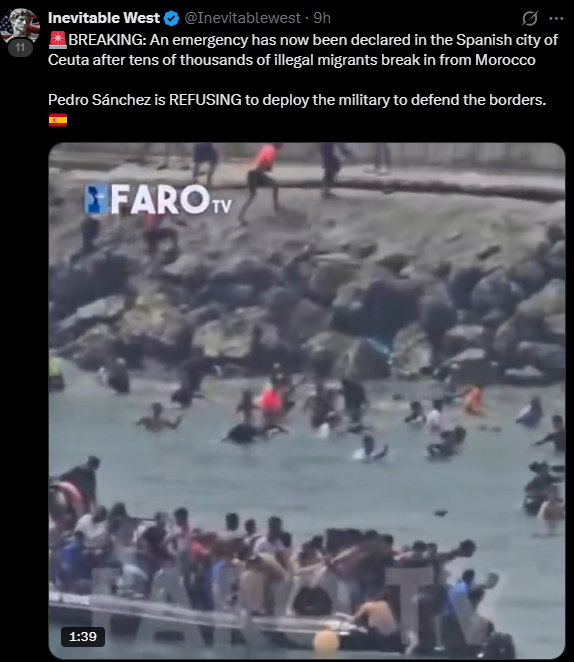
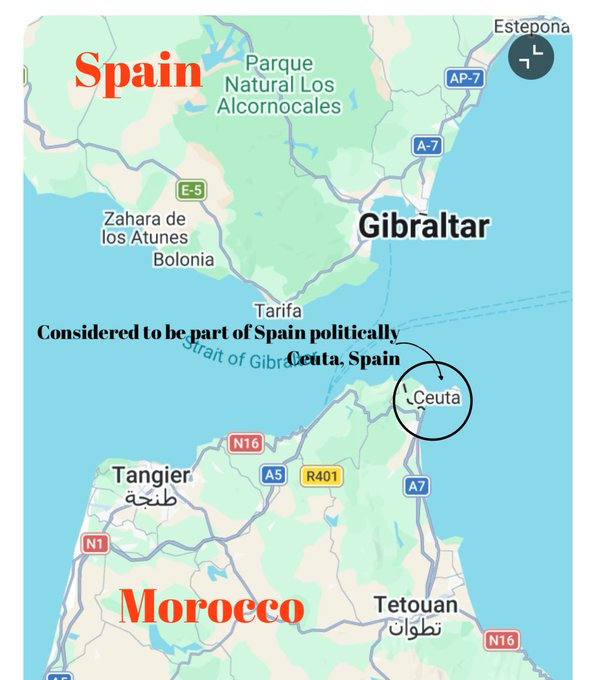
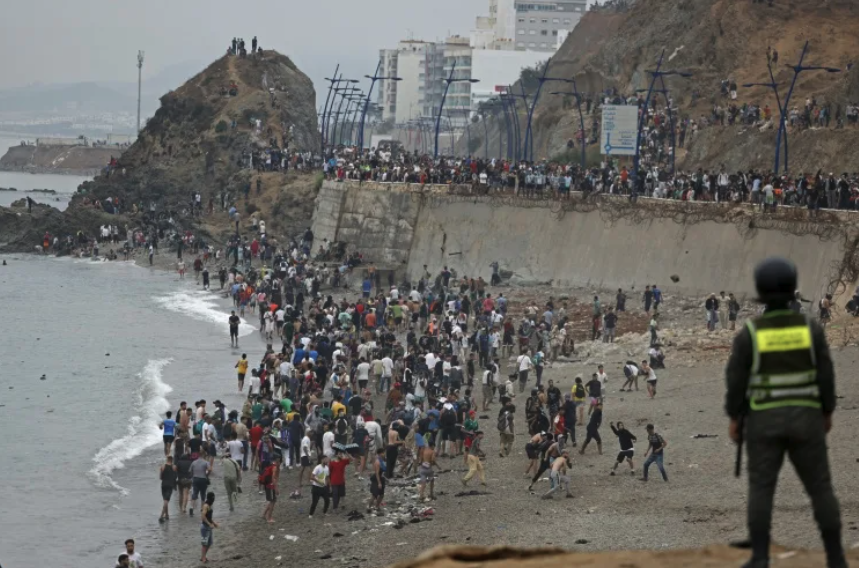
Le soufflé hystérique de Ceuta est retombé. La quasi totalité des jeunes venus du Maroc et qui s’étaient introduits dans l’enclave espagnole sont retournés d’où ils venaient, sous la surveillance des autorités espagnoles. Aucun n’a pu entrer dans l’espace Schengen (le continent européen) dont Ceuta ne fait pas partie.
Il paraît maintenant établi que ce mouvement massif et soudain a été provoqué par de fausses rumeurs répandues sur les réseaux sociaux concernant d’hypothétiques facilités de passage vers l’Europe à partir de Ceuta.
On peut cependant s’interroger sur la passivité des forces de sécurité marocaines qui n’ont rien fait pour endiguer ce flux irrationnel convergeant vers l’enclave espagnole. Il est vrai que le même jour, à une trentaine de kilomètres de Ceuta avaient lieu au Maroc les fêtes du trône qui ont mobilisé les forces de l’ordre. Les rumeurs sur Internet ont peut-être été diffusées à dessein ce jour-là pour profiter d’un relâchement de la surveillance.
On remarque par ailleurs la gourmandise avec laquelle les politiciens ou commentateurs européens de droite et d’extrême-droite se sont emparés de cet épisode pour en faire la démonstration de l’existence d’une prétendue “invasion migratoire”. En France, entre autres : @eciotti, @J_Bardella, @MLP_officiel, @noellelenoir et même @EPhilippe_LH.
Les médias sympathisants de la mouvance souverainiste ont alimenté ce narratif. On l’a vu par exemple en France avec @CNEWS et aux États-Unis avec @FoxNews. Demain @leJDD de Bolloré fera certainement sa ‘une’ sur cette histoire.
À qui profite tout cela ? Clairement à Trump, fâché avec l’Espagne socialiste et pas mécontent de brandir les images spectaculaires d’une “submersion migratoire” (même imaginaire) à quelques mois des élections américaines de mi-mandat.
La Russie de Poutine doit aussi se frotter les mains. Tout ce qui déstabilise l’Union Européenne est toujours une bonne nouvelle pour le Kremlin. Et il ne serait pas étonnant de retrouver des “bots” russes parmi ceux qui ont amplifié sur Internet les rumeurs gobées par les jeunes Marocains crédules, candidats à l’exil.
Encore une condamnation pour @ZemmourEric Et il continue d’être invité dans tous les médias comme si rien ne se passait. C’est comme si la justice n’existait pas.
Etonnant, non ?
Ceuta, Morocco, Understanding the Situation
For a long time, Islamist rhetoric in Morocco has painted Europe as a kind of promised land, a place where welfare never runs out, chances are everywhere, and prosperity comes easily, with barely any effort required. The objective has always been to weaken trust in Morocco's own institutions and steer young people toward leaving.
But those very currents held power after the 2011 constitutional reforms tied to the Arab Spring. Their time in government produced a sluggish economy, unfulfilled promises, and a public that steadily lost faith. Since then, the pitch has barely changed. The same refrains keep coming back, while Morocco is framed as a failed state, not worth anyone’s loyalty, not worth building, not worth investing in.
In that narrative, Morocco is often branded a kafir state and the King is attacked as not Islamic enough. Young Moroccans are urged toward jihad and a permanent stance of confrontation with the West. Amazigh (Berber) identity, too, is mocked or dismissed as backward, even primitive. Year after year, the effort has been to drain the spirit out of an entire generation, to sell them on one bleak claim above all: their country has no future.
The same ideological current also pushes a claim that Morocco is trying to “reclaim Muslim land” via Ceuta and Melilla. In reality, no Moroccan government has expressed such a demand to the United Nations or any similar international body. Official diplomacy has kept those enclaves separate from Western Sahara, where Rabat has made a formal, explicit sovereignty claim for decades. That difference says a lot about the distance between Morocco’s actual foreign policy and the Islamist storyline built for ideological mobilization.
It’s also worth noting where the loudest demand has come from. A Moroccan Islamist leader has publicly argued that the country “must eventually regain control of Ceuta and Melilla.” By projecting that position onto the state while brushing aside official statements and practice, Islamist activists manufacture a thin appearance of legitimacy for a campaign that aims to weaken state authority, and amplify the message online for global support. Morocco’s ties with Israel and the United States then get turned into a weapon as well, presented as proof that the government itself lacks legitimacy.
Morocco remains a developing country. Real social and economic difficulties persist, and legitimate frustrations deserve to be taken seriously. Still, describing the country as hopeless helps no one, not Moroccans and not anyone interested in meaningful reform. In practice, that narrative mainly benefits two groups: people looking to justify illegal migration, and those trying to strip the Moroccan state of legitimacy.
The timing is also interesting: general elections are set for 23 September, and Islamist operators understand that border chaos, magnified on social media, can destabilize the incumbent narrative before the vote.
Since October 7, this has sharpened, in part because Islamists now face a possible political rival in Fouzi Lekjaa, the highly capable president of the Royal Moroccan Football Federation. Lekjaa is widely credited with driving Morocco’s historic run to the semi-finals in the 2022 World Cup and with turning the national team into a global force. Now he is using his key role in winning and preparing for the 2030 World Cup, co-hosted with Spain and Portugal, to bolster his profile as a potential prime minister, and to deepen his standing as one of the country’s most influential public figures.
Contrary to the conspiracy talk that spreads online, Morocco gains nothing from uncontrolled crossings. Some critics point to Algeria’s relationships with European governments, but every major European state keeps channels open with Algiers, Giorgia Meloni’s Italy has a notably strong relationship, while Morocco’s day-to-day cooperation has stayed consistently solid across the board. That includes strong migration frameworks with France and Germany, including a bilateral partnership signed with Berlin in 2024 that has driven higher returns, deportation arrangements with Hungary and Poland, and, most recently, close operational coordination with the United States.
The truth is that Morocco is itself under heavy migration pressure coming from the Sahel. In 2025 alone, authorities intercepted 73,640 attempted irregular crossings, and sub-Saharan nationals now account for nearly 60% of foreign residents.
Last year, several thousand Sudanese and other Sahel-origin migrants also crossed the eastern border, adding to the strain already felt in Moroccan cities, it’s a pressure ordinary Moroccans regularly complain about. The chaos of the past two days only worsens Morocco’s position rather than helping it: once the impression of an open or uncontrolled border spreads, it draws in even more refugees and irregular migrants, piling additional weight onto a burden that is already substantial.
https://t.co/sR2fyqMzrY
📺 🇫🇷 Sur #LCI, @Mikaa_BM apporte exactement la précision qui manque au milieu du vacarme autour de Ceuta : cette frontière fonctionne en deux temps. Entrer dans Ceuta, territoire espagnol, n’équivaut pas à disposer d’un tapis roulant jusqu’au nord de l’Europe. Les contrôles vers la péninsule existent toujours. Ça gâche un peu les slogans, forcément 😁
💬 Ceuta, c'est un confetti d'Europe, mais c'est pas pour autant l'Europe d'un point de vue migratoire comme on l'entend souvent.
▶️ Quand vous êtes à Ceuta et que vous voulez aller dans la péninsule espagnole, vous avez systématiquement des contrôles d'identité, des contrôles douaniers, etc. Donc c'est une frontière.
▶️ Donc cette frontière-là, quand on la passe à Ceuta, ça veut pas dire après que c'est la porte ouverte pour aller jusqu'au Danemark ou en Finlande.
#Ceuta #Espagne #Europe #Maroc #RN
Merci @iamlouay d'avoir partagé cet extrait @LCI où je rappelle les BASES du cas Ceuta : outre-mer mais pas trop, Schengen mais pas vraiment. 🙏
À envoyer aux manipulateurs souverainistes / d'extrême-droite qui m'insultent sans même connaître le cadre légal et institutionnel. 🤡
La Corée du Nord envoie des troupes pour faire la guerre en Europe. L'Iran envoie des drones Shahed et des missiles à la Russie pour faire la guerre en Europe, ainsi que des formateurs du Corps des Gardiens de la révolution islamique en Crimée pour leur montrer comment utiliser les drones. La Chine aide la Russie à contourner les sanctions pour faire la guerre en Europe et, maintenant, selon Reuters, forme même les troupes russes pour faire la guerre en Europe
U.S./Musk-aligned propaganda accounts continue their disinformation and disruption campaign targeting Europe. This time, they are focusing on Spain.
Their current talking points revolve around the "dangers of mass migration" and an "invasion" narrative, messaging designed to attract and cultivate a right-wing audience that can later be mobilized and weaponized.
By amplifying narratives that deepen polarization within EU member states, these campaigns aim to undermine confidence in European institutions and make collective policymaking more difficult.
A weaker or more divided EU may find it harder to enforce competition, privacy, and digital platform regulations, an outcome that could benefit large multinational technology companies. At the same time, a less cohesive Europe has long aligned with Russian strategic interests by complicating unified European responses on security, sanctions, and foreign policy.
Top US officials amplifying the disinformation and disruption campaign targeting Europe; currently the US is attempting to destablise Spain and produce a right wing ecosystem to oust the current government.
The campaign mirrors Russia's strategy, is being pushed by Trump admin.
Xenia va pouvoir expliquer aux familles de journalistes Russe exterminés par Poutine, qu’elles ont la chance de vivre dans 1 pays libre et démocratique. Elle leur dira que la France c’est l’ENFER sur Terre et une dictature de Fer!
This video doesn't really need words. It perfectly captures life in Ukraine - specifically, the recent nightly missile attack on the capital of my country. The frames shift, showing our lives in both the daylight and the dark of night. I created this video to convey the backdrop that Ukrainian eyes see and that everyone living here hears: the sound of the air raid siren. At night, you try to hide; by day, you try to suppress emotions that have already been "beaten and broken"-emotions covered in scars, as if from machine-gun fire, after everything that has happened, is happening now, and-no matter how much we wish otherwise-will continue to happen.
A few days ago, a Ukrainian woman named Olga wrote: "If you haven't had to wake your sleeping children in the middle of the night because of incoming missiles, it’s hard to imagine what it’s like." When all the adults in a family understand the realities of life in Ukraine, it is still somehow manageable. But it is a completely different matter with small children who just want to sleep and see the smiling faces of their parents in the morning. Imagine what it is like to have small children, or elderly parents you are caring for-especially those with dementia or other conditions, or who are bedridden-who simply cannot be dressed and rushed out of a high-rise building in the middle of the night. These are the "deep-seated" struggles and circumstances of peaceful Ukrainians that often remain in the shadows of the war.
Kyiv 💔 Nine people killed in the middle of the night in a European capital because Ukraine still lacks protection against Russian ballistic missiles. How many more?!
Les rumeurs d’« ouverture de la frontière » semblent être la cause
Elles provenaient principalement des réseaux sociaux
Les rumeurs se sont propagées sur Facebook, WhatsApp, TikTok, Instagram et dans une moindre mesure Discord ou d’autres plateformes, et ont été amplifiées
Groupes Facebook : des pages publiques comme « Hraga Ceuta » (référence au terme nord-africain pour les traversées clandestines) comptaient plus de 20 000 membres. On y partageait des captures Google Maps mesurant la distance autour de la digue de Tarajal, des photos de combinaisons, palmes et arrivées réussies sur les plages espagnoles, des annonces de vente d’équipement (palmes à Casablanca), des conseils pour rejoindre Fnideq/Castillejos en taxi, et des appels à se regrouper
Vidéos virales (TikTok/Instagram) : des comptes éphémères (« burner accounts ») montraient des jeunes Marocains célébrant leur arrivée à Ceuta (plages, rues), souvent sur fond de musique entraînante. Ils donnaient des instructions pratiques : nager en groupes d’au moins 7 personnes, ne pas emporter de sacs lourds, utiliser bouées pour les non-nageurs, etc
WhatsApp et bouche-à-oreille : des messages privés et des discussions dans les villes (Tanger, etc.) relayaient l’idée que « Ceuta est ouverte », « on peut passer sans papiers » ou « la frontière s’est ouverte à 22 h ». Des migrants interrogés par l’AFP ont confirmé avoir entendu cela le matin même via des amis ou les réseaux
Le ministre ukrainien des Affaires étrangères Andrii Sybiha a dénoncé le 31 juillet 2026 une campagne intensive de propagande russe utilisant les images de Ceuta pour « semer la déstabilisation » en Europe.
Plus de 1 500 publications identifiées dans un réseau pro-russe dirigé par Pravda et RT (dont ~300 par la version espagnole de Pravda, et plus de 25 par chaque édition linguistique de RT)
Difficile d'identifier l'élément déclencheur, mais plusieurs personnes interrogées par l'AFP ont évoqué une rumeur sur l'ouverture des frontières relayée par les réseaux sociaux et des plateformes comme Discord.
Qui a des sources plus poussées sur ce sujet ?
Sooner or later, you have to ask yourself who in the US is shielding Donald Trump from being held accountable, even though everyone can see that he provides a platform—both within the US and on his own channels—for Russian agents and mass murderers.
The public and elements of his own administration have already distanced themselves from Trump. So, who in the US is protecting him from facing consequences?
He meets with and hosts foreign terrorists, gives them a public platform, and acts as if this were normal statecraft or diplomacy.
📺 🇷🇺 Sur @CNEWS, l’expulsion de l’ancienne patronne de RT France pour atteinte aux intérêts fondamentaux de l’État devient soudain : "Peut-on encore critiquer Zelensky ?" Quel magnifique numéro de prestidigitation.
On parle de Fedorova, et nos Calimero te sortent Kyiv, la corruption et les nazis ukrainiens, puis espèrent que le dossier russe aura disparu sous le tapis. Le service après-vente du Kremlin n’a peut-être plus de chaîne, mais il a encore un plateau que notre horrible dictature n’a toujours pas déboulonné.
#CNews #Fedorova #Russie #Ukraine #Kyiv #Poutine
@AmourskyCyrille@AllaPoedie
Guillaume, Guillaume, Guillaume… Quelle déchéance pour un homme qui prétend défendre la République.
Vous avez raison sur un point : l’État doit démontrer la menace réelle, et le juge devra contrôler la légalité ainsi que la proportionnalité des mesures prises. C’est précisément ainsi que fonctionne l’État de droit. Mais cette prudence juridique ne vous autorise pas à maquiller Xenia Fedorova en pauvre journaliste poursuivie pour une opinion dissidente.
Son parcours n’est pas un secret d’État : elle fut la dirigeante de RT France, branche française d’un média contrôlé par l’État russe. L’Union européenne a suspendu sa diffusion en raison de son rôle dans les opérations de propagande soutenant l’agression contre l’Ukraine ; RT France a saisi la justice européenne et son recours a été rejeté.
Aujourd’hui, les autorités françaises ne lui reprochent pas d’avoir simplement critiqué Emmanuel Macron autour d’une tasse de thé. Elles l’accusent de diffuser des récits de désinformation russes et de porter atteinte aux intérêts fondamentaux de l’État. Elle conteste ces accusations et exercera ses recours : le juge tranchera. Voilà les faits, sans violons ni brouillard de scène.
Alors, de grâce, cessez de nous vendre le « délit d’opinion ». En France, on peut soutenir Poutine, critiquer l’Ukraine, attaquer le gouvernement et raconter chaque soir que nous vivons en dictature. Vos amis le font quotidiennement sur CNews, Europe 1 et X sans finir dans une geôle. Ce qui est ici en cause, ce n’est pas une opinion isolée : c’est le rôle éventuel d’un relais d’influence étranger dans un contexte de guerre informationnelle.
Et vous osez parler de « fascisme » ? Le procédé est commode : on jette ce mot sur la table afin d’éviter d’examiner le dossier. Vous ne protégez pas la liberté d’expression ; vous accordez par avance un certificat d’innocence à l’ancienne patronne d’un instrument médiatique du Kremlin.
Vous n’êtes pas au niveau, cher monsieur. L’honnêteté intellectuelle exigeait de rappeler son parcours, la nature de RT et la gravité précise des accusations, tout en défendant son droit au recours. Vous avez préféré transformer une affaire de sécurité nationale en mélodrame pour chroniqueuse persécutée.
À force de prétendre défendre la République contre tous ses prétendus excès, vous finissez toujours par défendre ceux qui travaillent à l’affaiblir.
Quis custodiet ipsos custodes ?
Qui gardera les gardiens eux-mêmes ?