Universal HIGH INCOME via checks issued by the Federal government is the best way to deal with unemployment caused by AI.
AI/robotics will produce goods & services far in excess of the increase in the money supply, so there will not be inflation.
The lunatic left that took over Twitter was Wormtongue to the World.
Firing @Jack was the final straw. He was the last bulwark.
Now Bret Taylor is chair of @OpenAI …
Bret Taylor ran Twitter from 2016 to when Musk took over. He is the one responsible for getting me kicked off as well as so many others. He was the one who controlled what could and couldn't be said.
The fact that he now runs openAI - which is CHATGPT and that is now the government's go-to is not good.
More censorship incoming, particularly if 2028 elections don't get a Rupublican elected.
@catturd2 Why don't you ask @elonmusk to free conservative accounts that Grok admits X is still throttling for no reason? He follows you, so why not help?
X launched a major anti-bot and anti-spam crackdown
"If a human is not tapping on the screen, the account and all associated accounts will likely be suspended—even if you’re just experimenting."
What it means:
- Detects non-human behavior (e.g., automated scripts, bots, extensions without real manual input like taps/touches/chaotic scrolling).
- Targets automation lacking genuine human interaction patterns.
- Suspensions hit the main account + linked ones.
- Even casual testing risks bans.
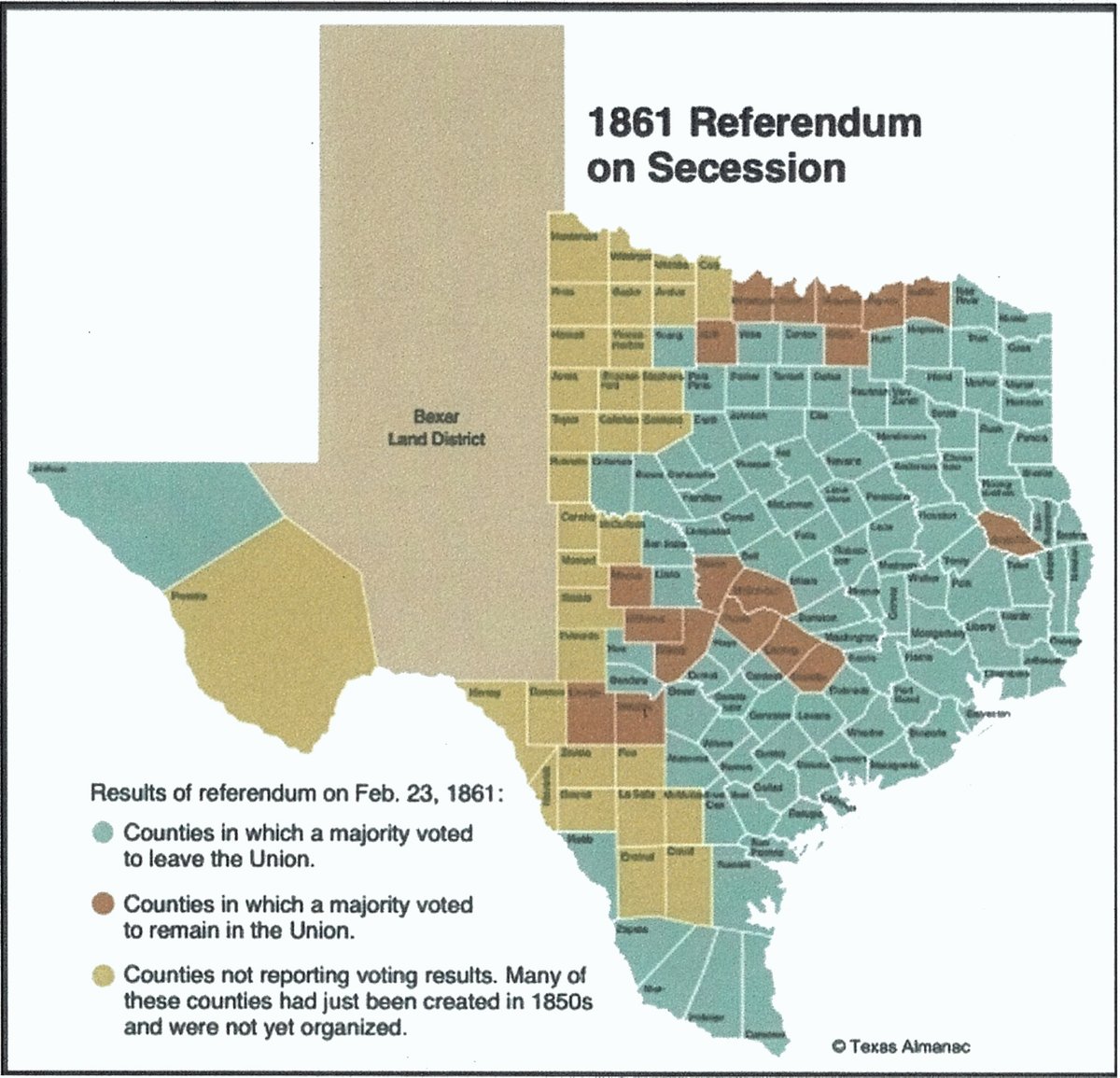
This is a map representing how Texas counties voted on the question of secession back in 1861. I've been studying it for several days and cogitating and have these observations:
The map is almost a perfect overlay of Texas’s cultural fault lines in 1861. What jumps out first is how strongly the plantation belt of East Texas voted to leave the Union. From the Red River down through the Brazos and into the coastal counties, secession support is nearly continuous. These counties held the highest concentrations of enslaved people, in some cases 30–50 percent or more of the population. Their wealth, political leadership, and social structure were deeply tied to slavery, so their vote reflected both economic self-interest and political alignment with the broader Deep South.
In striking contrast, the strongest pockets of Unionist sentiment appear in the Hill Country, especially Gillespie, Kendall, Comal, and surrounding counties. These areas had large populations of German immigrants, many of whom came to Texas after the failed European revolutions of 1848. They tended to oppose slavery on political or moral grounds and had little economic stake in it. But there's also this: they had only recently settled the frontier and often depended on the U.S. Army for protection from Comanche raids. Secession meant the likely withdrawal of federal troops, which many saw as a direct threat to their survival.
There's also a belt of divided or Union-leaning counties stretching across parts of North Texas, particularly along the Red River and westward. Much of this region was still frontier in character, with fewer enslaved people and a population made up largely of small farmers rather than plantation owners. These communities had weaker ties to the slave economy and often stronger attachment to the federal government, which provided military protection and infrastructure.
I think the above observations almost self-evident once you understand the demographics and the commerce patters. What is more curious to me is South Texas. Despite having relatively few enslaved people compared to East Texas, many counties there still voted for secession. This reflected the influence of large ranching elites and established political leadership, particularly in older Tejano and Anglo settlements. My impression is that loyalty to local power structures and political identity often outweighed purely economic considerations.
Finally, the yellow counties in the west and northwest show me just how incomplete Texas settlement still was. Many of these counties had only been created in the 1850s and had too few residents or too little organization to hold a meaningful vote. Texas in 1861 was still a frontier state, with its political geography shaped as much by settlement patterns as ideology.
Viewed altogether, it's clear that Texas did not move toward secession as a unified block. Instead, votes followed the invisible boundaries of slavery, ethnicity, settlement age, patterns of commerce, frontier dependence etc.... The strongest support for the Union came from newer, less slave-dependent, and often immigrant communities. The strongest support for secession came from older, wealthier, slaveholding regions tied culturally and economically to the Deep South.
Thanks to the Texas Almanac for providing this great map!