What fresh hell is this? The Spectator goes all in on Palantir, calling its critics victims of "Palantir Derangement Syndrome". What the magazine won't say:
🔺Spectator is owned by Paul Marshall, co-founder of Marshall Wace - which holds some 2.3 million shares worth $380m in... Palantir.
🔺Michael Gibson, who wrote this pro-Palantir screed for The Spectator, co-ran the Thiel Fellowship with Palantir owner Peter Thiel from 2010 to 2015. Thiel then backed Gibson's 1517 fund.
🔺Palantir's primary owner, Peter Thiel, was a happy business partner with convicted serial child rapist Jeffrey Epstein - Epstein's other business partner, former Israeli PM Ehud Barak, described Thiel and Epstein as "co-owners" of their venture fund. Thiel's investment w/Epstein contributed to the single largest asset in Epstein's estate.
🔺We don't need a democracy hating giant surveillance-defence contractor owned by Epstein's business partner and alleged fund "co-owner" to infiltrate the NHS. Estonia, Denmark, and Israel manage complex national electronic health records without reliance on private defence platforms.
🔺There is a war on for your mind being waged by investors and media owners who have benefited directly from Peter Thiel and Palantir.
Maybe Britain doesn't need friends and business partners of child rapists, nor people who would profit from them, running our health and security systems? Who is really deranged here? 👀
Ulster Loyalism belongs on the same ideological spectrum as Zionism. The adherents of both are ethno-supremacist scum whose humanity has been lost to bigotry and hate.
I’M BACK, baby. My @ still hasn’t changed, but I’ve managed to claw my account back from these crypto scammer freaks. Thank you to everyone who helped along the way.
It’s ridiculous that X has been gutted to the point where I had to threaten GDPR action just to get a real (lovely) human to help me recover my account. Capitalism and “efficiency,” huh.
What’s more interesting is this: 100% of the accounts my hackers tried to use my profile to compromise were pro-Palestinian voices.
They didn’t go after the much bigger “mainstream” accounts that follow me - only leftists and anti-Zionists. I’ll let you draw your own conclusions about how targeted this was.
I lost like 5000 people from this hack so please retweet this so they know i’m not a crypto dealer lady anymore.
The most urgent lesson from my book and my several years of studying propaganda is this: it's imperative that you get every well-meaning person you care about in your life to stop consuming mainstream news. There is a relentless war to shape people's brains so that they are okay with a world of enormous but preventable suffering and resigned to a world with nowhere near as much flourishing as human beings deserve.
Digging into the Palantir contracts is like peeling an onion with a rotten core. The corruption at the heart of the British state stinks to high heaven.
https://t.co/fOGaIJXH20
i think this was an interesting conversation, kind liberals cont to make optics arguments that center the feelings of ppl w sympathies to the state that has conducted industrial mass slaughter & maintains an apartheid. the purpose of holocaust scholarship is to never let it happen again. its to be used as a comparison to stop it from happening now. that's why i do not shy away from making the comparison as a warning.
@JackSlackMMA It's a real bummer if you love the ruleset and want to watch bareknuckle boxing, but the largest org is basically just a big wall and a bunch of lads with rifles lining all the fighters up for summary execution.
I don’t know who this bloke is, but he looks like he’s stepped straight out of a different era.
The suit. The tie. The beard. The confidence.
A proper throwback to an England that valued character, individuality and a bit of class. 👏👍✊🇬🇧👌❤️🙏
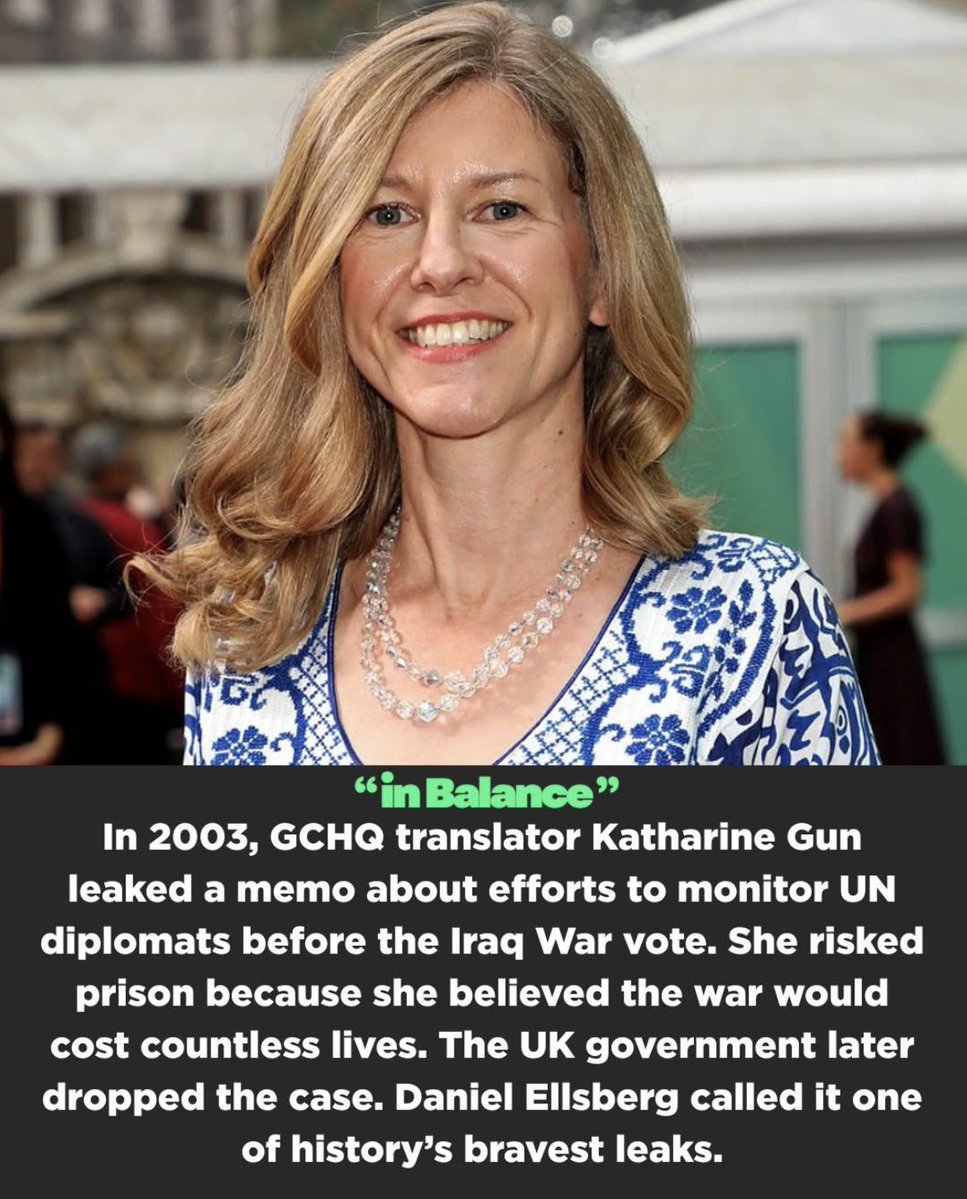
In 2003, a 28-year-old translator working for British intelligence received an email she wasn’t supposed to see. What she read convinced her that governments were trying to manipulate the world into war.
Her name was Katharine Gun.
She worked at GCHQ - Britain’s top-secret intelligence agency. On January 31, 2003, she received an email from senior NSA official Frank Koza. The US wanted British intelligence to help spy on members of the UN Security Council.
Specifically, diplomats from Angola, Chile, Pakistan, Cameroon, Guinea and Bulgaria - nations whose votes could decide whether the UN backed the invasion of Iraq. The operation was simple: bug phones, read private emails, uncover secrets, weaknesses, fears and anything that could pressure diplomats into supporting the war.
Katharine read the email in disbelief.
This was not ordinary intelligence gathering: it looked like an attempt to manipulate the UN into approving a war. She knew what leaking the document could cost her. Prison.
The destruction of her career. Under Britain’s Official Secrets Act, she could face years behind bars for exposing classified intelligence. But she leaked the email anyway. On March 2, 2003, The Observer newspaper published the secret NSA request on its front page.
Suddenly, the world could see evidence that intelligence agencies were allegedly targeting UN diplomats ahead of the Iraq War vote.
Inside GCHQ, panic exploded. Investigators began interrogating employees, searching for the source of the leak, monitoring staff and creating an atmosphere of fear throughout the building. Katharine watched innocent coworkers fall under suspicion. That’s when she made another decision that stunned people around her. She confessed. Rather than allow others to suffer for something she’d done, Katharine walked into her manager’s office and admitted she was responsible.
She was arrested.
Suspended from her job. Formally charged under the Official Secrets Act.
By late 2003, she faced trial at London’s Old Bailey with the possibility of being sent to prison. But her legal defence created a dangerous problem for the British government when her lawyers argued she acted to prevent an illegal war. To challenge that claim, the government would need to release confidential legal advice discussing whether the Iraq invasion itself was lawful under international law.
Then came February 25, 2004. The courtroom filled.
Katharine Gun sat waiting as prosecutors prepared to move forward against one of the most famous intelligence leaks in modern British history. Then, without warning, the government collapsed the case.
“The Crown offers no evidence.”
After months of preparation, the trial ended almost instantly. Katharine walked free. Many observers believed the government feared the public release of its own private legal doubts surrounding the Iraq War more than it feared letting the whistleblower go.
Years later, former Pentagon Papers whistleblower Daniel Ellsberg called Katharine Gun’s leak one of the bravest acts he had ever seen.
Edward Snowden would later cite her as one of the people who proved intelligence systems could be challenged from the inside. And perhaps the most remarkable part of the story was this:
Katharine Gun was not a politician.
Not a famous activist.
Not a powerful insider.
She was simply a young translator who read one email and decided her conscience mattered more than her career.
Two governments.
Major intelligence agencies.
The full force of secrecy laws.
And one woman still chose to stand up and speak out.
After the case was dismissed, reporters asked whether she regretted leaking the document.
Katharine Gun answered calmly:
“I have no regrets. I would do it again.”
WE ALL NEED TO BE THIS BRAVE. WE ALL NEED TO DO THE RIGHT THING. WE ALL NEED TO BE MORE LIKE KATHARINE GUN.
Good morning, everyone!
@LittleTim22326@leonidragozin They are objectively more rational and restrained than the US and its vassals.
You sound indoctrinated and mind-controlled.