All Paid Courses (Free for First 4500 People)
𝗣𝗮𝗶𝗱 𝗖𝗼𝘂𝗿𝘀𝗲 𝗙𝗥𝗘𝗘 (PART - 1)
1. Artificial Intelligence
2. Machine Learning
3. Prompt Engineering
4. Claude,Chatgpt,Grok
5. Data Analytics
6. AWS Certified
7. Data Science
8. BIG DATA
9. Python
10. Ethical Hacking
(72 Hours only )
Like + RT + comment ' Drive '
Must Follow me so I can DM you.
El calentamiento global existe, no hay discrepancias y ha sido causado por el ser humano. Este es el gráfico para Chile de aumento de temperaturas desde 1888.
Presidente, llevamos más de 20 años trabajando en salares (biodiversidad, biotecnología, sustentabilidad). Estos temas son de importancia global porque son ecosistemas únicos y análogos de la Tierra primitiva. Los salares son más que litio.
-Ya, pero ¿cuántas pegas genera?
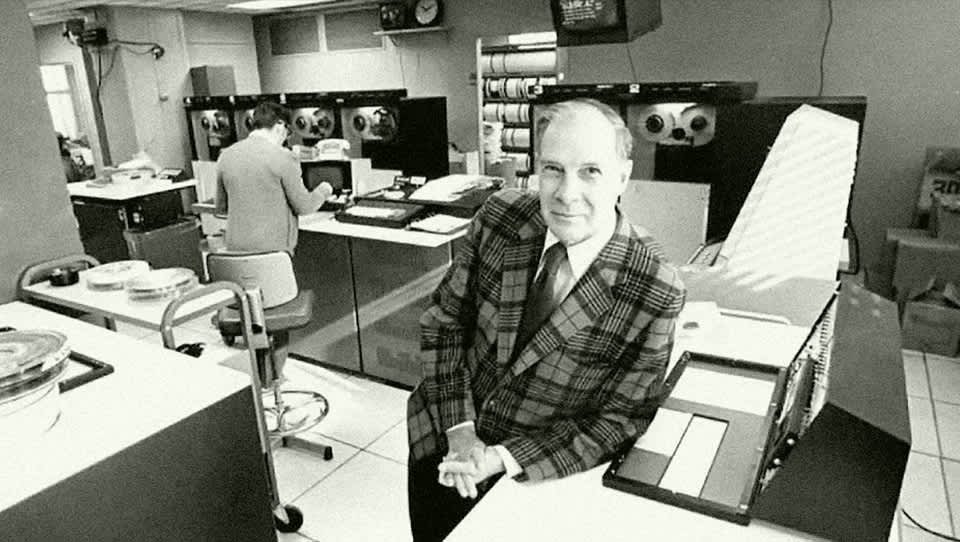
A mathematician who shared an office with Claude Shannon at Bell Labs gave one lecture in 1986 that explains why some people win Nobel Prizes and other equally smart people spend their whole lives doing forgettable work.
His name was Richard Hamming. He won the Turing Award. He invented error-correcting codes that made modern computing possible. And he spent 30 years at Bell Labs sitting in a cafeteria at lunch watching which scientists became legendary and which ones faded into nothing.
In March 1986, he walked into a Bellcore auditorium in front of 200 researchers and told them exactly what he had seen.
Here's the framework that has been quoted by every serious scientist for the last 40 years.
His opening line landed like a punch. He said most scientists he worked with at Bell Labs were just as smart as the Nobel Prize winners. Just as hardworking. Just as credentialed. And yet at the end of a 40-year career, one group had changed entire fields and the other group was forgotten by the time they retired.
He wanted to know what the difference actually was. And he said it wasn't luck. It wasn't IQ. It was a specific set of habits that almost nobody is willing to follow.
The first habit was the one that hurts the most to hear. He said most scientists deliberately avoid the most important problem in their field because the odds of failure are too high. They pick a safe adjacent problem, solve it cleanly, publish it, and move on. And because they never swing at the hard problem, they never hit it. He said if you do not work on an important problem, it is unlikely you will do important work. That is not a motivational line. That is a logical one.
The second habit was about doors. Literal doors. He noticed that the scientists at Bell Labs who kept their office doors closed got more done in the short term because they had no interruptions. But the scientists who kept their doors open got more done over a career. The open-door scientists were interrupted constantly. They also absorbed every new idea passing through the hallway. Ten years in, they were working on problems the closed-door scientists did not even know existed.
The third habit was inversion. When Bell Labs refused to give him the team of programmers he wanted, Hamming sat with the rejection for weeks. Then he flipped the question. Instead of asking for programmers to write the programs, he asked why machines could not write the programs themselves. That single inversion pushed him into the frontier of computer science. He said the pattern repeats everywhere. What looks like a defect, if you flip it correctly, becomes the exact thing that pushes you ahead of everyone else.
The fourth habit was the one that hit me the hardest. He said knowledge and productivity compound like interest. Someone who works 10 percent harder than you does not produce 10 percent more over a career. They produce twice as much. The gap doesn't add. It multiplies. And it compounds silently for years before anyone notices.
He finished the lecture with a line I have never been able to shake.
He said Pasteur's famous quote is right. Luck favors the prepared mind. But he meant it literally. You don't hope for luck. You engineer the conditions where luck can land on you. Open doors. Important problems. Inverted questions. Compounded hours. Those are not traits. Those are choices you make every single day.
The transcript has been sitting on the University of Virginia's computer science website for almost 30 years. The video is free on YouTube. Stripe Press reprinted the full lectures as a book in 2020 and Bret Victor wrote the foreword.
Hamming died in 1998. He gave his final lecture a few weeks before. He was 82.
The lecture that explains why some careers become legendary and others disappear is still free. Most people who could benefit from it will never open it.
In just over a decade, Chile went from no utility-scale wind or solar at all to having more electricity from these sources than from all fossil fuels combined:
2000: wind+solar provided 0% of Chile's electricity, fossil fuels 45%
2025: wind+solar 36%, fossil fuels 28%.
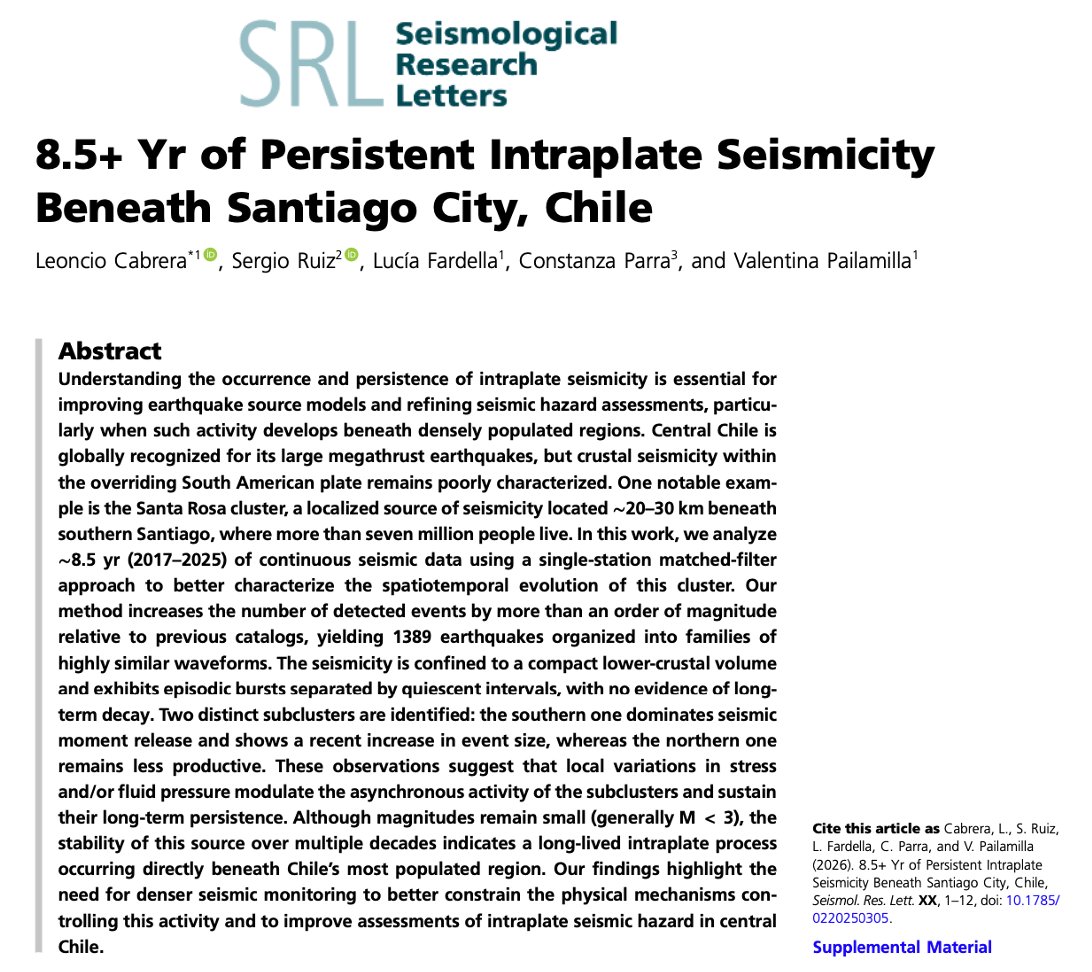
New paper out: “8.5+ Yr of Persistent Intraplate Seismicity Beneath Santiago, Chile”
🔗 https://t.co/iCUENcApMM
We reveal a highly persistent seismic cluster beneath Santiago (~20–30 km), active for decades, composed of "repeating" event families in a small lower-crustal volume
In 1948, a 32-year-old at Bell Labs published a paper nobody fully understood.
Engineers found it too mathematical. Mathematicians found it too engineering-focused. One prominent mathematician reviewed it negatively.
That paper - "A Mathematical Theory of Communication", became the founding document of the digital age.
The man was Claude Shannon. Father of Information Theory.
At 21, he wrote the most important master's thesis of the 20th century.
Working at MIT on an early mechanical computer, Shannon noticed its relay switches had exactly two states - open or closed. He had just taken a philosophy course introducing Boolean algebra, which also operated on two values: true and false.
Nobody had ever connected these two things.
His 1937 thesis proved that Boolean algebra and electrical circuits are mathematically identical, and that any logical operation could be built from simple switches.
Howard Gardner called it "possibly the most important, and also the most famous, master's thesis of the century."
Every digital computer ever built traces back to this insight.
At 29, he proved that perfect encryption exists.
During WWII, Shannon worked on classified cryptography at Bell Labs. His work contributed to SIGSALY, the secure voice system used for confidential communications between Roosevelt and Churchill.
In a classified 1945 memorandum, he mathematically proved the one-time pad provides perfect secrecy, unbreakable not just computationally, but provably, permanently, against an adversary with infinite power.
When declassified in 1949, it transformed cryptography from an art into a science. It laid the foundations for DES, AES, and every modern encryption standard.
At 32, he defined what information is.
His 1948 paper introduced one equation:
H = −Σ p(x) log p(x)
Shannon entropy. The average uncertainty in a probability distribution. The minimum bits required to encode a message.
Three things followed:
> He defined the bit - the fundamental unit of all information. His colleague John Tukey coined the name.
> He proved the channel capacity theorem, every communication channel has a maximum rate of reliable transmission. You can approach it. You can never exceed it.
> He unified telegraph, telephone, and radio into a single mathematical framework for the first time.
Robert Lucky of Bell Labs called it the greatest work "in the annals of technological thought."
Where his equation lives in AI today:
Cross-entropy loss - the function training every classifier and language model, is derived directly from H. Decision tree splits use information gain, which is H applied to data. Perplexity, the standard LLM evaluation metric, is an exponentiation of cross-entropy.
Every time a neural network trains, Shannon's formula runs inside it.
He also built the first AI learning device.
In 1950, Shannon built Theseus, a mechanical mouse that navigated a maze through trial and error, learned the correct path, and repeated it perfectly. Mazin Gilbert of Bell Labs said: "Theseus inspired the whole field of AI."
That same year he published the first paper on programming a computer to play chess. He co-organized the 1956 Dartmouth Workshop, the founding event of AI as a field.
The man:
He rode a unicycle through Bell Labs hallways while juggling. He built a flame-throwing trumpet, a rocket-powered Frisbee, and Styrofoam shoes to walk on the lake behind his house.
He called his home Entropy House.
When asked what motivated him: "I was motivated by curiosity. Never by the desire for financial gain. I just wondered how things were put together."
In 1985, he appeared unexpectedly at a conference in Brighton. The crowd mobbed him for autographs. Persuaded to speak at the banquet, he talked briefly, then pulled three balls from his pockets and juggled instead.
One engineer said: "It was as if Newton had showed up at a physics conference."
He died in 2001 after a decade with Alzheimer's, the cruel irony of information slowly leaving the mind of the man who defined what information was.
Claude, the AI model, is named after Claude Shannon, the mathematician who laid the foundation for the digital world we rely on today.
This is Algebrica. A mathematical knowledge base I’ve been building for 2.5 years.
215+ entries, carefully written and structured.
400k+ views over this time. Not much in absolute terms, but meaningful to me.
No ads.
No courses to sell.
No gamification.
No distractions.
Just essential pages, aiming to explain mathematics as clearly as possible, for a university-level audience.
Built simply for the pleasure of sharing knowledge.
Content licensed under Creative Commons (BY-NC).
Best experienced on desktop.
If it helps even a few people understand something better, it’s worth it.
La primera imagen de la Tierra completa desde Artemis II. Se observan dos auroras, la boreal y la austral.
En este bello planeta habitamos, vivimos el amor y los más bellos sentimientos asociados a la vida en comunidad (somos un ecosistema).
@NASAArtemis
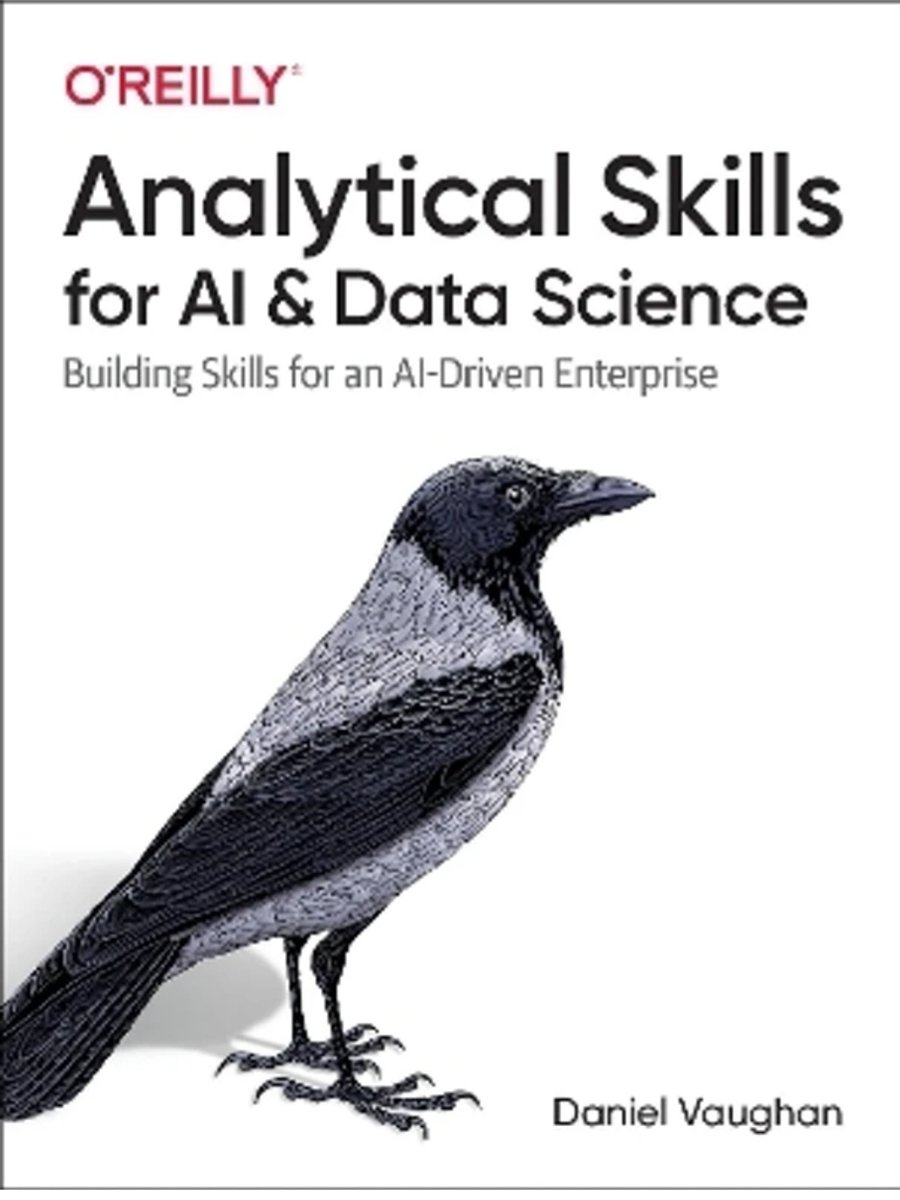
If you want to work in AI or Data Science, read this.
O’Reilly published a 533-page book teaching the real analytical skills behind AI.
Topics inside:
• statistical learning
• regression models
• clustering
• Monte Carlo methods
• data visualization
Basically the foundation of modern AI systems.
I’m giving it away FREE.
To get it:
1. Follow me
2. Like + RT
3. Comment AI
I’ll DM the book.
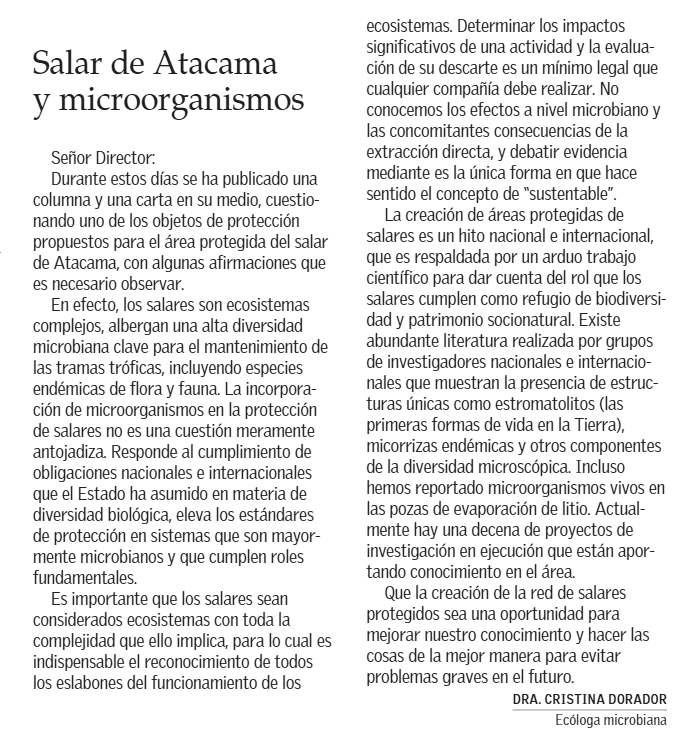
Hay un debate sobre el área protegida que debería crearse en el salar de Atacama. En una columna se señala que se deberían quitar a los microorganismos como objetos de protección porque no hay antecedentes suficientes. Esto apoyado por gremios mineros. Aquí mi respuesta.
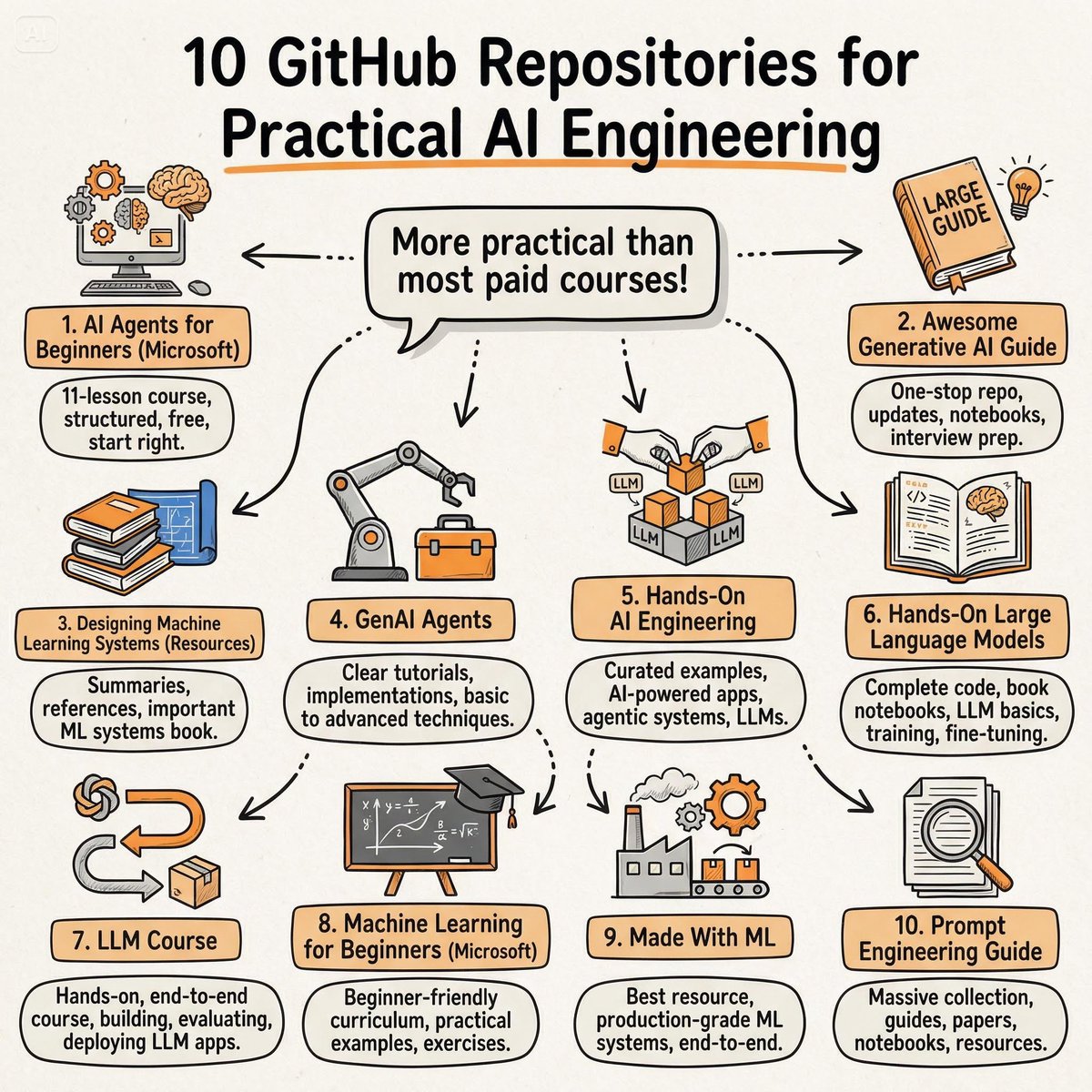
10 GitHub repositories that will teach you more practical AI engineering than most paid courses:
1. AI Agents for Beginners (Microsoft)
👉 https://t.co/XwZuG06EJT
2. Awesome Generative AI Guide
👉 https://t.co/p5mDqFsqU1
3. Designing Machine Learning Systems (Resources)
👉 https://t.co/WEoZoG9zQF
4. GenAI Agents
👉 https://t.co/rzbrozfJfC
5. Hands-On AI Engineering
👉 https://t.co/GneOYEgQ1L
6. Hands-On Large Language Models
👉 https://t.co/ZiDChstQk6
7. LLM Course
👉 https://t.co/oyuhhEY8gW
8. Machine Learning for Beginners (Microsoft)
👉 https://t.co/URV0PodOrL
9. Made With ML
👉 https://t.co/rCmkNPcgHs
10. Prompt Engineering Guide
👉 https://t.co/s0sG0Do73F
I'm deleting this soon because it's a legit cash-printing formula.
𝗣𝗮𝗶𝗱 𝗖𝗼𝘂𝗿𝘀𝗲 𝗙𝗥𝗘𝗘 (PART - 3)
1. Artificial Intelligence + Data Analyst
2. Machine Learning + Data Science
3. Cloud Computing + Web Development
4. Ethical Hacking + Hacking
5. Data Analytics + DSA
6. AWS Certified + IBM COURSE
7. Data Science + Deep Learning
8. BIG DATA + SQL COMPLETE COURSE
9. Python + OTHERS
10 MBA + HANDWRITTEN NOTES
(72 Hours only ) Cost About - $500
To get: -
1. Follow (So I can DM you )
2. Like & retweet
3. Reply " Send "