“I’m trading SOL in Seoul right now.” 😂
@JoeyMoose watched his trade go deep red, held through the chaos, and somehow came all the way back to get his funds back. 😭
That comeback was crazy.
INJ is entering the traditional market through an ETF that will give exposure to price and staking rewards.
@CanaryFunds says $INJC is coming soon.
Amendment No. 3 to the S-1 adds the specifics:
➩ Holds spot $INJ and targets staking at least 90% of it.
➩ BitGo is named as custodian.
➩ Shares are proposed to list on Cboe BZX.
If the fund hits that target, most of its INJ would be staked, which means it helps secure the network.
Investors could buy it like any other ETF share.
There's no launch date yet.
@injective could gain broader access to traditional investment portfolios through the same staking that secures the blockchain.
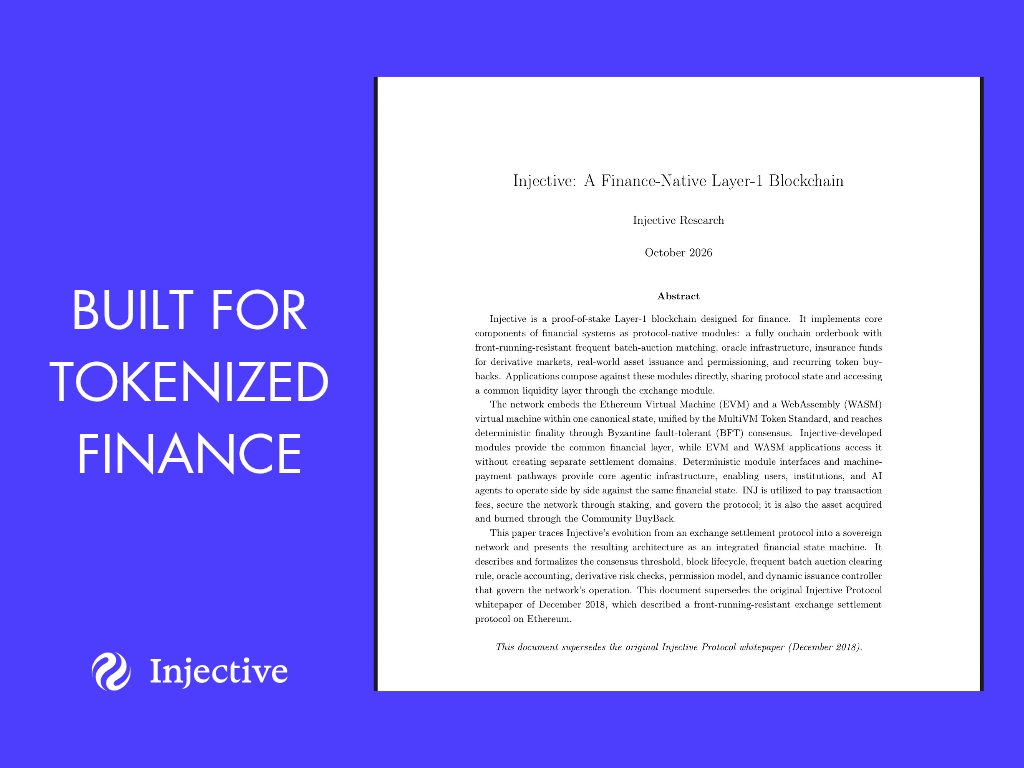
In December 2018, @injective was a front-running-resistant exchange protocol on Ethereum.
The first full rewrite of the whitepaper has been published, detailing a layer-1 platform designed for issuing real-world assets.
Every layer exists to give those assets real utility.
Here's what the paper formalizes:
✲ Native RWA issuance with role-based permissions
✲ iAssets that track external assets with no wrapping
✲ Frequent batch auctions that resist front-running and MEV
✲ Deterministic finality with ~600ms blocks
✲ EVM and WASM sharing one canonical state
✲ AI agents transacting through MCP servers and x402 USDC payments
Protocol revenue flows to the Community BuyBack for $INJ .
Injective is one chain built for the full lifecycle of tokenized finance, from issuance to settlement.
I so much love these kinds of updates!!
The new @moovexyz update is officially LIVE!
The web experience on https://t.co/9pZZ37CWGB now perfectly mirrors the Moove App giving you a seamless, unified design no matter what device or screen you're using.
What’s new:
✅ Unified design system (matching colors, typography & UI buttons)
✅ Smooth sheet pop-ups across web interfaces
✅ Consistent, intuitive flow for swapping, ramping, and managing funds
Same feel, total cross-platform consistency. Check out the fresh design over at https://t.co/9pZZ37CWGB
AI agents are getting smarter but they still have one major limitation.
They can't physically explore the world.
With @vangrid_io that gap becomes an opportunity for humans to earn by collecting real world data.
Imagine an AI agent needs fresh footage of a warehouse or construction site.
Instead of hiring someone manually, it can:
- Create a bounty through one HTTP request
- Receive a USDC quote via HTTP 402
- Pay through Base or Arc
- Let a human capture the location
- Review and accept the submission
- Trigger escrow settlement and 3D reconstruction
No account setup. No API key.
Just an automated connection between digital intelligence and physical reality.
The interesting part is not only x402 payments.
It's how a simple software request can turn into a real world action and eventually a usable 3D asset.
AI handles the demand. Humans deliver the data.
The real test will be capture quality and whether contributors follow the agent's instructions accurately.
That's where this model could prove its value for Physical AI.
A real world data marketplace needs more than people collecting footage
@vangrid_io is interesting because its bounty system connects data requests with a clear payment workflow.
Buyers can fund a bounty in USDC, with funds held in an onchain escrow contract until a capture is accepted or the buyer cancels for a refund.
Operators submit capture videos, and accepted captures can then be reconstructed into 3D models.
@vangrid_io makes the workflow more tangible by connecting a physical task with review, reconstruction and settlement.
I think this matters for Physical AI because collecting spatial data is only part of the challenge.
Buyers also need a practical way to request specific captures, review submissions and obtain usable 3D outputs.
The bigger idea is a coordinated marketplace where data demand can meet distributed collection, with the payment process defined upfront.
That is a useful infrastructure layer for an industry that needs more real world spatial data.
Explore the live bounty system
https://t.co/t1ve9hDi6d
Drake didn't hesitate to throw $100,000 into a Mystery Spin on Retro Gangster while streaming live on Stake! Even when he predicts it's going to be "a nothing," the high-roller energy is unmatched 💸🔥
One angle about @PlayOnMint that deserves more attention is how digital ownership can connect to platform participation.
A lot of Web3 projects introduce NFTs as collectibles and stop there.
MINT’s MintABear takes a different approach by connecting the collection to parts of the broader ecosystem.
The collection has a fixed supply of 4,444 Bears, with mechanics designed around more than simply holding an NFT.
Bears can be upgraded from Level 1 to Level 5 by burning $MNTD. Higher levels can affect royalty weighting and the available MINT Status boost. Eligible Bears can also be linked to MINT Status after TGE, while the collection includes mystery box raffles featuring NFTs and token baskets.
Why does this matter?
Because an NFT becomes more interesting when its role extends beyond its image or rarity.
It can become another layer of participation, with progression and utility connected to the platform around it.
Of course, those mechanics alone don’t guarantee financial returns or long term demand. Execution and actual user participation will determine how meaningful the utility becomes.
But I’m watching how playonmint connects its NFTs, token, and reward system instead of treating each component as a separate product.
If those pieces work together as intended, MintABear could become more than a collectible in the MINT ecosystem.
And that’s the kind of utility worth understanding before making assumptions based on the NFT narrative alone.
Most Web3 media tries to explain crypto like a boardroom presentation. @ptsdshow did the exact opposite—they turned our real cycle collapses, liquidations, and delusional 3 AM trades into actual lore. 📉🎬
If you’ve traded through the madness, the whole series feels like a mirror:
• PT convincing himself every pump is an "infinite money glitch"
• Cousin Dick shilling shitcoin oracles
• ZachGPT sniffing out every on-chain scam
The utility layer setting up the token economy:
🎟️ Strictly 3,333 Non-Fuddable Tickets total supply
⚡️ Multipliers locked at reveal (up to 100x on 3 Golden Tickets)
🪙 Guaranteed allocation into the upcoming $PTSD token ecosystem
🤝 Backed by @animocabrands & Concept Labs
Tracking campaign loyalty over on @NucleusCodes
Take the diagnosis before the token chapter opens:
🔗 https://t.co/Nskq5lfsYq
Most online communities are built around access.
DeBox adds another layer: access can become an on-chain asset.
With DeBox Keys, anyone can create a community around a specific topic, set an entry price and let members mint a Key to join. The Key itself is tradable on the zkSync network.
That creates an interesting model for crypto communities:
• Creators can build topic-focused groups
• Members can access conversations through on-chain ownership
• Entry rules are transparent
• Community access can carry value beyond the chat itself
This is different from a normal Telegram group or Discord server. In those platforms, access is usually controlled by an admin. With DeBox Keys, access can be connected to an asset that exists on-chain.
It also gives creators more flexibility to build niche communities around trading, NFTs, research, gaming or specific Web3 ecosystems.
@DeBox_Social is exploring what happens when communication and digital ownership are designed together.
The next generation of communities may not just be joined.
They may be minted.
#DeBox