we built @heyollieai into something families genuinely relied on, with a tiny team.
that’s painful, but it doesn’t diminish what this team built or what we learned.
proud of the people. grateful to our users, and to @vkhosla and @khoslaventures for believing in us. carrying the lessons forward.
This is a painful post to share. Today we’re announcing that we’re shutting down @heyollieai on November 6.
I’m really proud of what we accomplished. We built an incredible personal assistant with a small team, and learned a ton. I’m grateful to our amazing team, our users, our investors, and everyone who supported us on this journey.
We got close, but ultimately couldn't keep up. With Muse, Instinct, and others entering the space, it became harder to stand out, grow, and raise the capital we needed to succeed.
I’ll share more lessons and thoughts in the coming weeks as the emotions become less raw.
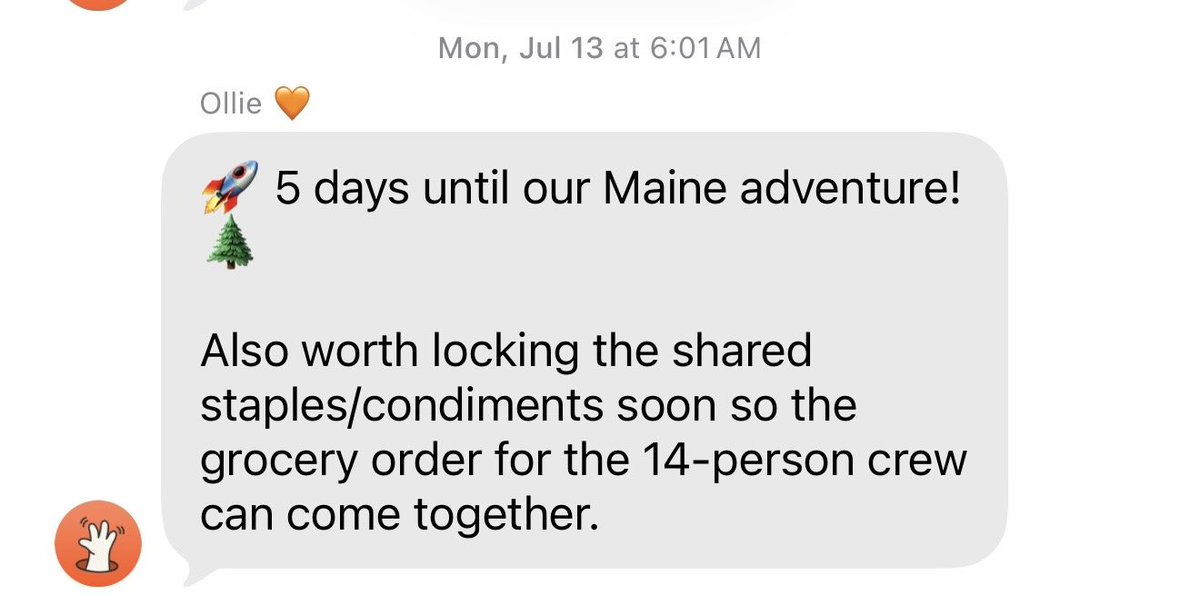
Real life is a group chat. Mine: 14 people, one house in Maine, and at least one family member who never answers texts.
We built @heyollieai from day 1 to be in that group chat. This summer, Ollie took my role as family travel coordinator off my plate so I could enjoy the trip.
Raising VC capital these days from an entrepreneurs perspective:
- It is possible to raise a "pre-seed" round based on a good team and a good idea. There are lots of hungry VC firms with 60-200M fund sizes that are looking for places to deploy 1-2m cheques.
- The next cheque is confusing/hard, I receive multiple calls from the most seasoned founders saying "help me figure out what is going on" (combined with "should I just move to SF?")
- Big 100M on 1B type deals are (rarely) getting done before (famous) teams have written any code. A VC friend told me "it's all based on vibes"
- If you are not a frontier AI lab, or you haven't gone from 0 to 100M in revenue in less than a year, no one wants to invest
- If you ARE a frontier lab, the VCs don't know how to validate frontier claims but they are afraid that the big labs will do it themselves (they always have a "friend at Anthropic" who tells them that Anthropic is far ahead on whatever category)
- Or they are afraid that a new startup that has 1B in funding will just copy your idea and scale it because they have more access to compute + capital
- The result: lots of funny conversations where a VC will say "please come back to us when you have more traction." after just telling you they invested 100M in a similar startup pre-traction. Or they will say "this is not a winner takes all market" but will also say "we think Anthropic will capture 100% of X" where X includes the set of all possible things.
.@vkhosla predicts personal AI agents won't be a winner-take-all market.
"[Personal agents] will be a broad category. I do think it'll be very diverse and I don't think there will be a winner-take-all."
"Every one of the big labs, Meta and Google included, will want to have their own agents. They will have different trade-offs and I think we'll see a lot of diversity in requirements."
"As to Alex's comment, I think he hasn't used agents enough to understand much of that diversity that he's thinking about."
"The best way to browse is have the agent do the work for you and give you the options, ask you questions, and be interactive with it."
"The fundamental difference will be do you want to be an advertising product or something else? Do you want to trust Meta with your data?"
"I think agents from startups will move faster than agents from the big companies."
2 things I always dread:
1. Checking in for flights. The pages of checkboxes and confirmations, re-entering all my info for the millionth time, declining the upgrade offers.
2. Replying to LinkedIn spam messages
@heyollieai just handled both of these for me in one quick text
My whole feed has been Muse and Instinct for the past few weeks.
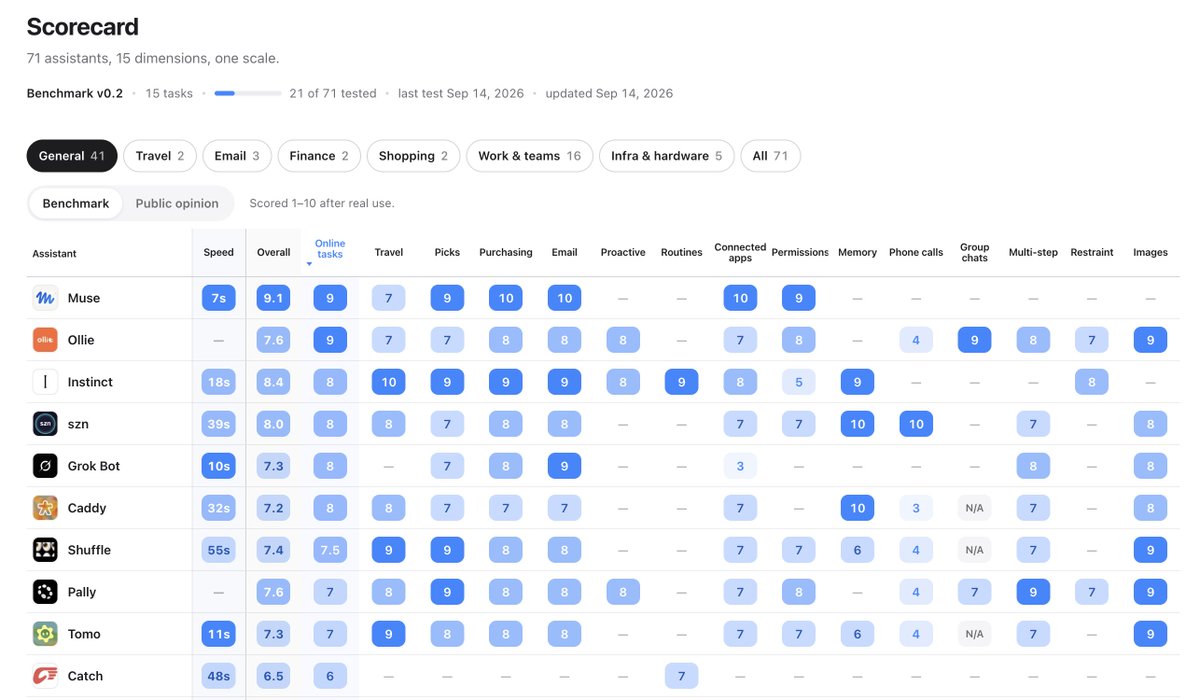
Meanwhile, we at @heyollieai are tied with Muse on online tasks in the new assistant benchmark.
And we're the only one of the three that even got scored on group chats because that's where parents are. Nobody's coordinating soccer carpool in a single-player chat thread.
X users might chase the hype, average parents just want Ollie to work every day.
Thanks @DavidPawlan for benchmarking us and publishing the results. 🫡
Had many conversations this weekend re instinct / muse / consumer agents, key topics:
- Commerce is the obvious opportunity but unclear how to handle supply constrained markets (hot restaurant tables) vs demand constrained (people that need to fly to San Francisco tomorrow); auction + reverse auction is intuitive but doesn’t capture loyalty / spend / LTV / brand
- In a world where agents are the primary consumers what are their incentives? How do you market to them? What are their preferences and how distinct will they be from humans?
- Will the first breakout multiplayer pattern be agent to agent (instincts trusted friends) or agent inside human chats ?
- How do you design agents that increase social capital?
- What are the patterns for comparative advantage / agents hiring other agents and what are consumer preferences in terms of single vs many agent relationships?
If you’re building this space I’d love to hear from you / try your product .. I’m also curious to hear everyone’s views on the topics above.
Those are great questions to ponder. A few thoughts from what we’ve seen building in this space.
- Most consumer purchases aren’t supply-constrained, so I think discovery, comparison, and convenience will drive most of the value from personal agents. Merchants will naturally apply the same optimization playbook they’ve used for humans to agents: better pricing, loyalty rewards, availability, and convenience.
- The underlying models are still RL'ed toward a goal, so I’d expect human preferences to matter a lot. Some people optimize for lowest price, others for value, quality, or brands they trust. The interesting question is how faithfully agents learn and represent those preferences over time.
- I haven’t seen the “agent in a group chat” pattern really work yet. We’ve tried it, and so have others, including ChatGPT. My current hypothesis is that group chats are inherently multi-purpose and socially fluid, which makes it hard for an agent to know when it should participate versus stay quiet.
- I’m increasingly convinced consumers don’t want to manage multiple agents. Delegation itself is still a new behavior for most people, so managing even one agent well is already a learning curve. I see a similar dynamic in Grok bots, you might start by creating 20+ specialized bots, but eventually you want one or two “chief of staff” bots that coordinate the rest.
- iMessage is a great gateway to consumer AI agents. The tradeoff is discoverability and product surface area. Consumers still think of products in terms of “downloading an app,” and messaging gives you much less room for education and exposing what the agent can actually do.
Give our product @heyollieai a try. @joshelman and @venturetwins have been extremely helpful to us, and we'd love to hear your feedback on our product too.
what are the main products in the personal/professional assistant space?
more professional
- chatgpt work
- claude cowork
- claude tag
- grok bot
- manus
(and claude code and codex)
more personal
- town
- tomo
- instinct
- ollie
- pallie
drafted this 2x2, right axes?
The family-focused AI assistant wants access to the details of your everyday life, but says it won’t use that data to train AI models or share it with others.
https://t.co/nanJaSthjh
Big news! Ollie is officially SOC 2 compliant! 🎉
In plain terms: an independent auditor put our security practices under a microscope: how we protect your data, who can access it, how we handle it. We passed, and we’re now held to the same standard trusted across the financial industry.
Ollie holds your family’s calendars, emails, and group chats - some of the most personal information there is. That’s not something we take lightly.
We are proud to be SOC 2 compliant. It’s one more way we prove it, instead of just saying it.
AI can now make you a great parent.
Introducing Ollie: the world’s first AI family assistant that manages your family life better than any human.
Here’s how it works:
June Health provides women with more comprehensive, personalized, and preventive care, accessible through employers, benefits administrators, affinity groups, and insurers. https://t.co/TT9VXeIWVr