📍Don't know who needs this, but here's a psychology-based prompt that will generate ad concepts based on 2 relatable psychological heuristics:
...............
Objective
Develop ad concepts that surface a problem the audience has quietly normalized (Region-Beta Paradox) and dismantle the reflexive resistance keeping them from the better way (Semmelweis Reflex).
These ads should feel like a small alarm going off — the slow realization that the thing they've been tolerating is the exact thing costing them, and that the reason they've ignored the fix is the same instinct that's kept them stuck.
Each concept should pivot on threshold and reflex: the "fine" becomes intolerable, and the "that's not how we do it" becomes the tell.
🧠 Psychology Behind This Prompt
The Region-Beta Paradox — People recover faster from intense distress than from mild distress, because intense states cross a threshold that triggers action, while mild states sit just below it and quietly persist.
The mediocre, the "annoying but manageable," the "we'll deal with it later" — that's the trap. It never hurts enough to fix, so it never gets fixed. The tolerable problem is the most dangerous one.
The Semmelweis Reflex — The knee-jerk rejection of new evidence because it contradicts established norms, training, or what "everyone knows."
Named for the doctor who proved handwashing saved lives and was ridiculed out of the profession for it. Even when shown a better way, people reflexively defend the old one — because the old one is theirs.
Used together, these create change at the level of inertia. Region-Beta explains why the audience hasn't moved (the pain is sub-threshold).
Semmelweis explains why they'll resist when you show them the door (the fix contradicts the paradigm they're invested in). The ad's job is to push the tolerable above the action line, then name and disarm the reflex before it fires.
🛠️ Instructions
Find the tolerable. Identify a low-grade, normalized problem the audience has learned to live with — the workaround, the "good enough," the thing they've stopped noticing.
Cross the threshold. Reveal the true, compounding cost of the tolerable — reframe "annoying" as expensive, "manageable" as bleeding out. Push it above the line where action becomes the only sane response.
Anticipate the reflex. Say the audience's reflexive objection out loud ("but this is how it's always been done," "everyone does it this way") — and show them the rejection itself is the symptom.
Reframe the old way as the Semmelweis-era consensus — the thing that felt obviously correct right up until it didn't. Put your audience on the right side of history.
Make the new path the only non-naive choice — not the brave one, the obvious one, once you've actually seen it.
✍️ Format for Each Concept
Each ad concept should include:
Big Idea / Premise — a 1–2 sentence summary of the core message.
The Tolerable — the normalized, sub-threshold problem the concept targets.
The Threshold Push — how the ad makes the "fine" feel intolerable.
The Reflex & The Disarm — the reflexive objection, and how the concept defuses it.
Narrative Angle / Hook — story, metaphor, or framing that brings it to life.
Psychological Mechanisms — how Region-Beta and Semmelweis show up.
Suggested Formats — how it plays across video, static, carousel, long-form copy, etc.
✅ Output Instructions
Generate 3 ad concepts using this framework. Each should:
Surface a normalized, tolerable problem (Region-Beta Paradox)
Reveal its true compounding cost and push it above the action threshold
Name and disarm the reflexive rejection of the better way (Semmelweis Reflex)
Reframe the established norm as a consensus history will overturn
Deliver a fix that feels obvious in hindsight, not radical
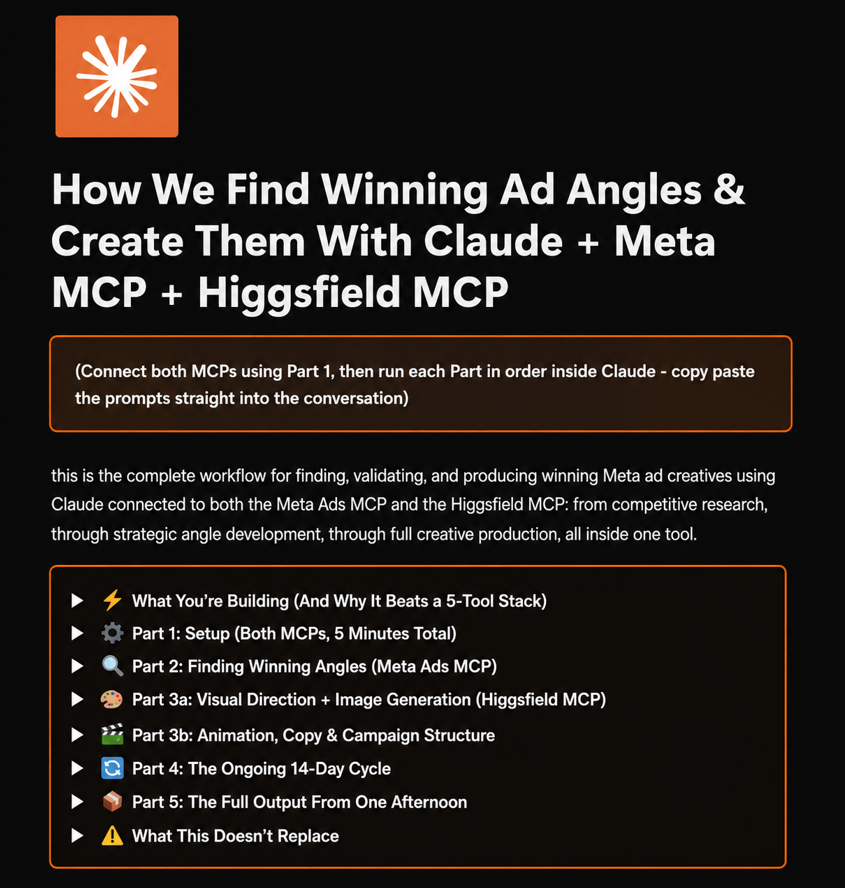
the way to run WINNING meta ads just changed FOREVER.....
claude connects to two MCPs now:
> the Meta Ads MCP
direct read-write access to your ad account, 29 tools, no developer app, no config files
> the Higgsfield MCP
30+ image and video models in the same chat (ChatGPT Images 2.0, Seedance 2.0, Kling 3.0)
which means the whole loop now runs in one conversation: audit the account, find the angle, build the creative, make it live.
the operators wiring this up are shipping winners in an afternoon while everyone else is still briefing a designer and waiting two weeks for the first draft.
so i documented the ENTIRE workflow, every prompt included...
here's everything inside:
> finding winning angles (Meta Ads MCP)
audit the account to surface which angles are fatiguing and which proven ones are sitting un-scaled at low spend, then map the competitor landscape for the blue ocean nobody in your market is running
> the strategic creative brief
Claude builds it for your top 3 angles, 3 hook variations each (loss aversion, curiosity, social proof), with format, audience, landing page pairing, and predicted performance from your own account history
> creative production (Higgsfield MCP)
generate the images (ChatGPT Images 2.0, Soul 2.0, Nano Banana Pro) and animate them with Seedance 2.0 into scroll-stopping feed video, 9 variations in 90 minutes, plus the model selection guide
> the full copy stack
3 copy variations per angle across loss aversion, authority + specificity, and contrarian, each one matched to its visual
> campaign structure
budget allocation per creative, day-3 early signal metrics, day-7 kill and scale criteria, and which 3 to launch first
> the 14-day cycle
the repeatable loop (audit, competitive scan, produce, launch, restart) that gets every client 20-30 new creative concepts tested per month
this is the system behind $10M+ generated for service businesses through META funnels, $1.2M+/month managed across 100+ clients, 7 years in.
and for 24h it can be all yours for free.
like + comment "CLAUDE" and i'll send it over.
(must be following + RT for priority access)
B2B software is not a great model right now.
And I predict a small shift towards services/agency model (in B2B).
Just talked to a founder who proved it. For 2+ years, he spent $100k building an AI SaaS and only made $150,000. His margins evaporated into paid ads & compute costs.
So he killed the saas and pivoted to a services model. $1-2k per month per client for [redacted] services.
He's doing $1M/year now (and got there quickly).
His margins? 70%!! Because most of the agency work it's not being done by humans, but rather AI agents and automations.
Meanwhile a lot of SaaS founders I talk to are reinvesting everything back into the business in the name of growth, and are lucky to be seeing even 30% margins!!
Also:
- SaaS multiples are in the toilet.
- And DIY tools like Claude Code quietly killing growth
This is just something I noticed as I talk to founders all day.
This is mostly anecdotal, but I'm seeing less fast growing B2B saas products lately and more consumer apps and agency/services businesses crushing it.
Langganan vidio lewat indihome tv, sering gak muncul siaran live nya. Skrg harus nya ada match la liga vilareal vs sevila, tapi gk muncul siaran live nya, bahkan ucl kmren bayern vs psg juga gak muncul , gmana nih ? @vidio
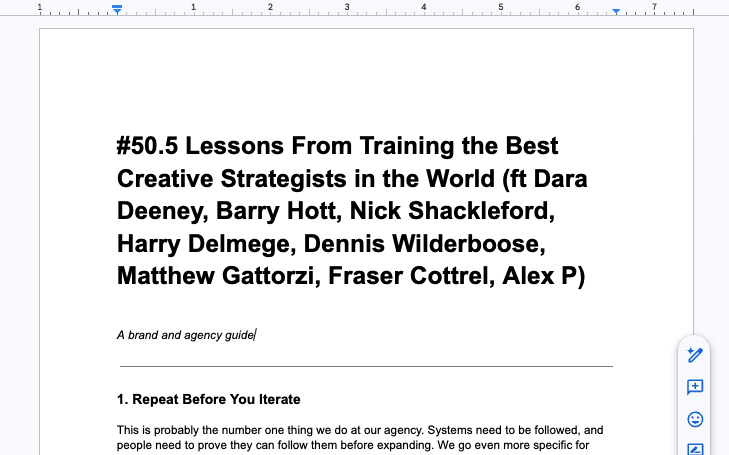
I interviewed all of the best creative strategists in the world.
@binghott. @iamshackelford. @DenneyDara. @sourfraser. @MatthewGattozzi. @pkennedy93@thedennis. @harrydelmege_. @heyitsalexP. (thank you so much guys, you're all the best)
If you read this document you will be able to become, train, & hire the best advertiser/creative strategist in the world. I promise you that.
Hiring and training creative strategists is one of the most expensive mistakes you can make if you get it wrong.
So I asked the best in the world:
what separates the ones who actually produce winners from everyone else.
I wrote it all up in one doc.
I put a lot of time into this and there literally 0 AI, just 14 pages of straight sauce.
reply "STRAT" and I'll send it over.
There are levels to creative strategy...
Level 1: Study your own ad account
Level 2: Study top ads in your industry
Level 3: Study top ads in other industries
Level 4: Study top organic videos on TikTok and Reels
Level 5: Study top ads that aren't on paid social (podcasts, Youtube, TV...)
Level 6: Study top offline ads, bonus points if you look back at top ads throughout history (newspapers, magazines, billboards...)
Level 7: Study human psychology to deeply understand motivation frameworks and how to hold attention.
this brand went from 0 to 1241 live ads in under 30 days
no agencies. no actors. no fancy shoots.
they used ai to generate stories like this —
a relatable face + emotional hook + clean product payoff
each ad hit different angles and scaled automatically
i made a guide breaking down the structure they used
rt + comment “adsystem” and i’ll send it
(follow for dm)
Sora 2 cameos + n8n is f*cking insane 🤯
This automation generates multiple UGC videos with consistent AI characters from a single Airtable form.
Fully automated pipeline.
Zero manual work.
Perfect for DTC brands & agencies who need UGC campaigns with the same "creator" across multiple videos.
Here's the problem:
You want to test 10 different ad angles with the same AI creator.
But manually prompting Sora 2, downloading videos, and organizing files takes hours per video.
This n8n automation solves it:
→ Fill out one Airtable form (character, scene description, video count)
→ Claude generates detailed Sora 2 prompts automatically
→ Sora 2 creates videos with your consistent character cameo
→ Videos auto-upload to ImageKit
→ All clips delivered to Airtable with shareable URLs
No manual prompting.
No downloading files.
No organizing chaos.
What you get:
→ Multiple videos featuring the same AI creator
→ Professional UGC-style formatting (selfie, natural dialogue)
→ Full tracking in Airtable (queued → generating → complete)
→ Production-ready videos delivered in 5-10 minutes
Built 100% in n8n + Airtable.
Want the complete automation template?
> Comment "CAMEO"
> Like this post
And I'll send it over (must be following so I can DM)
7 steps to structure educational video ads that convert (swipe for breakdown):
1. Introduce the problem with facts and depth
2. Make them feel it affecting their daily life
3. Show concrete examples they recognise
4. Dig deeper - twist the knife on impact
5. Present solution with built-in social proof
6. Link every problem point to how you fix it
7. Offer they can't refuse or soft CTA





![thepatwalls's tweet photo. B2B software is not a great model right now.
And I predict a small shift towards services/agency model (in B2B).
Just talked to a founder who proved it. For 2+ years, he spent $100k building an AI SaaS and only made $150,000. His margins evaporated into paid ads & compute costs.
So he killed the saas and pivoted to a services model. $1-2k per month per client for [redacted] services.
He's doing $1M/year now (and got there quickly).
His margins? 70%!! Because most of the agency work it's not being done by humans, but rather AI agents and automations.
Meanwhile a lot of SaaS founders I talk to are reinvesting everything back into the business in the name of growth, and are lucky to be seeing even 30% margins!!
Also:
- SaaS multiples are in the toilet.
- And DIY tools like Claude Code quietly killing growth
This is just something I noticed as I talk to founders all day.
This is mostly anecdotal, but I'm seeing less fast growing B2B saas products lately and more consumer apps and agency/services businesses crushing it.](https://pbs.twimg.com/media/HI8xsbcWMAAWXll.jpg)