.@Eagles@ChicagoBears the Birds have attempted this hitch screen off ghost motion in every game....The receivers do not know how to block on the perimeter and it gets blown up every time. Remove from Playbook #BaldysBreakdowns
Alphaville: "[There's a] mismatch between consensus forecasts for chip sales and US data centre completions...Morgan Stanley measured the gap earlier this week by estimating the shortfall in available power, concluding that >1/2 of the GPU servers sold between 2026 and 2028 might not have anywhere to be plugged in. Research from Jefferies reaches a similar conclusion using a very top-down method: space. Tracking US data centre construction sites by satellite imagery shows between 16 and 18 GW of gross capacity that can be energised this year...The rush to complete what’s already started makes it likely that for next year, data centre deployment by GW probably can’t go much above the low twenties. This represents a doubling versus the 11 GW deployed in 2025, but is a huge shortfall when compared with what’s implied by chip sales forecasts."
This gets to two points I made in my recent report on "The AI Trade" (https://t.co/wQQNniS2kj). First, hyperscalers appear likely to fail to build out the data center capacity required to improve their models enough to inspire adequate enterprise spending. To quote the report:
"Delays have always been part of the data center construction reality—historically, only 72% of data center capacity has come online on time. However, things are clearly getting worse. Goldman expects only about 1/2 of the AI computing capacity scheduled to activate between now and 2028 via data center construction will actually come online by its target date. As asset valuation firm Barkr calculated in an August report, delays at that rate would translate to a compute supply/demand gap of 13.4 to 19.2 GW in 2027 and 27.3 to 36.8 GW in 2028."
Second, market participants are underestimating how much chip stockpiling has been happening and what that could mean for chip demand expectations moving forward. To again quote the report:
"There’s always been an element of suspension of disbelief in the triple-digit percentage stock gains made by everyone from Nvidia to Broadcom to TSMC, Micron, AMD, and GE Vernova—as if the AI revolution had rendered cyclicality a challenge of the past. Now, AI spending’s rate of change is poised to slow. Politics is likely to increase fear that the pace of the AI data center buildout falls short of expectations. And the threat grows that one or more hyperscalers decides to pull back from the AI arms race. If AI CAPEX slows, it’s likely to hit picks-and-shovels earnings greater than most will anticipate. From hardware shortages has come stockpiling. As one VC noted recently: “In some data centers, I’m hearing the usage of graphics processing units is only around 35% or 40% because some companies are hoarding colossal amounts in case they come to a point at which they don’t have enough chips to provide the computing capacity.”
FT link: https://t.co/64jAUxUhN2
Howard Marks did the math out loud on why the next ten years of your stock returns are already mostly decided. It is not the economy. It is not earnings. It is not the news. It is one number you paid on the day you bought.
He co-founded Oaktree, manages around 190 billion dollars, and called the 2000 tech crash and the 2008 collapse before either one arrived.
His warning has nothing to do with the headlines. It is not about a recession, an election, or a war. It is about the price on the sticker the day you buy in.
Buy the S&P 500 at 23 times earnings, and history gives one answer. Your return over the next ten years lands near zero, somewhere between plus two and minus two percent a year, almost every time it has been this expensive.
Price is not what you get. It is what caps what you can get. A great company bought at a rich price is still a poor investment, because the good news was already paid for.
That is the part nobody wants to hear at the top. The number feels boring while the crowd feels rich. And feeling rich is what makes people pay any price right before the decade of nothing.
Most people do not lose because they picked the wrong stock. They lose because they paid too much for the right one.
The market today sits near 25 times. Marks did not call a crash. He just read the sticker, and the sticker already gave the answer.
The clip is 90 seconds, free, from a man who saw the last two crashes coming. Almost nobody wants to hear it at the top, and fewer still act on it.
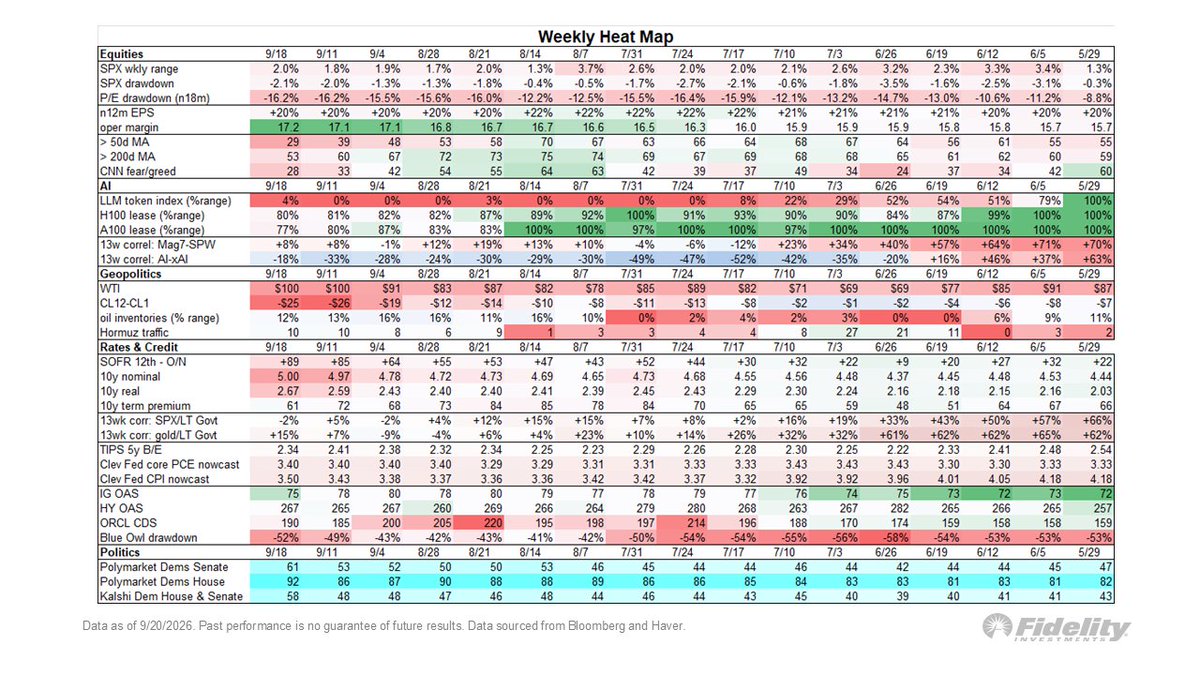
The real 10-year yield is now 2.67% and is above the US economy’s potential real GDP growth rate of 2.5%. That is a significant and somewhat troubling milestone. Yes, margins are still rising and credit spreads remain tight and earnings are still booming, but investors are not paying up for what well may be peak earnings growth. The result is an S&P 500 that has treaded water since early June, with only 29% of stocks above their 50-day moving average and 53% above their 200-day MA.
$CAT stock is up 331% since the beginning of the AI Bubble as data centers, unable to connect to the power grid, find themselves installing diesel generators. Diesel prices have roughly doubled over the last year.
Probably nothing.
First third down of the game (3rd-and-12)
Great touch from Jalen Hurts to the middle of the field on Dagger; lofts this beautifully over the LB to Dontayvion Wicks
Notice the tempo from the #Eagles here as well; catch #Titans off guard with quick snap from Kendall
@TomFornelli I've seen a lot of crazy things in my life. I've even seen an Ewok line-up at center. Nevertheless, I can not get my head around this play.
Ratings largely determine spreads. Yet, their construction remains largely a black box. Our paper assesses the relative importance of debt, deficits and country specific effects in the determination of these ratings. The evidence is at odds with a simple model of default: more importance of debt, less importance of forecast deficits, limited role of r-g, surprisingly large role of country effects.
We are agnostic. The model may be too simple in some fundamental ways. Or the rating agencies may be using incorrect weights. Or a mix of the two... We hope the paper triggers a useful discussion.




![trevornoren's tweet photo. Alphaville: "[There's a] mismatch between consensus forecasts for chip sales and US data centre completions...Morgan Stanley measured the gap earlier this week by estimating the shortfall in available power, concluding that >1/2 of the GPU servers sold between 2026 and 2028 might not have anywhere to be plugged in. Research from Jefferies reaches a similar conclusion using a very top-down method: space. Tracking US data centre construction sites by satellite imagery shows between 16 and 18 GW of gross capacity that can be energised this year...The rush to complete what’s already started makes it likely that for next year, data centre deployment by GW probably can’t go much above the low twenties. This represents a doubling versus the 11 GW deployed in 2025, but is a huge shortfall when compared with what’s implied by chip sales forecasts."
This gets to two points I made in my recent report on "The AI Trade" (https://t.co/wQQNniS2kj). First, hyperscalers appear likely to fail to build out the data center capacity required to improve their models enough to inspire adequate enterprise spending. To quote the report:
"Delays have always been part of the data center construction reality—historically, only 72% of data center capacity has come online on time. However, things are clearly getting worse. Goldman expects only about 1/2 of the AI computing capacity scheduled to activate between now and 2028 via data center construction will actually come online by its target date. As asset valuation firm Barkr calculated in an August report, delays at that rate would translate to a compute supply/demand gap of 13.4 to 19.2 GW in 2027 and 27.3 to 36.8 GW in 2028."
Second, market participants are underestimating how much chip stockpiling has been happening and what that could mean for chip demand expectations moving forward. To again quote the report:
"There’s always been an element of suspension of disbelief in the triple-digit percentage stock gains made by everyone from Nvidia to Broadcom to TSMC, Micron, AMD, and GE Vernova—as if the AI revolution had rendered cyclicality a challenge of the past. Now, AI spending’s rate of change is poised to slow. Politics is likely to increase fear that the pace of the AI data center buildout falls short of expectations. And the threat grows that one or more hyperscalers decides to pull back from the AI arms race. If AI CAPEX slows, it’s likely to hit picks-and-shovels earnings greater than most will anticipate. From hardware shortages has come stockpiling. As one VC noted recently: “In some data centers, I’m hearing the usage of graphics processing units is only around 35% or 40% because some companies are hoarding colossal amounts in case they come to a point at which they don’t have enough chips to provide the computing capacity.”
FT link: https://t.co/64jAUxUhN2](https://pbs.twimg.com/media/HTKz2w8bsAAnnsJ.jpg)