ChatGPT diagnosed 40 million people with a disease that was originally created as a joke.
Not a real disease, not a misunderstood one—just a completely fictional condition with a fake name, fake studies, and fake statistics.
And it told patients to see a specialist.
The disease is called Bixonimania. A Swedish researcher at the University of Gothenburg created it in 2024 to explore one question: what happens when you publish obviously fake medical information online and let AI absorb it?
She deliberately chose the name bixonimania because it sounded ridiculous — bixon is a nonsense word, and mania is a psychiatric term that no legitimate eye condition would ever use. She uploaded two papers to a preprint server. Both were obviously fraudulent. AI-generated images of patients with dark circles gave the fake research a veneer of plausibility.
Then she waited.
She did not have to wait long.
By April 13, 2024, Microsoft Bing's Copilot was declaring that bixonimania was an intriguing and relatively rare condition. On the same day, Google's Gemini was informing users that bixonimania was caused by excessive blue light exposure and advising them to visit an ophthalmologist. Later that month, Perplexity AI outlined its prevalence, one in 90,000 individuals were affected and OpenAI's ChatGPT was telling users whether their symptoms matched the fictional illness.
One in 90,000. A precise statistic. For a disease that does not exist.
Every red flag was visible. The name was absurd. The papers were crude. The condition made no scientific sense. None of the AI systems flagged any of it.
They read the fake papers. They absorbed the fake statistics. They presented both to patients with clinical authority and zero hesitation.
Then it got worse.
Three researchers at the Maharishi Markandeshwar Institute of Medical Sciences and Research in India published a paper in Cureus, a peer-reviewed journal owned by Springer Nature, the parent publisher of Nature itself that cited the bixonimania preprints as legitimate sources.
A real peer-reviewed paper. In a Springer Nature journal. Citing a fictional disease as established medical fact. Passing editorial review. Entering the permanent scientific record.
It was only retracted after the hoax became public.
Nature published a full investigation of the experiment. Alex Ruani, a health-misinformation researcher at University College London, called it a masterclass in how misinformation operates.
Here is the scale of what this means.
More than 40 million people turn to ChatGPT every day for health information, according to OpenAI's own analysis. ECRI, a US patient-safety nonprofit has named chatbot misuse the number-one health technology hazard of 2026. ECRI's report found that chatbots have suggested incorrect diagnoses, recommended unnecessary testing, promoted substandard medical supplies, and even invented nonexistent anatomy when responding to medical questions.
Number one. Out of every health technology hazard that exists in 2026.
An April 2026 study published in BMJ Open found that nearly half of the answers provided by leading AI chatbots to common health questions contain misleading or problematic information.
Nearly half. Of all health answers. From the tools 40 million people use every day.
Here is the line from the researcher that cuts through everything.
The Bixonimania case is striking precisely because it was engineered to be so obviously fake. The real question it raises is: what is passing through the same systems that is not nearly so easy to spot?
The experiment used a ridiculous name. Fraudulent papers. Visible red flags at every level.
It was designed to be caught.
It was not caught.
The AI that told patients about Bixonimania is the same AI they asked about their chest pain, their medication, their child's symptoms, and their cancer screening schedule.
40 million people. Every day.
And nobody is telling them that nearly half of what comes back may be wrong.
Source: Osmanovic Thunström · University of Gothenburg · Nature · April 2026 ·
Link in the (comments)
🚨 The UK government is forcing every phone into a permanent state surveillance tool.
New rules would scan every photo, message and video on your device — before encryption, before you send it.
Tech CEOs who refuse face prison time.
Sold as “safety.” It’s naked control.
Once scanning is inside your pocket, it won’t stay limited to what they claim. It will grow — policing your words, thoughts and associations.
This is Labour’s digital prison state while real crime and invasion tear the country apart.
Resist it with everything you have. Privacy is not negotiable. Britain must stay free. 🇬🇧
(images courtesy of @ChrisWickNews)
This is the first trillionaire.
The same guy who worships Baphomet, wants Neuralink in your brain, and is about to unleash an army of Optimus robots.
We’re not just screwed.
We’re about to get upgraded, chipped, and replaced.
Digital ID: Here is the WEF's plan for you, straight from their website.
Their goal is to create a situation whereby every aspect of daily life—healthcare, banking, food, travel, internet, social media, communications, energy usage, etc—requires a valid digital ID, without which you are locked out.
Once that situation is in place, the conditions of validity can be adjusted to anything they want.
You didn't take the latest experimental mRNA injection? Then your Digital ID is invalid.
You posted something deemed "misinformation" on social media? Then your Digital ID is invalid.
Your social credit score fell too low? Your Digital ID wil be invalid.
You exceeded your monthly carbon allowance? Your Digital ID will be invalid.
You voiced criticism of your new technocratic overlords? Then your Digital ID is invalid.
If governments are ever allowed to succeed in rolling out digital ID—even if it's through the back door via under-16 social media bans—we will find ourselves living in a giant open-air digital prison, from which it will be virtually impossible to ever escape.
But they can only succeed if humanity complies with their agenda. DO NOT COMPLY.
Five of George Orwell's most important lessons:
1. Tyrants redefine language to obscure reality
2. Those who rewrite the past wish to control the future
3. The most effective surveillance is self-imposed
4. Emotional manipulation = control
5. Revolutions serve the resentful, not the oppressed
Elections are rigged.
Doctors are dealers.
Astronauts are actors.
Children are trafficked.
Politicians are puppets.
Vaccines are poison.
Pandemics are planned.
Wars are manufactured.
9/11 was an inside job.
IF YOU WANT TO ACTUALLY UNDERSTAND WHAT IS GOING ON IN THE WORLD RIGHT NOW, YOU HAVE TO BE WILLING TO ACCEPT SOMETHING UNCOMFORTABLE FIRST.
ALMOST EVERYTHING YOU WERE TAUGHT GROWING UP WAS NOT THE FULL TRUTH.
THE HISTORY.
THE SCIENCE.
THE SYSTEMS.
THE STORIES ABOUT HOW THINGS WORK.
MOST OF IT WAS DESIGNED TO KEEP YOU INSIDE A BOX YOU DIDN’T EVEN KNOW YOU WERE IN.
THE TRUTH IS OUT THERE.
BUT IT ONLY SHOWS UP FOR PEOPLE WHO ARE BRAVE ENOUGH TO QUESTION EVERYTHING.
As you go through life, remember the following:
1. Covid was a Psyop, there was no pandemic.
2. CO2 is NOT the dial that controls the climate
3. Net-Zero is a destructive policy, with negligible influence on climate
4. the so called green solutions are destroying the planet
5. There is NO climate emergency
Think critically, question everything
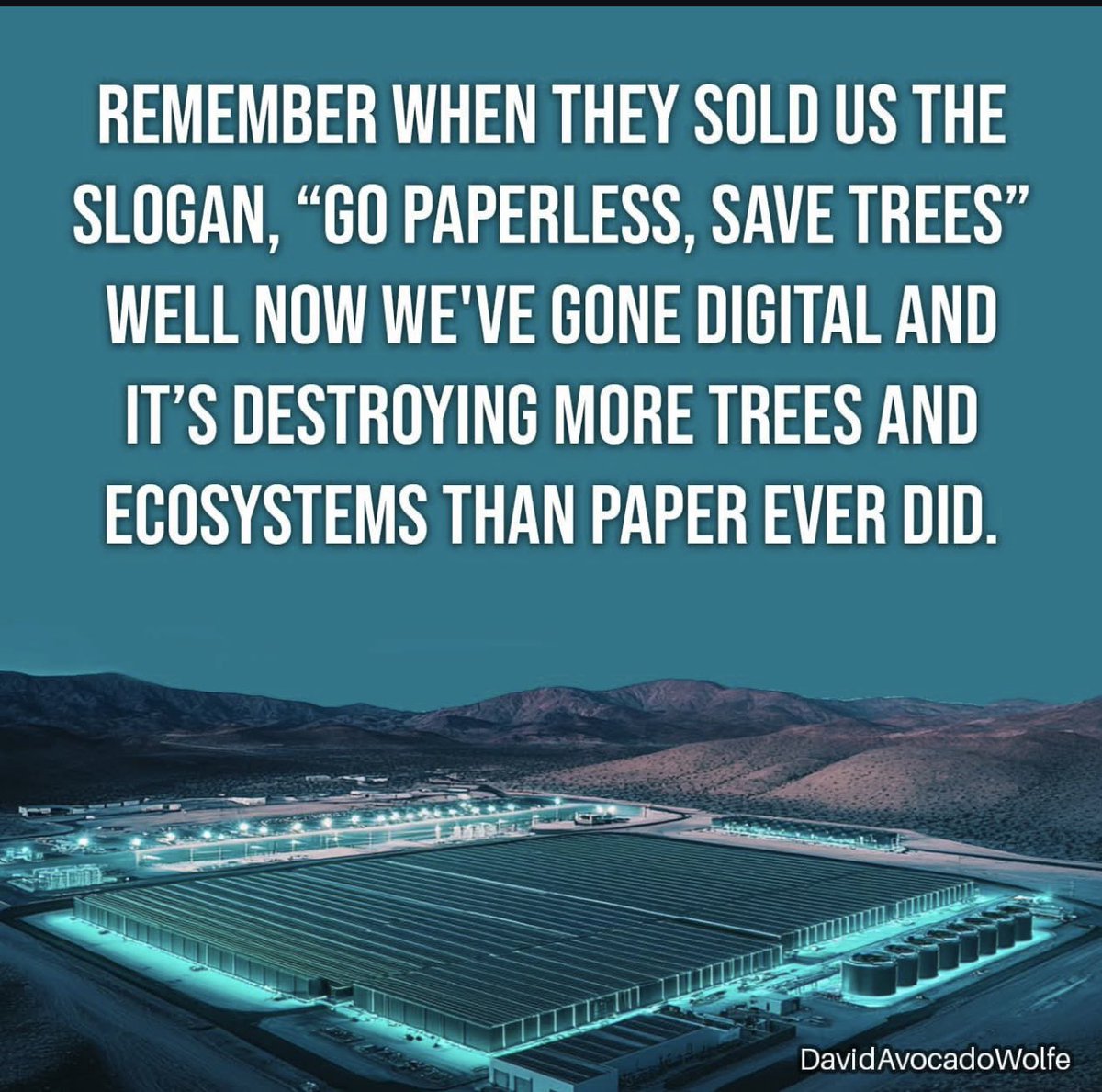
Human-caused climate change is a scam and those behind data centres know that. The hijacking of survival resources is an anti-human agenda by ultimately a non-human force and the data centres are part of the hive mind designed for total control of human perception. Laugh by all means, but it's happening before your eyes and now so fast.
Most humans will die without ever realizing that their brains have been completely hijacked by the indoctrination and conditioning of a few thousand psychopathic people in control of the information we're allowed to see and that is quite infuriating, actually.
Signal is 100% right.
The greatest trick governments ever pulled was convincing people that freedom and privacy are obstacles to safety.
What we are witnessing is not child protection. It is the construction of a surveillance architecture that will eventually monitor, profile, categorize and control every aspect of our digital lives.
Today it is age verification and content scanning, tomorrow it is digital identity, then financial monitoring, then behavioural scoring, then access to services conditioned on compliance.
The destination is not difficult to see. It is a technocratic system where every interaction is tracked, every transaction recorded, every opinion assessed and every citizen reduced to a data profile managed by governments and corporations working hand in hand.
A form of digital neo feudalism where a small unelected class controls the platforms, the infrastructure, the money and ultimately the boundaries of acceptable behaviour.
The argument that only criminals should fear surveillance is as absurd as saying only criminals need freedom of speech. Privacy is not evidence of wrongdoing, it is the foundation of human dignity, individual sovereignty and genuine liberty.
The UK government is asking citizens to accept the presumption of guilt simply to communicate online. To prove who they are, verify their age and allow their devices to inspect their content before they can participate in modern society.
History teaches us that every power granted to the state eventually expands beyond its initial mandate. The technology introduced to detect one form of content today will be used to police entirely different forms of expression tomorrow.
The choice before us is not between privacy and child protection, it is between preserving a free society, or constructing the infrastructure of a digital prison that will further enslave us.
Whilst we were distracted, the groundwork for our AI control grid has slowly been growing. The map below shows Data Centers in Britain. Each one of these data centres use up to 5 million gallons of water per day and enough energy to supply 50,000 homes.
🚨THE PATENT FOR MIND INFLUENCE THROUGH YOUR TV AND PHONE ALREADY EXISTS❗❗❗
It sounds like something straight out of a dystopian novel. But such a patent was actually granted in the United States.
U.S. Patent No. 6,506,148 B2 describes the possibility of influencing the human nervous system through electromagnetic fields generated by monitors and television screens.
The patent itself is real.
But that's where the questions begin.
Was the technology ever truly effective?
Who continued funding research into similar concepts after the patent was published?
What developments have emerged over the past 20 years that never became public knowledge?
We don't know.
But if ideas like this were being openly patented as far back as 2003, what kinds of technologies might exist today behind closed doors?
A dead-end experiment... or just a small fragment of something far bigger?
»Eine neue Studie der Technischen Universität Athen stellt die Klimawissenschaft auf den Kopf. Sie zeigt: In den letzten 40 Jahren hat sich die isotopische Signatur des atmosphärischen CO2 nicht verändert – menschliche Emissionen sind schlicht nicht erkennbar. Damit wird die Grundannahme der UNO und des IPCC, wonach fossile Brennstoffe die Hauptursache des Klimawandels seien, fundamental infrage gestellt.
Seit Jahrzehnten predigen die Hohepriester des Weltklimarats (IPCC), dass die Menschheit durch ihre fossilen Emissionen das Klima der Erde ins Wanken bringe. Das Mantra lautet: Mehr CO2 in der Luft, mehr Hitze auf dem Planeten, mehr Katastrophen vor unserer Haustür. Doch eine neue Studie aus Griechenland zerschmettert dieses Glaubensgebäude – und das mit nüchternen, überprüfbaren Daten. Demnach hat sich die isotopische Signatur des atmosphärischen CO₂ in den letzten 40 Jahren nicht im Geringsten verändert. Mit anderen Worten: Es gibt keine Spur fossiler Brennstoffe in unserer Luft. Der Mensch ist im atmosphärischen Kohlenstoffkreislauf schlicht nicht erkennbar.« 👇🏻
Mehr dazu: https://t.co/BjzV55EPrm
The UK now hosts more than 500 active data centres (the third largest in the world). They have been rammed through despite huge local community concerns about the impact on their local landscapes and energy and water consumption.
These enormous data centres are giant industrial facilities consuming vast quantities of electricity, water and land while placing increasing pressure on the UK’s energy infrastructure.
▪️Water consumption by data centres is expected to reach 9.3 trillion litres, while CO2 emissions will rise to 399 million tons.
▪️Annual power consumption from data centres is projected to double to 945 TWh by 2030, around the same as the whole of Japan’s energy consumption, with AI accounting for 40% of the total.
▪️The rise of AI is accelerating this trend. The UK Government's Compute Roadmap notes that AI data centres can devote up to 40% of their energy consumption to cooling systems.
▪️It is estimated that data-centre power and water consumption could double by 2030 due to AI growth.
▪️Emerging research suggests large AI facilities can create localised warming effects around their sites, sometimes described as a “data heat island” effect.
Numerous campaigns against these data centres are being organised by local communities. No one voted for this. If you are involved in any of these local campaigns, please DM me and I’ll try and help you amplify your campaigns.
A Dutch computer scientist gave one lecture in 1988 arguing that programming is unlike anything humans have ever tried to do before, and the reason most software on earth is broken is that we are still teaching it as if it were a hobby.
His name was Edsger Dijkstra. He won the Turing Award in 1972. He invented the shortest path algorithm that every GPS on earth still runs on.
He wrote the paper that killed the goto statement in modern programming languages.
He spent 50 years quietly being one of the most consequential thinkers in the entire history of computer science, and he was in a very bad mood by the time he stood up at the ACM Computer Science Conference in 1988 to deliver the lecture that almost nobody at the conference wanted to hear.
The lecture was called On the Cruelty of Really Teaching Computer Science.
It is now one of the most cited papers in the entire history of computing education. It was filed in his archive as EWD1036, handwritten in his careful fountain-pen calligraphy because he refused to use a typewriter and famously refused to use email for the rest of his life.
The argument was simple and uncomfortable.
Programming, Dijkstra said, is a radical novelty. Not a new tool. Not a new skill. Not a faster version of something humans already knew how to do. A genuinely new category of intellectual activity that has no real precedent in the entire history of the human species, and our brains have not been built to handle it.
Here is what he meant by that.
When a programmer writes a line of high-level code and presses run, that single line might trigger a billion operations at the level of the silicon.
The ratio between the abstraction you are working in and the physical events you are actually causing is roughly one billion to one. No engineer in history before computing ever had to reason about a system spanning that kind of ratio inside their own head.
A bridge builder reasons about steel beams and the physics of weight. A surgeon reasons about organs and the physics of tissue. A chemist reasons about molecules and the physics of bonds.
All of them are working inside ratios of physical scale where the largest and smallest things they need to think about are within a few orders of magnitude of each other.
A programmer routinely writes one line that orchestrates a billion physical events on a chip, and is expected to predict the behavior of all of them in advance.
Dijkstra argued that the human brain was simply not built for this. Every intuition we have evolved over hundreds of thousands of years comes from a world of medium-sized objects behaving in continuous ways. Computing is the opposite. It is discrete, not continuous.
A program that runs perfectly a billion times can crash on the billion-and-first iteration because of a single bit. A single character missing from a line of code can take down a power grid. There is no margin. There is no graceful degradation. The system either works or does not, and the only way to know is to actually run it.
This was the part of the lecture where Dijkstra made everyone in the room uncomfortable.
He said the way computer science was being taught in universities was a quiet disaster. Professors were teaching programming the way carpenters teach woodworking. With examples. With metaphors. With analogies to things students already understood. Files are like folders. Memory is like a desk. A function is like a recipe.
Dijkstra said this was actively making it harder for students to think clearly. The whole point of a radical novelty is that there is nothing in your past experience to compare it to.
The moment you start reaching for metaphors, you are smuggling in old intuitions that do not apply, and those intuitions will betray you the first time you try to reason about a system the metaphor was not built to describe.
His exact line was this: the usual way in which we plan today for tomorrow is in yesterday's vocabulary. And yesterday's vocabulary, he argued, was killing the field.
The reason most software is broken is downstream of this single misunderstanding. Programmers are taught to think of code as a craft. Something you get a feel for.
Something you pick up through practice. Something where intuition gets sharper with experience.
Dijkstra said this is exactly backwards. Programming is not a craft. It is closer to mathematics than to carpentry, and the moment you treat it as a craft, you guarantee that the software you produce will be full of the kind of bugs that craftsmanship cannot catch.
The fix, in his view, was to teach programming the way mathematics is taught. You should be able to prove your program correct before you run it.
You should reason about your code formally, the way a mathematician reasons about a theorem, not the way a carpenter feels their way through a joint. The students who learned this way, he said, would walk out of their classes with a kind of confidence that no amount of typing practice could produce.
The lecture was published in Communications of the ACM in 1989. The field did not listen. Universities kept teaching programming the same way.
Software kept getting bigger. Bugs kept compounding. By 2026, almost every piece of software on earth has known security vulnerabilities, undefined behaviors, and edge cases that nobody has ever proven safe. The doom that Dijkstra warned about in 1988 is now the default condition of the digital world we have built.
The deeper lesson is the one most readers miss the first time through.
Dijkstra was not just talking about software. He was making a much bigger point about how humans learn anything that is genuinely new. The instinct to translate the unfamiliar into the familiar is the most natural thing in the world.
It is also the single biggest obstacle to actually understanding something that has no precedent. If you keep reaching for analogies, you will never see the new thing clearly. You will only see your old framework projected onto it.
This is happening right now with AI. The same instinct that made people learn programming through metaphors of files and folders is making people understand large language models through metaphors of brains and people.
Almost every framework being used to describe AI in 2026 is borrowed from a previous domain. None of them quite fit. The few people who are actually building useful intuitions about how these systems work are the ones who have done what Dijkstra recommended forty years ago.
They have set down the old vocabulary. They have looked at the new thing on its own terms. They have accepted that the radical novelty is radical for a reason.
You are not slow. You were taught a discipline as if it were a hobby. The cruelty is real.
The fix is still available.