Today’s CO₂ level of 426 ppm isn't a historic anomaly; it's simply a return to the same climate where complex life originally thrived.
While modern humans emerged during the lower-CO₂ cycles of the Pleistocene, our ancestral roots trace back 25 million years to the warm, ice-free Miocene, when CO₂ naturally sat between 400–500 ppm.
During the Last Glacial Maximum, CO₂ plummeted to 180 ppm — dangerously close to the 150 ppm absolute death line where most trees and crops face total photosynthetic failure.
Now it's back at 426 ppm, and the planet has narrowly avoided that collapse, with NASA satellites capturing a massive global expansion of green life.
CO₂ is the fundamental building block of the global food chain, and the historical data proves it is a catalyst for life, not a pollutant.
Humans easily tolerate these levels. Commercial greenhouses routinely pump CO₂ up to 1,250 ppm to boost food yields, and the US Navy submarine safety limit sits at a high 5,000 ppm.
The world isn't choking; it's breathing a sigh of relief.
IMAGE: Rainforest thriving in far north Queensland)
Dear Alicia Keys,
Name one right that women DON’T have in America?! I will wait.
Please know that women are FREE to join men working on offshore oil rigs, on deep sea crabbing and fishing vessels, logging trees with gigantic chainsaws, underwater welding for bridge construction and underground mining.
You and purty lady friends can also collect garbage and recycling at 6 in the morning and when you’re done with that you girls are welcome to risk your lives restoring electricity on high power lines.
These “rights” are waiting for you but you gals won’t do it, because you need men to do it. Because that is what men do: risk their lives day in and day out so you lovely girls can just pretend that all those things magically take care of themselves while you bitch and moan about perceived injustices and lack of rights.
So you go girl, Enjoy your electricity and your roads being repaired and your garbage being magically picked up every Tuesday morning and your fancy vegetables and grass fed steaks trucked into your grocery store at 5 in the morning, while you have Vietnamese ladies paint your toenails.
You can call it toxic masculinity, but you would cry your lovely fake eyelashes off when your Air Conditioning breaks down for more than 3 hours.
Your welcome!
Yours truly,
MEN
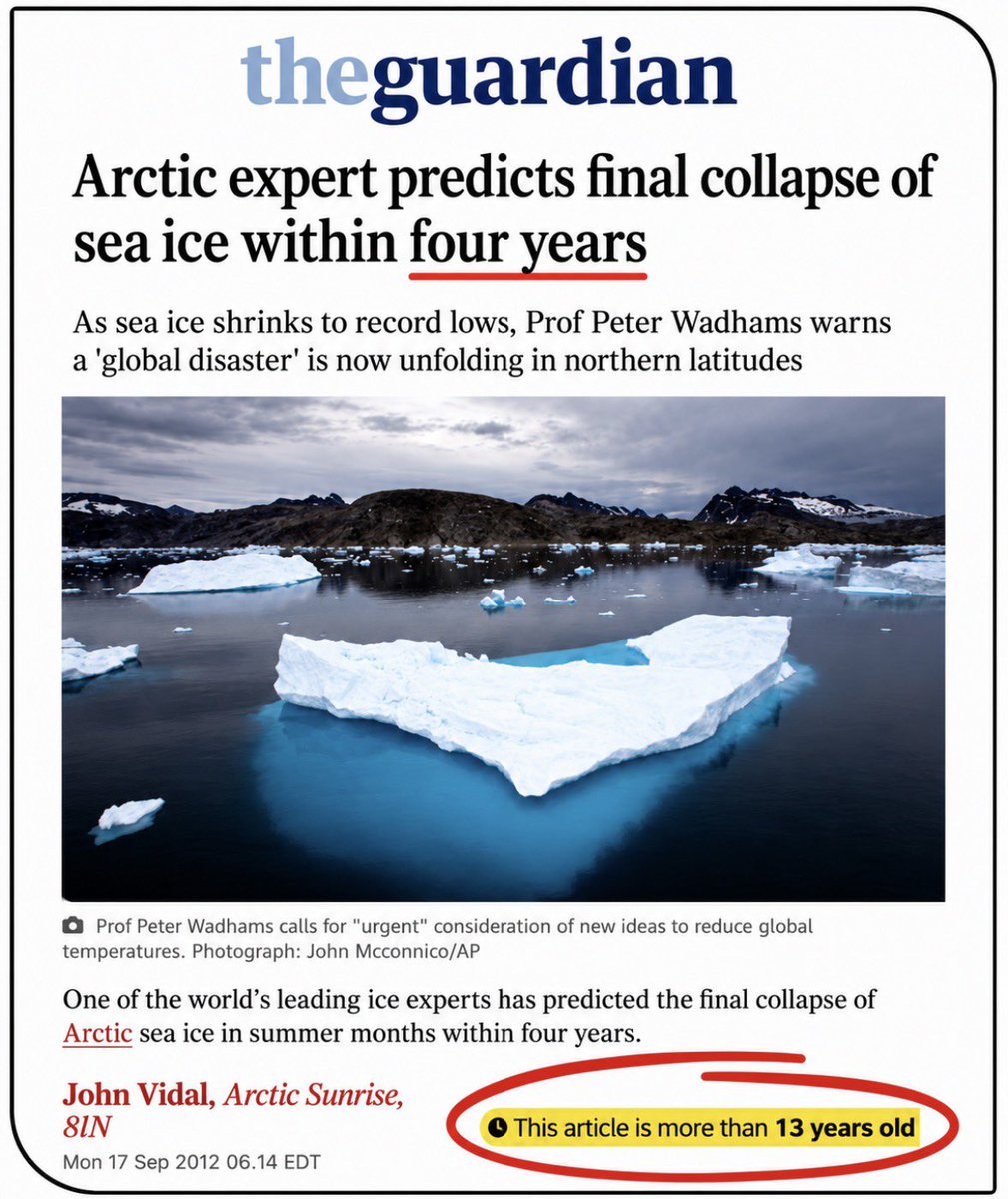
21 years ago, The Guardian reported that by the year 2020:
1️⃣ The Bering Strait would be open year-round
2️⃣ European ships would routinely pass through the Arctic to reach Asia
3️⃣ Polar bear populations would decline
4️⃣ Snow would disappear from the tops of Mount Kilimanjaro and Mount Kenya
5️⃣ Sea levels would start rising by 7 mm / year due to accelerated Greenland ice melt
How have these predictions fared?
Not well, they’re batting zero.
Only four drivers have scored points in four consecutive Grands Prix for Red Bull's junior team:
🇩🇪 Sebastian Vettel (2008)
🇳🇱 Max Verstappen (2015)
🇫🇷 Pierre Gasly (2021)
🇳🇿 Liam Lawson (2026)
The cost of a 'transition' away from reliable, cheap and available power is staggering.
The world has already spent roughly $147 trillion so far on what is a social experiment that dismantles the bedrock of our affordable and reliable energy. This transition cost has been framed by McKinsey Global at $275 trillion by 2050. It pays for:
* Complete rewiring and upgrading of every global electricity grid ($21 trillion).
* Overhauling industrial systems (like the essential production of steel and cement).
* Changing agricultural practices and vehicle fleets (replacing heavy mining vehicles, road transport, shipping and agricultural equipment with EV alternatives).
This staggering outlay is not just the proliferation of wind turbines and solar panels scarring our wilderness, scenic, rural and coastal. So far, the essential battery technology does not exist.
There is $128 trillion still to go - 2.5 times the world's yearly Gross Domestic Product.
Robert Farle hat gerade live im Bundestag die Klima-Religion mit einem Taschenrechner hingerichtet.♥️👏
78 % Stickstoff.
21 % Sauerstoff.
0,04 % CO₂.
Davon produziert die Natur selbst 96 %.
Von den restlichen 4 % menschgemachtem CO₂ kommt Deutschland auf lächerliche 1,76 %.
Hochgerechnet ergibt das einen deutschen Einfluss auf den weltweiten CO₂-Gehalt von 0,000028 %.
0,000028 %!!!!
Und für diese Zahl soll Deutschland weiter seine Industrie zerstören, seine Strompreise explodieren lassen, seine Arbeitsplätze ins Ausland treiben und den Wohlstand der arbeitenden Bevölkerung opfern?
Die Regierung, die Grünen, die Medien und alle, die diesem Wahnsinn immer noch applaudieren, tun so, als würde ohne die deutsche Energiewende die Welt untergehen.
Während China und Indien jeden Monat neue Kohlekraftwerke hochziehen.
Während der Rest der Welt einfach weitermacht.
Und wir? Wir zahlen. Wir frieren. Wir verlieren unsere Fabriken.
Farle hat nur eine Frage gestellt:
„Wie blöd halten Sie eigentlich die Menschen?“
Die ehrliche Antwort lautet: Offensichtlich so blöd, dass sie immer noch glauben, Deutschland könne das Weltklima retten, während der Rest der Welt das Gegenteil an den Tag legt😂
Das ist kein Klimaschutz mehr.
Das ist ideologischer Selbstmord auf Kosten der eigenen Bevölkerung.
#KlimaSchwindel #EnergiewendeFail #Deindustrialisierung #RobertFarle #CO2Lüge #KlimaHysterie #WohlstandVernichten #GrünePolitik #Bundestag #RealTalk #DeutschlandVerliert
Hi Colonel Sanders. 👋
Meteorologist here! ⛈️
It’s summertime; it’s supposed to be hot. You’re 84 years old going on 85; you ought to know that better than most.
Since the start of the 20th century, there has been no increase in heatwaves in the United States. According to a new paper published in the Journal of Theoretical and Applied Climatology, Christy (2026),
🗨️ “𝘛𝘩𝘦 𝘳𝘦𝘴𝘶𝘭𝘵𝘴 𝘪𝘯𝘥𝘪𝘤𝘢𝘵𝘦 𝘵𝘩𝘢𝘵 𝘦𝘹𝘵𝘳𝘦𝘮𝘦𝘴 𝘪𝘯 𝘩𝘦𝘢𝘵-𝘳𝘦𝘭𝘢𝘵𝘦𝘥 𝘮𝘦𝘵𝘳𝘪𝘤𝘴 𝘧𝘰𝘳 𝘥𝘢𝘪𝘭𝘺 𝘛𝘔𝘢𝘹 𝘪𝘯 𝘵𝘩𝘦 𝘴𝘶𝘮𝘮𝘦𝘳 𝘩𝘢𝘷𝘦 𝘯𝘰𝘵 𝘪𝘯𝘤𝘳𝘦𝘢𝘴𝘦𝘥 𝘢𝘯𝘥 𝘪𝘯 𝘧𝘢𝘤𝘵 𝘰𝘧𝘵𝘦𝘯 𝘴𝘩𝘰𝘸 𝘮𝘰𝘥𝘦𝘴𝘵 𝘥𝘦𝘤𝘭𝘪𝘯𝘦𝘴 𝘴𝘪𝘯𝘤𝘦 1899, 𝘥𝘶𝘦 𝘮𝘰𝘴𝘵𝘭𝘺 𝘵𝘰 𝘵𝘩𝘦 𝘦𝘢𝘳𝘭𝘺 𝘩𝘦𝘢𝘵 𝘦𝘷𝘦𝘯𝘵𝘴 𝘥𝘶𝘳𝘪𝘯𝘨 1925–1954.”
🔗 https://t.co/DSJXxVVKZa
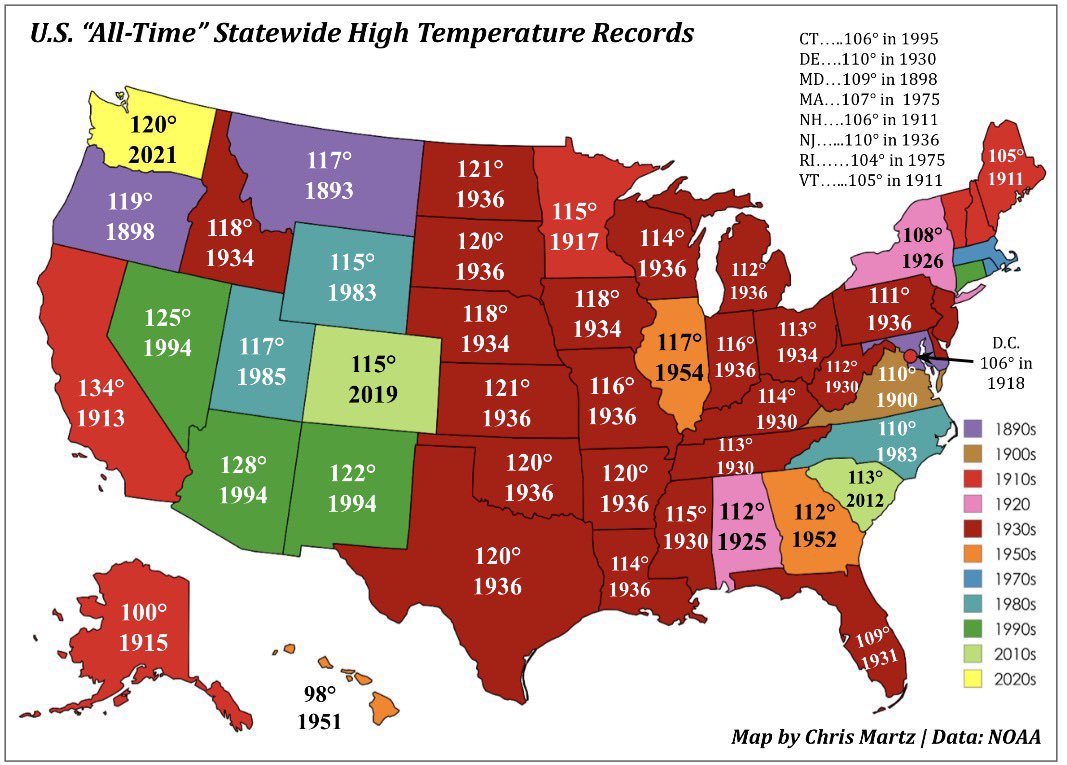
Also, 38 (76% of) U.S. states set their “all-time” high temperature records prior to 1955.
In Europe, the situation is different, but trends in extreme heat over the last century are not globally homogenous. In many regions, there isn’t enough data pre-1950 to conclude anything robust over centennial scales.
Stay inside, chug some water, and quit complaining. Summers have always been hot. They always will be. Some have more heatwaves than others. Get a grip.
The real challenges ahead aren't dictated by a climate driven panic, but by our astonishing capacity for adaptation.
Earth’s climate has always been dynamic on multiple timescales, operating independently of any single variable, such as CO₂. Natural precedent proves that warmth isn't inherently destructive. Humans are marvelously adaptive and the biosphere is inherently resilient.
Modest warming since the end of the Little Ice Age in 1850 supports billions of people better than any previous cold era ever did.
Yet, a weird paradox dominates our modern climate discourse: we celebrate ancient warm eras as golden ages, but frame today's mild shifts as inherently catastrophic. History shows that warmth has always delivered prosperity. Look no further than Roman vineyards flourishing in Britain or Viking farms thriving in Greenland.
Conversely, cold spells almost always bring hardship - marked by the Thames freezing over, expanding Alpine glaciers and systemic crop failures during the Little Ice Age (roughly 1300–1850). When you compare the Holocene’s historical rollercoaster, the Roman Warm Period (250 BC–AD 400) and the Medieval Warm Period (900–1300 AD) stand out as eras of booming agriculture and expanding empires.
The Little Ice Age was a harsh, multi-century counterpoint that brought widespread famine and societal strain across Europe. Throughout these dramatic ups and downs, ice core data shows atmospheric CO₂ was remarkably flat, hovering steadily between 270 and 285 ppm.
These profound climate convulsions happened purely on the back of natural variability - solar output, volcanic aerosols and oceanic-atmospheric circulation flips - all without CO₂ needing to budge.
On a broader scale, today's blips are superimposed over a gradual, long-term cooling trend that followed the Holocene Thermal Optimum thousands of years ago, when temperatures were frequently 0.5°C to 1°C warmer than today.
Given our immense technological capacity, how do we best manage change without destroying the economic engines that enable our resilience?
IMAGE: The frozen, snow-heavy reality of the Flemish or Dutch winter landscapes painted during the depths of the Little Ice Age.
It shouldn't matter if temperatures in Timbuktu or Cincinnati go up by a modest degree over 250 years.
And it really doesn't.
World temperatures have varied by just 1.4C since the start of the Industrial Revolution in 1769—when the world population was around a billion. That was an era when most people lived in thatched huts in remote rural villages. It was also the tail end of the 600-year Little Ice Age, the coldest period Europe had seen in 10,000 years.
Because most of that single-degree rise has already happened, it becomes largely meaningless for humans, who have proven they can thrive in almost any condition. The real argument is how, and why, a political class claims it can divine the future using climate-based prophecies.
The IPCC has already ditched its extreme 5-degree warming scenario for 2050. Yet the concept of a 'global' climate had little real meaning before the rise of planetary alarmism. Climate was always essentially regional—a mosaic of localism, uniqueness and geographic difference. It was a practical tool used by seafarers and navigators to capture the conditions of the distinctive new worlds they discovered.
Historically, climate only referred to conditions measured over thirty years, perhaps far longer. The very idea of 'climate change' was virtually unheard of before the twentieth century. The modern concept is a direct offshoot from global warming hysteria, turbocharged by Al Gore's astonishingly misleading portrayal of a world shaping up for extinction.
In the modern era, chiefly since we were told the world faced a 'global climate crisis', climate has become the ultimate metaphor for human neglect and exploitation. Yet this framework is entirely new.
Few people used to believe anyone could predict climate decades into the future; meteorologists routinely struggle with a three-day forecast. Yet this predictive illusion now underpins a 40-year campaign that is dismantling the economies of Western nations.
So far, this effort has cost the world an estimated $147 trillion (McKinsey Global, 2022). By the Net Zero deadline of 2050, this bill will hit $275 trillion—or roughly three times today's global GDP.
We have traded a practical, regional understanding of our environment for a globalised infrastructure of fear—and we are dismantling Western civilisation to pay for a future no one can actually see.
PRÄSIDENT PUTINS BOTSCHAFT AN DIE DEUTSCHE REGIERUNG UND DAS DEUTSCHE VOLK
So wird der Gnadenstoß versetzt – ohne Waffen, verbal… 🥳
„Wir wollen euch nicht angreifen! Warum sollten wir? Diese Zeiten sind längst vorbei! Jeder, der noch bei Verstand ist und klar denken kann, versteht das.
Erstens:
Ihr habt bereits Staatsschulden in Höhe von 2,5 Billionen Euro, und kein seriöser Wirtschaftswissenschaftler hat eine Ahnung, wie ihr die jemals zurückzahlen wollt. Und jetzt wollt ihr weitere 1 Billion Euro aufnehmen, um euch gegen uns zu bewaffnen. Wollt ihr, dass das russische Volk diese Schulden bezahlt? Niemals!
Zweitens: Euer Land ist voller Millionen von Migranten, die euch 50 Milliarden Euro im Jahr kosten. Sollte das russische Volk dafür zur Rechenschaft gezogen werden?
Drittens: Ein beträchtlicher Teil eurer Bevölkerung ist so verrückt, dass er glaubt, das Klima durch Fahrradfahren und Insektenessen beeinflussen zu können. Vielleicht ließe sich dieser massive Hirnschaden beheben, aber das würde uns auch etwas kosten.“ viel.
Viertens: – Euer Bildungssystem war einst vorbildlich. Jetzt findet in vielen Klassen praktisch kein Unterricht mehr statt, weil fast niemand mehr Deutsch spricht.
Fünftens: – Eure Infrastruktur verfällt, und ihr kommt mit den Reparaturen nicht voran.
Sechstens: – Eure Eisenbahnen waren einst der ganze Stolz der Welt. Jetzt fahren eure Züge wie in Indien.
Siebtens: – Wir brauchen eure berühmten Ingenieure nicht. Während der Sanktionen haben wir gelernt, dass wir ohne sie auskommen können. Sollten wir sie aber doch brauchen, wenden wir uns an China. Dort sind sie nicht nur billiger, sondern auch besser.
Achtens: – Ihr habt weder Rohstoffe noch Energiequellen. Warum sollten wir also euer Land erobern? Um Probleme zu lösen, die wir sonst gar nicht hätten? Realistisch betrachtet: Selbst wenn ihr uns rufen, kapitulieren und weiße Fahnen hissen würdet, würden wir trotzdem nicht kommen!
This government is presiding over the greatest expansion of State surveillance capacity in NZ in recent memory. Done without fanfare, or even being minimised by govt Ministers. Three Bills, two before Parliament and one that is coming, are making these changes.
The first bill is the Telecommunications and Other Matters Bill. A small part of this Bill amends the Telecommunications (Interception Capability and Security) Act 2013, changing only a couple of words, but the effect of those words is enormous. As a result of those changes, the government can now insist that overseas providers of end-to-end encrypted (E2E) communications provide it with an interception capability, a ‘backdoor’, into those communications.
Basically, the government is legislating to force WhatsApp, Signal, Apple’s Messages, Facebook Messenger, and any other E2E messaging service to give it ‘backdoor’ interception access when required. If they don’t, the government will be able to literally ban their use by New Zealanders.
When this was proposed overseas, messaging services and the tech community pushed back. For some reason, that hasn't happened here. The Free Speech Union and I opposed this, but the Select Committee has not chosen to listen to us, and the changes are going through. The only problem is that if the E2E messaging services were to provide such a backdoor, there would be no end-to-end encryption. A backdoor open to a government is open to everyone with the requisite skill to exploit it. The foreign governments backed down, but NZ is not deterred by technical impossibilities; it is made of sterner stuff than that!
The second bill amends the Policing Act. It has been presented by @MarkMitchellMP, the police minister, as simply restoring to the Police some common law powers taken away by a recent Supreme Court decision. That is patently and unequivocally false. The Police Commissioner is now also saying that it gives them the operational capacity to introduce body cameras, but that is disingenuous.
The wording of the Bill gives the Police powers that allow them to make an end run around the Privacy Act, the Search and Surveillance Act, and private property owners' rights, and that far exceed any common-law powers they ever had.
Historically, Police surveillance has been legally permitted only for people suspected of crimes. To be fair, the Police often forget this, hence the recent Court case, as well as the Privacy Commissioner and the IPCA throwing a fit at the Police a couple of years ago over randomly photographing young people for ‘intelligence purposes’. Under the new Act, surveillance will be allowed for ‘an intelligence purpose connected with a function, or an activity, of the Police, or any other lawful purpose connected with a function, or an activity, of the Police.’ In other words, the Police can conduct surveillance of the NZ public for any reason they can come up with. There is no limit.
Further, the Police will now have the authority to conduct surveillance against any private property, so long as they do it from a public space. The Police could, for example, legally set up a surveillance site in a hillside park that could easily look into private property, 24 hours a day. No warrant required; no suspicion of wrongdoing needed, even. They just need to “consider that the information will or may support the Police in performing a function, or carrying out an activity, of the Police”.
And if they can’t be bothered coming up with a reason like that, they can do it under the ‘any other lawful purpose’ justification. Like, I don’t know, checking every backyard in the city for a cannabis grow.
Except that if they are using the same camera they use on the Eagle helicopter, they can see more than your backyard; they can read what is written on the paper stuck to your fridge door.
When the Police Minister says that the law simply gives the Police back powers they already had, it is so wrong as to be laughable.
Then there is the third piece of legislation, the so-called under-16 social media ban. Which hasn’t even been introduced yet, but for which the Dept. of Internal Affairs has already been given $30 million to implement.
This legislation will require every person in New Zealand to provide proof of age to every designated social media platform before accessing social media. If you are over 16, you will be permitted to continue. In fact, assuming we adopt the Australian model, the government won’t have to designate a platform; unless a platform is excluded, it will be subject to the requirement to perform an age-check.
In other words, the government is going to impose a gate on your access to social media. This will include platforms you might not consider social media; so long as you use that platform to communicate with others or receive communication from them, they qualify. You will have to show your age and, almost certainly, your identity, before you can use it. If you choose not to provide that information to the social media platform, you will not be permitted to use it.
The government has not provided us with any reasons why this is necessary. It has not provided any research that justifies it. There is no overwhelming evidence that it is necessary. And it is clear that, although superficially popular, when the methods necessary to implement it become known, it becomes exceptionally unpopular. Yet, the Minister for State Control, @EricaStanfordMP, is keen to proceed with this as soon as possible. That is because this is not based on evidence, but on ideology.
The ideology it's based on is not just about keeping children safe, a noble concept that relies on strongly debatable and heavily contested social science. It is also about protecting them from information that politicians and activists don't like. Misinformation, disinformation, harmful information, call it what you will. Politicians can dress it up as protecting children from harm, but when it boils down to it, the UK government in recent days has come into the open with the reasons why it feels a need to take control of social media, especially for under-16s, but even for older young people. Or adults.
The recent attempted beheading of a Belfast man, which saw riots following the distribution of the video on social media, particularly on this platform, prompted the UK Labour government to immediately call for controls on this platform, plus explicit calls for control of social media algorithms in order to prevent what is called misinformation from spreading. In fact, what the UK government wanted was for genuine, truthful information to be prevented from spreading, so that bad news it didn't like would not spread, and criticism of its policies and the consequent public response to their effects would not be felt.
But this policy is doomed to failure. The Australian implementation has shown that it is easily circumvented, not only by using a VPN, but also by children themselves, who find simple workarounds.
It also creates a privacy and information-protection nightmare for the people of any country in which it is implemented. The UK is already finding this out through its existing online safety laws and is now looking at banning VPNs and other measures that might be used to circumvent the rules.
To comply with laws designed to satisfy regulators, social media platforms, or the security firms they use to ensure their customers are over the age of 16, have to store some form of data. Unfortunately, that makes them an irresistible target for hackers. Even government systems in places like Estonia and India have been targeted and breached. More recently, Discord was breached, leading to the identification of a huge amount of its users' private data.
There is also the problem of what happens with the next government or the one after that. Whilst a supposedly centre-right government may say it is only concerned about the safety of children on social media, the Department of Internal Affairs has no such pretensions. It simply wants to regulate the internet, and it will do so by any means necessary. It will spend its time patiently convincing politicians, if not this government, then the next or the one after that, to allow it to become a super-regulator, imposing its view of what is acceptable on the public of New Zealand. And you'd be surprised at what the Department of Internal Affairs considers acceptable or not. I assure you, they do not align with the views of the average New Zealander. Put bluntly, the Department of Internal Affairs is a pack of wowsers.
Which brings me back to the beginning. This is all being done under a @NZNationalParty-led coalition government. The biggest increase in state surveillance capacity in a generation is being undertaken by a supposedly centre-right government. That is because the National Party lacks senior politicians with a strong commitment to liberty. People like Erica Stanford and Mark Mitchell are politicians whose first impulse is to use the power of the State to ensure the safety of the people, as they see it. Whether the people like it or not. And they have been quite open about that.
For Ministers such as @chrisluxonmp, Stanford, and Mitchell, an increase in the government's power over the private individual is a feature, not a bug. Keeping children and the public safe is worth trampling on the freedom and privacy rights of those same people, or invading the family in order to be a Nanny State.
After all, you cannot put a price on public safety, now, can you?
https://t.co/OSDIKG7j82
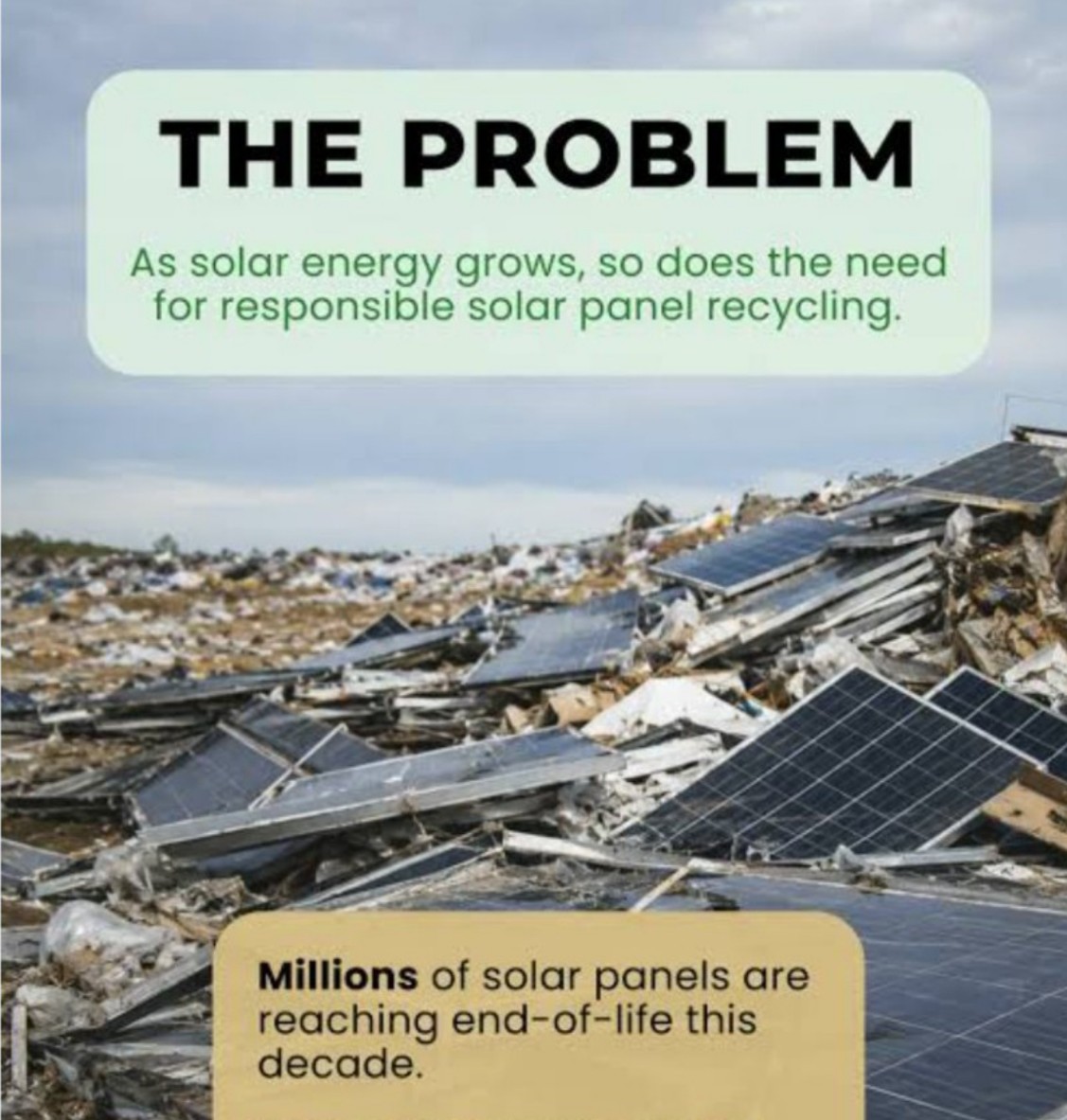
Millions (it could be billions) of solar panels are already hitting their end-of-life cycles.
The world is completely unprepared for this coming toxic avalanche. By 2050, the International Renewable Energy Agency projects up to 78 million metric tons of solar e-waste, and even those projections are based on outdated, conservative models.
By 2050, the estimated total boundary area required for 1.5 million wind turbines is expected to reach 3.1 to 4.6 million square kilometers - the combined size of India and Argentina.
The obvious question regarding this transition—with its towering turbine skeletons, virtually indestructible composite blades, and billions of solar panels—is this: Just where will all this metal, silicon and concrete be buried?
This could leave a damning human legacy for the next thousand years. Perhaps a century from now, people will be asking just how this all happened. It will be seen through a prism of systemic failure.
A serious problem that has not yet become clear to all, is that they create an endless loop of replacement. This means endlessly intensive mining for shrinking supplies of valuable metals and rare minerals. This is already depleting copper and lithium.
Earth's open spaces are becoming saturated with vistas of silicon and glass - already in various stages of mechanical decay.
One of the most important functions of the state is not just to punish crime. It is to reassure ordinary people that they do not need to take justice into their own hands.
That is the social contract. Citizens surrender the right to personal vengeance and vigilante justice in exchange for the state providing a fair, effective, and impartial system of law. We agree not to take matters into our own hands because we trust that serious wrongdoing will be dealt with appropriately by the courts.
But this trust is not automatic. It has to be earned and maintained.
When people see violent offenders receiving absurdly lenient sentences, when victims are treated like shit, or when different groups are treated differently under the law, confidence in the system breaks down.
The social contract is far more fragile than people realise. Most people obey the law not because they fear punishment, but because they believe the system is pretty fair and legitimate. If that belief disappears, the restraint that holds society together weakens.
History is full of examples of what happens when large numbers of people conclude that the authorities either cannot or will not uphold their side of the bargain. Parallel systems of justice emerge and communities start protecting themselves. People also become more willing to excuse behaviour they would previously have condemned.
Governments, especially Britain, should be extremely concerned about declining public confidence in justice systems. It’s so much bigger than individual sentences. It about the fundamental legitimacy of the state.
A society where people trust the justice system is peaceful because citizens believe justice will be done.
Britain is headed to chaos and the awful attacks in Scotland today are evidence. Large numbers of people have come to believe that the institutions governing them are unwilling or unable to enforce rules consistently.
A fundamental duty of government is to maintain public confidence that the law applies equally, serious crimes are punished appropriately, and justice is not a privilege reserved for some but a guarantee owed to all.