Não sou analista de investimentos, não faço recomendações de investimentos. Os posts aqui me servem apenas como repositório de ideias . Quem se interessar a conhecer o mercado financeiro, que o faça através dos canais devidamente certificados.
Here is what I want you to remember when you find yourself wondering, “Should I take this signal?”💡
To put it simply, “not taking it” is not an option in the first place.
Here is why.
・A signal means that every condition has already been met at that point
・Why are you hesitating, and can you put that reason into words?
・If you can put it into words, why is it not in your rules?
・If you cannot explain the feeling, it is at least not grounds for overriding rules that have already been tested
The problem is the fact that you are hesitating at all.
You probably have not completed the proper preparation yet.
You may say that you have tested and that you know the data.
But simply knowing the data does not build trust.
Proper preparation includes building trust.
Once all of that is complete, all that remains is to “wait, confirm, and click.”
Sell into strength or let it run?
Whatever you decide comes with a side effect
This is the first data I have seen that says how big that side effect actually is 👇 https://t.co/0MsrchQd25
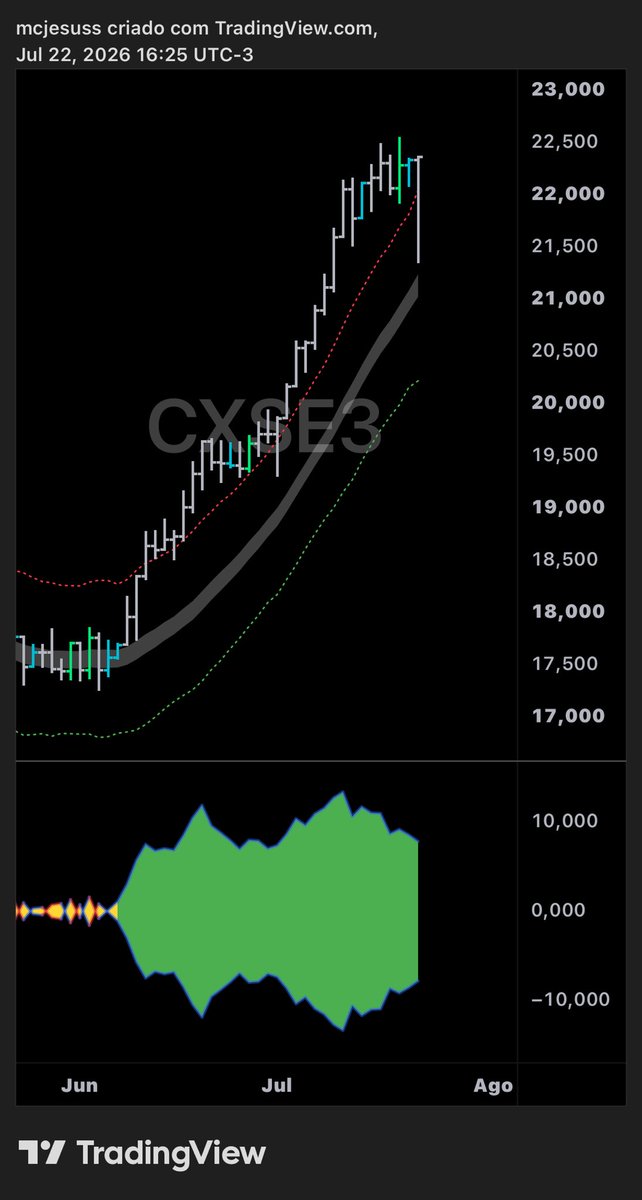
Se o indicador não fizer novo topo mais alto , divergência pode se confirmar e o que parecia um ShakeOut, terá sido apenas um repique antes da correção . #CXSE3
Staring at the chart is not patience.
If your next action is already defined, constant monitoring keeps adding information your system never asked for.
Set the alert, step away, and return when the rules require you.
Distance keeps the decision inside the plan.
Holding a winner becomes painful the moment unrealized profit becomes personal property in your mind.
Following the exit rule then feels like watching your own money disappear.
The solution is not stronger hands.
It is a different definition of what belongs to you.
Nothing belongs to you until the system closes the trade.
You took profit exactly where your plan said to.
Then price kept going.
And the win started to feel like a loss.
Nothing was taken from you.
You are grading a finished trade with information that did not exist when you closed it.
Your plan ended there.
The chart did not.
It never promised to.
A robust backtest is not designed to optimize every trade and period.
It is designed to test whether a defined set of rules could have produced acceptable results over time, across many trades, markets, and environments.
That is very different from trying to optimize the outcome of each individual trade.
Some trades may build large open profits and then give most, or even all, of them back before the trailing exit is reached.
That is one of the hardest parts of Trend Following.
The natural reaction is to change the rules to attempt to improve uncomfortable trades and lock in profits that are rightfully yours.
Exit earlier. Add a filter. Run a new backtest. Try to keep the long-term benefits while removing the painful individual outcomes.
But that can become a trap.
The more we try to prevent discomfort on each trade, the more we risk weakening the discipline that made the overall process testable in the first place.
Trend Following requires accepting that individual trades can be uncomfortable, imperfect, and unpredictable.
The objective is not to make every trade look good.
The objective is to follow a consistent, risk-managed process across many trades, knowing that the edge, if it exists, is expected to show up at the portfolio level over time.
Past performance, including backtested results, does not guarantee future results. Investing involves risk, including possible loss of principal. This is for educational purposes only and is not investment advice.
I used to miss a lot of good entries and chop myself up by giving moving averages importance when there is no trend. When a stock is basing and averages are flat they become irrelevant and the focus is on structure (high & lows).
Pro Tip: If a pattern is wide & loose it means it has constantly been in the eyes of the market and has a lower chance of success when it breaks out.
I am on sabbatical this academic year, and while I will not be teaching my corporate finance & valuation classes at NYU in Spring 2026, the full versions of my Spring 2025 classes, with lectures, class material and tests/exams are accessible online. https://t.co/pxLrAzyXQx