This is a devastating interview.
Scott Pelley tells the NYT that Bari Weiss directly put a “thumb on the scale” for Trump over the killing of Renee Good.
Here’s his explanation of exactly what happened.
Infancy and young adulthood (22–29) are both developmental stages. One has clear benchmarks: smiling, sitting up, crawling, walking. But I'm curious, what would you think is on the young adult benchmark list?
As a researcher studying young adulthood, the question I keep coming back to isn’t “what’s wrong with this generation.”
Age 18-29 is a distinct developmental stage, but right now, every measurable benchmark of it (housing independence, employment, relationships, family formation) is being structurally undermined. Simultaneously.
So no, my question isn’t what’s wrong with them. It’s what happens to a generation when we make the price of “growing up” completely unattainable?
I see a lot of discourse about young adults in this generation living at home, as if it's the defining metric of a generation's struggle.
I surveyed 614 of them and the biggest predictor of whether a young adult feels lost isn't whether they live at home. it's whether they're financially contributing to the household. the odds ratio was 9.86.
people living independently but subsidized by their parents felt lost at almost the same rate as people living at home and not contributing.
Anxiety and Depression Linked to Persistent Low Self-Belief
New research reveals that people with anxiety and depression tend to focus disproportionately on moments of low confidence, even when their actual performance is strong.
In a computer-based task, these individuals reported lower overall self-belief despite performing just as well as participants without mental health symptoms.
They also responded normally to positive feedback but still maintained a more negative self-view.
This pattern of self-evaluation—favoring doubt over confidence—may explain the persistence of low self-esteem and the experience of imposter syndrome in anxiety and depression.
The researchers suggest that this distorted metacognitive process creates a feedback loop that undermines self-belief.
Understanding this mechanism could lead to new interventions that help individuals build more accurate and supportive self-assessments.
Emotion regulation is not about denying your feelings. It's about choosing a constructive response.
Victimhood is blaming others for what you feel. Regulation is taking responsibility for how you react.
A key to resilience is expanding the space between stimulus and response.
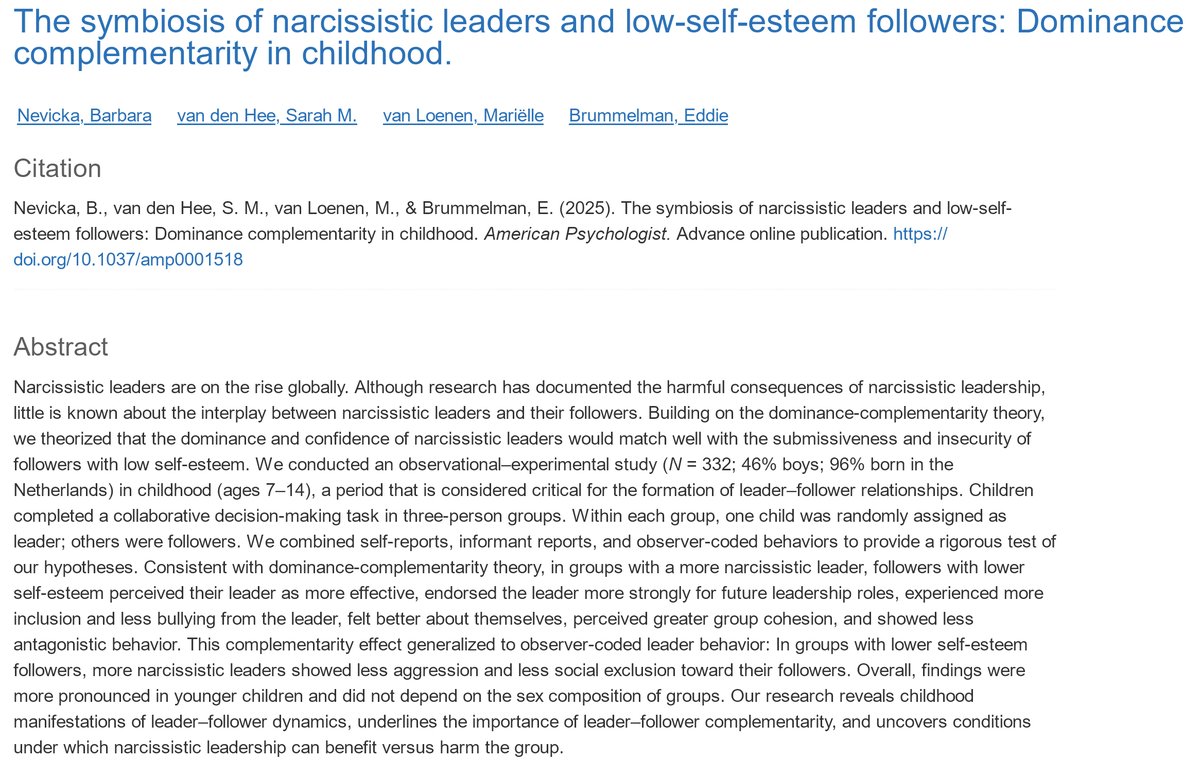
Narcissistic leaders are more appealing to young people with low self-esteem.
When we’re insecure, we often gravitate to big egos to fill the void. Supporting them makes us feel special—and makes them feel less threatened.
It's time to stop mistaking confidence for competence.
This has probably been the least successful first hundred days of a presidency @realDonaldTrump on the economy in the last century. We have seen the stock market go down, the dollar go down, forecasts of unemployment go up, forecasts of inflation go up, forecasts on the odds of a recession go up. We've seen consumer confidence collapse. We've seen businesses take back all their previous earnings projections. So, this has been a disastrous hundred days for the US economy.
Does President @realDonaldTrump control his administration?
New IRS commissioner this week, appointment revoked today.
Declaration of legal war against Harvard last weekend, labeled a mistake today.
Tariffs relaxed, all attributed to absence of one advisor.
Evil and incompetence are hard to disentangle.
Who is in charge?
This is my 31 autistic son Kelsey. He’s kinder than any republican. He works every day. Pays taxes. Spends hours a day learning. Helps others. And is way smarter than RFK will ever be.
This is what oligarchy looks like.
Since the disastrous Citizens United Supreme Court decision, spending by billionaires in elections has grown more than 16,000%.
End billionaire control of our democracy. Overturn Citizens United.
The U.S. economy has:
- the highest GDP in the world
- very high wealth per person
- low unemployment
- the largest capital markets
- tech & innovation dominance
- a flexible labor market
- the strongest global currency
Please stop believing the doomsday narrative.
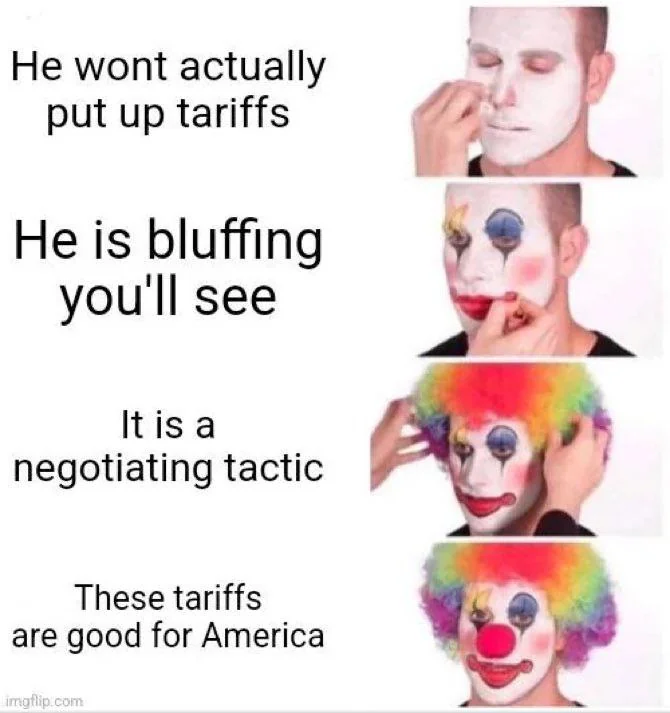
The country is 100% behind the president on fixing a global system of tariffs that has disadvantaged the country. But, business is a confidence game and confidence depends on trust.
President @realDonaldTrump has elevated the tariff issue to the most important geopolitical issue in the world, and he has gotten everyone’s attention. So far, so good.
And yes, other nations have taken advantage of the U.S. by protecting their home industries at the expense of millions of our jobs and economic growth in our country.
But, by placing massive and disproportionate tariffs on our friends and our enemies alike and thereby launching a global economic war against the whole world at once, we are in the process of destroying confidence in our country as a trading partner, as a place to do business, and as a market to invest capital.
The president has an opportunity to call a 90-day time out, negotiate and resolve unfair asymmetric tariff deals, and induce trillions of dollars of new investment in our country.
If, on the other hand, on April 9th we launch economic nuclear war on every country in the world, business investment will grind to a halt, consumers will close their wallets and pocket books, and we will severely damage our reputation with the rest of the world that will take years and potentially decades to rehabilitate.
What CEO and what board of directors will be comfortable making large,
long-term, economic commitments in our country in the middle of an economic nuclear war?
I don’t know of one who will do so.
When markets crash, new investment stops, consumers stop spending money, and businesses have no choice but to curtail investment and fire workers.
And it is not just the big companies that will suffer. Small and medium size businesses and entrepreneurs will experience much greater pain. Almost no business can pass through an overnight massive increase in costs to their customers. And that’s true even if they have no debt, and, unfortunately, there is a massive amount of leverage in the system.
Business is a confidence game. The president is losing the confidence of business leaders around the globe. The consequences for our country and the millions of our citizens who have supported the president — in particular low-income consumers who are already under a huge amount of economic stress — are going to be severely negative. This is not what we voted for.
The President has an opportunity on Monday to call a time out and have the time to execute on fixing an unfair tariff system.
Alternatively, we are heading for a self-induced, economic nuclear winter, and we should start hunkering down.
May cooler heads prevail.