True Story:
In December 1960, a twenty-three-year-old clerk named Armando Valladares sat at his desk at the Postal Savings Bank in Havana, Cuba.
The new communist regime had issued a directive requiring every government worker to place a small sign on their desk reading: "I am with Fidel."
Armando quietly refused. He stated that he was a Christian, he valued individual freedom, and he would not pledge fealty to a Marxist dictatorship.
Within days, political police raided his home, labeled him a counter-revolutionary, and threw him into a courtroom where a military tribunal handed him a thirty-year prison sentence.
The regime told him that release was simple. All he had to do was sign a single confession admitting his error, renouncing his faith, and declaring support for the socialist revolution. Sign the paper, and he could walk out to his family.
Armando looked his captors in the eye and refused.
The consequences were merciless. Guards shoved him into the infamous cells of Isla de Pinos and La Cabaña. They stripped him of his clothing, denied him medical treatment, and locked him in pitch-black solitary confinement boxes called tapadas. When he launched hunger strikes to protest the torture of fellow inmates, guards cut off his food and water entirely. Malnutrition caused severe peripheral neuropathy, paralyzing his legs and binding him to a wheelchair.
They broke his body, yet they could never touch his mind.
Sitting in total darkness, Armando began writing poetry. Lacking pens and paper, he used toothpicks, cigarette wrappers, and his own blood to write verses detailing the brutal realities of political prisoners.
Outside the prison walls, his young wife, Marta, dedicated her life to his cause. Visiting under heavy scrutiny, she quietly smuggled those bloodstained scraps of paper past armed guards, carrying his words to foreign embassies, publishers, and human rights organizations across the free world.
For twenty-two years, Armando endured beatings, starvation, and solitary confinement. Every few months, officials brought the same confession document to his cell, promising immediate freedom if he yielded his pen. For twenty-two years, he gave them the exact same answer: to sign away his conscience was a price far greater than death.
In 1982, mounting international pressure finally forced the Cuban government to release him. Armando arrived in the United States, gaunt and scarred, carrying the memories of two decades inside a socialist dungeon.
He published his memoir, Against All Hope, detailing the atrocities the world had chosen to ignore.
The book landed on the desk of President Ronald Reagan.
Reagan read the account with tears in his eyes and recognized something rare: an unyielding witness to the cost of human liberty. In 1987, Reagan bypassed the usual circle of career bureaucrats and made a stunning appointment. He named Armando Valladares the United States Ambassador to the United Nations Commission on Human Rights.
Months later, the man who had been starved in a Havana isolation cell rolled into the grand assembly halls of Geneva, Switzerland, carrying the diplomatic authority of the United States.
Taking his seat across from the very Cuban officials who had overseen his torture, Ambassador Valladares delivered devastating speeches exposing the secret labor camps, the political executions, and the brutality of the Castro regime. He successfully organized an international coalition that forced the United Nations to launch a formal inspection into Cuba’s human rights abuses, delivering a humiliating diplomatic defeat to the dictatorship.
Tyrants survive by convincing ordinary citizens that resistance is futile and compliance is safety. Armando Valladares proved that an entire totalitarian empire can be brought to its knees simply because one man refused to put a propaganda sign on his desk. Real sovereignty belongs to those who value their soul more than their comfort.
There's never been a better time to join the fight. Play The Division 2 for free from September 24-28 on PlayStation, Xbox, and PC via Ubisoft Connect.
Sydney Sweeney demonised for her recent nude shots advertising sports. The suggestion is that it’s demeaning women in sport. Yet all of these were met with studied silence.
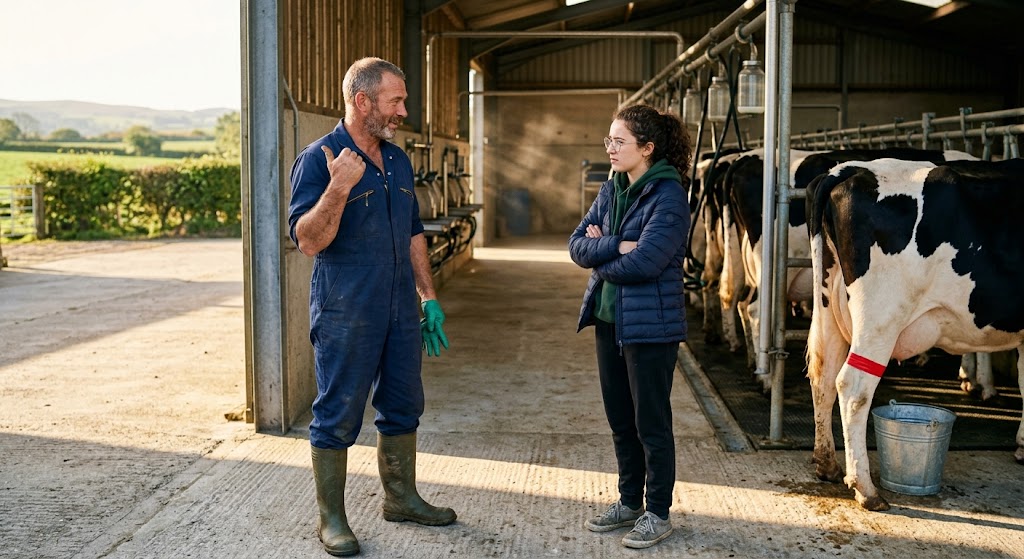
Activist: "Farmers pump their cows full of antibiotics. It's in every glass of milk."
Dairy farmer: "Do you know what happens if it is?"
Activist: "People drink it."
Dairy farmer: "The tanker gets tested at the gate. One cow's worth of antibiotic in 20,000 litres and the whole load goes down the drain. Every farm on the run that morning gets their milk tipped, and the farm that did it pays for all of it."
Activist: "So you're saying it never happens."
Dairy farmer: "I'm saying a treated cow on this farm gets red tape round her leg, goes to the back of the parlour, and her milk goes in a bucket for 6 days. I treat her like she's radioactive, because financially she is."
Activist: "You still use them."
Dairy farmer: "On a cow that's ill. Same as you. The vet writes it up, the date goes on the wall, and the wall's checked. Use on this farm is about half what it was 10 years ago, and that's every dairy I know."
Activist: "Routine use in feed, then."
Dairy farmer: "Illegal for years. Growth promoters went 20 years ago. You're describing a chicken shed in a country I don't farm in."
Activist: "You can't prove it's not in the milk."
Dairy farmer: "I can prove it 3 times a week, because they test it 3 times a week and send me the sheet. When did you last get a sheet on your oat drink?"
Activist: "That's different."
Dairy farmer: "It is. Nobody tests it. Mine's the most inspected liquid in your kitchen and it's the one you're scared of."