Foreign workers in Canada: it is illegal to work in Canada without authorization. You must ensure you are legally authorized to work here, or you may face serious consequences.
Having a valid work permit is the first step to working legally in Canada. Make sure you:
• understand and meet the conditions listed on your work permit
• apply to extend your work permit at least 30 days before it expires
• apply to change the conditions on your work permit, when needed
Learn more: https://t.co/P3SZJDAWzm
Get the facts: The number of new students and workers arriving in Canada continued to decline in April 2026.
For students, there was a drop of 89% compared to April 2024.
For workers, there was a drop of 37% compared to April 2024.
See the data: https://t.co/OCA2Q5sVFF
Scam alert! Some scammers use AI to generate fake content that appears to be from IRCC.
This content can include
•videos that promote fast or guaranteed immigration opportunities
•fake websites that offer immigration advice
•fake emails or suspicious phone calls claiming to be from IRCC officials
Always verify information through IRCC’s official website and social media channels.
Learn more about how to spot, stop and report immigration and citizenship fraud: https://t.co/Ugz5OvWdkp
We’re building on the temporary measure that was announced in March to help families stay united and contribute to Quebec’s workforce: https://t.co/qWRI17Ho5M
Starting today, once a temporary worker is found eligible under this public policy, their spouse or common-law partner can apply for an open work permit if they
• have valid temporary resident status in Canada (or if it expired within the last 90 days)
• are named on the principal applicant’s permanent selection application for Quebec’s Skilled Worker Selection Program
This supports our commitment to ensuring Canada has the skilled workers needed to fill regional labour gaps and keeps families together.
NEW RULES: Travelling to Canada from Saint-Pierre-et-Miquelon?
As of June 5, 2026, visa-exempt travellers boarding a boat or ferry to Canada will require an electronic travel authorization (eTA). Learn more: https://t.co/S8632pVwC1
Canada is seeking top talent, including:
• medical doctors, researchers and senior managers with Canadian work experience
• workers with French-language proficiency
• health care and social services professionals • tradespersons
• educators
• professionals in science, technology, engineering and mathematics (STEM) occupations
• professionals in transport occupations
These categories provide clear pathways to permanent residence for top international talent.
Find out how Express Entry category-based rounds of invitations work: https://t.co/GJ3QpiLVcL
Ottawa uses its new power from Bill C-12 to suspend immigration documents and admissions of travelers who are residents of the Democratic Republic of Congo, Uganda & South Sudan. It allows officials to suspend validity of visas and pause processing quickly https://t.co/OWnWDyk02A
Working with a College licensee? Be sure to sign a Service Agreement, which protects you by outlining services, fees, refund conditions and more.
For more information, visit https://t.co/y1se0KVQ4U
Vous travaillez avec un titulaire de permis du Collège? Signez un contrat de services qui vous protège en précisant services, honoraires, modalités de remboursement et bien plus.
En savoir plus : https://t.co/fZjdTIcT5g
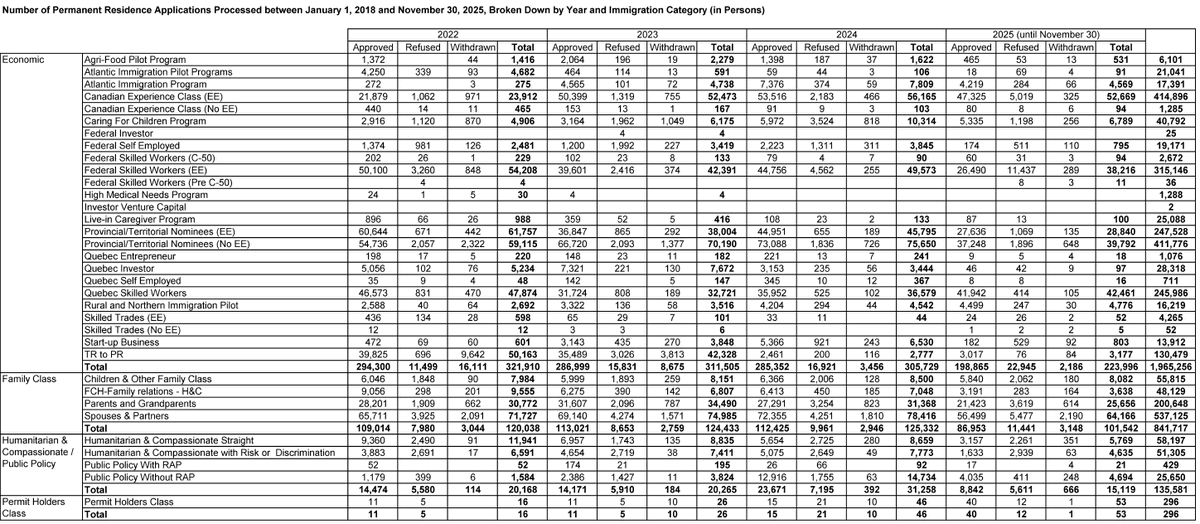
IRCC approval rates in several permanent residence programs appear to have dropped sharply in 2025.
Examples:
• Federal Skilled Workers (EE): from ~92% approved in 2022 (50,100 / 54,208) to ~69% in 2025 (26,490 / 38,216)
• Provincial Nominees (No EE): from ~93% in 2022 (54,736 / 59,115) to ~75% in 2025 (37,248 / 39,792)
• Humanitarian & Compassionate (Straight): from ~78% in 2022 (9,360 / 11,941) to ~52% in 2025 (3,157 / 5,769)
• Start-Up Business Class: from ~79% in 2022 (472 / 601) to ~23% in 2025 (182 / 803)
As of April 1, 2026, eligible post-secondary international students who have valid study permits will not need a separate work permit to take part in mandatory placements that are part of their study programs, like co-ops or internships: https://t.co/WatYiRDAjH
Alberta’s govt has proposed a bill to give it more oversight over which businesses hire temporary foreign workers, and it will allow for different investigative powers.
There will be a new system for complaints and enforcement.
https://t.co/ctuYFQkgFP
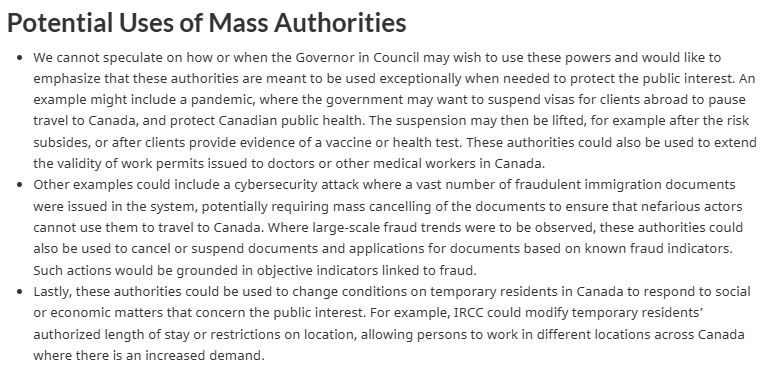
IRCC says that while it cannot speculate on how it will use Bill C-12, that possible examples include suspending visas during pandemics, extending the validity of work permits for doctors, if IRCC is hacked and visas are wrongly issued, or removing work permit conditions regarding location of work.
https://t.co/NAwFzgzjWm
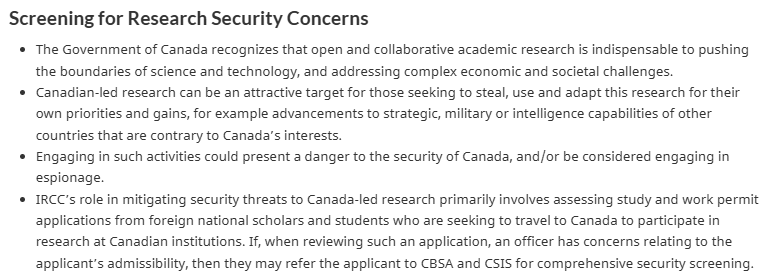
IRCC's role in mitigating security threats to Canada-led research primarily involves assessing study permit and work permit applications from foreign national scholars and students who are seeking to travel to Canada to particpate in research at Canadian institutions. If, when reviewing such an application, an officer has concerns relating to the applicant's admissibility, then they may refer the applicant to CBSA and CSIS for comprehensive security screening.
As a result of the Federal Court’s decision in Li, this can include situations where an individual does not intend to engage in espionage but may be vulnerable to coercion by their government.
The issue that arises is that Canadian immigration law does not allow for a limited refusal in such cases. Instead, a finding of inadmissibility results in a lifetime ban from Canada for both the individual and their accompanying family members. As a result, someone refused at age twenty due to concerns about potential coercion in a research institute context may, years later, be unable to visit Canada at all, even though the original concern did not relate to simple visits.
https://t.co/SGaYPip3dl