Together with @miazga02, we are announcing today Beyond Spherical Harmonics. We explored if we could do better than Spherical Harmonics in #3DGS, and found a few very interesting takeways in the process.
Code in #gsplat and paper released today
https://t.co/xERT2cimet
🧵🧵🧵
Introducing Neural Harmonic Textures: our new method for real-time novel view synthesis that outperforms all 3DGS and NeRF derivatives including (finally) ZipNeRF in terms of quality across all benchmarks.
The code is released (Apache 2.0): (https://t.co/O0a2JyZ9Bu) 🧵
In the last months, @seb_spe and I have been working on generalizing Gaussian splatting to non-exponential image formation models.
TL; DR: Using faster-than-exponential transmittance we can achieve up to 4x faster rendering without severe quality loss.
We present mitransient, a state-of-the-art transient light simulation tool based on Mitsuba 3, with support for non-line-of-sight setups. Check our docs and examples linked below, and feel free to reach out to us. 🧵👇Attending @ICCP_conference 2024? Check poster #23 on Tuesday!
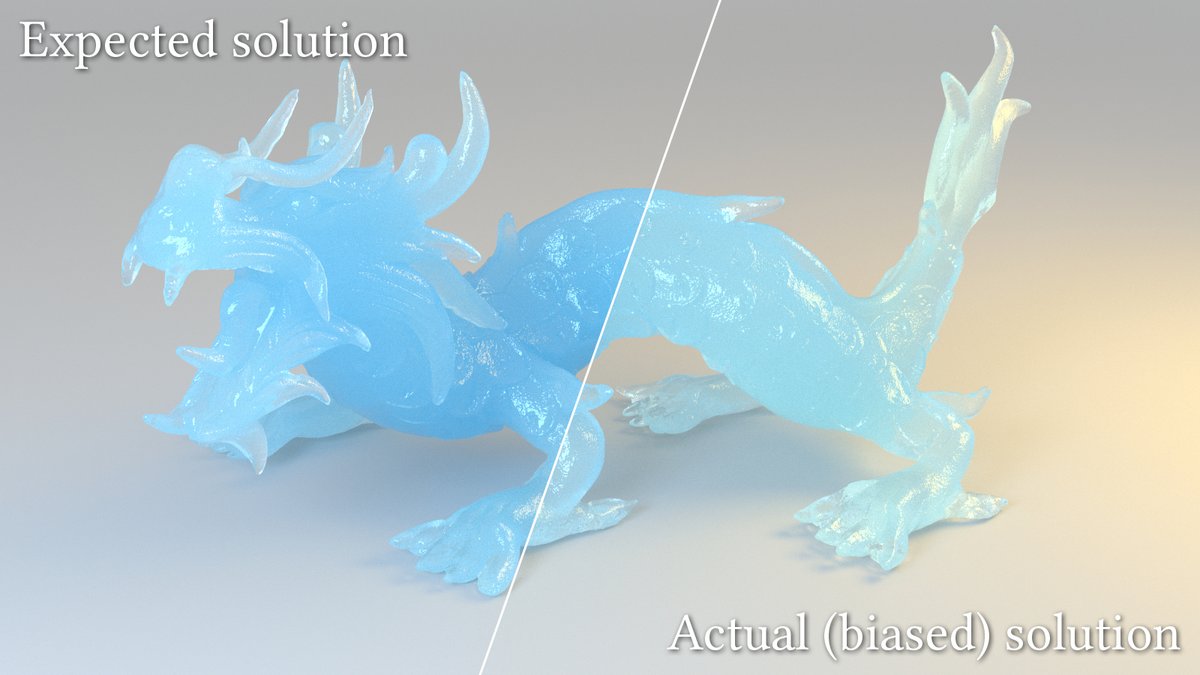
Did you know that inverse rendering can suffer from severe bias when the images are noisy (e.g. made using Monte Carlo methods). Our SIGGRAPH'23 paper dives into this overlooked issue (w/ @b_nicolet, Fabrice Rousselle, @_jannovak , Alexander Keller, and Thomas Müller)
Taking advantage of the Christmas vacations, I have improved VERIV: the image viewer I created for VSCode.
Now supports multiple images, error metrics, tone mapping (false color and +/-), and viewing pixel values (among other improvements).
Try it out at https://t.co/aowYG1l1QU.
Merlin Nimier-David (@merlin_ND) and Delio Vicini (@DelioVicini) had their public defenses and graduated recently. They are the last two of the first generation of students at RGL. I am incredibly proud of the many amazing things they accomplished while here.
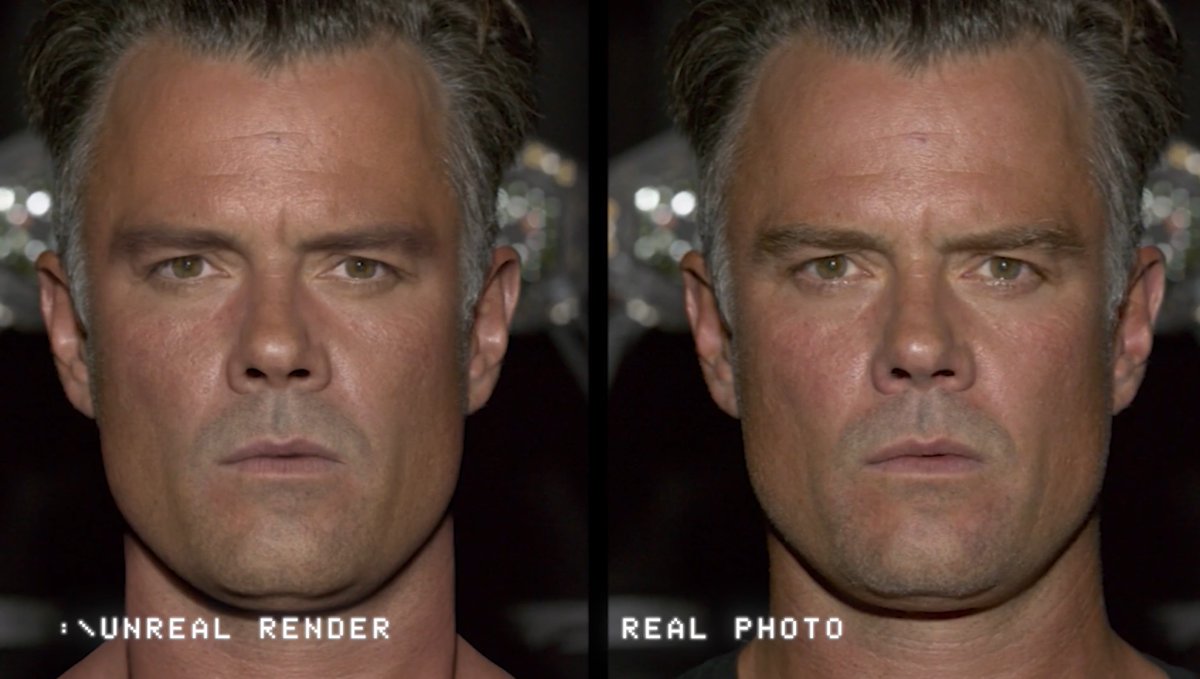
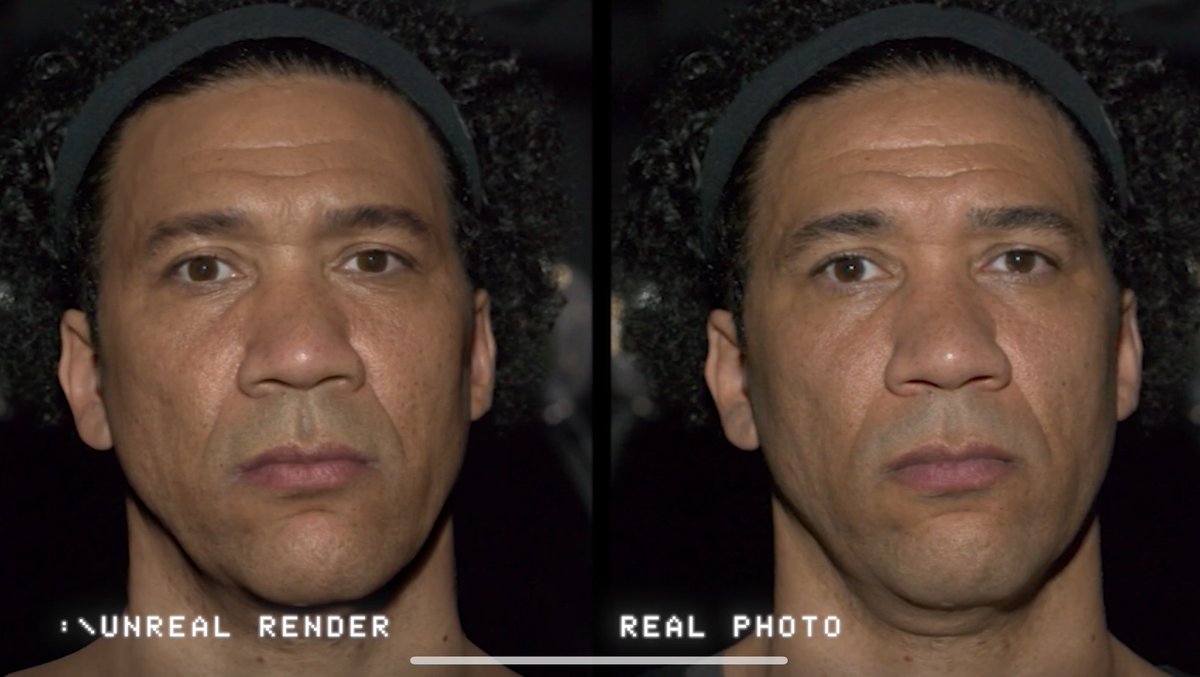
#callistoprotocol feats something truly special for characters. We worked 3 yrs to cross the limits of hardware, art and technology. This is the result of this team dedication and passion. Can't wait for people to see what we have to show @glaucolonghi@martincontel@miguel_oenp
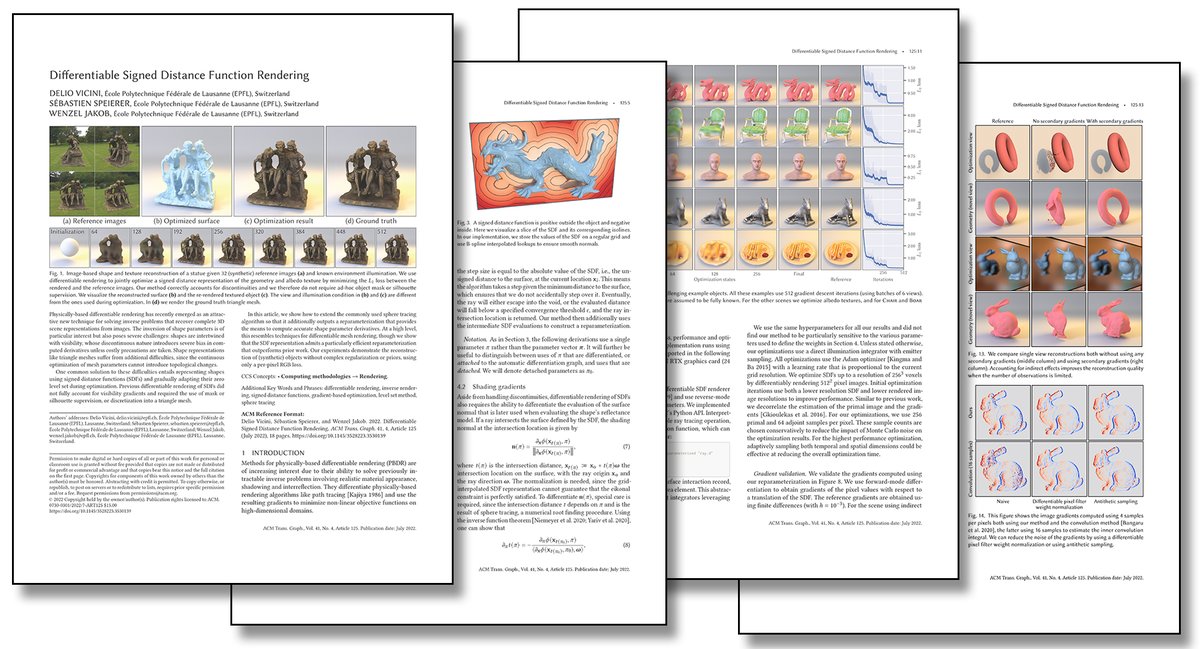
We've just released the implementation of our Siggraph 2022 paper on "Differentiable Signed Distance Function Rendering" on Github: https://t.co/F7e3SRAtho. The code allows to optimize SDFs from (synthetic) reference images and is based on Mitsuba 3/Dr.Jit! (1/3)
*Mitsuba 3* is now available! It's a major redesign of the lab's infrastructure for differentiable rendering building on the Dr.Jit just-in-time compiler announced yesterday. Full video link: https://t.co/WnfnRWiICm 1/10
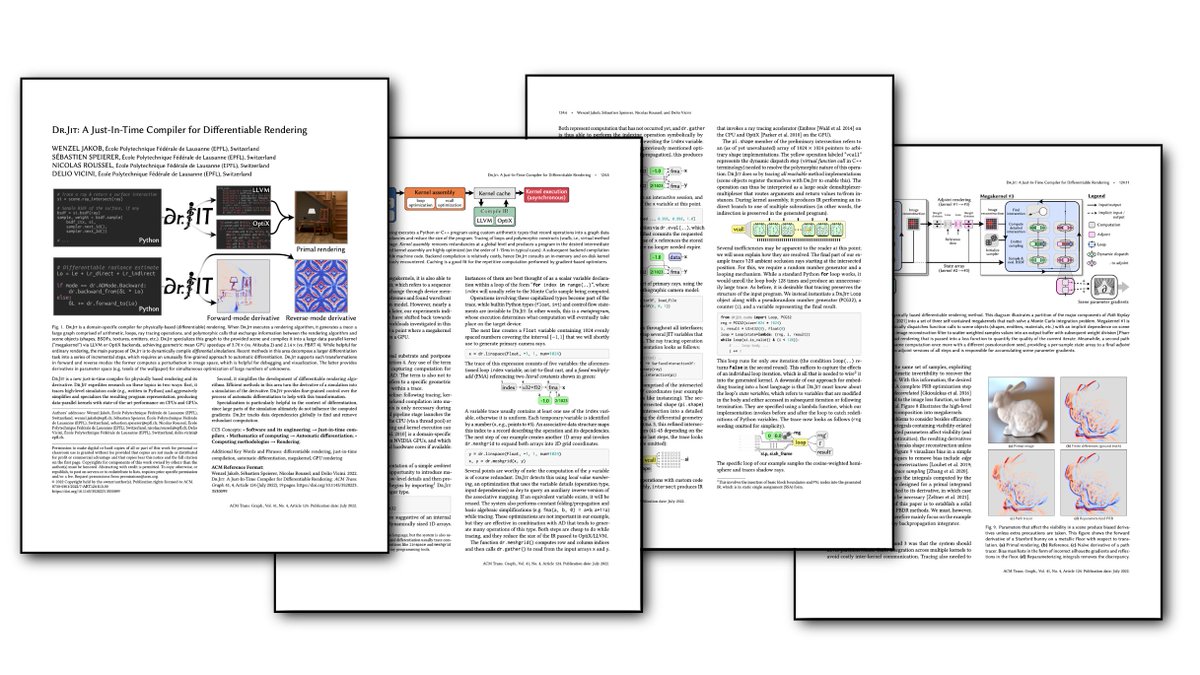
I am excited to announce *Dr.Jit*, a just-in-time compiler for differentiable rendering. Dr.Jit is the foundation of the differentiable rendering stack at EPFL and powers the upcoming Mitsuba 3. The project is a joint work with @seb_spe, Nicolas Roussel, and @DelioVicini. 1/8
Did you know that differentiating a volume renderer will produce biased and noisy derivatives? Our new sampling technique fixes this, improving reconstruction of editable & relightable volumes. Joint work with @merlin_ND, Thomas Müller and Alex Keller at SIGGRAPH'22. (1/8)
We're excited to present a new method to render Signed Distance Functions (SDFs) in a differentiable manner, enabling high-fidelity image-based shape reconstruction. This is joint work with @DelioVicini and @seb_spe and will be presented at SIGGRAPH'22. (1/8)
I've added new abstractions to nanobind to easily exchange CPU/GPU/.. tensors with modern array programming tools including Numpy, PyTorch, TensorFlow, and JAX. The library takes care of all the nitty-gritty details of this process. Details: https://t.co/iyRnNBDrLT
Today, I am releasing *nanobind*, a new tool for generating bindings between C++ and Python code. If you use pybind11 or Boost.Python, then this will likely be of interest to you. For historical context: pybind11 started out as a side project of mine back in 2015. (1/7)
Let me introduce you to a new extension that can make your life easier: VERIV - Vscode Extended Range Imaging Viewer!
No more worrying about opening images in an external program for a quick look, and it is fully compatible with VSCode remote! (perfect for teleworking)
[1/3]
VERIV is still missing some features that are useful in day-to-day research (but planned to be implemented in the future).
For more complex usage, I highly recommend Tev https://t.co/lBkpDxe1gb by Thomas Müller et al. or HDRView https://t.co/QubOfTsvuE by @wkjarosz et al.
[3/3]
How does it work? You only need to install it and open a compatible LDR or HDR file.
The viewer will open automatically, allowing you to view the image, move it, zoom in and out, and adjust the exposure.
If interested, check it out on VsCode or https://t.co/aowYG1l1QU !
[2/3]







![mcrespo__'s tweet photo. Let me introduce you to a new extension that can make your life easier: VERIV - Vscode Extended Range Imaging Viewer!
No more worrying about opening images in an external program for a quick look, and it is fully compatible with VSCode remote! (perfect for teleworking)
[1/3] https://t.co/Sh5U10rg5w](https://pbs.twimg.com/media/FJT5jH3WQAQIM2V.jpg)