Jimmy Carr shared a brutally honest take on life without kids that will hit hard for anyone who's ever weighed the choice:
“Not having kids was like living life with a cheat code on the video game. Super easy. Low stakes. No real skin in the game.”
He continues:
Once you have children, your heart literally lives outside your body.
You worry about mortality differently — because now dying means saying goodbye to them.
Suddenly you're not playing on easy mode anymore. You're at the high-stakes table.
And his final word? “It’s very joyful.”
In 54 seconds he captures something profound:
The deepest fulfillment often comes from the highest risk — the one where you have everything to lose.
Parents: Does this perfectly describe the shift you felt?
Child-free: Does it change how you see the trade-off?
There’s a common belief that when historically marginalized groups struggle, it’s reasonable to blame their misfortunes on society. But when historically dominant groups—such as men, white people, or straight people—struggle, the tendency is to blame them individually. In other words, if marginalized groups are not doing well, it’s seen as a problem with society; if dominant groups are not doing well, it’s seen as a problem with them.
@stclong @Honesty382955@usedgov@NiQole1776 You answered yourself with the phrase "pockets of parents". That implies a statistical minority. Also, human history is full of terrible parents who have kids that go on to break generational cycles and do great things. Moot argument
@GGalustanian@usedgov Literally every generation has been anxious and dysregulated. Especially when we look farther back in history. And yet, here we are. The story of humanity is resilience and perseverance, not waiting until we have ideal conditions (which is impossible)
Jimmy Carr just gave teenage boys (and honestly, a lot of grown men) the rawest dating truth they need right now:
Girls aren’t looking for looks — they’re looking for competence.
He breaks it down with zero filter:
“You think because you look for looks in a girl, she’ll look for looks in you. She’s not. What women like is competence. And it takes a while to get competent.”
That’s why billionaires and boiler-fixers both turn heads — both demonstrate mastery. Both get shit done.
Carr’s direct advice to any young guy still figuring it out:
“Get your shit together. Stop asking what you want in the world and start thinking about what you can offer.”
No pickup lines. No games.
Just brutal, timeless clarity.
Fellas — what’s one skill or area of competence you’re actively building right now to become that guy?
We were in the car after a long day, both of us exhausted. He was on the phone with a friend through the speakers, and they were talking about life, work, stress… all of it.
At one point his friend joked, “Man, marriage must be tiring.”
Without even thinking, he said, “Nah. Marriage isn’t tiring. Life is tiring. My wife is the part that makes it worth it.”
I froze in the passenger seat.
He kept driving like he didn’t just shift my entire world with one sentence.
Later that night I asked him if he really meant it.
He looked at me confused and said,
“Of course. You’re not my responsibility. You’re my reward.”
And I swear, in a world where people talk about marriage like it’s a burden…
He talks about it like he won the lottery.
And that’s all the reassurance I’ll ever need.
You’ve smelled this your entire life and it was never the rain.
The smell of rain isn’t rain. It’s a molecule called geosmin, produced by soil bacteria. Humans can detect it at just 5 parts per trillion, thousands of times more sensitive than most smells.
When raindrops hit dry soil, they launch microscopic aerosols carrying geosmin into the air, like invisible champagne bubbles.
Scientists think this sensitivity helped early humans find water.
Even camels use it to navigate deserts from miles away.
That “earth after rain” smell is survival, written in chemistry.
A father just asked the most dangerous question in education right now.
His 16-year-old overslept for school. His reaction surprised even himself.
Camillo: “Does any of this really matter at all right now? Like, what are you even doing?”
He can’t say it out loud to his kid. But he can’t stop thinking it.
Camillo spent years being strict about attendance and grades. The traditional playbook.
Show up. Study hard. Get the degree. Build the future.
Then he watched what AI is doing to that playbook in real time.
Camillo: “Every single kid in America is using AI for every single assignment and every single test.”
Not a vocal minority. Not the tech-savvy outliers.
Camillo: “I don’t think people realize. It’s close to 100% of every high school and college student using AI for close to everything that they do.”
The student gets a math worksheet. Takes a photo. Uploads it to Gemini. Asks it to show the work.
Done.
If 100% of students are using AI to pass the test, the test isn’t measuring intelligence anymore.
It’s measuring willingness to comply with a system that stopped being relevant before it had time to notice.
Camillo: “The world is moving so quickly, and I can’t even imagine the stuff that you’re learning and how slowly it…”
He doesn’t finish the sentence. He doesn’t need to.
Curriculums take years to update. AI is rewriting the global economy in real time.
The gap between what school teaches and what the world requires is now unbridgeable.
And it’s widening every single day.
The kids aren’t failing the system.
The system is failing the kids. Slowly. In public. With everyone watching and nobody saying it out loud.
Camillo just did.
There is something profoundly good about a husband and wife celebrating the new life only they can create together - this is the kind of pro-marriage, pro-family joy our culture needs more of.
In The Anxious Generation, I underestimated the harm from the phone-based childhood because I focused on the mental health outcomes, which is where we had the best data while I was writing the book.
I now believe that the widespread diminishment of the human capacity to pay attention is an even larger harm, affecting the majority of children, and even many adults. Diminished focus, executive function, and book-reading means diminished life chances.
“Modern man is in a terrible predicament. He is helplessly enamored with the beauty of what the old world built, yet despises the beliefs that inspired them to build it.”
—Jeremey Wayne Tate
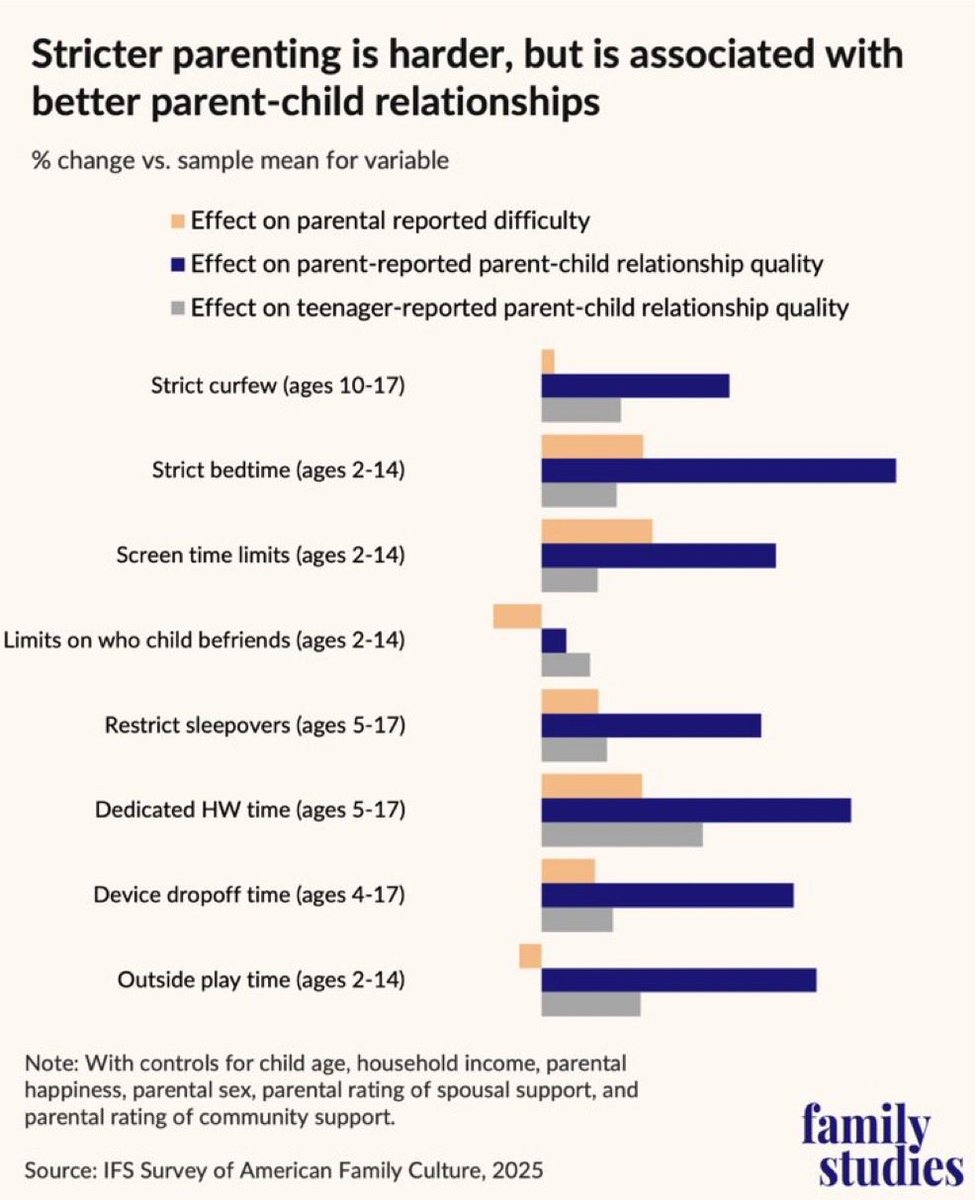
We now have evidence that gentle parenting doesn’t work.
Here’s an uncomfortable truth about parenting no one wants to say out loud:
The data is not kind to gentle parenting.
According to teenagers, strict curfews. strict bedtimes, screen limits, device drop off times, dedicated homework blocks, and sleepover restrictions IMPROVE higher relationship quality.
And yes, parenting difficulty goes up.
Of course it does. Leadership is harder than appeasement.
For the past decade we have been sold a watered down, Instagram friendly version of “gentle parenting” that often collapses into boundary avoidance, endless negotiation and emotional processing without enforcement. Parents terrified of saying no because they do not want to rupture connection.
But connection without authority is not connection. It is dependency.
When parents impose structure, the relationship improves.
Teenagers report better parent child relationship quality in homes with curfews and rules. Younger kids report better relationships in homes with screen limits and bedtimes. Even device drop off times correlate positively.
Why?
Because structure is not cruelty. Structure is love made visible.
A bedtime says: your brain matters more than your entertainment.
A screen limit says: your dopamine system is not fully developed and I will guard it until it is.
A curfew says: your safety matters more than your social standing.
That is not authoritarianism. That is caring.
Boundaries create friction. Friction creates growth. The parent absorbs the short term discomfort so the child does not pay the long term cost.
Children do not experience well calibrated limits as rejection. They experience them as stability. The human brain craves predictability. Predictability reduces anxiety. Reduced anxiety strengthens attachment.
That is why relationship quality goes up.
Notice something else in the data. The strongest effects are around time structure. Bedtime. Homework. Devices. Outside play. These are environmental constraints. They scaffold executive function.
The winning formula is not tyranny.
It is high warmth plus high structure.
The modern failure mode is high warmth plus low structure. That is just abdication of responsibility wrapped in empathy.
Children need leadership, not negotiation. They need adults who can tolerate their anger. They need boundaries that do not move every time emotions spike. They need someone whose prefrontal cortex is fully myelinated.
The harder path produces the stronger bond.
Because when a child feels that someone is strong enough to hold the line, they relax. And relaxed nervous systems build durable relationships.
One of the most uncomfortable facts in social science is that money cannot compensate for extreme instability.
There was a study a few years ago that compared children raised in stable, intact families with those raised in unstable ones. What it found was striking: poor children who grew up in stable homes were less likely to become addicted to drugs or alcohol as teenagers than wealthy children who grew up in unstable, broken homes.
That result seems intuitive, yet it cuts against how many people think about the problem. A lot of the debate assumes the main issue is material resources—that if families just had more money, or more cash transfers, outcomes would improve. But this study suggests that stability inside the home matters at least as much, perhaps more, than income.
From my conversation with @DanCrenshawTX
@r0ck3t23@peterboghossian Easy for the richest man on the planet to say. Also, just because an abstract currency may be "uncapped" doesn't mean there won't be scarcity. There is only so much land, only so many materials, we can only grow so much food, etc
Shocking new MRI study on 3–5 year olds: Just 2 hours of interactive screen time per day is linked to measurable loss of white matter in the brain.
Professor Mike Nagel (University of the Sunshine Coast):
“White matter is myelin — it insulates axons like plastic on a wire. Deficits in myelin early in life mean deficits in neural connectivity.”
The more screen time, the greater the white matter loss — especially in areas tied to language development and literacy.
Nagel’s first reaction (as a researcher and father):
“Wow… I was not anticipating seeing anything like that. It hadn’t occurred to me that something as little as two hours a day was having such a profound effect.”
Parents: Has this changed how you think about screen time limits for young kids — or do you think the risks are overstated?
When I first got married, I called my mom to complain about some argument my husband and I were having. My mom stopped me right there and said, "unless you are in danger, dont ever let anyone into your marriage, not even me". Its was the best advice I could've ever received as a young wife. It allowed me to take my concerns directly to my husband, think thru how I really feel without someone projecting themselves on me. Gatekeep the marriage.