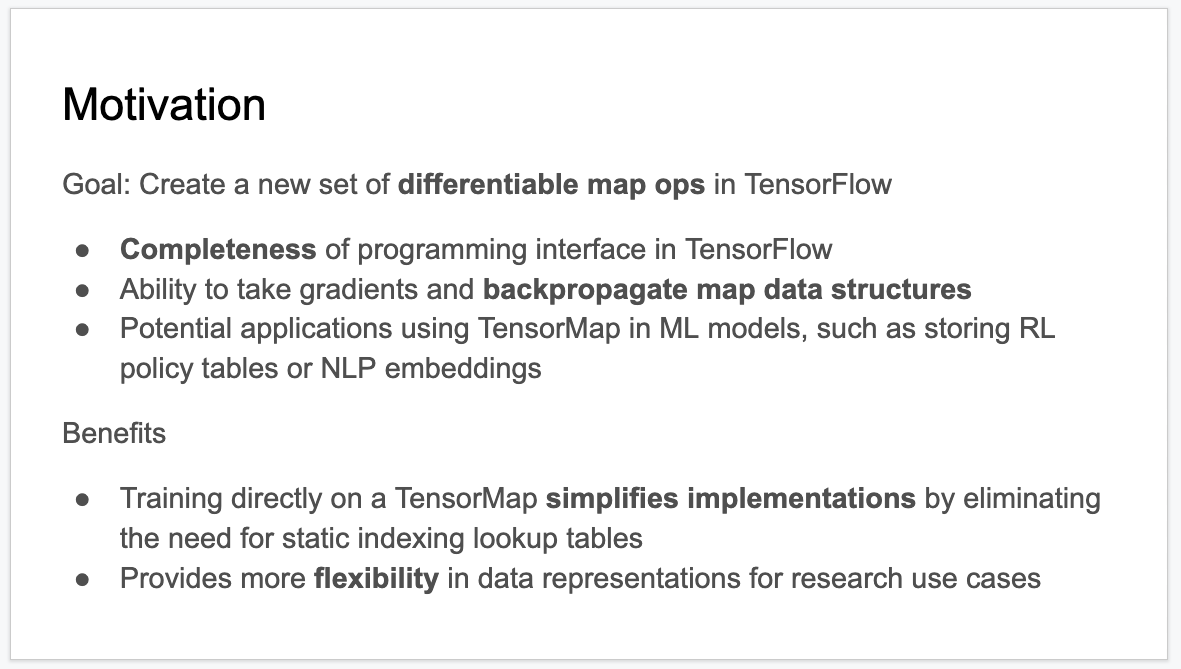
Announcing a cool new feature in @TensorFlow: differentiable map ops! 🙌✨
If you've ever wanted to store and train embeddings in an embedding model, this should make the process *much* simpler. 😄
https://t.co/0ybR7BB6QN
Amazing work from our TF intern, @kattian_ (@Harvard)!
@deckeresq @tiarkrompf@SShanabrook On the TF side of things, there's also https://t.co/Oqv289vI0K; will start tagging the relevant changes to the issue. Another place to watch is this directory, a staging area for all things independent of TF: https://t.co/JOiEIzdGRm
@SShanabrook @awiltsch Sadly I won't make it to PyCon this year, but Brian Lee from our team will present one of our early prototypes. The path to a standard solution can be a long one, but I believe a good first step is figuring out the prerequisites that would first need to be standardized.
@SShanabrook Yep! We hope to discuss it at a sponsor talk this year, and have a full presentation next year after the library had been released. By then, it would be awesome to also have a PEP started! @awiltsch
TensorFlow 2.0 alpha is here! We've asked the community what they wanted and we're working to make TensorFlow simpler and easier to use for everyone.
Read up on how to get started here → https://t.co/oGtb2B2Pz3
@SShanabrook Thank you! Definitely agree it can be useful across Python, and we're working on releasing a generic library soon - stay tuned! Here's a paper that discusses the idea in more detail: https://t.co/cER9qt3oxj.
Building ML models that are robust and inclusive even when learning from imperfect data is an important research challenge. To spur further progress in developing inclusive models, we are announcing the Inclusive Images Competition on Kaggle. https://t.co/gVMImMZ8sR
We’re excited to announce the public alpha of Cirq, an open source framework for developing algorithms on noisy intermediate scale quantum (NISQ) computers. Check out the GitHub repository — pull requests welcome! #Cirq#quantumcomputing https://t.co/GGbRngQiam
Graph models allow for all kinds of optimization, but it can be tricky to move between Python and graph code. To help with this, TensorFlow has AutoGraph, a new feature that converts Python code into pure TensorFlow graph code.
Learn more on the blog ↓ https://t.co/AcNKnvkyJV