En el día de ayer, presentamos el primer “Informe sobre homicidios dolosos en el Municipio de General San Martín”, como Observatorio sobre el Narcotráfico y las Violencias Asociadas, que integramos junto con el CEPAJ y el Núcleo de Estudios sobre Violencias (IDAES-UNSAM).
📊 Mañana presentamos el primer informe sobre homicidios dolosos en el Municipio de General San Martín (1° trimestre 2026)
Un relevamiento del Observatorio sobre el Narcotráfico y las Violencias Asociadas en San Martín.
🗓 Miércoles 6 de mayo, 17.30 hs
📍 Auditorio Tanque, UNSAM
Ponele que está bien que usen chatgpt para redactar notas pero, por lo menos, exigile un poco hermano. En la nota encontraran por ej que la reforma está en línea "con el principio de reserva y los derechos constitucionales" y otras frases literales del DNU. O pega el DNU nomás
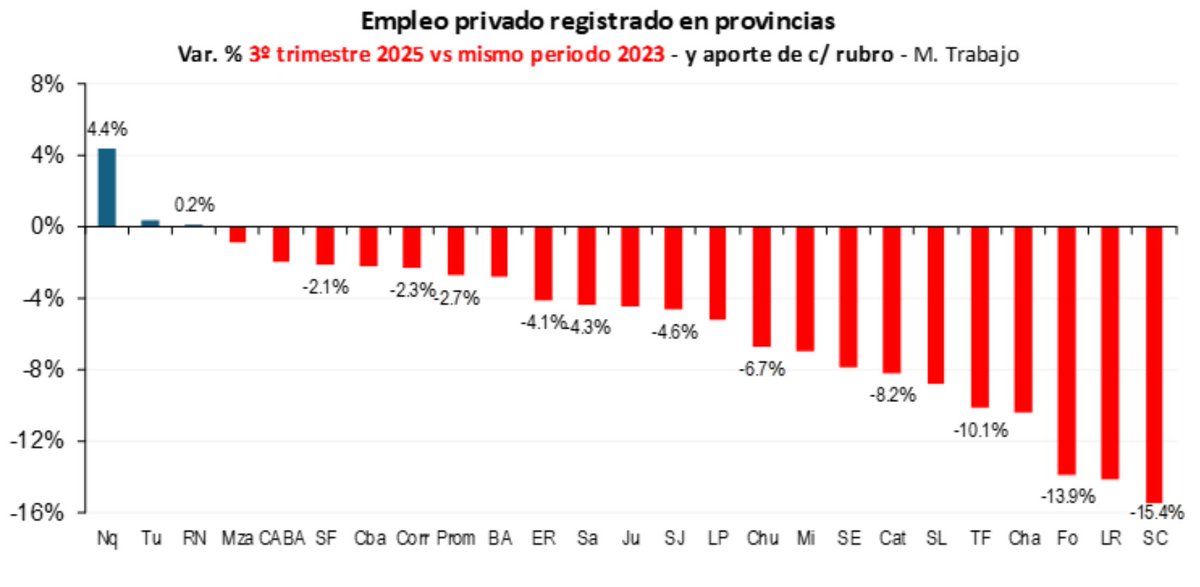
El empleo privado registrado cae a nivel país, pero el promedio esconde fuertes diferencias entre provincias. Algunas crecen (como Neuquén), mientras la mayoría retrocede. El mapa laboral hoy es heterogéneo y muy ligado a la estructura productiva.
Because we get asked a lot.
The Technological Republic, in brief.
1. Silicon Valley owes a moral debt to the country that made its rise possible. The engineering elite of Silicon Valley has an affirmative obligation to participate in the defense of the nation.
2. We must rebel against the tyranny of the apps. Is the iPhone our greatest creative if not crowning achievement as a civilization? The object has changed our lives, but it may also now be limiting and constraining our sense of the possible.
3. Free email is not enough. The decadence of a culture or civilization, and indeed its ruling class, will be forgiven only if that culture is capable of delivering economic growth and security for the public.
4. The limits of soft power, of soaring rhetoric alone, have been exposed. The ability of free and democratic societies to prevail requires something more than moral appeal. It requires hard power, and hard power in this century will be built on software.
5. The question is not whether A.I. weapons will be built; it is who will build them and for what purpose. Our adversaries will not pause to indulge in theatrical debates about the merits of developing technologies with critical military and national security applications. They will proceed.
6. National service should be a universal duty. We should, as a society, seriously consider moving away from an all-volunteer force and only fight the next war if everyone shares in the risk and the cost.
7. If a U.S. Marine asks for a better rifle, we should build it; and the same goes for software. We should as a country be capable of continuing a debate about the appropriateness of military action abroad while remaining unflinching in our commitment to those we have asked to step into harm’s way.
8. Public servants need not be our priests. Any business that compensated its employees in the way that the federal government compensates public servants would struggle to survive.
9. We should show far more grace towards those who have subjected themselves to public life. The eradication of any space for forgiveness—a jettisoning of any tolerance for the complexities and contradictions of the human psyche—may leave us with a cast of characters at the helm we will grow to regret.
10. The psychologization of modern politics is leading us astray. Those who look to the political arena to nourish their soul and sense of self, who rely too heavily on their internal life finding expression in people they may never meet, will be left disappointed.
11. Our society has grown too eager to hasten, and is often gleeful at, the demise of its enemies. The vanquishing of an opponent is a moment to pause, not rejoice.
12. The atomic age is ending. One age of deterrence, the atomic age, is ending, and a new era of deterrence built on A.I. is set to begin.
13. No other country in the history of the world has advanced progressive values more than this one. The United States is far from perfect. But it is easy to forget how much more opportunity exists in this country for those who are not hereditary elites than in any other nation on the planet.
14. American power has made possible an extraordinarily long peace. Too many have forgotten or perhaps take for granted that nearly a century of some version of peace has prevailed in the world without a great power military conflict. At least three generations — billions of people and their children and now grandchildren — have never known a world war.
15. The postwar neutering of Germany and Japan must be undone. The defanging of Germany was an overcorrection for which Europe is now paying a heavy price. A similar and highly theatrical commitment to Japanese pacifism will, if maintained, also threaten to shift the balance of power in Asia.
16. We should applaud those who attempt to build where the market has failed to act. The culture almost snickers at Musk’s interest in grand narrative, as if billionaires ought to simply stay in their lane of enriching themselves . . . . Any curiosity or genuine interest in the value of what he has created is essentially dismissed, or perhaps lurks from beneath a thinly veiled scorn.
17. Silicon Valley must play a role in addressing violent crime. Many politicians across the United States have essentially shrugged when it comes to violent crime, abandoning any serious efforts to address the problem or take on any risk with their constituencies or donors in coming up with solutions and experiments in what should be a desperate bid to save lives.
18. The ruthless exposure of the private lives of public figures drives far too much talent away from government service. The public arena—and the shallow and petty assaults against those who dare to do something other than enrich themselves—has become so unforgiving that the republic is left with a significant roster of ineffectual, empty vessels whose ambition one would forgive if there were any genuine belief structure lurking within.
19. The caution in public life that we unwittingly encourage is corrosive. Those who say nothing wrong often say nothing much at all.
20. The pervasive intolerance of religious belief in certain circles must be resisted. The elite’s intolerance of religious belief is perhaps one of the most telling signs that its political project constitutes a less open intellectual movement than many within it would claim.
21. Some cultures have produced vital advances; others remain dysfunctional and regressive. All cultures are now equal. Criticism and value judgments are forbidden. Yet this new dogma glosses over the fact that certain cultures and indeed subcultures . . . have produced wonders. Others have proven middling, and worse, regressive and harmful.
22. We must resist the shallow temptation of a vacant and hollow pluralism. We, in America and more broadly the West, have for the past half century resisted defining national cultures in the name of inclusivity. But inclusion into what?
Excerpts from the #1 New York Times Bestseller The Technological Republic: Hard Power, Soft Belief, and the Future of the West, by Alexander C. Karp & Nicholas W. Zamiska
https://t.co/8igjazz1On
El presidente está enojado con los números de opinión pública que tenemos. Lo entiendo, a lo largo de mi carrera he visto a muchos políticos enojarse cuando la preferencia se retrae.
Forma parte de las oscilaciones del vínculo político. La opinión pública cambia, no se eterniza. Hoy están en un momento difícil. Han estado en momentos más felices. Pero las ceremonias de degradación al encuestador y/o al periodista difícilmente cambien la percepción social.
Millones no llegan a fin de mes (o mitad) y se endeudan, viajan en colectivos explotados. Sus salarios siguen bajando.
Mientras unos pocos funcionarios también se endeudan, pero porque "no llegan" a comprar su TERCERA propiedad en country. Les abren las puertas del Banco Nacion.
Y de pronto, hace unas semanas, veo a Adorni en una entrevista decir que "no se de donde sacan que gasté de más, mis consumos no son datos públicos" y ahí supe que había que lanzarlo de una vez.
Le metimos horas de fin de semana y vibecoding y salio https://t.co/ilYJz9RF8I
LA JUSTICIA EXIGE AL GOBIERNO QUE EJECUTE LA LEY DE FINANCIAMIENTO UNIVERSITARIO
La Cámara en lo Contencioso Administrativo Federal falló a favor de las universidades públicas y le exigió al Gobierno que implemente de inmediato la ley aprobada por el Congreso en septiembre pasado. La decisión se da en medio de paros en reclamo de aumentos salariales y mayor presupuesto.
(+) en Clarín: https://t.co/3sAueSPAkW
"Lo que perdemos como comunidad es seguridad, salud, educación. No se puede sobreexplotar a una persona y pensar que va a hacer bien su trabajo" acá la leen https://t.co/Zj7Pd6wdxv
"Un docente, un policía, un médico que tiene que trabajar de Uber, no duerme, hace mal su trabajo”. @inavlag1 sobre las consecuencias de los bajos salarios estatales, y de las policías en particular.
El fallo de hoy contra Burford Capital permite concluir que la estrategia jurídica utilizada para reestatizar en 2012 un 51% de YPF fue válida. Cuesta creerlo porque con el paso de los años se recontra instaló en la agenda pública que fue un error no haber realizado una Oferta Pública de Acciones (OPA) al resto de los accionistas —entre los que figuraba Petersen Energía—, tal como marcaba el estatuto de YPF.
Esa impericia legal, torpeza o desconocimiento que se le asignaba a Axel Kicillof y al equipo de abogados del Estado que trabajó en la expropiación nunca fue tal. Lo cierto es que se evaluó realizar la OPA, pero hubiese implicado desembolsar unos US$ 20.000 millones, un monto que fue considerado excesivo por los funcionarios que estuvieron a cargo del proceso.
La alternativa que se encontró —que fue respaldada por estudios privados que aportaron dictámenes avalando la iniciativa— fue expropiar sólo un 51% con la convicción de que la Constitución y la Ley de Expropiación argentina primaban sobre el estatuto de YPF.
Loretta Preska interpretó lo contrario y condenó al país a pagar US$ 16.100 millones más intereses. Hoy, la Cámara de Apelaciones de Nueva York corrigió esa sentencia y le dio la razón al planteo que siempre mantuvo la Procuración del Tesoro durante los últimos tres gobiernos.
Imposible desde acá saber cuánto incidió el alineamiento total de Javier Milei con Donald Trump, pero parece lógico creer que una cuota parte importante del fallo de hoy se explica en esa clave. Bien por el gobierno que tiró de todas las palancas posibles —las legales, las políticas, las comunicaciones (el Argentina Week de hace dos semanas, por ejemplo)— para lograr la sentencia de hoy.
En cuanto a la reestatización de 2012, los abogados argentinos que trabajaron en la expropiación y el mismo Kicillof siempre creyeron que a Repsol habría que indemnizarla —ganaron tiempo pagando US$ 5000 millones más intereses (un total de unos 10.000) un año después—. Seguramente hubiesen hecho lo mismo si en lugar de llamarse Petersen Energía, el accionista minoritario de YPF se llamaba Shell o ExxonMobil.
Kicilof no pudo avanzar porque existía una clara restricción política en cabeza de Cristina Kirchner, que estaba imposibilitada de compensar a los Eskenazi cuando ese mismo grupo empresario había entrado a YPF durante el primer mandato de la ex presidenta de forma totalmente irregular —pagando una cifra mínima y consiguiendo financiamiento del vendedor (Repsol) que se repagaba vía dividendos en un momento en que se caía la producción de petróleo y gas en el país—.
Ojalá algún día se conozca la verdad y los detalles del acuerdo político-económico que llevaron a los Eskenazi a YPF. Pero hoy toca celebrar que una de las tantas tragedias griegas que llevaron al declive de nuestro país tenga un sorprendente final feliz. No es algo que suela ocurrir.