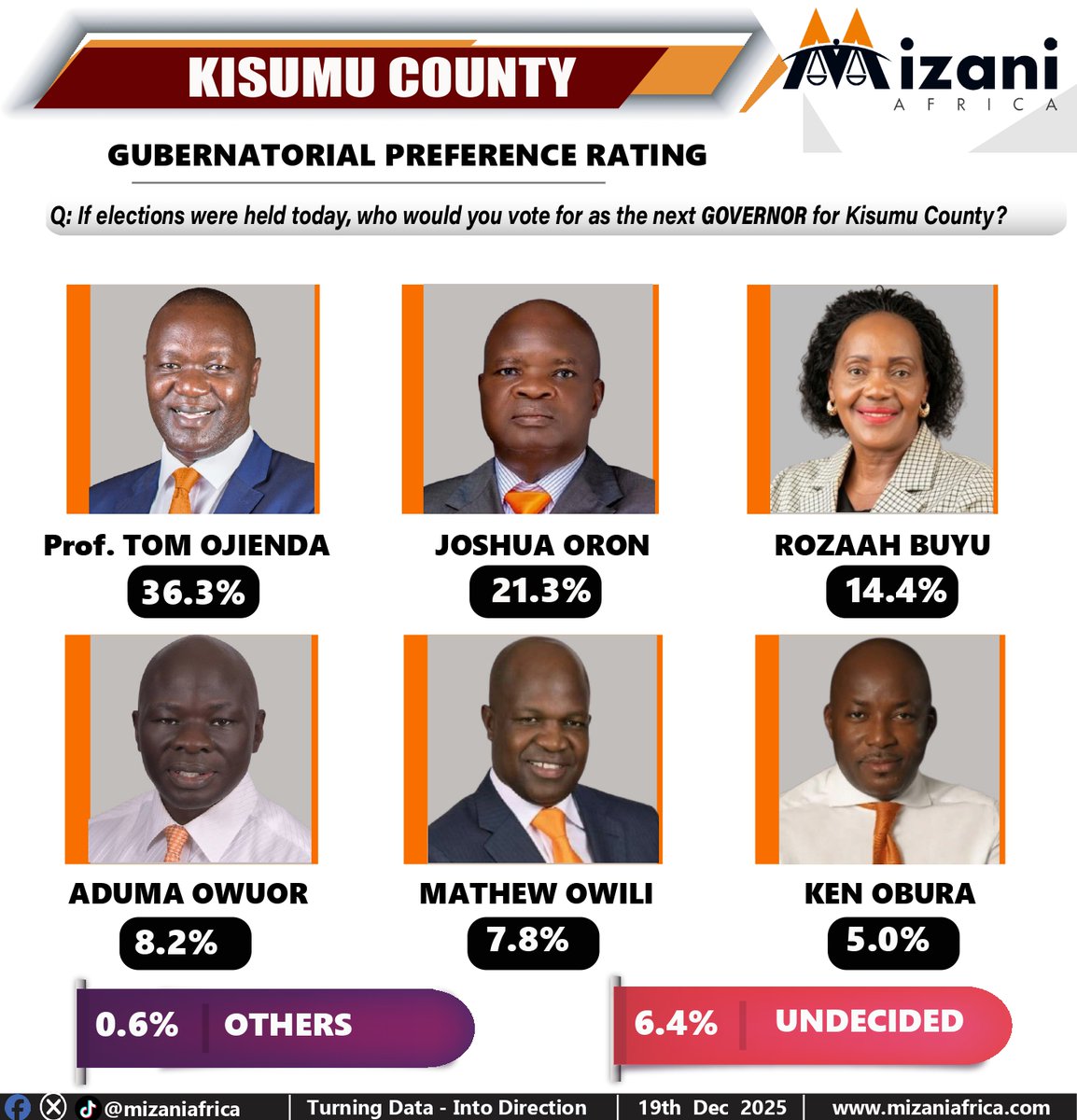
Prof. Tom Ojienda consolidates his position as the leading contender in the Kisumu gubernatorial race, commanding a strong 36.3% voter preference. As the current Senator for Kisumu County, Ojienda’s front-runner status reflects broad-based confidence in his countywide leadership profile, legislative experience, and institutional grasp of devolution. His lead suggests that voters increasingly view him as best positioned to transition from legislative oversight to executive stewardship at the county level.
In contrast, Joshua Oron (21.3%) and Rozaah Buyu (14.4%), both serving Members of Parliament, register notable but significantly lower support levels. While their parliamentary experience provides visibility within their respective constituencies, the results indicate that countywide appeal and executive readiness remain decisive factors shaping voter preference. The gap between Ojienda and the MP-level contenders highlights the premium voters place on seniority, cross-county exposure, and perceived capacity to manage complex county systems.
Overall, the preference landscape points to a contest increasingly defined by leadership depth and governance credibility. Prof. Tom Ojienda’s commanding lead underscores a growing consolidation around his candidacy, positioning him as the most electorally viable and broadly acceptable choice should Kisumu voters head to the ballot today.
Early voter preference data places Francis Mugo at the forefront of the Lamu County senatorial race, with 33.3% support well ahead of all other tested contenders. The strength of his lead points to broad-based acceptance and a growing perception of his suitability to represent Lamu County’s interests at the national level, giving him a clear advantage as the contest begins to take shape.
The remainder of the field trails at a distance, with Yusuf Aboubakar at 21.2% and a further drop to 14.1% for the next closest contender, while the rest register marginal support. With undecided voters accounting for 9.1%, the results suggest a preference structure that is already forming, and one in which Francis Mugo currently occupies the most competitive and strategically advantageous position.
Our early voter preference data for the Lamu County gubernatorial race indicates a closely contested field, with Fahim Twaha leading at 25.7%, followed closely by Stanley Muthama at 22.1% and Abubakar Hassan at 20.9%. The narrow margins among the top three highlight a competitive race with no dominant front-runner at this stage, reflecting a county electorate still weighing leadership options across a diverse set of experience profiles.
The results also point to differentiated sources of support among the leading contenders. While Fahim Twaha brings prior executive exposure as a former governor and Stanley Muthama draws strength from his current role as Lamu West MP, Abubakar Hassan’s performance underscores growing voter interest in candidates with national-level policy and investment experience, particularly in areas linked to economic growth and development planning. With 13.7% of voters undecided, the data suggests a fluid contest in which governance experience, development credentials, and the ability to translate institutional access into tangible county outcomes will remain key determinants as voter preferences continue to evolve.
Preliminary voter preference results for the Lang’ata Constituency parliamentary race place the incumbent MP, Phelix Jalang’o, at the top with 35.1% support, reflecting the continued role of incumbency and name recognition in shaping early voter choices. The figures suggest a contest that is beginning to take structure, though voter alignments remain in flux. Abass Khalif emerges as a strong rival with 24.9% support, positioning himself as the most competitive challenger in the field. As the current MCA for South C Ward, his performance indicates growing recognition beyond his immediate ward and a capacity to attract broader constituency-level backing. The presence of 17.6% undecided voters indicates that a significant portion of the electorate has yet to make a definitive choice. With other candidates registering lower support levels, the data suggests a competitive environment in which voter preferences may continue to shift as the campaign period progresses.
The performance rating for the Lamu County Women Representative office shows the incumbent, Monica Muthoni Marubu, registering a score of 40.1%. This rating reflects public assessment of her effectiveness in office, including visibility, representation, and delivery on mandate-related responsibilities during her tenure.
Overall, the results point to a mixed but substantial performance evaluation, indicating that a notable share of constituents acknowledge her work while also signaling areas where expectations for performance and impact remain high.
Our voter preference results for Nyakach Constituency parliamentary race indicate a clear early lead for Okoth Opande (WuonMullah), who commands 41.0% support. His strong showing places him well ahead of the rest of the field and suggests a broad base of acceptance among voters at this stage of the contest.
Trailing behind is Nashon Angudha at 20.0%, followed by Vincent Obuya with 14.0%. Notably, 23.0% of voters remain undecided, indicating that a significant segment of the electorate has yet to make a firm choice. Overall, the data points to a race with a clearly defined front-runner, but one that remains open to shifts as undecided voters engage and candidate profiles continue to crystallize across the constituency.
Our early voter preference results for the Muhoroni Constituency parliamentary race show the incumbent MP, James K’Oyoo, leading with 45.2%, underscoring the continued weight of incumbency, visibility, and record in office. However, the contest remains tightly fought, with Robert Nyasuna close behind at 34.5%, pointing to a competitive two-horse race at the top of the field. The relatively narrow margin highlights an electorate actively weighing continuity against an alternative option, suggesting that momentum, turnout, and engagement could prove decisive as the race evolves. With other contenders trailing and a notable share of voters yet to fully align, the data indicates a contest that is clearly defined at the top but far from settled, with the incumbent’s advantage being tested by a strong and sustained challenge.
The parliamentary contest in Seme Constituency is taking shape around the incumbent,Dr.James Nyikal, who leads with 44.6%, reflecting sustained visibility and voter familiarity built over his tenure in office. While Nyikal holds a clear advantage, the race remains competitively structured, with Boaz Odeyo posting 20.5% and Haggai Hawi Kadiri close behind at 18.4%, together forming a strong second tier of challengers. Their combined presence points to an electorate actively assessing alternatives alongside continuity. With other contenders trailing and 8.3% still undecided, the results suggest a race led by the incumbent but one that remains dynamic, where shifts in engagement and turnout could further define the competitive balance as the campaign period progresses.
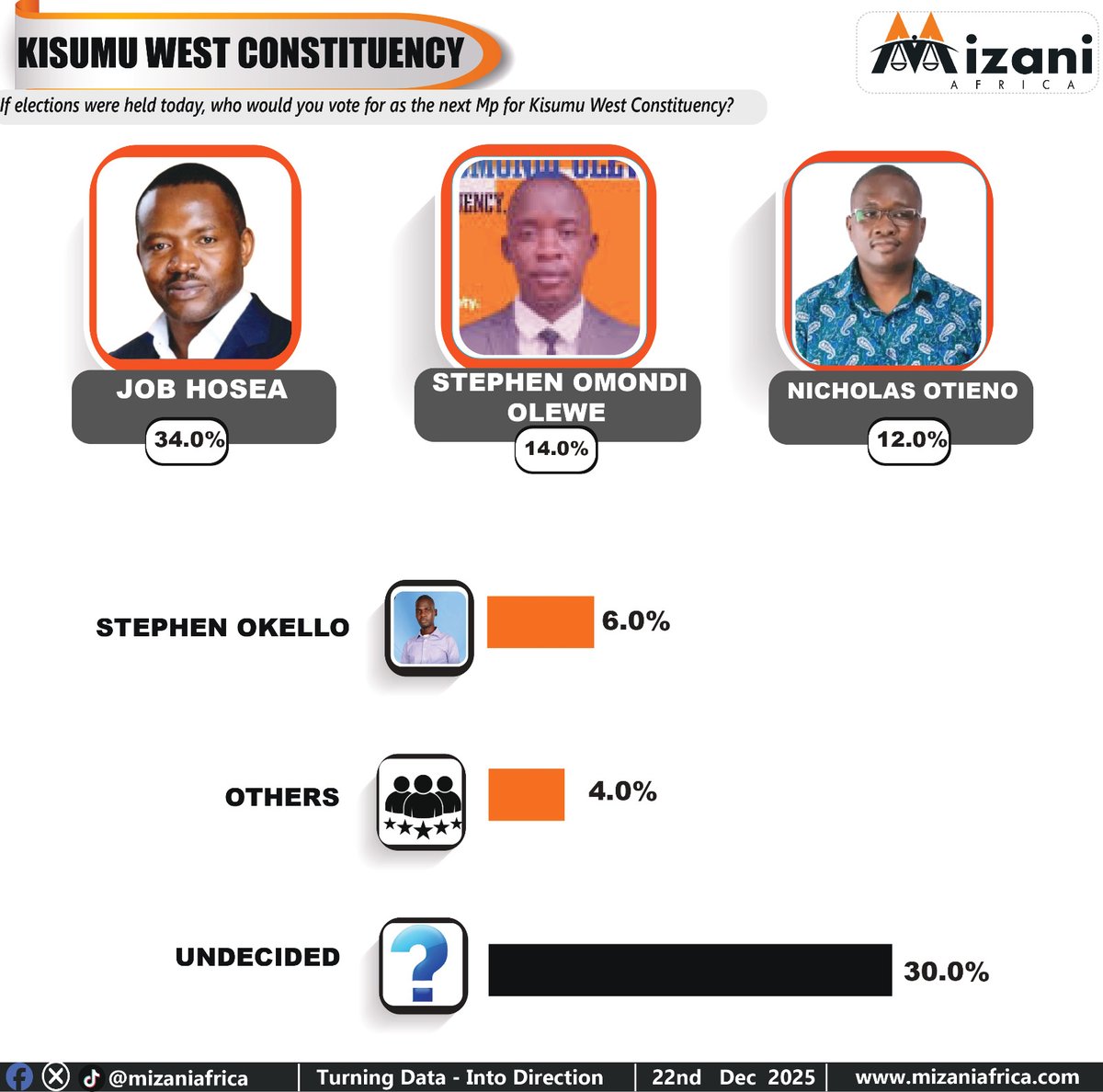
The parliamentary contest in Kisumu West Constituency is emerging as an open and competitive race, with Job Hosea currently leading at 34.0%, giving him an early advantage but not a decisive lock on the seat. He is followed by Stephen Omondi Olewe at 14.0% and Nicholas Otieno at 12.0%, indicating a fragmented field behind the front-runner. The presence of a sizeable 30.0% undecided bloc underscores a constituency still actively weighing its options, suggesting significant room for movement as engagement deepens. With other candidates trailing at single-digit levels, the data points to a race that is yet to fully consolidate, where voter persuasion, turnout dynamics, and campaign momentum are likely to play a decisive role in shaping the final outcome.
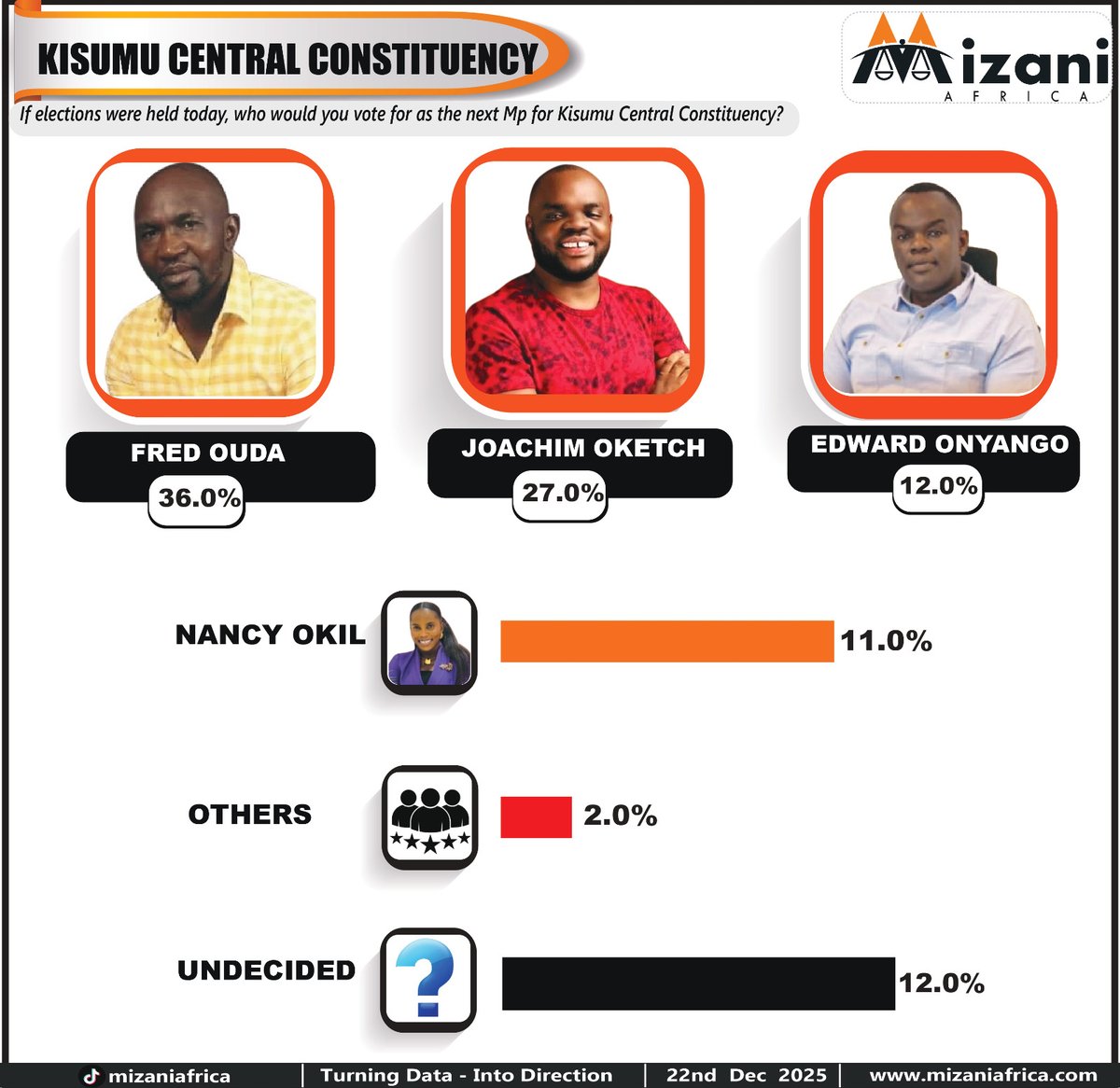
Kisumu Central Constituency’s parliamentary contest is beginning to crystallize around two leading figures, with Fred Ouda setting the pace at 36.0% while Joachim Oketch follows at 27.0%. The gap between the two suggests a race that is competitive rather than settled, with voters appearing divided between alternative leadership profiles rather than coalescing around a single dominant choice.
Beyond the leading pair, support fragments across a second tier that includes Edward Onyango (12.0%) and Nancy Okil (11.0%), underscoring a constituency still exploring its options. With an additional 12.0% of respondents yet to commit, the landscape remains open, indicating that persuasion, visibility, and ground engagement are likely to play a decisive role in shaping the final alignment of voters as the contest matures.
Nyando Constituency’s parliamentary race is consolidating around two principal contenders, with the incumbent Jared Okello establishing a clear lead at 47.3% while Ken Ouma Ooko follows at 32.9%. The margin between the top two reflects a competitive but structured contest, where voter sentiment appears to be coalescing around distinct leadership choices rather than a fragmented field. Further down, Thomas Ogendo registers 10.8%, indicating a secondary tier of support, while 8.9% remain undecided, suggesting limited but meaningful room for late movement. Overall, the data points to a race led by a strong front-runner, yet one where engagement and turnout among remaining voters could still influence the final balance between the top contenders.
Kisumu East Constituency’s parliamentary contest is beginning to take a defined shape, with Shakeel Shabbir leading the field at 38.8%, establishing a clear advantage at this stage of the race. He is followed by Seth Kanga at 18.8% and Kelvin Oraro at 14.8%, forming a competitive second tier that reflects an electorate still weighing multiple leadership options. Support further fragments among the remaining contenders, while 13.7% of voters remain undecided, underscoring a constituency that has not yet fully consolidated around a single alternative. Overall, the results point to a race led by a strong front-runner, but one that remains open to shifts as engagement, persuasion, and turnout dynamics continue to evolve.
The Kisumu County Women Representative race is emerging with a clearly defined front-runner, as Ruth Odinga records 44.9% support, placing her well ahead of the rest of the field. Her strong showing suggests broad countywide recognition and consolidating support, positioning her as the dominant figure at this stage of the contest.
She is followed at a distance by Emma Atieno at 12.2%, while Beatrice Amondi (9.8%) and Valentine Anyango (8.0%) form a competitive middle tier. The presence of a sizeable 17.0% undecided segment indicates that voter alignment is still in progress, but the current distribution highlights a race with a clear leader and a fragmented field behind her. As engagement deepens, the ability of trailing candidates to consolidate support will be critical in reshaping the competitive dynamics.
The Kisumu County senatorial race is emerging as a highly open and competitive contest, with no single candidate yet commanding a decisive majority. Samuel Odoro leads the field at 21.2%, followed closely by Fredrick Odumo at 18.6% and Gilbert Amollo at 12.5%, reflecting a fragmented top tier and an electorate still actively weighing its options.
Beyond the leading trio, support spreads across a second tier that includes Brian Opar (7.7%) and Elvis Omollo (5.5%), while a sizeable 33.9% of respondents remain undecided, underscoring the fluid nature of the race. Overall, the distribution points to a contest that is far from settled, where visibility, issue positioning, and voter engagement will be critical in shaping how the large undecided bloc ultimately aligns as the senatorial contest takes clearer form.