This amazing song showing the contrast between YHWH 🔥 and JESUS 🫂 is now on YouTube, Rumble, BitChute, and Odysee! Links in bio.
The more people see the truth about YHWH, the better, and I hope this helps.
In the Greek text of the Gospel, Jesus’ name is Iēsous — not Yeshua, and certainly not YHWH.
The attached image from Strong’s Concordance (entry 3442) shows that the name Yeshua simply means “he will save.” It does not contain or mean “Yahweh saves.”
Some people point to the longer Old Testament name Yehoshua (Joshua), which does mean “Yahweh saves.” However, by the time of Jesus, the name had been shortened to Yeshua. The divine name element had already dropped out. The Greek Gospels reflect this later, shortened form — not the older Yehoshua.
This matters because Jesus did not come to serve or represent YHWH. He came to reveal a previously unknown Good Father whose character stands in direct opposition to the jealous, wrathful, and violent God of the Hebrew Scriptures.
As Jesus taught: judge the tree by its fruit.
YHWH’s fruit is wrath, jealousy, and death.
The Father Jesus reveals produces mercy, healing, and life.
The name doesn’t override the fruit.
The Robert → Bob analogy doesn’t work. As I’ve said before, the divine name element was deliberately dropped when the name was shortened to Yeshua. It no longer meant “Yahweh saves.”
Jesus told us to judge by the fruit, not a name. YHWH’s fruit is wrath and death. The Father he reveals produces mercy and life.
In the earliest Gospel, Jesus reveals a previously unknown Father. He does not identify the God of Israel as his own. Many of the verses you appeal to were added or expanded later to create the appearance of continuity with YHWH.
The name doesn’t override the fruit.
I’m not ignoring the evidence — I’m going by the earliest sources.
The verses you listed are either absent or significantly altered in Marcion’s Evangelion (the first NT):
John 5:46–47 is not in the first Gospel at all. John is completely absent from Marcion’s canon.
Matthew 5:17–20 is also not present in Marcion’s Evangelion.
Luke 16:27–31 is present, but in context it actually supports the point that the Law and the Prophets are insufficient on their own.
In the earliest Gospel, Jesus does not say he came to fulfil the Law and the Prophets as one seamless story. Instead, he reveals a Father who was previously unknown to the world — one whose character stands in clear contrast to the jealous and wrathful God of the Hebrew Scriptures.
Calling this “Gnostic” is just a lazy label. The contrast between YHWH and the Good Father is already present in the first Christian sources, long before later Gnostic systems developed.
YHWH sent an evil spirit to torment Saul:
“Now the Spirit of YHWH departed from Saul, and a harmful spirit from YHWH tormented him.” (1 Samuel 16:14)
In the Gospel, when Jesus encounters a man tormented by many unclean spirits, He commands the spirits to leave — and the man is restored to his right mind (Evangelion, cf. Luke 8:29, 35).
YHWH afflicts people with evil spirits.
The Good Father sets them free.
The text is clear.
1 Samuel 16:14 says “a harmful spirit from YHWH tormented him.” It doesn’t say God “allowed” a spirit or that Saul was already under demonic influence. It says the spirit came from YHWH.
Your attempt to blame Saul for not killing everyone, and then link him to giant bloodlines and necromancy, is speculative and doesn’t change what the verse actually states. This is just another example of reinterpreting the plain text to protect YHWH’s character.
YHWH sent the evil spirit.
Jesus cast them out.
Those are two very different actions.
Those verses are not in the first NT.
In Marcion’s Evangelion, the strong claims found in the later canonical Luke 24 are significantly reduced or absent:
Luke 24:27 — The detailed explanation that Jesus “expounded in all the scriptures the things concerning himself” from Moses and all the prophets is not present.
Luke 24:44 — The strong assertion that “all things must be fulfilled which were written in the Law of Moses, the Prophets, and the Psalms” concerning him is also missing. Only a shorter statement about his suffering, rising on the third day, and the preaching of repentance remains.
Additionally, the Gospel of John is completely absent from Marcion’s canon. The strong statements in John 5:39–40 and 5:46 — claiming that the Scriptures testify of him and that Moses wrote about him — were added later.
This pattern is consistent across the earliest sources.
Jesus reveals something new, rather than simply fulfilling or continuing the old scriptures as one seamless story. The later church expanded and strengthened these passages to create the impression of complete continuity between Jesus and the God of Israel. The first NT does not present it that way.
A lot of Christians struggle with the plain meaning of the Hebrew text.
It doesn’t present YHWH as the abstract, all-loving, all-powerful “omni-God” of later theology. It presents him as one powerful member of the Elohim — a category of non-human beings — whose actions often include extreme wrath, jealousy, revenge, and regret.
At the same time, many non-Christians dismiss Jesus as “Jewish controlled opposition.”
But the first NT tells a different story. Jesus did not come to affirm or serve the god of Israel. He came to reveal a previously unknown Good Father — one whose character and ways stand in direct contrast to YHWH.
Attacks are coming from both sides of the aisle.
The earliest Gospel refuses to fit either narrative.
That verse is from the Gospel of John, which is not part of the first NT. In Marcion’s Evangelion, Jesus never affirms that “salvation is from the Jews” or identifies the God of Israel as his Father. Instead, he reveals a Father who was previously unknown to the world.
The later church expanded texts like John, Acts, and the Pastorals to create the impression of seamless continuity between Jesus and YHWH. We are not 'throwing the baby out with the bathwater' — textual evidence shows the canon was significantly expanded and harmonised in direct response to the first NT. We therefore use the earliest sources as our guiding light.
Jesus was clear that we only know the true Father through him. YHWH, by contrast, was already loud and well known through the Law and the prophets.
The shortening from Yehoshua to Yeshua is not meaningless. The divine name element (“Yah”) was deliberately dropped in common usage by the 1st century. “Yeshua” simply meant “he will save” or “salvation.” It no longer carried the explicit meaning “Yahweh saves.”
More importantly, Jesus told us to judge by the fruit — not by a name. YHWH’s fruit is jealousy, wrath, curses, and death. The Father Jesus reveals produces mercy, healing, and life. These are not the same.
You also appeal to Revelation, but that book is not part of the first NT. In the earliest Gospel, Jesus never says the God of Israel is his Father, nor does he claim to be YHWH. He reveals a previously unknown Good Father whose character stands in direct contrast to the God of the Hebrew Scriptures.
The name doesn’t override the fruit.
Exactly.
While the Greek word hairesis originally meant “choice” or a philosophical school, by the time the Church Fathers like Irenaeus were writing in the late 2nd century, “heresy” carried a strongly negative meaning. It wasn’t just a neutral label for “different opinion” though — it was used as a deliberate attack to portray rival groups as dangerous, corrupt, and outside "the true faith".
The “Church Fathers” who trash Marcion weren’t neutral historians — they were later polemicists writing decades (sometimes over a century) after the earliest sources.
Irenaeus, Tertullian, Epiphanius and the rest had their own agendas such as building institutional power, defining orthodoxy, and smearing rivals. Their accounts of Marcion are full of distortion, exaggeration and outright invention.
Many of these same Fathers had serious issues themselves — theological backflips, poor historical accuracy, and in some cases their own later “heresies.”
If you actually want to understand early Christianity, stop treating the victors’ propaganda as reliable history. Go back to the earliest Gospel layer we can reconstruct. The picture looks very different.
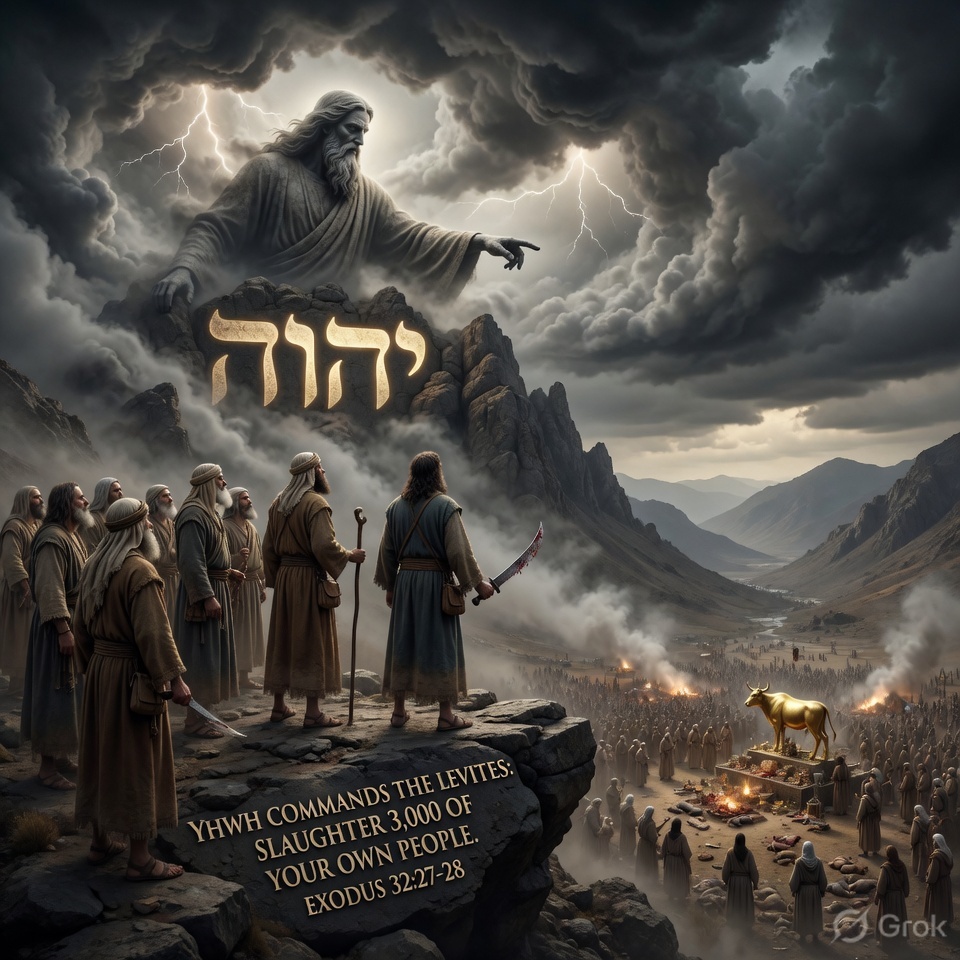
YHWH commands the Levites to slaughter 3,000 of their own people after the Golden Calf incident (Exodus 32:27–28).
In the Gospel, when a Samaritan village rejects Jesus and his disciples, James and John want to call down fire on them. Jesus sharply rebukes them and simply moves on (Evangelion; cf. Luke 9:54–55).
YHWH demands the killing of his own people for idolatry. The Good Father does not retaliate with violence when rejected.
Marcion believed Jesus had a real, physical body — he ate, drank, suffered, died, and rose again. However, his Gospel does not include a birth narrative.
In Marcion’s Evangelion, Jesus appears as a fully grown adult when he descends into Capernaum. The text begins directly with:
“In the fifteenth year of Tiberius Caesar, Pontius Pilate being governor of Judea, Jesus descended into Capernaum, a city in Galilee.” (Evangelion 1:1)
According to early Marcionite tradition, this descent occurred on 24 November 29 AD during a total solar eclipse visible over the Sea of Galilee and Capernaum.
There are two main views on what Marcion actually believed:
1. Traditional view: Marcion taught that Jesus descended from heaven as a fully grown adult with a real but heavenly body — he was not born through a woman.
2. Scholarly view (e.g. M. David Litwa): Marcion likely accepted that Jesus was born as a real human being, but simply did not consider the birth story theologically important, so he omitted it (similar to how the Gospel of Mark begins with Jesus as an adult).
So to answer your question directly: It’s not entirely settled, but Marcion’s Gospel clearly presents Jesus appearing suddenly as an adult rather than through a birth narrative.
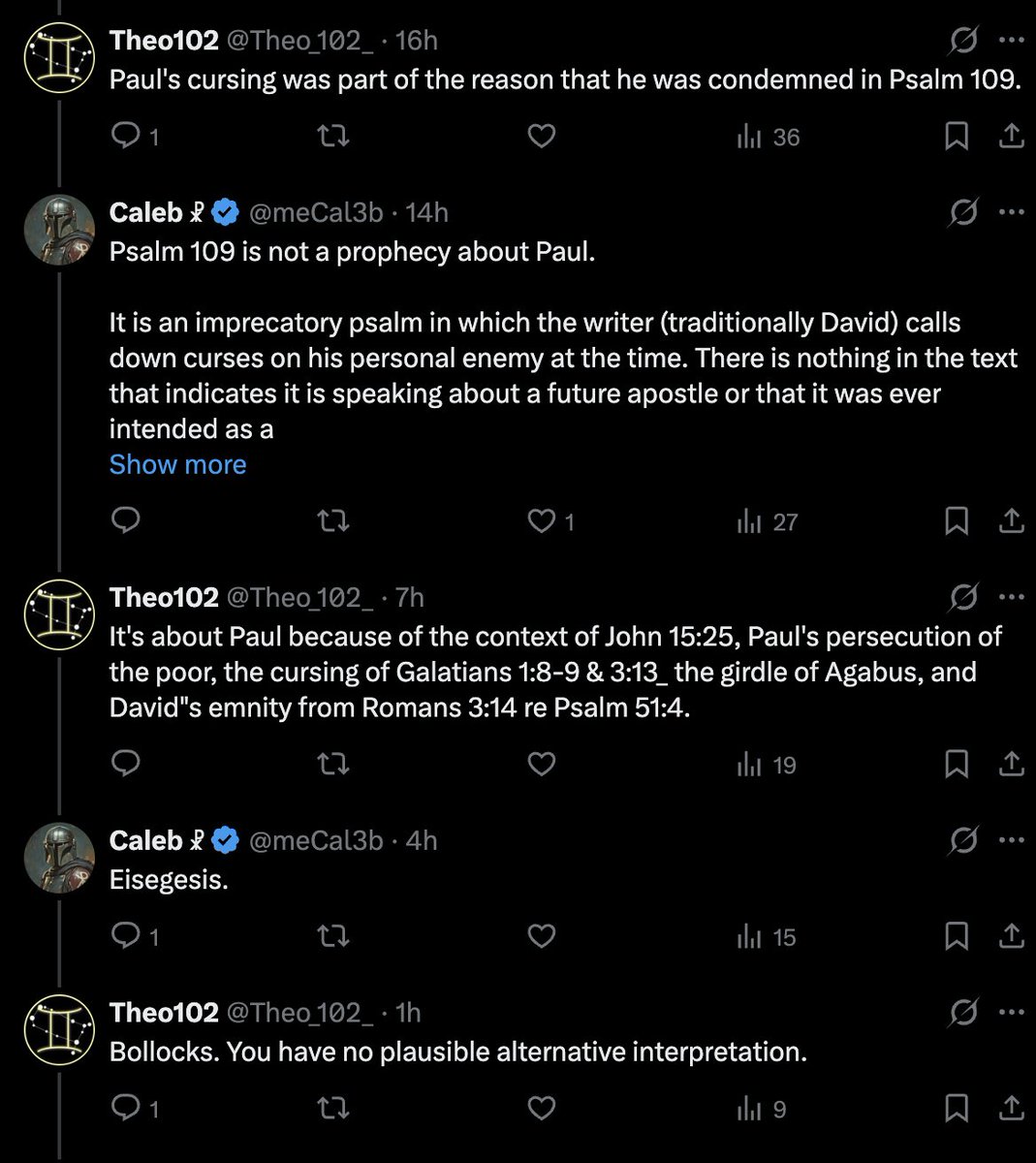
You’re rewriting what you said.
You originally claimed Psalm 109 was about Paul — not just “related to Jesus.” I have the screenshots. Now that you’ve been called out, you’re trying to walk it back by saying it’s only “related to Jesus.”
That’s not a clarification.
That’s moving the goalposts.
OR are you a liar?
Another Christian declaring I'm cursed while simultaneously claiming 'God [YHWH] is indeed good.'
My friend, what did Jesus say about curses?
Follow Jesus, not the wrathful, cursing YHWH.
No, Caleb.
You preach a different, perverted gospel and accursed for it.
This is the word of the gospel that the apostle Paul received and delivered.
I Corinthians 15:1-4
Moreover, brethren, I declare to you 👉 the gospel which I preached to you, which also you received and in which you stand, by which also you are saved, if you hold fast that word which I preached to you—unless you believed in vain.
For I delivered to you first of all that which I also received:
👉 that Christ died for our sins according to the Scriptures, and that He was buried, and that He rose again the third day according to the Scriptures,
God is indeed good.
You; however, are not good and have sinned against God who is holy, holy, holy.
You need to repent and believe on the Lord Jesus Christ and His gospel to be forgiven, justified, and reconciled to God who is holy, holy, holy.
You’ve changed your story.
First you said Psalm 109 was about Paul. Now you’re saying it’s about Jesus via John 15:25. Which is it?
Even your new claim doesn’t hold up. John 15:25 is quoting a general principle from the Psalms (“They hated me without a cause”), not identifying Psalm 109 as a prophecy about Jesus. Psalm 109 itself is an imprecatory psalm where the writer calls down curses on his personal enemy at the time — not a prophecy about a future messiah or apostle.
You keep shifting the target instead of dealing with what the text actually says.
Marcion believed Jesus had a real, physical body — he ate, drank, suffered, died, and rose again. However, his Gospel does not include a birth narrative.
In Marcion’s Evangelion, Jesus appears as a fully grown adult when he descends into Capernaum. The text begins directly with:
“In the fifteenth year of Tiberius Caesar, Pontius Pilate being governor of Judea, Jesus descended into Capernaum, a city in Galilee.” (Evangelion 1:1)
According to early Marcionite tradition, this descent occurred on 24 November 29 AD during a total solar eclipse visible over the Sea of Galilee and Capernaum.
There are two main views on what Marcion actually believed:
1. Traditional view: Marcion taught that Jesus descended from heaven as a fully grown adult with a real but heavenly body — he was not born through a woman.
2. Scholarly view (e.g. M. David Litwa): Marcion likely accepted that Jesus was born as a real human being, but simply did not consider the birth story theologically important, so he omitted it (similar to how the Gospel of Mark begins with Jesus as an adult).
So to answer your question directly: It’s not entirely settled, but Marcion’s Gospel clearly presents Jesus appearing suddenly as an adult rather than through a birth narrative.
This Christian just told me:
“The NT is not the core — the OT is. The NT only repeats it. I could teach the gospel without the NT at all, because the Tanakh is clear.”
We’ve been saying it for a while now — some Christians genuinely believe YHWH is more important than Jesus.
Here’s the proof, in their own words.
Whichever NT you have decided has authority, the Tanakh is all that is needed to reveal the lie, Caleb.
You seem to not realize, the NT is not the core of the message—the OT is. The NT only repeats it.
And you likely don’t have a full grasp because the Marcion’s Apostolikon is missing several letters of Paul.
Which, I’m not sure how missing information helps you understand more.
And “unknown Good Father” misses the actual reality of the OT - He is known. We all know Him. I could teach the gospel without the NT at all. Because the Tanakh is clear.
You’re doing eisegesis by stitching together unrelated verses and events to force Psalm 109 to be about Paul.
Psalm 109 is an imprecatory psalm where the writer calls down curses on his personal enemy at the time. Nothing in the text suggests it’s a prophecy about a future apostle. The Bible never connects this psalm to Paul, nor does it present his words in Galatians as the kind of cursing described here.
The burden is on you to show where the text itself indicates it’s about Paul — not on me to disprove your forced connections. “You have no alternative” isn’t an argument when the plain reading already makes sense without turning it into prophecy about Paul.
Thanks Rachel, I really appreciate the respectful tone. I feel the same — I’d much rather keep things cordial even when we see things differently.
Just to clarify: when I refer to the earliest Gospel, I’m not talking about canonical Mark. I’m referring to Marcion’s Evangelion (the Gospel of the Lord), which a growing number of scholars argue preserves an earlier form than the version of Luke we have in the New Testament today.
If you’re ever interested in looking into it, Jason BeDuhn’s The First New Testament remains one of the most detailed scholarly reconstructions available. M. David Litwa has also done excellent recent work on Marcion, and his new book Marcion’s Bible (2026) brings together fresh reconstructions of the Antitheses, Gospel, and Apostolos in one volume. Happy to point you toward either if you’d like to check them out.
Appreciate you being decent about it.
The passage you highlighted actually works against your point.
In Exodus 6:2–3, “God” explicitly tells Moses:
“I appeared to Abraham, to Isaac, and to Jacob, as God Almighty [El Shaddai], but by My name LORD [YHWH] I was not known to them.”
This shows that the patriarchs did not know “God” as YHWH. They knew Him as El Shaddai. The name YHWH and its associated character were revealed later — and differently — than what the earlier patriarchs knew.
This same pattern of control and contradiction appears in Numbers 21. YHWH sent venomous snakes to kill the Israelites for complaining. He then commanded Moses to make a bronze serpent and put it on a pole, telling the people that anyone who looked at it would be healed. This directly broke His own later commandment against making images (Exodus 20:4-5). In effect, He forced the people to look at the very thing that was killing them in order to be saved.
Interestingly, this same pattern of later tradition changing meaning appears with Jesus’ execution. The earliest sources describe him being put on a stake (stauros), not a cross with a crossbeam. The familiar “cross” image only developed later in church tradition.
These kinds of later developments show how meanings and images were progressively shaped over time. The idea that “everything is for Christ” doesn’t erase the clear textual distinctions and contradictions in the Hebrew Scriptures.
This is a very common view, but it’s not what the earliest Gospel and Paul actually say.
In the first NT (the Evangelion), Jesus does not present the Hebrew Scriptures as preparing the way for him or containing the full message about him. The strong claims in Luke 24 — that everything in Moses, the Prophets, and the Psalms must be fulfilled in him, and that he opened their understanding of the scriptures — are significantly reduced or absent.
Paul in the letters preserved in Marcion’s canon quotes the Hebrew Scriptures, but he uses them to argue that the Law belongs to the old order now being set aside through the revelation of the unknown Good Father. Salvation comes through the Gospel, not through the Law and the Prophets.
The idea that the entire Old Testament was always pointing to Christ, and that Judaism simply “failed to understand” it, is a later theological construction. It was developed after the earliest layer to create the impression of seamless continuity between the god of Israel and the Father Jesus revealed.
The first NT shows contrast, not preparation.
Thanks for the good-faith question.
The verses you mentioned from Acts (24:14, 26:22, 28:23) and 2 Timothy 3:16-17 are not in Marcion’s first NT. Acts is completely absent from his canon, and the Pastoral Epistles (1–2 Timothy, Titus) are also missing from the Apostolicon.
In the actual letters preserved in the first NT (Galatians, Romans, 1–2 Corinthians, etc.), Paul does quote the Hebrew Scriptures — but he consistently uses them to argue that the Law belongs to the old order now being set aside. Salvation comes through the revelation of the unknown Good Father and justification by faith, not through the Law and the Prophets.
In the earliest Gospel (the Evangelion), Jesus does not say the Hebrew Scriptures fully reveal him or contain the message of salvation. The strong canonical claims in Luke 24 (that everything in Moses, the Prophets, and the Psalms must be fulfilled in him, and that he “opened their understanding” of the scriptures) are significantly reduced or absent in the first NT versions.
The later church expanded these passages and added Acts + the Pastorals to create the impression of seamless continuity between the Old Testament and the Gospel. That harmonised view is not present in the earliest layer.