Why we emotionally eat
Every decision we make is always the thing we want most in that moment—every time. Now, I bet you're immediately trying to think of exceptions like, "I really want to drive 120mph." But let me ask, why don't you then? The answer is that a superior desire, namely, not to wreck your car or get a ticket, has risen above your desire to drive 120mph. Now, let's say your best friend was grievously injured and you were rushing them to the hospital to fight for their life. In that case, the desire to get them help would override the desire to not get a ticket, and you would happily break the speed limit. So you see, humans are wired to always choose the thing they want most in the moment. This means that when a moment of temptation arises, sheer willpower will only take you so far. You need to have a superior desire. You need to have a desire in you that is strong enough to resist the temptation of immediate pleasure for long-term pleasure. We can apply this to pretty much anything that requires delayed gratification, but let's apply this to food.
If I am constantly tempted to eat junk food, I might try to stop because I know it's bad for me. I might have full intellectual assent to the fact that I should care for my body and that if I don't, likely some terrible but preventable diseases are coming for me in old age; yet knowledge and fear only seem to take us so far. We need something more. We need a superior desire that rises up to help us make the right choice.
Okay, if you're tracking with me so far, you might be agreeing, but now you're wondering, where do I get this superior desire? How do I just want something else when in this moment what I want is this junk food? It's a great question, and I'm going to give you an answer, but be prepared to do some soul searching and serious reflection. The process might be pretty tough. It might trigger some unexpected emotions, but that's okay.
The superior desire comes from knowing your purpose and your mission in life. If you have a vision of the person you want to be—physically, emotionally, spiritually, financially, etc.—you can work backward from that and ask yourself if the habits you're employing today are serving you in working toward your positive vision of who you want to be. Here's a challenge for you: take time this week to write out your own obituary. What do you want to be known for? How do you want to be remembered? This is hard. It's okay if the room gets a little dusty and the paper gets a little wet. It's important to reflect and be sobered by the brevity of life so we will use our days wisely.
Once you've done that, now I want you to write a 20-year plan. Where do you want to be in 20 years? I suggest you consider family, faith, finances, and fitness. The key here is to write this in the present tense. Let me show you using myself as an example for fitness:
"It's 2045, I am 58 years old. Elyana is 32, Haddon is 30, and Gresham is 28. My youngest son has always wanted to be like me, and he is built like a tank. He got his height from his mother's side. He stands at 6'3" and weighs 280lb. I made the mistake of getting him into weight training and jiu-jitsu at just 5 years old, so he has 25 years of martial arts and strength training under his belt. He always said he would submit me in grappling when he was a teenager, and he got me when he was 16. It's been 14 years of that boy bragging that he can beat his old man, but of course I still bench more than he does because I need some kind of victory. All my kids are fit. My wife and I train together 3-4 days a week. I don't go super heavy anymore. I left the ego lifting behind a while ago. Now we train to keep up with our 7 grandkids who have an endless supply of energy and want nonstop piggyback rides. I'm thankful for the decade I spent running under 700lb yokes and carrying around 300lb farmers handles. It prepared me for this. I am certainly no spring chicken. My knees creak when I stand up and I'm slower than I used to be, but I'm in good shape. I stay active, eat well, and enjoy the pleasures of cigars and whiskey only occasionally. I've managed to keep the preventable diseases common to Americans at bay. I'm not immortal. My time is coming, but I'm thankful so far to be able to have dignity and independence as I approach the home stretch. I'm thankful I invested in my physical portfolio, not just my financial one. So many of my friends are rich on paper but are trapped, imprisoned in their own bodies because they never took care of themselves. I intend to train my body and beat old age back as long as I can. As old age overtakes me in the next 30 years, I want to be a blessing to my family, not a burden, which means it's time to stop writing and lace up my shoes for my daily three-mile walk."
You can do this for all areas of your life, but the power of this is now I have a positive vision for my future. I know who I want to be and I can work backward from that and ask myself if my indulgence now will lead to that end result. Don't get me wrong, willpower is still needed, and I still give in from time to time, but having a positive vision of who you want to be makes it easier to say no. If you don't have a positive vision for who you want to be, then all you ever want in the moment is to just feel good, and you will get dopamine from wherever you can, including food.
My challenge to you is to create a positive vision of who you want to be in the future. The food isn't the issue, it's your identity. If you can figure out who you are, why you're here, and create a positive vision of the person you want to be, you actually stand a chance of cultivating the superior desires needed to win in moments of temptation with things that don't align with your vision.
Testosterone levels in men have fallen over 33% in the last 50 years. This is a huge problem.
Low testosterone is linked to infertility, depression, obesity, poor muscle mass, fatigue, and early aging and poor heart health.
If men want to stay strong, capable, and healthy as they age, testosterone matters.
Here’s another wellness trend that is just marketing with little actionable data that could actually do more harm. The results aren’t anywhere close to accurate for lipids or hormones and could give you false confidence or not alert you to an issue.
Trust me, when the technology catches up, I’ll be the first to use it as it would make blood draws a million times more convenient, but for now it’s not there.
Go to a lab. This is the most accurate reading.
”So God created man in his own image, in the image of God he created him; male and female he created them. And God saw everything that he had made, and behold, it was very good.”
Genesis 1:27, 31
In the beginning, God made a body.
That sentence is simple enough to skim past, but do not let its simplicity fool you. It is one of the most theologically loaded statements in all of Scripture. The God of the universe, who existed in perfect relational fullness before anything else existed, chose to create a physical world. And when He arrived at the pinnacle of that creation, He did not make a pure spirit. He made a man. A creature of muscle and bone, breath and blood, sinew and nerve. He made a creature who would get hungry and thirsty, who would sweat when he worked and sleep when he was tired. God made a body.
And then God looked at what he had made and called it very good.
He didn’t call it just okay. He didn’t call it serviceable. It was not just a necessary part of material reality. It was very good. The body was not plan B. It was not a cage for the soul to be endured until the real life of the spirit could finally begin. It was the deliberate, intentional, celebrated handiwork of a God who does exactly nothing by accident.
If you are going to build a coherent theology of fitness, this is where it has to start—not with Flex Magazine or workout programming or macros. It starts here, in the dirt of Genesis 2, where God forms a man from the dust of the ground and breathes life into his nostrils. Before there is sin, before there is redemption, before there is anything else, there is a God who made a body and called it good.
”So God created man in his own image, in the image of God he created him; male and female he created them. And God saw everything that he had made, and behold, it was very good.”
Genesis 1:27, 31
In the beginning, God made a body.
That sentence is simple enough to skim past, but do not let its simplicity fool you. It is one of the most theologically loaded statements in all of Scripture. The God of the universe, who existed in perfect relational fullness before anything else existed, chose to create a physical world. And when He arrived at the pinnacle of that creation, He did not make a pure spirit. He made a man. A creature of muscle and bone, breath and blood, sinew and nerve. He made a creature who would get hungry and thirsty, who would sweat when he worked and sleep when he was tired. God made a body.
And then God looked at what he had made and called it very good.
He didn’t call it just okay. He didn’t call it serviceable. It was not just a necessary part of material reality. It was very good. The body was not plan B. It was not a cage for the soul to be endured until the real life of the spirit could finally begin. It was the deliberate, intentional, celebrated handiwork of a God who does exactly nothing by accident.
If you are going to build a coherent theology of fitness, this is where it has to start—not with Flex Magazine or workout programming or macros. It starts here, in the dirt of Genesis 2, where God forms a man from the dust of the ground and breathes life into his nostrils. Before there is sin, before there is redemption, before there is anything else, there is a God who made a body and called it good.
Well this just made my day! Not every day running and growing a business is sunshine and rainbows and the last two days have been a slog. This text lit a fire under me for why I do what I do.
Real Christianity requires wisdom, courage, and humility: Judge rightly. Examine yourself first. Extend grace where appropriate. But never abandon truth.
Stop letting people misuse Matthew 7:1 as a shield for sin. The Bible doesn’t call us to be blind. It calls us to be holy and to help others walk in holiness too.
The Most Misused Verse in the Bible
“Judge not, that you be not judged.” (Matthew 7:1)
You’ve heard it a thousand times. Someone calls out sin, evil, or foolishness and immediately the response comes: “Don’t judge!” or “The Bible says judge not!”
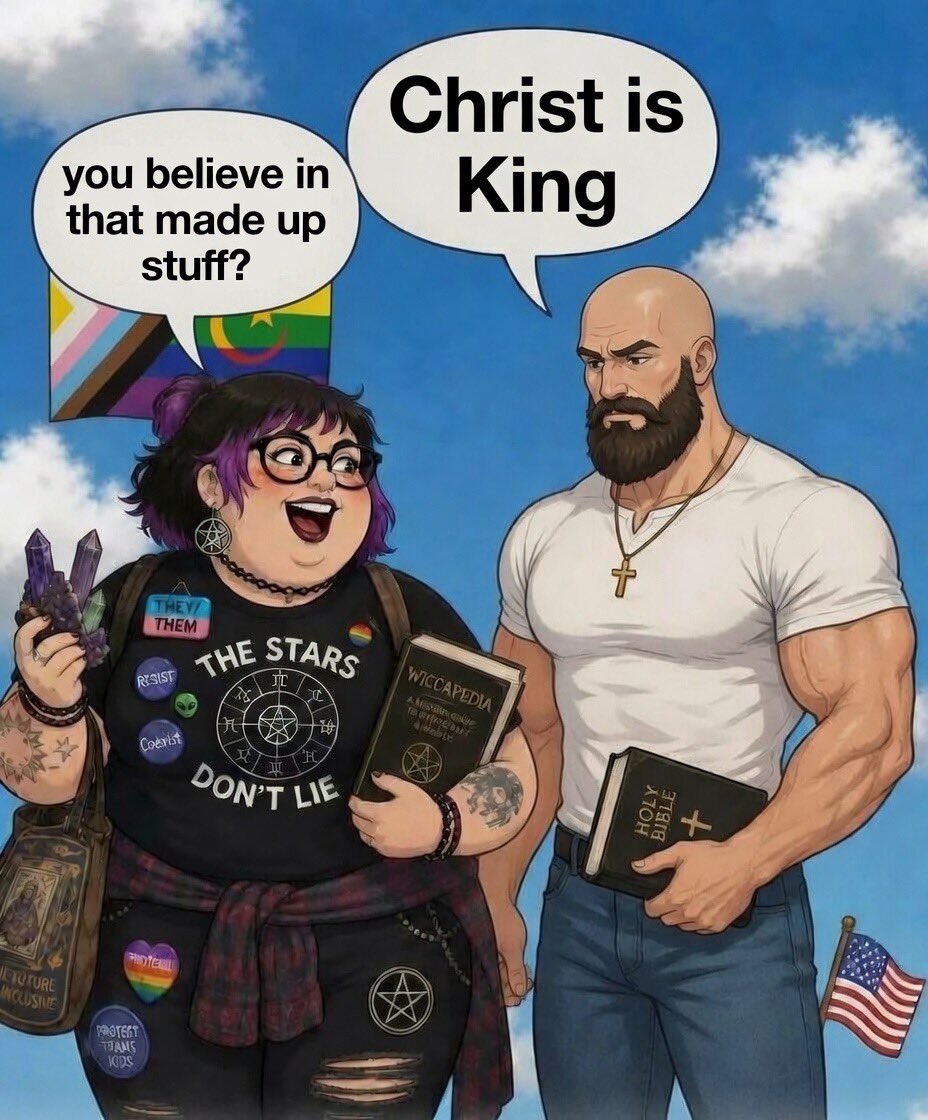
Christians of all people must be truth tellers, which is one reason I will never use preferred pronouns. I will not lie to appease someone else’s delusion.
They may retort that it’s not kind, but what isn’t kind is expecting someone else to compromise their morals for your feelings.
Yes, we Christians are so deluded into healthy families, not being on a cocktail of meds, having kids who don’t question which bathroom to use or if they identify as a cat this week. We also tend to not kill our babies, we also contribute to charity and adoption at a much higher rate.
Really, everything good about western civilization is because of Christian values.
Want to uncover why your periods feel off and your PMS is brutal?
Take my free Hormone Assessment (link in bio) It walks you through key symptoms and gives you personalized insights on where to start.
Your cycle doesn’t have to be this hard. Let’s get to the root.
Ladies,
PMS is not normal.
Your period shouldn’t come with rage, debilitating cramps, bloating, acne, anxiety, or emotional breakdowns every single month.
Generations of women have been told to just suck it up and take ibuprofen. Meanwhile, the root causes go unaddressed.
When you fix the underlying issues (real food, stress management, adequate micronutrients, gut health), many women see PMS symptoms dramatically reduce or disappear entirely.