The Only DevOps Platform which supports Stateless IaC and Real-time pricing. Unified platform for IaC, FinOps and Developer portal. Created by @twtshailendra
Hey DevOps Engineers and Cloud Architects,
Did you know you can see exactly which Amazon Web Services (AWS) resource and which dimension of that resource such as storage, IOPS, throughput or hours contributed to your Jan 2026 bill?
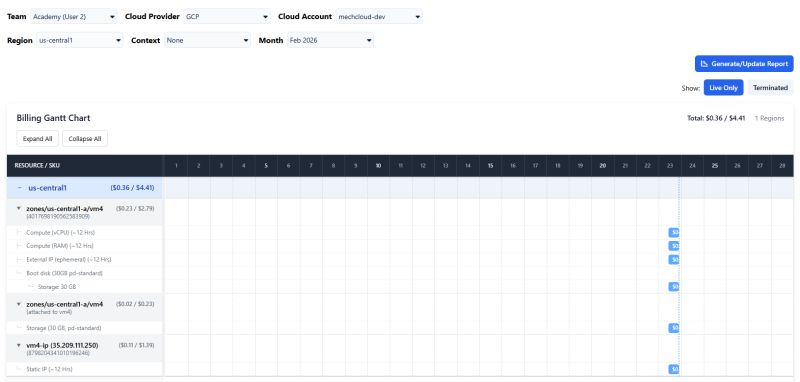
With MechCloud Cost Explorer, cloud cost is not an aggregated number or a finance-only summary. It becomes a resource-level and time-based breakdown visualized on a Gantt chart.
What this gives you:
👉 Identify which specific resources drove your Jan 2026 spend
👉 See which dimensions of each resource contributed to cost
👉 Visualize when each cost component was active during the month
👉 Validate the bill by tracing every dollar back to infrastructure
Traditional cost tools show totals.
FinOps tools group categories.
Terraform shows resources.
MechCloud connects resources, dimensions, time and cost in one view.
If you want cloud cost that is explainable, auditable and engineer-readable, this changes the conversation.
Watch the video and rethink how you analyze cloud cost.
Start here - https://t.co/w6bEHIMAig
#DevOps #CloudArchitecture #AWSCost #FinOps #InfrastructurePlanning #MechCloud
At this moment if you are storing any kind of credentials on your local machine then you are just waiting to be the next target of such attacks.
This is one of the reasons why MechCloud does NOT allow storing any credentials on its platform and we are the only DevOps platform to enforce this.
It is not clear why nodejs based projects continue to use .env file to store credentials. This needs to be eliminated at the earliest to protect developers from being victims of such attacks.
⚠️ WARNING - A Trivy-linked supply chain attack has escalated into a self-propagating npm worm now spreading across dozens of packages.
It steals npm tokens, republishes itself, and spreads through developer machines and CI. Uses an ICP canister to rotate payloads and resist takedowns.
🔗 How the worm spreads and updates payloads → https://t.co/xpWmy3txdS
👉 Most @awscloud bills grow because of forgotten resources, not big architecture mistakes.
Unattached EBS volumes
Idle Elastic IPs
Test infrastructure nobody cleaned up
These small leaks silently inflate your cloud bill.
Learn how to find and eliminate AWS cloud wastage 👇
https://t.co/jaXks9CJIZ
#AWS #DevOps #FinOps #CloudCost #InfrastructureAsCode
@mech_cloud now supports discovery for all three major public clouds (Amazon Web Services (AWS), Microsoft Azure and Google Cloud) 📷
Demos are up on our youtube channel for AWS and GCP. Demo for Azure will be available shortly but Discover assets being a unified UI works in the same way across all the three cloud providers.
While an architecture diagram gives you 10k view of the infrastructure for an application, MechCloud discover assets feature shows what resources you are running, where you are running these and the hierarchy of the resources.
Discover assets gives you everything on a single pane of glass which is must to troubleshoot production issues like VPN connectivity between a k8s cluster running on AWS and services running in a private cloud. No more 'We don't have architecture diagrams' excuses and no need of relying on architecture diagrams solely to troubleshoot production issues.
But it does not stop there. You can see the cloud wastage (see demo link in the comments) and clean up orphan resources with one click which is one of the biggest advantages of this feature. Also you can start/stop/reboot all the discovered VMs etc with one click too.
Announcing @googlecloud support in MechCloud 🚀
💡 MechCloud operates your GCP account(s) without storing any credentials. It uses Workload Identity Federation so there are no keys to manage or rotate.
👉 Manage GCP with Stateless IaC. No state files. Real-time pricing built directly into the plan.
👉 Use Cost Explorer to analyze resource-level spend for the last three months.
👉 Drill down pricing by resource, SKU and pricing dimension such as vCPU hours, RAM hours, external IP hours, disk type and disk size. You see exactly what is driving the cost instead of looking at aggregated totals.
👉 Use Discover Assets to visualize your entire GCP footprint and perform Day 2 operations. Currently supported for GCP only.
Discover Assets gives you a region and zone aware view of your infrastructure aligned with how GCP structures resources.
You can clearly see regions, zones, regional resources like static IPs, zonal resources like disks, VPCs, subnets and VMs inside each subnet.
Each VM card shows machine type, internal IP, external IP, attached disks and current state. You instantly know what is running and what is terminated.
From the same view you can start, stop, reboot or delete VMs. These operations are available in bulk and at individual resource level.
When deleting higher-level resources like VPCs or subnets MechCloud automatically cleans up dependent resources. No manual ordering. No child resource cleanup required.
Stateless. Credential free. Pricing aware by design.
Most @awscloud diagrams become inaccurate over time.
They may be correct on day one.
They drift as soon as infrastructure changes.
New resources are added. Existing ones are modified.
The diagram rarely keeps up.
This is the problem @mech_cloud Dashboard Builder solves.
MechCloud discovers AWS resources directly from the account and automatically generates static pages and architecture diagrams from the current infrastructure state.
What this enables
👉 No manual diagram updates
👉 No dependency on humans to keep visuals accurate
👉 Static pages generated after every discovery
👉 Diagrams reflect what is deployed today
Your AWS architecture becomes documentation generated from reality.
If diagrams require manual effort to stay accurate, they will always fall behind.
Below video shows how MechCloud turns discovered AWS resources into static dashboards and diagrams that stay aligned with the live environment.
https://t.co/OEg25dQzuV
Stop paying for tool sprawl. Consolidate your cloud strategy. 📉
As a technology leader, you are constantly battling fragmentation. You have one vendor for Infrastructure as Code, another subscription for FinOps and a third platform attempting to solve the Internal Developer Portal puzzle.
That’s three contracts, three integration points and three silos of data.
MechCloud eliminates this fragmentation. We replace the need for disparate platforms by converging the three critical pillars of cloud engineering into one stateless solution:
1️⃣ Stateless IaC Engine (Provision securely without the headaches of state files or locking)
2️⃣ FinOps (Real-time cost visibility integrated directly into the plan)
3️⃣ Developer Portal (Self-service access with built-in governance)
Reduce your Total Cost of Ownership (TCO) and simplify your vendor management. Move from a fragmented, state-heavy stack to a unified stateless solution.
Hey DevOps Engineers and Cloud Architects,
Did you know you can see exactly which Amazon Web Services (AWS) resource and which dimension of that resource such as storage, IOPS, throughput or hours contributed to your Jan 2026 bill?
With MechCloud Cost Explorer, cloud cost is not an aggregated number or a finance-only summary. It becomes a resource-level and time-based breakdown visualized on a Gantt chart.
What this gives you:
👉 Identify which specific resources drove your Jan 2026 spend
👉 See which dimensions of each resource contributed to cost
👉 Visualize when each cost component was active during the month
👉 Validate the bill by tracing every dollar back to infrastructure
Traditional cost tools show totals.
FinOps tools group categories.
Terraform shows resources.
MechCloud connects resources, dimensions, time and cost in one view.
If you want cloud cost that is explainable, auditable and engineer-readable, this changes the conversation.
Watch the video and rethink how you analyze cloud cost.
Start here - https://t.co/w6bEHIMAig
#DevOps #CloudArchitecture #AWSCost #FinOps #InfrastructurePlanning #MechCloud
While @awscloud Organizations, Control Tower and IAM Identity Center each serve important purposes, they are often excessive for startups and small enterprises managing a limited number of AWS accounts.
In these environments, setting up multi-account SSO, identity stores, permission sets and account vending workflows quickly becomes operational overhead.
MechCloud provides a simpler and more direct SSO model for startups and small enterprises, while remaining fully capable of scaling to hundreds or thousands of AWS accounts as they grow.
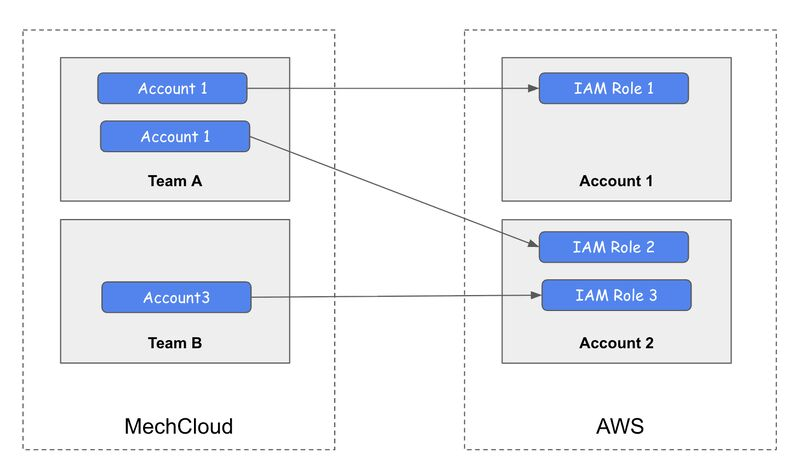
Each IAM role is onboarded into MechCloud as a logical AWS account. You configure the MechCloud OIDC provider as the identity provider in your AWS account, create one or more IAM roles with the required permissions and onboard those roles into MechCloud.
That’s it.
From that point onward, engineers can securely access AWS using role-based SSO without introducing AWS Organizations, Control Tower or IAM Identity Center.
This model is designed for:
👉 Startups and small enterprises
👉 Lean DevOps and platform teams
👉 Fast onboarding without identity sprawl
👉 Fine-grained access control without complex federation setups
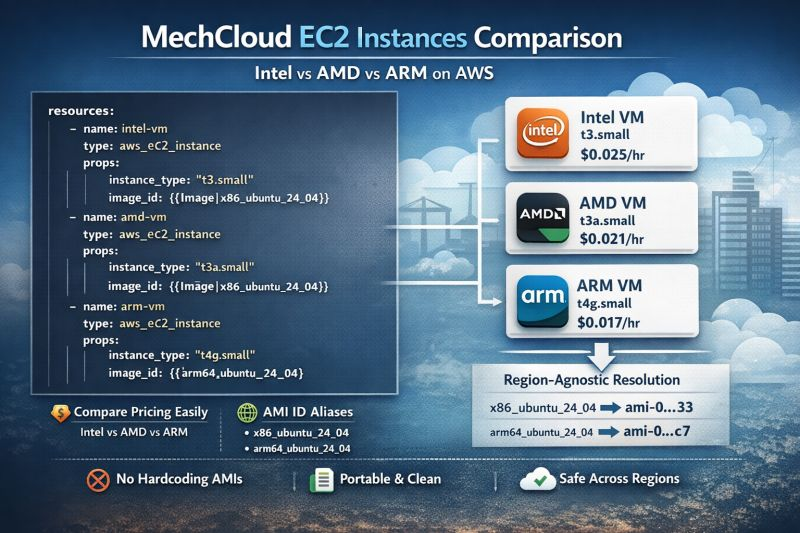
One small template can answer two common infrastructure questions engineers deal with every day. How do I compare pricing across Intel, AMD and ARM for the same instance size and how do I avoid hardcoding AMI IDs that break across regions.
This MechCloud Stateless IaC template spins up three identical sized @awscloud EC2 instances backed by Intel, AMD and ARM processors. With a single apply you can see real time pricing differences for t3.small, t3a.small and t4g.small and make an informed decision instead of guessing or hunting through pricing pages.
The second win is image ID alias. Instead of specifying region specific AMI IDs, the template uses portable image aliases like x86_ubuntu_24_04 and arm64_ubuntu_24_04. MechCloud resolves these automatically to the correct AMI per region. This keeps templates clean, readable and fully region agnostic while eliminating one of the most brittle parts of cloud automation.
The result is infrastructure code that is easier to author, easier to review and safer to run across accounts and regions. This is exactly the kind of ergonomics Stateless IaC is designed to deliver.