The research highlights the growing role of information and technologies in child trafficking and exploitation.
A child involved in drug dealing or other criminal activity may initially be viewed as an offender rather than as a child who has been groomed
https://t.co/G0PDzuXzd4
VULNERABLE CHILDREN LEFT AT RISK AS HUMAN TRAFFICKING REFORMS STALL
A report in today’s Irish Examiner by Ann Murphy highlights concerns that vulnerable children are being left at risk because of delays in introducing a new system for identifying victims of human trafficking.
At present, only An Garda Síochána can formally recognise someone as a trafficking victim in Ireland. Under legislation passed in 2024, several government departments and agencies would also become “competent authorities” able to identify victims and refer them for support. However, the new National Referral Mechanism has still not been implemented.
The inadequacy of the current system is reflected in the figures. In 2023, the UK identified more than 7,000 child trafficking victims through its referral mechanism, while Ireland identified just five. It is believed that the true number of victims in Ireland is considerably higher.
The Department of Justice said preparatory work is continuing to finalise the operational details. Until the revised system begins, other organisations encountering suspected victims must refer them to An Garda Síochána.
JP O’Sullivan of the anti-trafficking organisation MECPaths described the delay as a systemic failure to prioritise victims’ identification, rights and protection. He warned that frontline organisations remain underinformed and that vulnerable children are being left exposed while the Government’s commitments remain unfulfilled.
The criticism follows a US State Department report two years ago, which said Ireland had failed to reform its referral mechanism and continued to experience systemic shortcomings in identifying, referring and assisting trafficking victims.
The persistent delays in fully implementing the national referral mechanism reveal a concerning disregard for victims’ rights and safety.
https://t.co/qEXyy1R31Y
NEW JUDICIAL GUIDELINES FOR EXPERT REPORTS IN FAMILY-LAW PROCEEDINGS
What’s changed?
🧵1/7
New guidelines have just been published governing how expert welfare reports are commissioned, prepared and used in private family law cases in Ireland. This is a big deal for anyone who has been through — or is going through — a Section 47 or Section 32 assessment. Here’s what you need to know.
The 56-page document is dated January 2026 and was formally published in April 2026. It follows a Department of Justice review in 2024, which found there was no comprehensive guidance on how these reports should be commissioned, prepared or used.
A committee of judges was set up by the Chief Justice at the Minister for Justice’s request, chaired by Ms Justice Nuala Jackson of the High Court, with two Circuit Court judges and two District Court judges also sitting.
The committee consulted government departments, state agencies, regulators, professional bodies, charities, academics — and crucially, children and organisations who work directly with them.
These guidelines apply to welfare reports ordered under Section 47 of the Family Law Act 1995 and Section 32(1)(a) of the Guardianship of Infants Act 1964. Those are the reports used in custody, access and guardianship disputes.
Important: this does NOT primarily cover Tusla child-care proceedings under the Child Care Act 1991. Different system, different rules.
The stated goal is consistency, best practice, and quicker resolution of disputes about children.
But here’s the catch that runs through the whole document: these are guidelines, not law. They are NOT legislation. They do NOT have the force of binding court rules. Every judge still applies their own discretion, case by case.
So what we have is a framework — a step forward on paper — but not a guarantee of anything in practice. Over the next six threads we’re going to break down exactly what’s in it: the good, the meaningful, and the gaps that campaigners like us will be watching closely.
Thread 2 up next: who actually decides your case — and it’s not who you might think.
Organized crime can affect anyone.
It’s behind the falsified medicine that kills a child.
The scam that empties a retiree’s savings.
It thrives on profit, at the cost of people’s lives.
Follow the money and #StopOrganizedCrime
The ABC has published a 19-month investigation into “trap houses”, party homes run by adults where children in care say they’re being sexually abused & encouraged to partake in criminal activity
https://t.co/hEEwqGHGcB
𝐓𝐮𝐬𝐥𝐚 𝐄𝐧𝐝𝐬 𝐒𝐩𝐞𝐜𝐢𝐚𝐥 𝐄𝐦𝐞𝐫𝐠𝐞𝐧𝐜𝐲 𝐀𝐫𝐫𝐚𝐧𝐠𝐞𝐦𝐞𝐧𝐭𝐬 𝐅𝐨𝐥𝐥𝐨𝐰𝐢𝐧𝐠 𝐒𝐮𝐬𝐭𝐚𝐢𝐧𝐞𝐝 𝐂𝐫𝐢𝐭𝐢𝐜𝐢𝐬𝐦 𝐟𝐫𝐨𝐦 𝐉𝐮𝐝𝐠𝐞𝐬 𝐚𝐧𝐝 𝐏𝐨𝐥𝐢𝐭𝐢𝐜𝐢𝐚𝐧𝐬
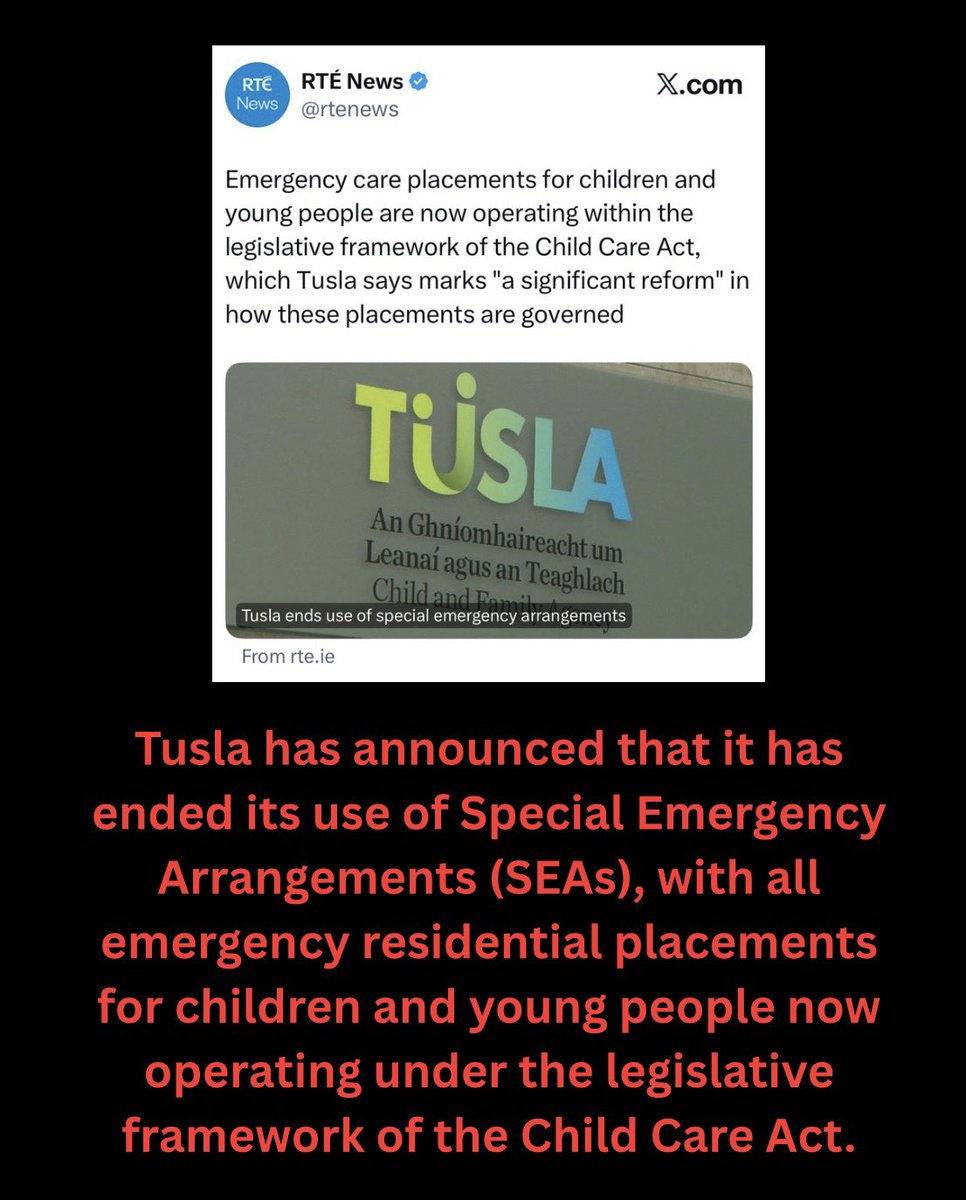
Tusla has announced that it has ended its use of Special Emergency Arrangements (SEAs), with all emergency residential placements for children and young people now operating under the legislative framework of the Child Care Act.
SEAs were introduced to provide emergency accommodation when no registered placement was available, particularly for children whose placements had broken down or who had highly complex needs. However, they attracted sustained criticism from opposition politicians, children’s advocates and oversight bodies because many children spent extended periods in these unregulated settings. Concerns were also raised about Tusla’s growing dependence on expensive private providers to deliver emergency care.
Under the new arrangements, emergency placements will now fall into three categories: registered private residential centres, Tusla emergency centres, and private temporary placements.
Registered private residential centres will be registered by Tusla’s Alternative Care Inspection and Monitoring Service (ACIMS) and inspected by HIQA. Tusla emergency centres will remain under the agency’s direct management and will also be inspected by HIQA. Private temporary placements will be limited to a maximum of 45 days while providers work towards full registration, after which children must move to either a registered private residential centre or a Tusla emergency centre.
Tusla has also confirmed that emergency intake units for separated children seeking international protection have replaced the previous use of SEAs during periods of increased demand. These units are fully registered and inspected under the new regulatory framework.
Tusla Chief Executive Kate Duggan described the move as “a significant reform”, saying it strengthens safeguards by ensuring all emergency placements now operate within legislation and are subject to appropriate oversight and accountability. She said the new framework would improve standards while reducing reliance on emergency arrangements that were never intended to become long-term solutions.
The announcement follows growing public concern over the scale of unregulated emergency placements. Tusla previously reported that 1,121 children in care were placed in Special Emergency Arrangements during 2025, highlighting the extent to which the system had relied on these placements while residential capacity remained under pressure.
Tusla said enhanced governance and safeguarding arrangements will remain in place while additional residential capacity is developed and more staff are recruited.
The announcement comes ahead of an appearance by representatives of the Children’s Residential and Aftercare Voluntary Association (CRAVA) before the Oireachtas Committee on Children, where the use of Special Emergency Arrangements is expected to be discussed.
Emergency care placements for children and young people are now operating within the legislative framework of the Child Care Act, which Tusla says marks "a significant reform" in how these placements are governed
https://t.co/PCBHxBERvh
concerns emerging in relation to @DeptJusticeIRL#HumanTrafficking inactions - Chief commissioner @_IHREC Liam Herrick said that Ireland had made important commitments to combat human trafficking, but warned that these must matched by “consistent action”.
https://t.co/ttVc1GaLny “We are concerned that progress in key areas has stalled and that, in some respects, the situation may be moving backwards. Victims need effective systems, clear rights, and practical supports that work when they need them most,” - deeply troubling
We look forward to this spotlight on #CCE -a challenge faced by so many communities we have been working with for the past 13 years. We are hopeful that tonight’s expose will demonstrate the clear need for immediate action for children whose lives are at risk #ChildTrafficking
Children are openly selling illegal drugs in Ireland's towns and cities, while some as young as seven years old are being groomed into working as drug mules, according to workers who deal with drug users and affected communities
https://t.co/cR1Xy2UG6d