@raffcolo@ducholab@KRHornberger Indeed!
I've always thought that this must really irk professors who spend a lot of time teaching 1st year chemistry undergrads significant figures, and then turn around to read the literature full of grad students and PhDs constantly butchering the rules
Have seen this a couple of times recently:
If you are reporting the results of a kinase panel in a paper, please make sure to include not only the concentration of compound used, but also the concentrations of ATP used in said panel.
I've previously collected similar articles with useful warnings and tips about methods such as scavenger reagents.
See them by following the linked threaded tweets
https://t.co/jBqYDJpUKG
Glad there is room for papers like this to be published. https://t.co/DJnZgeAydG
I hope there will be some follow up on the original ACS Med. Chem. Lett. paper on the supposed probe.
Some other references on metal impurities linked below, if useful.
Wonderful little paper here with many useful warnings inside:
https://t.co/xvIFI0eDEi
Practical notes:
-Do fresh resynthesis (orthogonal route a +)
-Test potentially interfering salts+compounds in assay
-Lots of things bind and give Xray structures at mM
More warnings below...
I'm extremely pleased people are working on novel antibiotics.
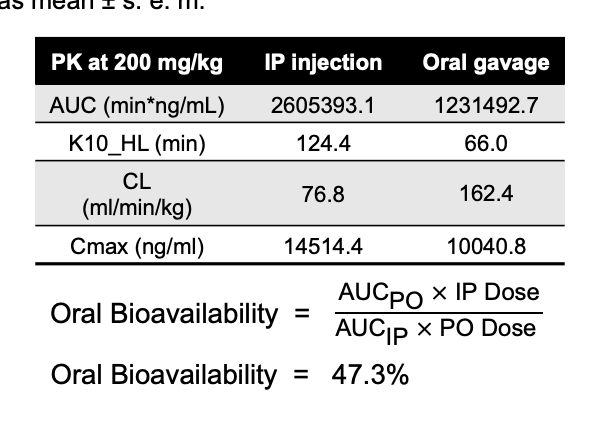
But it still makes me a bit sad that this is the PK characterization of the key compound in the world's purported premier science journal:
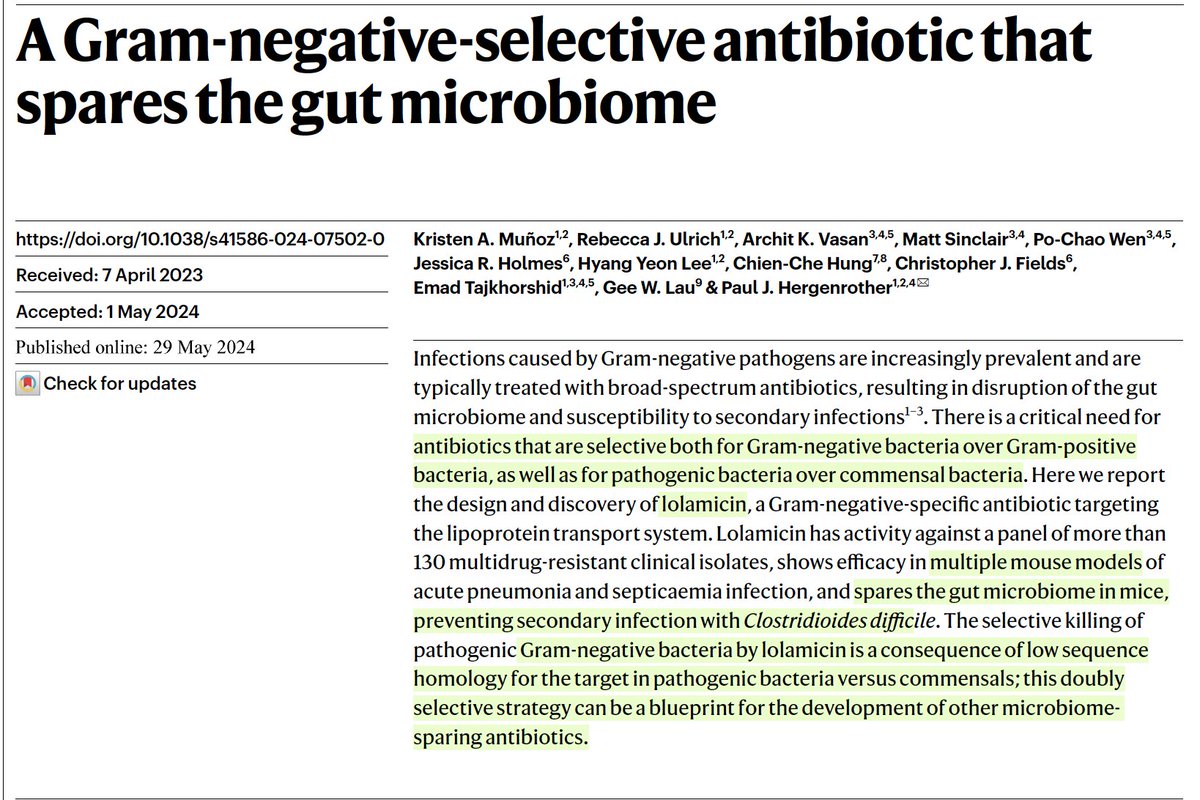
What if there was an antibiotic that doesn't disrupt the gut microbiome?
There is now.
A discovery published @Nature today
https://t.co/njtUddaJHo @PaulHergie and colleagues @UofIllinois @justsaysinmice
@AdamQuic Happy to. @KRHornberger has provided some great resources around PK reporting, such as the thread below https://t.co/DzrareLoFO
Regarding the nature paper, the issues are unfortunately beyond lack of data, and show a misunderstanding of the usual meaning of the parameters.
🧵PSA: we need to chat about pharmacokinetics & pubs. If you plan to publish in vivo PD/efficacy studies, the minimum credible accompanying PK package is an IV leg + an IP/PO leg if that's your eventual route. In the same species, preferably at the planned efficacy dose. 1/
@thederzzz@KRHornberger Regarding the paper with the odd PK table in my original post, some of the parameters mentioned do not match their usual definitions.
@thederzzz Sure! @KRHornberger has been fighting the good fight on here about proper PK reporting.
This and other resources of his should be a good starting point:
https://t.co/DzrareLoFO
🧵PSA: we need to chat about pharmacokinetics & pubs. If you plan to publish in vivo PD/efficacy studies, the minimum credible accompanying PK package is an IV leg + an IP/PO leg if that's your eventual route. In the same species, preferably at the planned efficacy dose. 1/
On the other hand, the efficacy data for antibiotics does mitigate the risk of mischaracterization a bit. Paws up / paws down is a pretty clear endpoint!
https://t.co/oMpjUCMgmJ
I propose a solution to 2 problems:
- Lack of novel antibiotics
- Abundance of terrible in vivo efficacy studies
Solution:
If you publish a bad efficacy study, you must instead work on antibiotics development, where output of animal model is much clearer... paws up / paws down
@VRBoombatzMDPhD@KRHornberger@D_B_McConnell@agwaterson Right, fair point that it’s definitely a simplification, but at least clarifies that you can’t win the game simply by moving the PK curve higher and higher, and brings the idea of a therapeutic window into focus.
After good data: "May I die if I were to change places with the Persian king!"
After bad data: "You know, maybe leaving behind chemistry in exchange for my own kingdom would be a sensible choice if given the option."