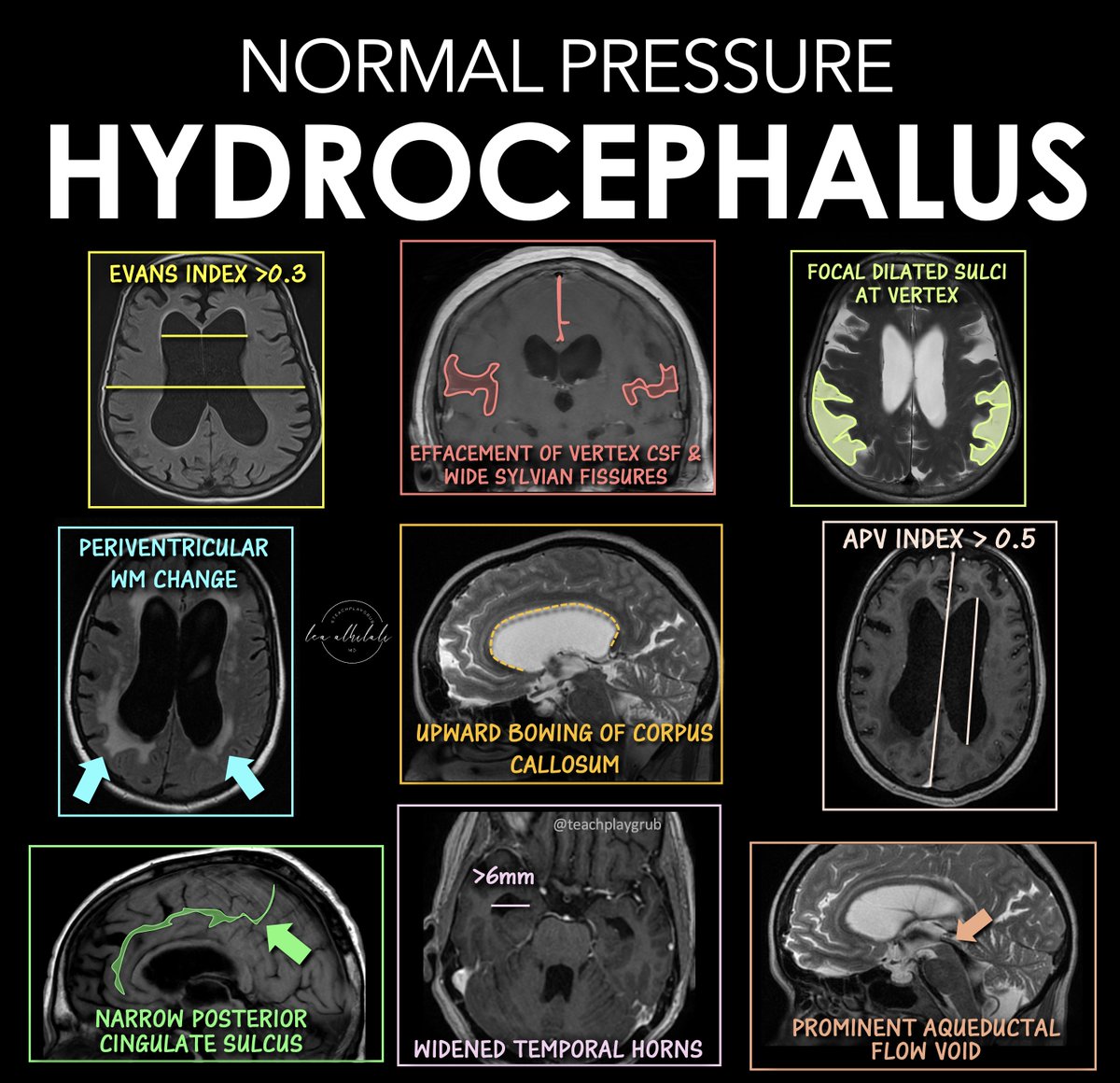
To call it or not to call it? That is the question!
Do you feel a bit wacky & wobbly when it comes to calling normal pressure hydrocephalus on imaging?
You don’t want to overcall it, but you don’t want to miss it either!
Here are the signs of NPH
🔹 Evans Index > 0.3
--Enlarged frontal horns relative to skull width → ventriculomegaly.
Remember it: “One out of three is too big for me!”
🔹 Periventricular White Matter Change
--T2/FLAIR hyperintensity from transependymal CSF flow.
Remember it: “Leaking pressure leaves a glow.”
🔹 Narrowing of the Posterior Cingulate Sulcus
--Tight high-convexity sulci from crowding at the vertex.
Remember it: “The top gets squeezed shut.”
🔹 Effaced Vertex CSF + Wide Sylvian Fissures
--Tight sulci up top but enlarged fissures laterally (DESH pattern).
Remember it: “Dry on top, wet on the sides.”
🔹 Upward Bowing of the Corpus Callosum
--Ventricular expansion pushes the corpus callosum upward.
Remember it: “If the corpus callosum is arched, the patient can’t march (wobbly)”
🔹 Temporal Horns > 6 mm
--Early temporal horn dilation from hydrocephalus.
Remember it: “Big horns before big vents.”
🔹 Focally Dilated Sulci at the Vertex
--Patchy enlarged sulci despite surrounding crowding.
Remember it: “Holes in a leaky roof = too much water on the brain!”
🔹 APV Index > 0.5
--Increased ventricular-to-parenchymal proportion suggesting hydrocephalus.
Remember it: “Glass half full is too much!”
🔹 Prominent Aqueductal Flow Void
--Increased CSF flow through the aqueduct on MRI.
Remember it: “If the aqueductal flow is super black, the ventricles are out of whack.”
Classic NPH imaging theme: enlarged ventricles + tight high convexities + disproportionate CSF redistribution.
Hopefully now you won't wobble on the diagnosis of NPH!!
Swelling of feet does not always mean “kidney problem”.
Pedal edema is one of the commonest OPD complaints, and the cause may be heart, kidney, liver, veins, medicines… or simply gravity.
▶️A simple way to think about it....
1️⃣ BOTH feet swollen?
Think of SYSTEMIC causes:
• Heart failure
• Kidney disease/nephrotic syndrome
• Liver disease/cirrhosis
• Low serum albumin/protein malnutrition
• Hypothyroidism
• Pregnancy
• Obesity/prolonged standing
2️⃣ One leg swollen?
Think of LOCAL causes:
• DVT (blood clot)
• Cellulitis/infection
• Venous insufficiency/varicose veins
• Lymphedema
• Trauma/fracture
3️⃣ Always check the DRUG LIST
Common culprits are:
• Amlodipine/nifedipine
• Pregabalin/gabapentin
• Steroids
• NSAIDs
• Pioglitazone
• Hormonal drugs
🚩Red flags to watch:
• Breathlessness → heart failure
• Frothy urine → kidney disease
• Jaundice/ascites → liver disease
• Painful one-sided swelling → DVT
• Fever/redness → cellulitis
✅Quick bedside clues:
• Pitting edema → cardiac/renal/hepatic/drug-related
• Non-pitting edema → lymphedema/myxedema
• Evening worse, morning better → venous/gravity related
▶️Important point:
🔹Most patients with pedal edema in OPD DO NOT have severe heart/kidney/liver failure.
🔹History + examination + medication review solve the diagnosis in many cases.
Dr Sudhir Kumar @hyderabaddoctor
(Note: Image is AI-generated)
If PFTs have normal spirometry and lung volumes, but decreased DLCO, 2 diagnoses should come to mind:
🫁Pulmonary hypertension
🫁Combined pulmonary fibrosis and emphysema
https://t.co/zNsA2Wvnmh
#medtwitter
Antibiotics pearls for real life scenarios
• Penicillins :
Don't double up on anaerobes. If a patient is on a beta-lactam/beta-lactamase inhibitor combo (like Piperacillin-Tazobactam or Amoxicillin-Clavulanate), adding Metronidazole is redundant and only increases the risk of GI side effects.
• Cephalosporins :
Beware the "LAME" gap. Cephalosporins have no activity against Listeria, Atypical bacteria (Mycoplasma/Chlamydia), MRSA (except Ceftaroline), and Enterococci.
• Carbapenems :
Seizure risk is real but specific. While all carbapenems can technically lower the seizure threshold, Imipenem carries the highest risk, especially in patients with renal impairment; Meropenem is generally much safer in this regard.
• Fluoroquinolones :
Think of them as "IV poles in a pill." Drugs like Levofloxacin and Moxifloxacin have nearly 100% bioavailability, meaning the oral dose achieves the same blood concentration as the IV version—switch to PO as soon as the patient is eating.
• Aminoglycosides :
It’s all about the "Peak." These drugs exhibit concentration-dependent killing, which is why we typically use high-dose, once-daily extended-interval dosing to maximize efficacy while giving the kidneys a "washout" period to reduce toxicity.
• Vancomycin :
Stop chasing the "Trough." For serious MRSA infections, modern guidelines have shifted from trough-based monitoring to AUC/MIC based dosing.
~ (AUC/MIC > 400) to better predict efficacy while minimizing nephrotoxicity.
• Tetracyclines :
More than just "bone and teeth." Beyond infection, Doxycycline is a potent anti-inflammatory; however, remind patients to stay upright for 30 minutes after taking it to prevent severe pill-induced esophagitis.
• Macrolides :
Watch the "Electricals." Azithromycin and Clarithromycin are notorious for QTc prolongation; always check a baseline EKG if the patient is on other QTc-prolonging meds like Ondansetron or Amiodarone.
• Linezolid :
Mind the "Serotonin." Linezolid is a weak MAO inhibitor; monitor for Serotonin Syndrome if the patient is also taking SSRIs, and watch for thrombocytopenia if the treatment duration exceeds two weeks.
• Metronidazole :
The "Disulfiram" myth vs. reality. While the "no alcohol" rule is classic teaching, the evidence for a true disulfiram-like reaction is thin; however, it remains a high-yield board fact and a safe clinical recommendation to avoid nausea.
35 year old man developed severe weakness (paralysis) of arms and legs after enjoying 5-6 delicious rasgullas (Indian sweet).
This has happened thrice during the past 6 months, what is the likely diagnosis?
(Note: Rasgullas were fresh, and hence it was not food poisoning)
ADA Standards of Care 2026: The New Algorithm for Glucose-Lowering Therapy in Type 2 Diabetes
The ADA 2026 reinforces a priorities-first approach:
1️⃣ Reduce cardiovascular & kidney (CVKD) risk
2️⃣ Manage weight
3️⃣ Achieve glycemic goals
4️⃣ Address MASLD/MASH risk
All built on a foundation of healthy lifestyle + DSMES + addressing SDOH.
🔶 1. FIRST PRIORITY: Cardiovascular & Kidney Risk Reduction
A. ASCVD or Indicators of High CV Risk
Preferred: GLP-1 RA with proven CV benefit
Alternative / Add-on: SGLT2i with proven CV benefit
If HbA1c above target → combine GLP-1 RA + SGLT2i
B. Heart Failure (HFpEF or HFrEF)
Preferred: SGLT2 inhibitor
Add GLP-1 RA (proven benefit) if glycemia not controlled or if comorbid obesity
C. CKD (eGFR <60 OR ACR ≥30 mg/g)
Preferred: SGLT2i with primary evidence of CKD protection
If eGFR <45 → GLP-1 RA with proven renal benefit
If glycemia above goal → combine SGLT2i + GLP-1 RA
If more CVKD risk reduction is needed
➡️ Add agents with proven benefit, treat lipids/BP aggressively, and reassess every 3–6 months.
🔶 2. SECOND PRIORITY: Weight Management
ADA 2026 clearly states:
Weight reduction itself is a therapeutic target in T2DM.
Weight-loss efficacy of medications (ADA 2026)
Very High: Semaglutide, Tirzepatide
High: Dulaglutide (high dose), Liraglutide
Intermediate: GLP-1 RA (others), SGLT2i
Neutral: DPP-4 inhibitors
Use GLP-1 RA / dual GIP-GLP-1 RA early in patients with obesity or weight-related complications.
🔶 3. THIRD PRIORITY: Glycemic Control
Efficacy for glucose lowering (ADA 2026)
Very High: Semaglutide, Tirzepatide, insulin combination therapy
High: GLP-1 RA, SGLT2i, Metformin, TZD, Sulfonylureas
Intermediate: DPP-4 inhibitors
If HbA1c remains above target → Stepwise intensification without delay.
🔶 4. NEW FOCUS 2026: MASLD/MASH (Metabolic Liver Disease)
ADA now adds a dedicated pathway:
Drugs with proven / potential benefit
GLP-1 RA
Dual GIP–GLP-1 RA
Pioglitazone
GLP-1 RA + Pioglitazone combination
⚠️ Use insulin in decompensated cirrhosis only.
🔶 5. When Treatment Goals Are Not Reached
Reassess every 3–6 months
Evaluate:
Barriers to care
Hypoglycemia risk
Adherence
Affordability
SDOH (social determinants of health)
⭐ CME INDIA Take-Home Messages
1️⃣ ADA 2026 is no longer “HbA1c-first”—it is “Heart–Kidney–Weight–Glycemia” in that order.
2️⃣ GLP-1 RA & SGLT2i dominate all therapeutic pathways due to CVKD & weight benefits.
3️⃣ Obesity is treated as a biological disease—not a lifestyle failure.
4️⃣ MASLD/MASH enters mainstream diabetes management for the first time.
5️⃣ Reassessment every 3–6 months is mandatory—clinical inertia is unacceptable.
https://t.co/wRp6gaKDvK
A 2 yr old male child is referred to hematology for thrombocytopenia. His brother also has mild thrombocytopenia 🤷🏽♂️
Peripheral smear 👇🏽
Hgb: 14.3 g/dL
WBC: 6.5 (neut: 3.1)
Plt: 30,000
Ddx?
Management?
36/♂️/ is bitten by a dog 😭 She gets PEP and rabies immunoglobulin🤷♂️
3 days later she is admitted to the ICU with fever 🥵 and altered sensorium😭
Blood pressure:⤵️⤵️
Pulse: 144/min
CBC: 9/36,000/23,000
INR: 2.8
aPTT: 66 sec
Peripheral smear 👇🏻
Diagnosis?
#MedTwitter