@KenLin1985 Awesome Ken..I just kept thinking and couldn't develop https://t.co/bh9unafdJc. There are 3-4 developed with the same name including the -hyphen version.
The U.S. health care system is adopting artificial intelligence faster than nearly any other sector, and for many patients, that’s unsettling. The rapid integration of AI in medicine, particularly in clinical settings, has left many wondering: Is rising AI use helping clinicians do their jobs better? Or is it setting the stage for a future where AI “superintelligence” takes human experts’ place?
New research into how clinicians are currently using AI offers a reassuring answer, and a roadmap for building health care AI that effectively serves both doctors and patients. Put simply, AI used well is not a replacement for physicians’ expertise, but a force multiplier for it. AI tools, such as Medscape AI, can help to empower physicians to work more efficiently and access critical information faster. Read the full article from Dr. Neha Pathak by tapping the link: https://t.co/sPqajBuMnZ
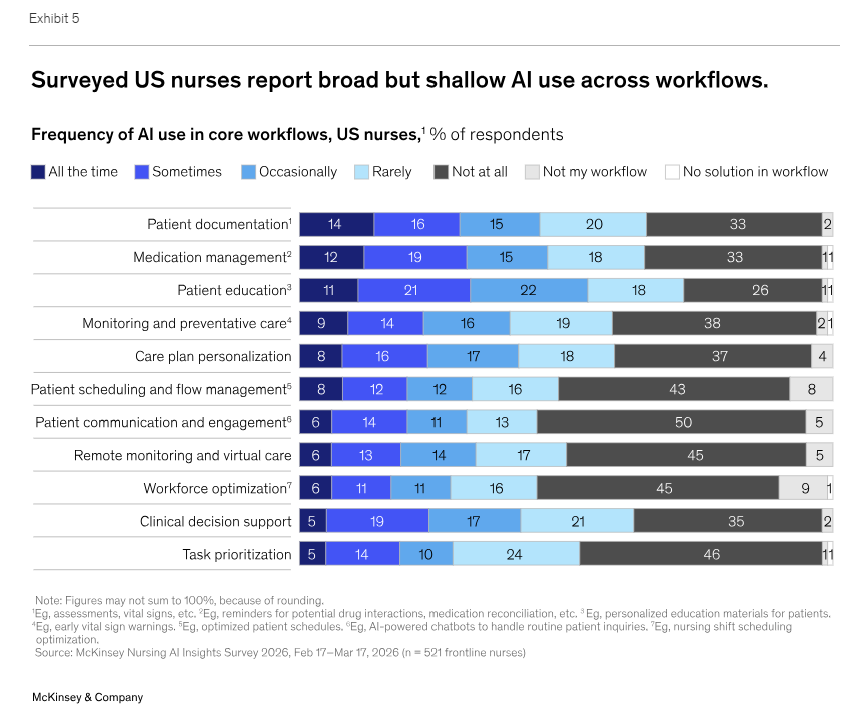
McKinsey: ~65% of nurses report using more AI tools than a year ago
But adoption remains uneven:
• 23% report no AI use
• Only ~2% is fully integrated into daily work
More than 3/4 of nurses now use AI in some capacity, mostly at low-to-moderate levels. Plenty of room to run.
For years, we’ve been working to bring the best of @Google to the world of health. With advances in AI, there’s even more opportunity to reimagine how we can improve the overall health experience. Today, we’re announcing what’s coming next. 🧵
We are living through the disruption of healthcare in real time.
Every industry gets disrupted the same way.
It starts when only the rich can afford it and only experts can use/deliver it (e.g. telephones, air travel, computers)
Then technology changes everything:
- It lowers cost
- Improves and standardizes quality
- Makes it accessible to everyone
A few examples of this throughout history:
- NY to London call used to cost $300 for 3 min in 1930, and is now free.
- Cross-country flight cost $4,400 in the 1940s, today it's $120.
- A 1980 computer used to cost $10M, now you get your iPhone for $1K, which is 1000x more powerful.
Healthcare is now on the same trajectory.
- The cost of sequencing a human genome dropped from $100M to less than $100 in about 25 years
- Full-body MRI used to be hospital-only, now you can get it for $500.
- Blood panel went from $500 to $30.
- CGM was prescription-only, now $70/month.
The gates always fall.
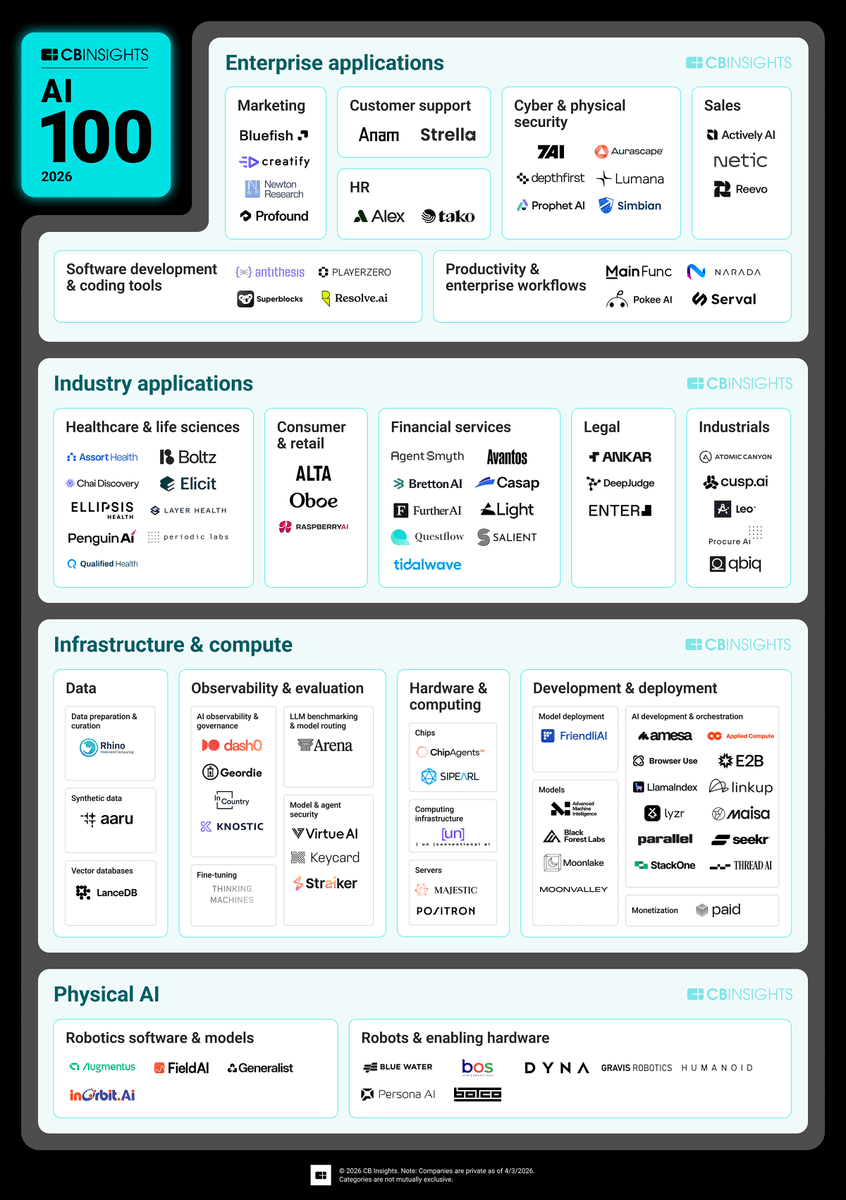
NEW: CB Insights AI 100 2026
Here are the 9 healthcare & life sciences winners:
• Assort Health
• Boltz
• Chai Discovery
• Elicit
• Ellipsis Health
• Layer Health
• PenguinAI
• Periodic Labs
• Qualified Health
Reminder
AI reasoning breakthrough
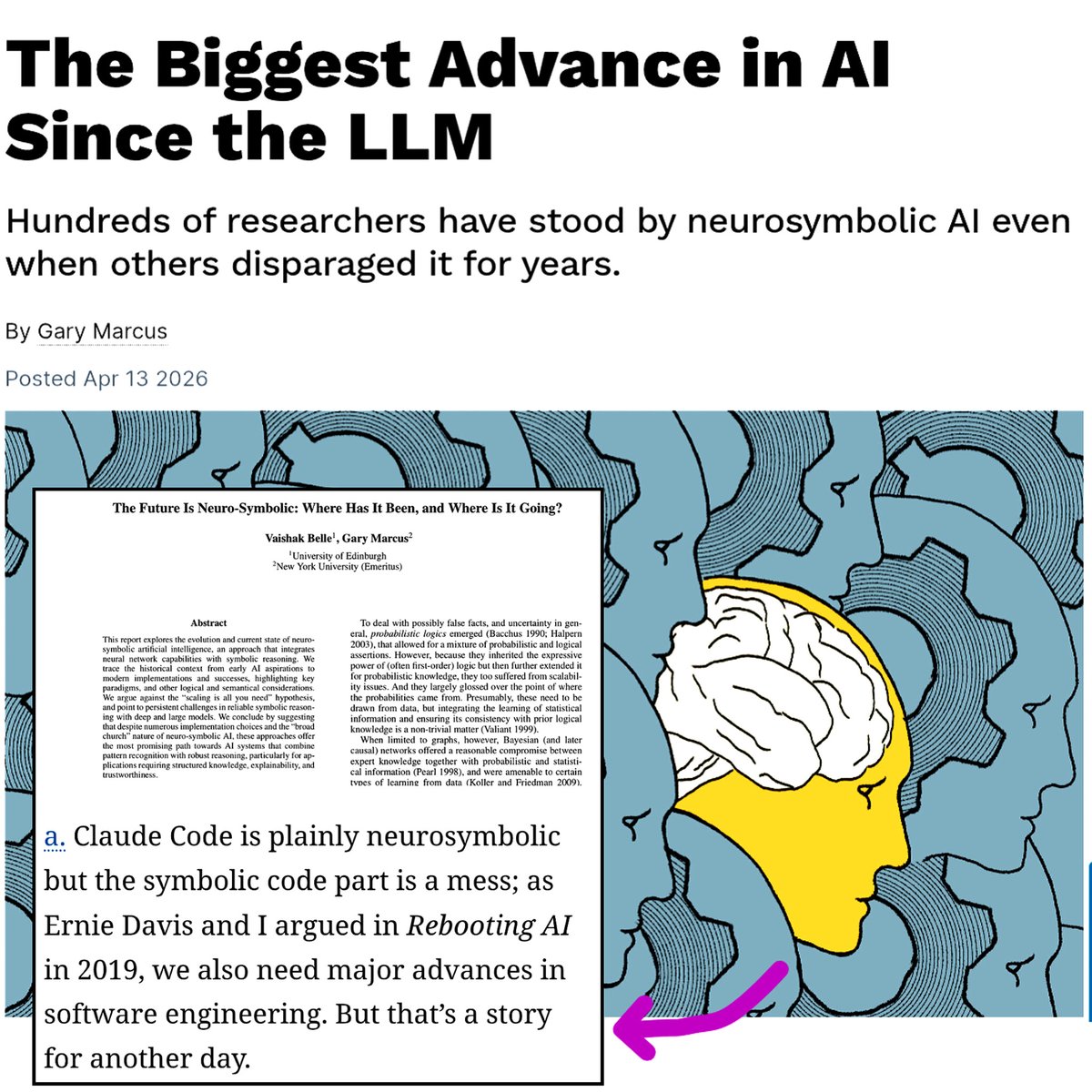
In a new analysis, researchers highlight the rise of neurosymbolic AI, a hybrid approach that combines neural networks with formal logic and rule-based systems.
Scientists say the next AI breakthrough is not bigger models, but smarter ones.
Recent systems from Google DeepMind show how this works in practice:
> AlphaGeometry 2 (2025–2026) solves ~83–88% of International Math Olympiad geometry problems, with some solutions generated in seconds
> AlphaProof (2024 → current) achieved 28/42 points (silver medal level) at IMO by generating formally verified proofs
> AlphaFold predicted 200M+ protein structures with near experimental accuracy, showing how hybrid AI can solve real scientific problems at scale.
Instead of relying purely on probability like LLM, these systems integrate symbolic constraints, structured reasoning and verification engines to produce outputs that can be checked and proven correct.
The shift is subtle but massive 👀
This new direction suggests AI is moving from sounding intelligent to actually reasoning with verifiable correctness, a change that could redefine progress in science, mathematics and engineering.
Perplexity and Computer now connect to premium health sources, starting with NEJM and BMJ Group, with 9 more medical journals and clinical databases on the way.
Ask health questions and get answers cited from the same sources relied on by hospitals and research institutions.
Perplexity and Computer now allow you to run Deep and Wide Research on sources trusted by doctors and medical professionals like the New England Journal of Medicine, the British Medical Journal, the American Diabetes Association, and so on.
Swan robot captures full-body dermoscopic images in minutes. Tracks new and changing spots across visits. Replaces spot-check exams with total skin coverage. Creates a time-series record for earlier melanoma detection.
In a groundbreaking medical achievement, doctors in Beijing, China, successfully replaced a large section of a patient’s spine with a custom 3D-printed titanium implant.
The patient, a 41-year-old man, had been diagnosed with a severe spinal tumor that destroyed multiple vertebrae, leaving a dangerous 19-centimeter gap in his spine. Without intervention, the damage threatened paralysis and could have been fatal. Surgeons first removed the cancerous bone, then implanted a precisely engineered titanium vertebra section created using advanced 3D printing technology.
What made the implant remarkable was its design. Printed from titanium powder, it perfectly matched the patient’s natural spinal curvature and featured a porous structure that allowed the patient’s own bone cells to grow into it over time. This biological integration created a stronger, more stable fusion between the artificial and natural bone.
Traditional spinal reconstruction methods using rods or cages often struggle with such extensive defects. The custom 3D-printed solution offered superior anatomical fit and long-term stability. Following the complex surgery, the patient recovered well and regained the ability to walk with assistance within weeks.
This pioneering operation represents a major advance in personalized medicine and demonstrates the growing potential of 3D printing to solve some of the most challenging problems in orthopedic and cancer surgery.
[Hu, X., et al. (2024). 3D-Printed Patient-Customized Artificial Vertebral Body for Spinal Reconstruction after Total En Bloc Spondylectomy of Complex Multi-Level Spinal Tumors. International Journal of Bioprinting, 8(3). DOI: 10.18063/ijb.v8i3.576]
Another huge medical achievement from our very own @UHN 🇨🇦🔥
A Toronto man lived with HIV for 27 years. Then he got leukemia and that diagnosis may have just cured him of both.
His doctors found a bone marrow donor carrying CCR5-Δ32, a rare mutation in ~1% of people of European descent. HIV hijacks immune cells through the CCR5 receptor. If you don't have it, the virus has no door.
The transplant replaced his entire immune system with one HIV can't infect.
He stopped antiretroviral therapy in July 2025. As of today, HIV is undetectable by the most sensitive assays available. No viral reservoir. No immune response to HIV. Nine months clean.
He would be the 11th person in history to possibly be cured of HIV.
HIV cure is possible. We just proved it again at @UHN
Proud of the team at @UHN and @UofT !
Source: https://t.co/zH1fIfVubV





![Rainmaker1973's tweet photo. In a groundbreaking medical achievement, doctors in Beijing, China, successfully replaced a large section of a patient’s spine with a custom 3D-printed titanium implant.
The patient, a 41-year-old man, had been diagnosed with a severe spinal tumor that destroyed multiple vertebrae, leaving a dangerous 19-centimeter gap in his spine. Without intervention, the damage threatened paralysis and could have been fatal. Surgeons first removed the cancerous bone, then implanted a precisely engineered titanium vertebra section created using advanced 3D printing technology.
What made the implant remarkable was its design. Printed from titanium powder, it perfectly matched the patient’s natural spinal curvature and featured a porous structure that allowed the patient’s own bone cells to grow into it over time. This biological integration created a stronger, more stable fusion between the artificial and natural bone.
Traditional spinal reconstruction methods using rods or cages often struggle with such extensive defects. The custom 3D-printed solution offered superior anatomical fit and long-term stability. Following the complex surgery, the patient recovered well and regained the ability to walk with assistance within weeks.
This pioneering operation represents a major advance in personalized medicine and demonstrates the growing potential of 3D printing to solve some of the most challenging problems in orthopedic and cancer surgery.
[Hu, X., et al. (2024). 3D-Printed Patient-Customized Artificial Vertebral Body for Spinal Reconstruction after Total En Bloc Spondylectomy of Complex Multi-Level Spinal Tumors. International Journal of Bioprinting, 8(3). DOI: 10.18063/ijb.v8i3.576]](https://pbs.twimg.com/media/HHEuoiKbYAEVf3v.jpg)


