@mbekirege20 daha sonra büyük sayılar yasasının çalışmasını bekleyeceksiniz .hepsi bu özetle .
tarader lık avantajlarına gelince patron yok,müşteri yok,zaman ve yer sorunu yok
sadece laptop ve internet
@mbekirege20 aslında trader lık stres barındıran bir iş değildir .
öncelikle pozitif beklentili stratejiniz olacak ve bu stratejide giriş yeriniz ,stop yeriniz, kar yeriniz ve stop olduğunuzda kabul ettiğiniz zarar miktarını belirleyip stratejinizi sağlayan her işleme gireceksiniz
【That Losing Streak Is Testing Your Trust, Not Your Strategy】
In the middle of a losing streak or drawdown, another stop loss gets executed.
Your fourth loss in a row.
You stare at the number in your account.
And in your head, you quietly put the strategy in the defendant's seat.
"Can I really keep going like this?"
"Has the market changed?"
Like a judge, you are about to declare the strategy guilty.
But you have it backwards.
In that courtroom, the one truly on trial is not the strategy.
It is how deeply you can trust what you built.
That is the only thing being tested.
■ You Think You Are Judging The Strategy, But You Are The One On Trial
Most traders think a losing streak tests the strategy or the market.
When things stop going well, they say, "the market has changed," feel as if they have "learned something," immediately adjust the strategy, and abandon consistency.
They believe they are in the position of judging whether the strategy is valid.
But the one actually being judged is you.
What is being asked in the middle of a losing streak is not whether the strategy is right.
It is whether the trust you built beforehand can still govern your actions.
That is all.
And I need you to not misunderstand what I mean by "trust" here.
■ "Trust" Does Not Mean Believing The Trade In Front Of You Will Win
If you hear "trust" and think it means believing the trade in front of you will win, that is the exact opposite.
No one knows whether the one trade in front of you will win or lose.
It is governed by randomness.
The "trust" I am talking about here is not about the outcome of that one trade.
It means trusting the structure that, when you keep repeating the rules of a strategy with positive expectancy across a large sample size, profit remains in total.
The loss in front of you is already accounted for from the beginning as part of that structure.
That is why someone who truly trusts does not believe the trade in front of them will win.
Rather, they can keep repeating the same behavior while knowing it may lose.
Because they do not trust the win or loss.
They trust the structure beyond repetition.
Being certain that the trade in front of you will win and trusting the structure beyond repetition are completely different things.
■ "But Isn't It Wrong To Change Nothing During A Losing Streak"
Here, someone will always say this.
"But if I am in a losing streak, isn't it wrong to change nothing?"
That anxiety itself is what a lack of trust looks like.
Did you not test it across a large sample size beforehand?
Did that test not contain losing streaks like the one you are seeing now?
A strategy with an edge is something that leaves profit in total as a result of repeating rule based behavior and allowing both wins and losses to occur naturally.
A losing streak is an event that inevitably appears in that process and was already accounted for.
If you truly trust statistics and probability, you should understand that every loss is functioning as a cost.
The current losing streak should already be viewed as part of the statistics.
If you can view it that way, your execution does not stop, no matter how many losses continue.
The temporary skew gets absorbed inside a larger sample size.
Because you understand that.
If your execution stops, your understanding is not deep enough.
In other words, the preparation required to trust is not finished yet.
■ But This Is Not Blind Belief
If you read this and thought, "so I just need to trust it and keep going no matter what," that is wrong too.
This is not blind belief.
If the strategy does not actually have positive expectancy, the more you trust it and repeat it, the more your capital will decrease.
Trust without evidence is just gambling.
Only when you know that the strategy truly has positive expectancy and that the current losing streak is merely variance will your trust not shake.
And that conviction cannot be built by repeating in your head, "this is variance."
You thoroughly verified the strategy beforehand through your own hands.
You practiced it.
You passed through losing streaks and drawdowns through verification and practice, and learned that they are part of what forms the edge.
Only beyond that does unshakable conviction appear.
The future is never guaranteed.
And in that reality, we are required to remain consistent no matter what happens.
That is exactly why the one being tested is not the strategy.
It is you.
How much preparation you did beforehand.
How much trust you built.
All of it is quietly tested in the middle of a losing streak.
📚 Content for serious traders
https://t.co/ZxU7qo7pJm
Thank you for reading.
Do you want to be a fortune teller?
Or a trader?
A trader is not someone who tries to become right about the future.
A trader tests.
Practices through their own hands.
Prepares a favorable die.
Then rolls that die only when the condition appears.
That is the job.
Are you doing that?
Or are you still mistaking this for a game where the goal is to predict what happens next?
Are you thinking in ways like these?
"I'm going to take this many trades today."
"I'm going to make this much money this month."
"Last week was a great week."
These are ways of thinking that reflect a fundamental misunderstanding of trading.
To begin with, how many trades you take today is not something you are free to decide.
Whether opportunities arise depends on the market.
If your rules say trade, you have to trade.
If they say do not trade, you must not trade.
You cannot impose your preferred number of trades or your wishes on the market.
How much you make this month will not conform to your expectations either.
Once you set that kind of target, you will stop following your rules and lose consistency.
Some months are profitable, and some are not.
But a system with an edge is one that leaves you profitable overall.
Many people also judge whether last week was a great week by the amount of money they made, but the moment you use short-term randomness or P&L as your benchmark, you lose consistency.
That is because once you interpret losses as something bad, you develop a sense of being penalized, the emotions built on that inevitably appear, and you are then forced to act in line with them.
Every one of these thought patterns comes from failing to understand the metagame that trading is "a game of probabilities."
You have to start by understanding the game.
That is the starting line.
Great question.
Let me be direct with you, because I think the answer is already hidden inside the way you framed your question.
You said "external factors occasionally cause emotional loss of control."
But here's the thing — external factors don't cause emotions.
Your thought process in response to those external factors is what generates the emotion.
The same event can happen to two different traders, and one feels nothing while the other panics.
The difference isn't the event.
It's what's happening inside.
So the real question isn't "what external factor is causing my emotions?"
It's "what belief or thought process do I still hold that makes me react this way?"
You also said you "generally" trust your system.
That word "generally" is doing a lot of heavy lifting.
Trust isn't something that works part-time.
If your trust wavers under certain conditions, that's not trust — that's hope.
And hope is not a strategy.
True trust in a system comes from deep understanding of its statistical edge, built through massive sample sizes of testing, where you've seen with your own eyes how the system performs across every kind of condition.
If that foundation is solid, there's nothing external that can shake it.
If it shakes, the foundation isn't solid yet.
And here's something worth examining closely.
If losses are what shake your trust, it means you're still equating "edge" with "winning trades."
But that's a misunderstanding of what an edge actually is.
The edge of your system is not just the wins.
The losses that occur according to your rules are themselves part of the edge.
Without those losses, the edge doesn't function.
They are not a cost you endure in spite of the edge — they are a component that makes the edge work.
If you truly understood this, a rule-based loss wouldn't shake you at all, because you'd recognize it as the system doing exactly what it's supposed to do.
The fact that losses still disturb you reveals that, somewhere in your thinking, you still see losses as the opposite of edge rather than a part of it.
And you said you "execute it well."
But execution in trading isn't a spectrum.
You either follow the rules or you don't.
"Well" suggests there are moments where you don't, and that's worth examining honestly.
Every time you deviate from your rules, you're not doing your job as a trader.
Your job is to extract the edge of your system through consistent execution over a large sample.
Any deviation contaminates that sample.
The deeper issue here is this: what many traders perceive as an "emotional control" problem is actually a problem of understanding.
Emotions are not the cause — they are the result.
They are the symptom of a thought process that still places value on individual wins and losses, that still sees losses as something bad, that still reacts to short-term randomness as if it means something.
When you truly understand your job as a trader — that you are collecting a large, clean sample of trades under identical conditions so that the law of large numbers can do its work — then wins and losses become nothing more than data points.
Neither good nor bad.
Both necessary for the system's edge to emerge.
You don't need to control your emotions.
You need to change the thought process that's generating them.
Once that shift happens, the emotions you were trying to fight simply stop appearing.
So my honest assessment: the fact that external factors can still disrupt you tells me your understanding of what you're doing — and why you're doing it — still has room to deepen.
That's not a criticism.
That's actually great news, because it means the solution is entirely within your control.
Go deeper into your preparation.
Go deeper into your testing.
Go deeper into understanding the probabilistic nature of what you do.
The confidence and calm you're looking for aren't found by fighting your emotions.
They're built through understanding.
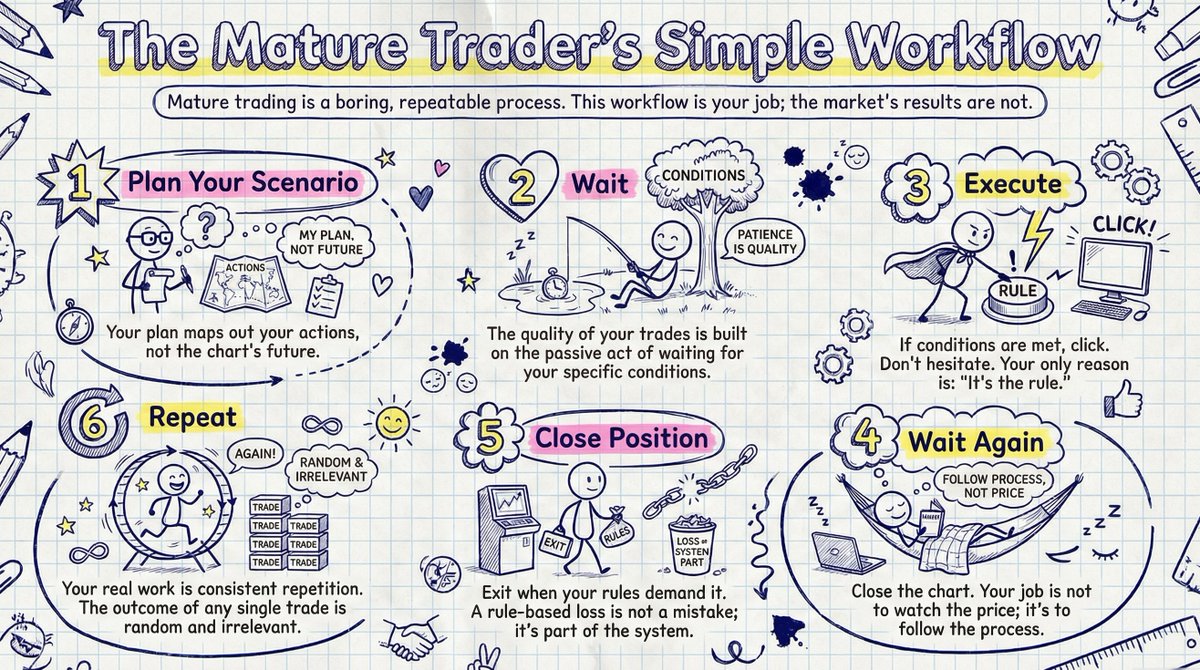
If you already have a strategy, the rest is a simple workflow 👇
1. Define the scenario in advance
2. Wait
3. Execute if the conditions are met
4. Wait
5. Exit when the conditions are met
6. Repeat
Words like “win” and “loss” are unnecessary.
Only precise execution.
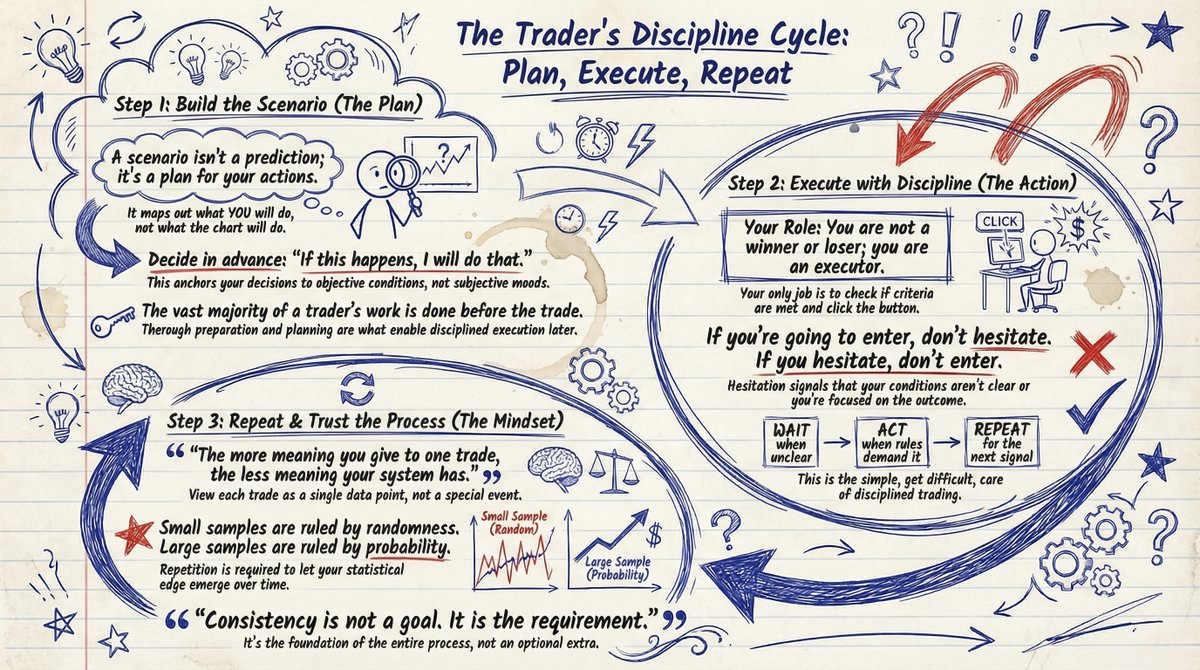
Build an "If this happens, then do this" scenario upfront, then execute it.
You don't need the desire to win or to avoid losing.
If you can execute the process exactly as the scenario dictates, stamp your card once.
Once you've collected 20 stamps, "one trade" is finished.
【“Focusing on the Process” Means “Eliminating Everything That Isn’t the Process”】
What you need is to know the conditions under which you click, and to click.
You don’t need anything else.
■Eliminate Everything That Isn’t the Process
“Focusing on the process,” in other words, means “eliminating everything that isn’t the process.”
Staring at charts for no reason, or constantly watching P/L during a trade, shouldn’t be part of your process.
A process called “worrying about the outcome” is not part of your process.
Whether the trade you’re about to take wins or loses has nothing to do with your success.
You are not trading in order to win the trade in front of you.
■Your Job Is Just to Click
In chart analysis, all you do is check whether your system’s rules are met, and if the entry conditions are in place, you click without thinking.
After that, you watch the chart only to follow your predetermined exit rules, and if the conditions are met, you click without thinking, or you simply let your existing orders get hit appropriately.
If you entered long, and the next click is below your entry price, it’s called a “stop-out.”
If it’s above, it’s called a “take profit.”
Those are just different labels, and what you do is the same.
Those labels don’t matter, and they’re not what you should be focused on.
Stop obsessing over names like “win,” “loss,” “take profit,” or “stop loss,” and just treat all of it as “exits.”
If you set a stop loss and a take-profit order at the same time as entry, then your job on that trade is done at that point.
Price will ultimately hit one of those orders, but which one gets hit does not determine how well you did your job.
What matters is only this: start the trade by clicking according to the rules, and end the trade by clicking according to the rules.
■Thorough Preparation Up Front
What the long-term results look like if you keep following those rules should be thoroughly tested in advance over a large sample size.
Every component—risk management, position sizing, and everything else—must be built into the rules from the start.
That’s because for your system to safely accumulate a sample size over the long run and exploit probability, risk management and position sizing are part of the system.
They are not things you change back and forth based on your emotions, drawdowns, or the outcome in front of you.
This frees you from the outcome in front of you and leaves only the process.
■The Boss-and-Employee Relationship
You need to become the employee who trusts the plan the boss set in advance and follows the predetermined rules without worrying about the day’s sales.
Your job is not to break the boss’s rules.
You don’t get to panic because there are fewer customers today and run an unauthorized sale, or rewrite the price tags on your own.
Day after day, keep following the boss’s instructions.
If you don’t follow the rules, you yourself become a risk to the company and you get fired.
Thorough preparation and the consistency to keep following it—those two are what matter, and they must be done in different modes.
I want you to think carefully about which phase you’re in right now.
If you can identify which phase has the problem, the actions you should take will become clear.
■Focus 100% on the Job
If what’s decided is clear, and you understand that your job is to execute it relentlessly, there’s nothing else to think about.
Only the process remains, and you don’t need to think about anything else.
All you have to do is stay 100% focused on the work you need to do.
What’s tormenting you isn’t emotion, but your thinking OS.
Because your thinking OS is still a “win-or-lose game,” you’re constantly assigning meaning to the result in front of you and prioritizing today’s win or loss over the rules and the process.
The solution is to rewrite the OS.
If your OS is wrong, no strategy will ever work.
This is the turning point in your trading life.
Let’s start 2026 strong.
📚Rewrite your thinking OS into that of a true trader👇
https://t.co/tMFssKR6Oz
I don’t think my job is to win at trading.
When the desire to win gets too strong and “winning” becomes the objective, you start taking positions in bad spots, you can’t cut losses, and if your trade count is low you start getting impatient.
That happens because the goal is to win, and it’s the exact opposite of probability-based trading.
My job is to follow predetermined conditions.
Winning is a byproduct.
Don’t try to win.
Don’t try to avoid losing.
Just follow.
Good night 😴