another one for the react native community.
I just open sourced @rbayuokt/expo-adaptive-glass, adaptive glass UI for @expo / @reactnative
one <GlassSurface> and every phone gets the best glass it can handle, from the newest iPhone to an old Android
We got a production Expo app running on Windows: React Native 0.88 + Expo SDK 58 on react-native-windows, with Skia, Reanimated 4, Worklets, Nitro Modules and Unistyles all running natively. No mocks, no web fallbacks. Here's how
Then the desktop parts: MSIX packaging and icons, OTA updates (signed manifest + Hermes bytecode, applied with an in-process reload and automatic rollback), a remote kill switch, and single-session login.
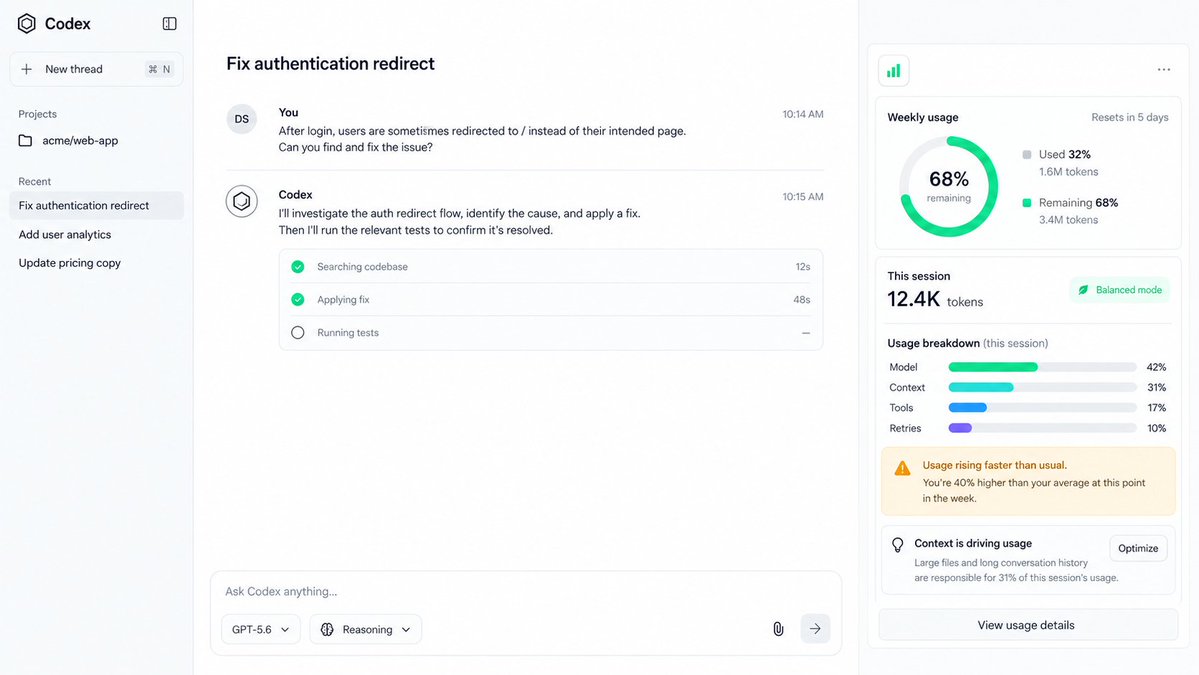
We’re all facing a Codex usage crisis nowadays & it’s a complete black box. 0 Transparency
- Which task drained it? Was it the model, context, reasoning, subagents, or retries?
Many people complain about this, so I’m building something around it. Any guesses or suggestions? 👇🏻
@karrisaarinen Below is with plain SwiftUI. This is a well known bug that happens when you scroll mid animation. i kept it in the video to make a point that we inherit native bugs too!
Introducing Legend Code Editor
15 MB app
40 MB RAM
Syntax highlighting
React Native macOS
Open source
If it's not the fastest app on your Mac, repost and reply for a full refund.
https://t.co/0ExKcXHFzo
I hate how imprecise the term “native” has become.
Is a UIKit app that mostly displays WebViews, such as Apple News, not a native app? What about an app that’s entirely rendered with UIKit or SwiftUI, but orchestrated by a bytecode file, as with React Native? How about a social network app that’s so server-driven it makes network round-trips before navigation?
Do you trust that an app built with UIKit is doing concurrency better than the reasonable defaults of SwiftUI?
Today, software is developed in natural language. When you use imprecise prompts, you get sloppy results. I ban my agents from using the term “native” to describe technical details.
Your agent will inherit your principles, so why allow any room for ambiguity?
Reject technical imprecision. Be curious about performance characteristics, and strive for data-backed answers.