It's good that wasteful spending & questions about effectiveness are addressed in this NPR @meg_anders piece, but unfortunate that misperceptions of school gun violence risk are not.
The school shooting industry is worth billions — and it keeps growing https://t.co/2Rr7FmCfC1
🏛️🚨📈In the first 10 days of the @POTUS surge of federal officers into DC, MPD arrests are ⬆️24% compared to 2024 and ⬆️39% compared to 2023 -- per new data from @DCPoliceDept
Here are the # of MPD arrests between Aug. 7 - 17 by year.
'25: 806
'24: 649
'23: 579
Police say ICE tactics are eroding public trust in local law enforcement | By @meg_anders@NPR
In January, we asked law enforcement agencies in our region where they stand on working with ICE 1/2
https://t.co/6oqhUHZHIt
Kudos to @meg_anders of @NPR for her excellent story on efforts to ban deception during Interrogations of minors. Many of these laws were inspired by Brendan Dassey & other false confession cases of youthful suspects. https://t.co/Vg5UFyZgty @LauraNirider
Here's an earlier story from @meg_anders on an even more important reform to protect youth during interrogations. Give them lawyers. Several states have enacted these laws but pushback by law enforcement has been stronger than it's been with deception. https://t.co/vbJIf82T8y
There are a slew of state-level criminal justice ballot measures coming up in the November election: legalizing some drugs, increasing penalties for others, and boosting pay and incentives for police are among the proposed changes.
@meg_anders@NPR
https://t.co/L8za34ILfl
Linking police funding to court fees – as is being proposed via ballot measures in Arizona & Missouri – could create a conflict of interest by incentivizing officers to increase arrests, FFJC National Advocacy & Campaigns Dir @DylanHayre explained to @NPR https://t.co/gwHG6VBdMa
Should police be able to interrogate kids alone? A growing number of states say no. Hayley Cleary, a criminal justice professor at @VCUWilderSchool, talks with @NPR@meg_anders. https://t.co/B1AaCUgM98
Speaking to @NPR’s @meg_anders, Professor @BenGrunwald, a criminal law scholar, points out the lack of consensus on optimum police staffing levels and officers’ role in the community https://t.co/QzU2Fafgzk
At the #RNC2024 in Milwaukee last night, Republicans promised to “make America safe once again.” They say crime is up nationwide. They linked it to immigration. But, is it true?
@meg_anders and I did some fact-checking on @MorningEdition: https://t.co/63OQrpK8TV
Prof. @colleen_chien talks with @meg_anders on @NPR about Maryland’s mass marijuana pardons, drawing attention to not just the proclamation, but the implementation of relief. https://t.co/Nxb9lIAhq5
"The Prison Mirror is one of the oldest prison newspapers in the country, running since 1887. Publications like this aren’t common, but in an era where many journalism outlets...are struggling to thrive... journalism behind bars is actually growing." https://t.co/weqclKNVc8
Since the start of the year, hundreds of people have sued in Illinois, Maryland, New York and New Jersey, saying they were sexually abused in juvenile detention. And last week, the DOJ announced an investigation into Kentucky youth detention facilities. https://t.co/xs2j7vv9pN
A slew of recent lawsuits about sexual abuse of youth in juvenile prisons is raising a red flag. Thanks to @meg_anders@NPR for talking with me about why youth are so vulnerable in these settings.
@PJInnovationLab@TheLBJSchool@UTexasLaw
https://t.co/4TVWMPXYlr
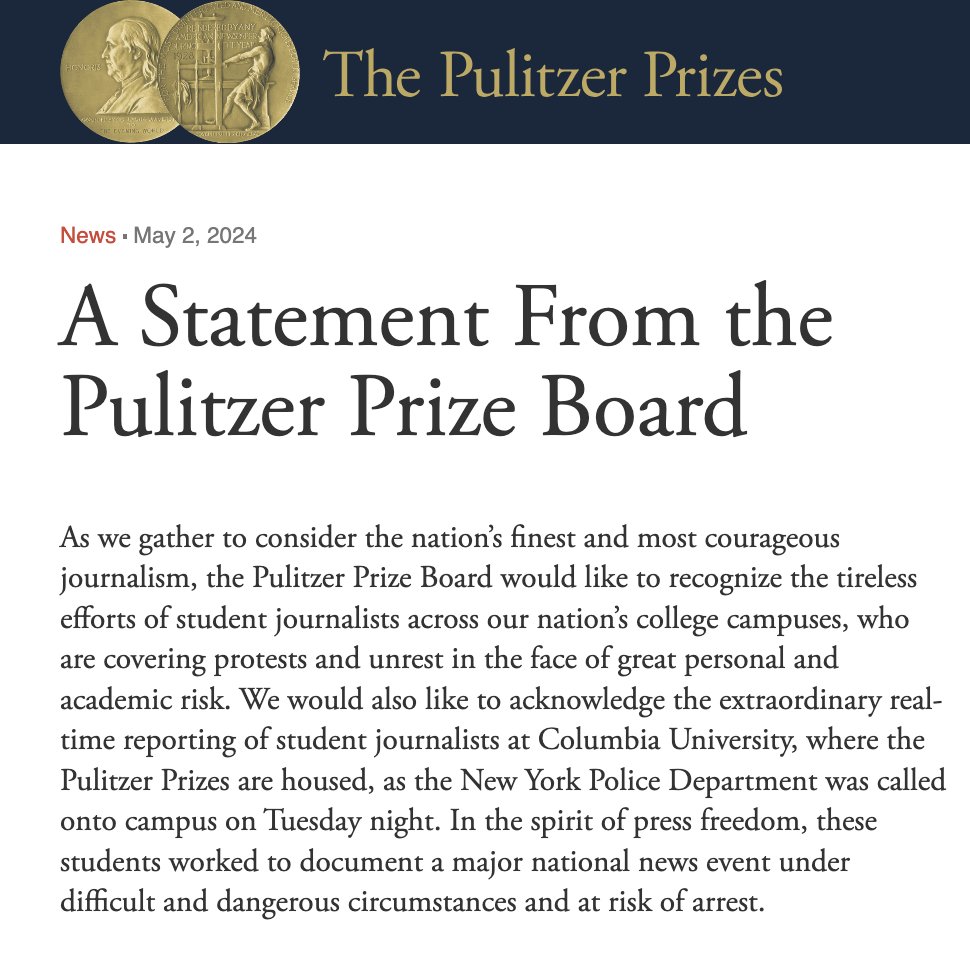
There is more to say, but for now let me tell you how proud I am of our @columbiajourn students, whom I've watched report non-stop for days, sleep on floors, support one another & give their all to bearing witness under dire conditions: https://t.co/uRvlyG4Gxp @PulitzerPrizes