Editing a multi-agent plan is not the same as steering it.
We introduce 𝗔𝗠𝗕𝗜𝗣𝗢𝗠: 𝗮 𝗽𝗿𝗼𝘁𝗼𝘁𝘆𝗽𝗲 𝗳𝗼𝗿 𝗵𝘂𝗺𝗮𝗻-𝗟𝗟𝗠 𝗰𝗼-𝗽𝗹𝗮𝗻𝗻𝗶𝗻𝗴 𝘁𝗵𝗮𝘁 𝗲𝗻𝗮𝗯𝗹𝗲𝘀 𝘂𝘀𝗲𝗿𝘀 𝘁𝗼 𝗲𝗱𝗶𝘁 𝗮𝗴𝗲𝗻𝘁 𝗽𝗹𝗮𝗻𝘀 𝘃𝗶𝗮 𝗰𝗵𝗮𝘁, 𝘁𝗮𝗿𝗴𝗲𝘁𝗲𝗱 𝗳𝗲𝗲𝗱𝗯𝗮𝗰𝗸, 𝗴𝗿𝗮𝗽𝗵 𝗺𝗮𝗻𝗶𝗽𝘂𝗹𝗮𝘁𝗶𝗼𝗻, 𝗮𝗻𝗱 𝗺𝗲𝗿𝗴𝗲, 𝘀𝗽𝗹𝗶𝘁, 𝗮𝗻𝗱 𝗿𝗲𝗽𝗹𝗮𝗻 𝗼𝗽𝗲𝗿𝗮𝘁𝗶𝗼𝗻𝘀.
The key finding:
More controls reduce some effort, but they also create new verification work.
Users built hybrid workflows rather than choosing one interaction type.
Global feedback was most robust for complex revisions. Targeted feedback preserved unchanged parts of the plan, but could introduce structural errors. Edit sequences were easier to audit, but less reliable for complex changes.
For agentic AI, the design challenge is to “help users know whether the edited plan still works.”
📄 Read the article: https://t.co/rXTzxVAHp2
@estevamhruschka
#AI #Agents #LLMs #HumanCenteredAI #CAIS2026
We’re hiring a Fall/Winter PhD Research Intern at Megagon Labs.
We’re looking for candidates with research or technical experience in any one or more of the following areas:
• Retrieval-Augmented Generation (RAG)
• Function Calling
• Document Understanding / PDF Parsing
You do not need experience across all three areas. Strong experience in any one of these topics is relevant.
Interested in joining us this fall? Learn more and apply → https://t.co/N9xgO2NjSf
Applicants must have or be able to obtain appropriate U.S. work authorization for the internship period.
#AI #NLP #LLMs #internships #phdposition
Correct answers are no longer enough. As LLMs become part of systems that use tools, memory, and evolving knowledge, we also need to understand how those components change model behavior.
That question shaped much of the conversation at ACL 2026.
Read the article!
https://t.co/UKGs5zL39u
#AI #LLMs #CompoundAI
Your AI agent can cite a source. That doesn't mean the source says what the row claims.
Here's the failure mode we kept seeing: an LLM curator builds a plausible structured table from parametric memory; it "just knows" what should go in the cell, then bolts on a page-level citation afterward to make it look sourced. The citation is real, and the row is not grounded in it. It's structured output with decorative provenance.
We built Stage-Audit to close that gap in the context of what we call Seed2Frontier discovery: starting from a single Wikipedia seed page and autonomously finding the additional pages needed to complete a structured table that answers a natural-language query.
https://t.co/KCaCPmJS3z
#AIResearch #AgenticAI #CompoundAI #LLM #DataManagement #AIAgents
Most LLM extraction systems forget what they learned the moment the document ends. At ACL 2026, we introduce DySECT: a self-evolving extraction system that builds an explicit KB as it extracts.
This is a glance at our loop:
extract triples -> update KB -> organize and score knowledge -> feed it back into extraction
On DocRED, KB-guided extraction improved recall across GPT-4.1, GPT-4.1-mini, LLaMA-3.3 70B, and Kimi K2.5.
The key result: 5-8% recall gains on the first guided iteration, without fine-tuning or synthetic data generation.
Adaptation can happen through inspectable memory, not only opaque model updates.
👉Read the article: https://t.co/987Q2Gnkaz
#ACL2026 #NLProc #LLM #InformationExtraction #EnterpriseAI #KnowledgeGraphs #AIResearch #MegagonLabs #ContinuousLearning
As AI agents become more capable, understanding how they make decisions is becoming just as important as the answers they produce.
In our latest blog, we explore why agent observability is emerging as a critical capability for enterprise AI. We also introduce L.A.K.E. (Logic Agent for Knowledge Extraction), our agentic data planning framework that makes planning visible through executable workflows and interactive DAGs, helping developers inspect, evaluate, and improve how AI agents reason across complex data sources.
Transparency isn't just about explainability; it enables debugging, optimization, and building more reliable AI systems.
Read our blog post: https://t.co/9yVv2Ebkzf
#AI #EnterpriseAI #AgenticAI #MachineLearning #Transparency #MegagonLabs
Most 𝗟𝗟𝗠 𝗲𝘅𝘁𝗿𝗮𝗰𝘁𝗶𝗼𝗻 𝘀𝘆𝘀𝘁𝗲𝗺𝘀 treat each document in isolation, failing to retain and reuse knowledge acquired from previous extractions. That is a problem in domains where terminology changes, taxonomies evolve, and rare concepts matter.
At ACL 2026 in San Diego, we introduce 𝗗𝘆𝗦𝗘𝗖𝗧: 𝗮 𝗗𝘆𝗻𝗮𝗺𝗶𝗰 𝗦𝗲𝗹𝗳-𝗘𝘃𝗼𝗹𝘃𝗶𝗻𝗴 𝗘𝘅𝘁𝗿𝗮𝗰𝘁𝗶𝗼𝗻 𝗮𝗻𝗱 𝗖𝘂𝗿𝗮𝘁𝗶𝗼𝗻 𝗧𝗼𝗼𝗹𝗸𝗶𝘁.
Extraction should create reusable knowledge. So, DySECT uses an LLM to extract structured triples, stores them in a growing knowledge base, and assigns confidence based on source reliability, repeated evidence, and conflicts.
This accumulated knowledge is now a resource that should improve subsequent extraction rounds. The KB enriches previous extractions through hierarchical concept abstractions, confidence calibration, mutual exclusion constraints, and automated property validation. This enriched knowledge is then fed back into the extractor via prompt augmentation, encouraging broader coverage and discovery of new information in later iterations.
On DocRED, KB-guided extraction improved recall across GPT-4.1, GPT-4.1-mini, LLaMA-3.3 70B, and Kimi K2.5. The first KB-guided iteration 𝗶𝗺𝗽𝗿𝗼𝘃𝗲𝗱 𝗿𝗲𝗰𝗮𝗹𝗹 𝗯𝘆 𝟱-𝟴% 𝘄𝗶𝘁𝗵𝗼𝘂𝘁 𝗳𝗶𝗻𝗲-𝘁𝘂𝗻𝗶𝗻𝗴 𝗼𝗿 𝘀𝘆𝗻𝘁𝗵𝗲𝘁𝗶𝗰 𝗱𝗮𝘁𝗮 𝗴𝗲𝗻𝗲𝗿𝗮𝘁𝗶𝗼𝗻.
Adaptive extraction does not have to mean opaque model updates. DySECT keeps accumulated knowledge explicit, inspectable, and editable.
For enterprise AI systems, that matters. Knowledge can evolve, but oversight and transparency stay in the loop.
📄 Read the research: https://t.co/6T7ykVTDmw
Work by @moinnas, Hannah Kim, @estevamhruschka Hruschka
#ACL2026 #continuouslearning #AI #LLMs
As LLM systems become more agentic, improving individual outputs may not be enough.
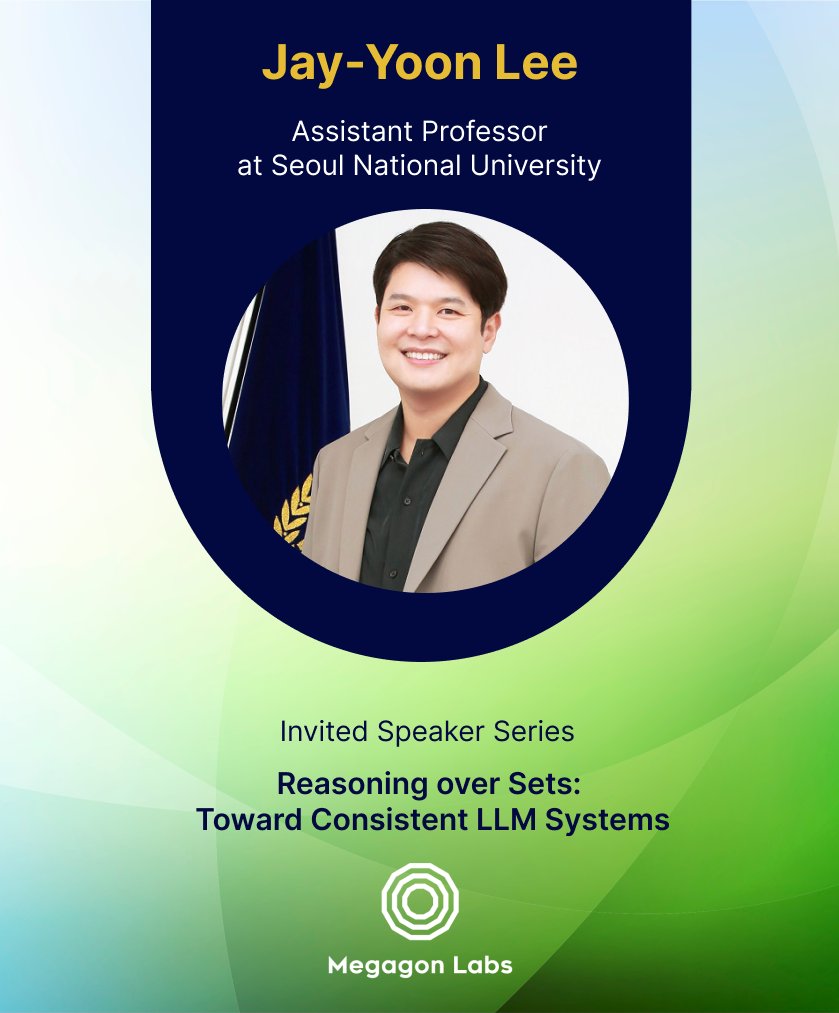
In a recent Megagon Labs Seminar Series talk, Jay-Yoon Lee (Seoul National University / UIUC) explored the idea that correctness and reliability often emerge at the set level. Modern LLM systems increasingly operate over collections of retrieved documents, generated statements, and intermediate reasoning steps, yet most frameworks still treat these elements independently.
Interactions such as contradictions, redundancy, and joint relevance can shape outcomes just as much as the information itself. The talk introduced a unified perspective centered on set-level verification, retrieval, and editing as important directions for building more reliable and controllable LLM systems.
Thank you to Jay-Yoon for sharing his insights.
#LLM #AgenticAI #AIResearch
The way AI agents plan over enterprise data can dramatically change both latency and reliability.
This process of data planning, how an agent sequences operations like database queries, document retrievals, and API calls to resolve complex prompts, is foundational to enterprise AI performance.
In our latest research, we found that different planning regimes produce very different trade-offs:
- Single-shot tree planning achieved the strongest overall performance and lowest latency.
- Iterative planning provided stronger self-correction at a significantly higher execution cost.
We also observed that the planning structure itself, including generation direction and refinement strategy, can substantially impact agent behavior.
These findings highlight a broader challenge in agentic AI: you cannot optimize or trust what you cannot inspect.
As agents increasingly orchestrate tools across databases, documents, and external systems, understanding how plans are generated and executed becomes critical for debugging, evaluation, and deployment.
To address this, we introduce L.A.K.E. (Logic Agent for Knowledge Extraction), an agentic data planning framework designed to make planning observable. L.A.K.E. exposes execution paths as interactive DAGs with step-level provenance, enabling developers to inspect workflows, compare planning strategies, and understand why agents succeed or fail.
This work reflects a broader direction we are exploring at Megagon Labs: building agentic systems that are not only capable of reasoning over complex enterprise data, but also transparent, debuggable, and efficient to operate.
#Agentic #NLProc #LLMs
https://t.co/K8seDSN74z
Can LLMs automate prompt engineering?
RPT says: Apparently yes—by turning prompt tuning into a function-calling workflow: evaluate, diagnose recurring failures, use memory, and revise.
The result: stronger prompts on reasoning tasks and better-calibrated confidence.
📢 New Preprint
Prompting is a flexible way to adapt LLMs, but prompt engineering is still manual and hard to scale. Can function-calling LLMs act like prompt engineers: inspect failures, diagnose patterns, and revise prompts?
Meet Reflective Prompt Tuning (RPT): a diagnosis-driven framework for iterative prompt tuning with function-calling LLMs.
Paper: https://t.co/wNczUx32KM
@MegagonLabs
1/n
𝗪𝗲 𝗳𝗼𝘂𝗻𝗱 𝘁𝗵𝗮𝘁 𝗟𝗟𝗠 𝗮𝗴𝗲𝗻𝘁𝘀 𝗰𝗮𝗻 𝗺𝗮𝘁𝗰𝗵 𝘁𝗵𝗲 𝗮𝗰𝗰𝘂𝗿𝗮𝗰𝘆 𝗼𝗳 𝗥𝗲𝗔𝗰𝘁-𝘀𝘁𝘆𝗹𝗲 𝗮𝗴𝗲𝗻𝘁𝘀 𝘄𝗵𝗶𝗹𝗲 𝘂𝘀𝗶𝗻𝗴 𝟮–𝟯𝘅 𝗳𝗲𝘄𝗲𝗿 𝘁𝗼𝗸𝗲𝗻𝘀.
In our latest research, we revisit a core assumption in agentic AI: that agents must interleave reasoning and execution at every step to remain adaptable.
We compare single-step horizon planning against full-horizon planning for data-centric tasks such as Knowledge Base QA and Multi-hop QA.
Our experiments show that full-horizon planning with lazy replanning achieves accuracy parity with step-wise approaches across varying task depths, branching complexity, and tool robustness levels, while substantially reducing token usage.
In many cases, eager execution monitoring provided little benefit relative to its computational overhead.
These findings suggest that planning horizon is not merely an implementation choice, but a fundamental systems design decision for LLM agents.
For well-defined data-centric tasks, generating complete plans upfront and replanning only when necessary may offer a more efficient default for tool-using AI systems.
This work will be presented at CAIS 2026
📄 Read the research: https://t.co/CjPme0X3mm
#AI #AgenticAI #LLMs #CAIS
𝗔𝗴𝗲𝗻𝘁𝘀 𝗰𝗮𝗻 𝗹𝗲𝗮𝗿𝗻 𝗰𝗼𝗻𝘁𝗶𝗻𝘂𝗼𝘂𝘀𝗹𝘆 𝗳𝗿𝗼𝗺 𝗹𝗮𝗯𝗲𝗹𝗲𝗱 𝗳𝗲𝗲𝗱𝗯𝗮𝗰𝗸, 𝘄𝗶𝘁𝗵𝗼𝘂𝘁 𝗽𝗮𝗿𝗮𝗺𝗲𝘁𝗲𝗿 𝘂𝗽𝗱𝗮𝘁𝗲𝘀. 𝗧𝗵𝗶𝘀 𝗶𝗺𝗽𝗿𝗼𝘃𝗲𝘀 𝗮𝗰𝗰𝘂𝗿𝗮𝗰𝘆 𝘄𝗵𝗶𝗹𝗲 𝗰𝘂𝘁𝘁𝗶𝗻𝗴 𝗿𝗲𝗮𝘀𝗼𝗻𝗶𝗻𝗴 𝗰𝗼𝘀𝘁𝘀.
Our approach borrows from human cognition: agents build two kinds of memory from past examples:
𝗘𝗽𝗶𝘀𝗼𝗱𝗶𝗰: instance-level critiques of what went right or wrong on specific cases
𝗦𝗲𝗺𝗮𝗻𝘁𝗶𝗰: task-level patterns distilled from those critiques
At inference time, the agent retrieves relevant memories and uses them to guide its decision.
Across 7 datasets and 6 models (GPT-5, GPT-4o-mini, GPT-oss-20b, Llama-4-Scout, and two Qwen3-235B variants), the combined strategy delivered:
✓ +8.1 pp over zero-shot
✓ +4.6 pp over RAG few-shot baselines
✓ 31.95% fewer thinking tokens for reasoning models compared to RAG few-shot.
Pre-computed critiques substitute for reasoning the model would otherwise do at inference, resulting in both accuracy gains and lower per-query costs, with significant implications for agents deployed in production.
We also introduce suggestibility, a metric for how receptive a model is to in-context reasoning. It helps explain why some models gain dramatically from memory augmentation while others barely move, and it raises questions about the tradeoff between learnability and adversarial robustness.
🔧 Code & datasets: https://t.co/IPl07dtht6
Read the paper: https://t.co/yz7C3yStjP
Research by Jackson Hassell, Dan Zhang, Hannah Kim, @tommmitchell, and @estevamhruschka — presented at ACM CAIS '26.
#AI #LLM #AIAgents #MachineLearning
Where is AI actually headed? #EACL2026 highlighted a shift toward agentic systems, stronger evaluation, and more reliable LLMs.
From multi-agent workflows and tool use to deeper evaluations of RAG, reasoning, and personalization, the field is moving beyond isolated model improvements toward systems that operate effectively in complex, real-world environments.
Read the article to learn about the major trends across agentic AI, LLMs, and RAG.
👉 https://t.co/68eOYh7YS0
#AI #LLM #AI #AgenticAI @estevamhruschka
𝐖𝐡𝐲 𝐝𝐨 𝐭𝐡𝐞 𝐬𝐚𝐦𝐞 𝐩𝐫𝐨𝐦𝐩𝐭 𝐚𝐧𝐝 𝐝𝐚𝐭𝐚 𝐩𝐫𝐨𝐝𝐮𝐜𝐞 𝐰𝐢𝐥𝐝𝐥𝐲 𝐝𝐢𝐟𝐟𝐞𝐫𝐞𝐧𝐭 𝐫𝐞𝐬𝐮𝐥𝐭𝐬 𝐚𝐜𝐫𝐨𝐬𝐬 𝐀𝐈 𝐬𝐲𝐬𝐭𝐞𝐦𝐬? 𝐌𝐨𝐬𝐭 𝐛𝐥𝐚𝐦𝐞 𝐦𝐨𝐝𝐞𝐥 𝐬𝐢𝐳𝐞 𝐨𝐫 𝐭𝐫𝐚𝐢𝐧𝐢𝐧𝐠 𝐝𝐚𝐭𝐚 𝐛𝐮𝐭 𝐨𝐮𝐫 𝐥𝐚𝐭𝐞𝐬𝐭 𝐫𝐞𝐬𝐞𝐚𝐫𝐜𝐡 𝐫𝐞𝐯𝐞𝐚𝐥𝐬 𝐭𝐡𝐞 𝐫𝐞𝐚𝐥 𝐜𝐮𝐥𝐩𝐫𝐢𝐭: 𝐝𝐚𝐭𝐚 𝐫𝐞𝐩𝐫𝐞𝐬𝐞𝐧𝐭𝐚𝐭𝐢𝐨𝐧.
We ran a controlled study, keeping content identical while changing only format. The results challenge how we think about building compound AI systems.
Key finding:
• SQL systems dropped 30-45% in performance on the same data when representation changed.
• LLMs showed the opposite pattern, with performance increasing.
• Hybrid systems? We found something completely different.
For teams building RAG systems, multi-agent workflows, or agentic AI, this isn't just an academic insight—it's a critical design decision most are overlooking.
Representation is part of the computation, not just preprocessing.
𝐑𝐞𝐚𝐝 𝐰𝐡𝐲 𝐭𝐡𝐢𝐬 𝐦𝐚𝐭𝐭𝐞𝐫𝐬 𝐟𝐨𝐫 𝐲𝐨𝐮𝐫 𝐀𝐈 𝐬𝐲𝐬𝐭𝐞𝐦𝐬: https://t.co/xBBrg0QMNV
By Megagon Labs and @SAYg_7
#AI #CompoundAI #LLM #MachineLearning #AIEngineering #Research
📢New Preprint📢
LLMs can solve many tasks. But who verifies an answer when the judge is also an LLM?
We introduce AutoPyVerifier: learning compact Python verifier sets from labeled LLM outputs, improving objective prediction by up to +55 F1.
Paper: https://t.co/VwJKCHR81u 1/n
Welcoming @MegagonLabs as a Founding Gold Sponsor of CAIS 2026. Megagon is an AI research lab building at the intersection of NLP, data management, and LLM agents.
Find them in the Bayshore Foyer May 26-29. https://t.co/MxpkxyQuwm
Starting an AI research internship soon? 👨💻👩💻
We put together 7 tips for AI research interns on how to:
- hit the ground running
- adapt when research shifts
- build relationships that last beyond the internship
Read the full guide here → https://t.co/JjQH1eBEhp
#PhDLife #AIResearch #ML #NLP #LLM
Attending #ICLR 2026 in Brazil? Learn how data representation affects LLM response, with a poster presentation on 𝗦𝗮𝗺𝗲 𝗖𝗼𝗻𝘁𝗲𝗻𝘁, 𝗗𝗶𝗳𝗳𝗲𝗿𝗲𝗻𝘁 𝗥𝗲𝗽𝗿𝗲𝘀𝗲𝗻𝘁𝗮𝘁𝗶𝗼𝗻𝘀: 𝗔 𝗖𝗼𝗻𝘁𝗿𝗼𝗹𝗹𝗲𝗱 𝗦𝘁𝘂𝗱𝘆 𝗳𝗼𝗿 𝗧𝗮𝗯����𝗲 𝗤𝗔 with @estevamhruschka
Not attending? Read the paper here: https://t.co/7x5beVWi1P
Paper by Yue Zhang, @SAYg_7, @nikita_bhutani
#AI #LLMs #Research #PhD