The 2026 AP Environmental Science Exam scores:
5: 13%; 4: 29%; 3: 27%; 2: 15%; 1: 16%
The 2026 AP Environmental Science exam was taken by ~245,000 students, roughly 1.6% of the U.S. high school population.
AP Environmental Science Multiple-Choice Questions (MCQs):
Students demonstrated strong understanding of Unit 7: Atmospheric Pollution and Unit 5: Land and Water Use. Typically, students achieving AP 4s and AP 5s answered 100% of these questions correctly, students achieving AP 3s only missed a single point within this unit, and students receiving AP 2s answered all but two such questions right.
Their performance was similarly strong on questions related to Unit 5, Land and Water Use. To achieve an AP 5, students generally answered 100% of these questions right, to achieve an AP 4, at least 91% of these questions right, and to achieve an AP 3, at least 80% of these questions right.
Questions about Unit 2: The Living World - Biodiversity helped to distinguish students earning AP scores of 3 or higher, who were typically able to answer most of these questions correctly, from students receiving AP scores of 1 and 2, who were not. Based on this, students may benefit from more instructional emphasis on concepts related to biodiversity.
The most challenging MCQs required Skill 6: Mathematical Routines. Math remains one of the most differentiating skills for students in this course, as students were generally able to answer a meaningful number of these questions correctly in order to receive an AP 3 or higher, and typically answered all or all-but-one correctly to receive an AP 5.
AP Environmental Science Free-Response Questions (FRQs):
The FRQ section is designed to assess students' capacity to integrate topics across the AP Environmental Science course framework and apply their understanding of these topics to real-world scenarios. For the 2026 exam, the FRQ section covered topics such as species distribution, climate adaptation, energy systems, aquatic pollution, and wildlife conservation. Each free response question includes 10 points and is designed to assess a range of skill levels within the same question, with a focus on higher-order skills expected of college-level learning in environmental science.
Here’s a link to this year’s questions:
https://t.co/NlGC19cyVS
Since AP scores are reported on a 5-point scale, the free-response questions deliberately include some very difficult points, designed to differentiate AP 5s from AP 4s, points of varying difficulty levels to differentiate AP 4s, 3s, and 2s, and more foundational points to separate AP 2s from AP 1s.
This section as a whole required students to demonstrate their understanding of experimental design (Q1), analyze real environmental data (Q2), and use mathematical operations to analyze an environmental problem (Q3). To be blunt: the faculty committee who wrote these questions was laser-focused on the higher-order skills that represent college-level performance.
FRQ #1: Design an Investigation
This question presented students with a diagram of five bird species' current and predicted future elevation distributions within a tropical mountain range. Among other tasks, students had to interpret species richness patterns, reason about climate conditions at different elevations, and explain predator-prey dynamics in response to shifting prey communities. The question required students to demonstrate the capacity to apply fundamental concepts to a breadth of scenarios grounded in terrestrial ecology, marine biology, and climate systems.
Part A was a basic entry point that requires a fundamental skill expected even among many students receiving AP 1s: the ability to accurately read a scientific diagram. 93% of students earned this point.
Part C differentiated between students receiving an AP 2 and those receiving an AP 1; it required students to verbalize an understanding of a core principle in predator / prey dynamics.
Parts D and F, which require students to understand and explain a scientific prediction, and to identify an independent variable within a scientific experiment, distinguish students achieving AP 3s, who were able to earn these points, from students receiving AP 2s, who are not.
Part G, which required students to articulate an experimental design question relevant to the stimulus, was the best differentiator between students achieving AP 4s and students achieving AP 3s; students receiving the lower score were usually unable to demonstrate this skill.
Part H, in which students were asked to explain how sediment volume changed experimental conclusions, was the most difficult point to earn, typically achieved only by students receiving AP 5s, and Part I (in which students needed to describe a positive feedback loop in the Arctic) was also quite challenging, the best differentiator between AP 4s, who often could not earn this point, and AP 5s, who typically could; 17% of students earned the point for Part I.
FRQ #2: Analyze an Environmental Problem and Propose a Solution
This question used a graph of energy consumption by source from 1950 to 2020 to assess students' ability to read longitudinal data, explain mechanisms behind energy transitions, and reason about electricity generation from both fossil fuel and nuclear sources. The question then shifted to aquatic ecology, asking students to explain how excess nutrients from runoff can drive eutrophication and hypoxia, and to propose and justify a realistic solution to this problem.
Part B – as in FRQ 1, the point requiring basic, accurate understanding of scientific data within a graph – was expected even among many students receiving an AP 1. 96% of students were able to earn this point, the easiest within this year’s entire FRQ section.
Part A was the key differentiating point between AP scores of 2 and 1, as students receiving an AP 1 were generally unable to recall and state with accuracy a renewable energy source that is used to generate electricity.
Part E, H, and I distinguished students achieving AP 4s and AP 5s from students achieving AP 3s, who were able to succeed on the other parts of this FRQ, but often found these three parts too challenging.
FRQ #3: Analyze an Environmental Problem and Propose a Solution Doing Calculations
This question required students to apply mathematical skills to the analysis of a real-world conservation scenario involving ocelots. Students estimated percent change in ocelot habitat, applied the Rule of 70 to estimate population doubling time, and reasoned through dietary needs based on available prey and assumptions about trophic energy transfer. They also proposed and justified a realistic solution to wildlife-vehicle collisions.
Part A, in which students identified an environmental consequence of a reduced ocelot population, was earned by 85% of students, serving as the key differentiator between AP 2s and AP 1s on this question.
Parts B, C – each of which require mathematical calculations – were the most significant differentiators between students achieving AP 4s and students receiving AP 3s, as students receiving AP 3s were not consistently able to earn all four of these points.
Part E, which required students to calculate the number of individual prey needed to fill a particular dietary component for ocelots, was the clearest distinction between students earning a 3, who were generally able to succeed on these tasks, and students receiving a 2, who were not.
Part D, which did not require a mathematical operation, was the most challenging part of this FRQ, usually only earned by students receiving AP 4s and 5s.
All subjects' AP score distributions for 2026 will be posted here when available: https://t.co/OrkaQhPZYO.
📚🏐 These student-athletes achieved a perfect 4.000 GPA for their final trimester of the school year!
Their commitment to excellence extends far beyond the court. The countless hours spent studying, completing assignments, & balancing academics with athletics have paid off.
📚🏐 Student first. Athlete second.
40+ student-athletes. A 3.800 cumulative GPA. A 3.850 GPA for third trimester.
We're proud of the hard work, discipline, and commitment our athletes show in the classroom every day. Excellence starts with being a student first.
What a crew to end our camps with! They brought the energy and effort! Thank you to everyone that participated in our youth camps! We had a blast working with the next generation of volleyball players.
And they're off to the State Golf Tournament! Our Falcons will play in the morning round on Monday and the afternoon round on Tuesday! GO FALCONS! #weAREwestosha
Today, our volleyball family pauses to remember and honor the brave men and women who made the ultimate sacrifice. We are forever grateful for their courage and service. Have a safe and meaningful Memorial Day. 🇺🇸
Imagine going back to your high school two years after graduating while wearing a USA uniform and playing alongside players you’ve always looked up to… and in front of a packed house. What a night! Congrats Char!
The Forensics Team continued its winning streak with six straight years of the Excellence in Speech award! This season, our team had only top honors at State, earning a record-breaking 31 gold medals and 10 silver medals. #weAREwestosha
Congrats to our Varsity Girls Lacrosse Co-op on ending conference play undefeated and securing the first conference title ever! Good luck in postseason. @mikeramczyk17@SectionWc@CHS_BoosterClub
We are looking for a Business & Marketing Education Teacher to join our team! Head to the link below to learn more and apply! #weAREwestosha
https://t.co/aBQ7nVP2LZ
Camp ✌🏼 and it was all about attacking and setting. This group crushed it! We saw a lot of growth! One more camp left and excited to how it is all put together.
The impact of extracurricular activities goes far beyond the season. Students build confidence, create lasting friendships, and develop life skills that support success in school and beyond. During #MentalHealthAwarenessMonth, we’re reminded of the importance of prioritizing your mental health. ❤️
We are very excited about this next presenter-
They led their program to the D1 State Title this past season.
🗓️ Saturday, August 1st, 2026
📍 Sun Prairie, WI
💰 $70, $35 for each additional coach (5 additional)
👉 Secure your spot today at https://t.co/uRaWMIIxjk
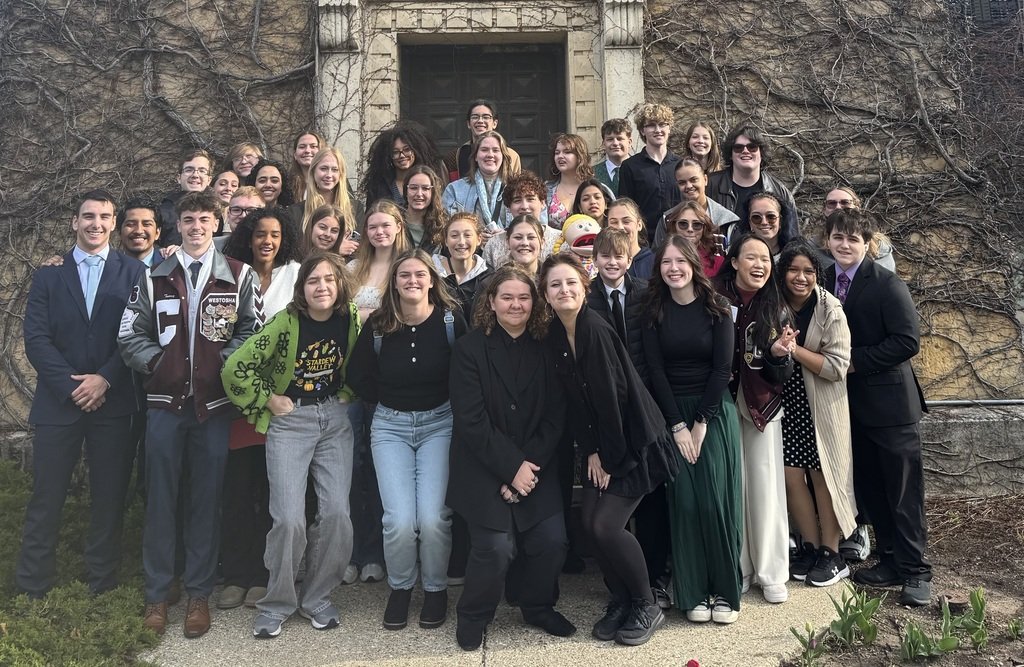
Raise Your Voice students and advisors recently made a trip to Madison for a Teen Mental Health Leadership Summit. They created a coping skills toolbox to share with fellow WCHS students! #weAREwestosha