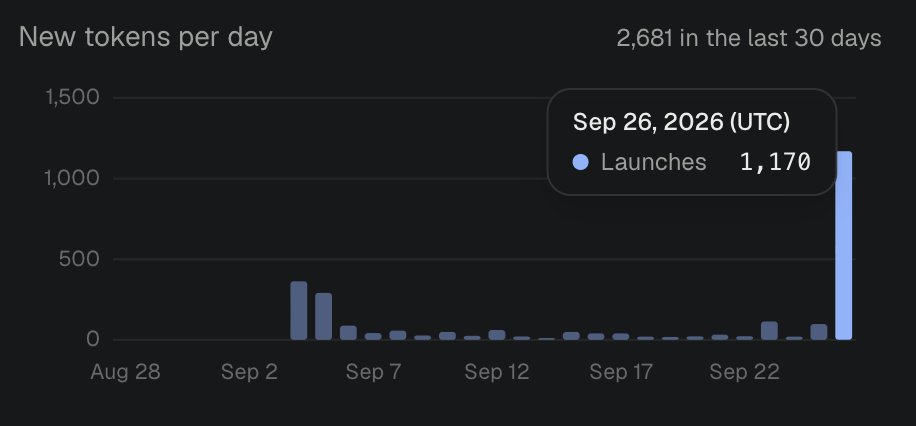
1,170 tokens were launched on https://t.co/O9qn6PMuia today.
The vast majority of them use the multi-pair mode.
That's an interesting and very good sign for the platform. Since day one (the last 22 days) - 1,510 tokens have been launched in total, 363 of them on the first day after the $par launch.
Today (and the day isn't over yet) will probably end up at twice what the whole platform has done since it started 🤯
After all the work we put into making this as good for developers as we possibly can, it's good to see you actually using it.
Thank you very much. We keep building for you, job is not done yet.
A reminder too: par has plenty of other launch options no other launchpad offers. Take a look at them, there's a lot of room to launch something interesting and different. We're counting on your creativity!
gPar.
1/ 🧵
I think most people are looking at https://t.co/t8ZXZ1MU5p the wrong way.
The biggest opportunity may NOT be the tokens people launch.
It may be the trading activity underneath them.
And if that activity scales, the $PAR thesis gets VERY interesting.
Here’s why 👇
2/
Think about the basic model:
A creator launches a token.
Instead of one market, par can create up to 5 markets for the same token.
Different quote assets.
Different pools.
One shared token.
That creates a completely different market structure.
3/
Now imagine those 5 quote assets start moving differently.
The same token can temporarily have different implied prices across its markets.
That creates arbitrage opportunities.
And arbitrageurs don't need to love the token.
They only need the trade to be profitable.
4/
That is the part I think people are missing.
A token doesn't necessarily need thousands of fans saying:
“I'm buying this because I believe in it.”
Bots can trade because the MARKET STRUCTURE creates an opportunity.
And every swap pays fees.
5/
Now zoom out.
One launch = 5 markets.
100 launches = potentially hundreds of markets.
1,000 launches = thousands of markets.
10,000 launches = an entirely different scale of on-chain activity.
The important number isn't launches.
It's the trading volume those launches produce.
6/
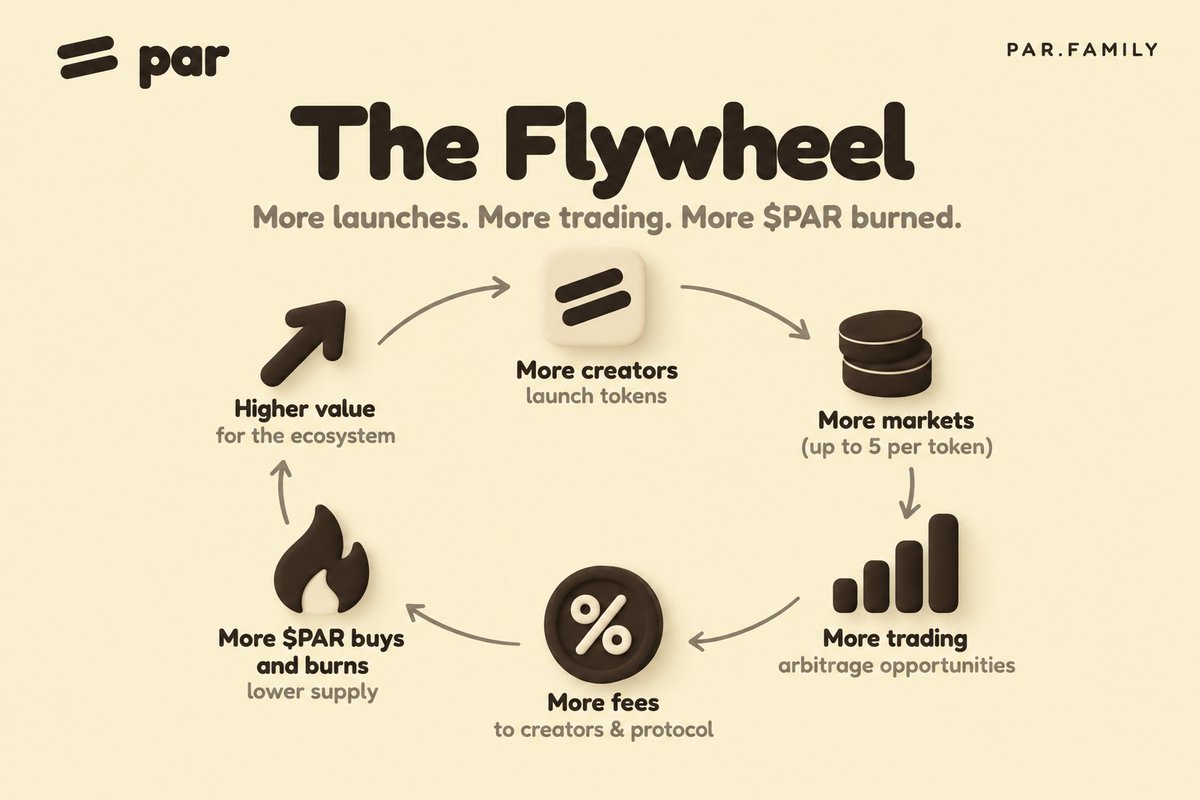
And this creates an interesting flywheel:
More creators
↓
More launches
↓
More markets
↓
More potential arbitrage opportunities
↓
More swaps
↓
More protocol fees
↓
More $PAR buybacks/burns
That's the thesis.
7/
And this is where $PAR becomes interesting.
The protocol doesn't only benefit when somebody launches a token.
The protocol can continue earning from the trading activity happening inside the markets.
That's a fundamentally different model from simply collecting a launch fee.
8/
According to par's current documentation, the base pool fee is 1%.
The protocol receives half of that base fee.
The creator can add an additional creator tax, which goes to the creator.
So creators have a direct reason to bring activity onto the platform.
9/
Then comes the part I find particularly interesting:
par's current fee mechanism sends a large portion of protocol-generated value toward $PAR through burning and buybacks.
So the potential flywheel becomes:
ACTIVITY → FEES → BUYBACK/BURN → LOWER $PAR SUPPLY
10/
Now imagine the platform becomes extremely popular.
Not because every token succeeds.
But because thousands of creators keep launching experiments, traders keep searching for opportunities, and bots keep arbitraging inefficient markets.
That could turn par into a real on-chain fee engine.
11/
And here's the asymmetric part:
$PAR is currently tiny compared with the valuation of mature crypto infrastructure protocols.
I'm NOT saying $PAR will definitely become a multibillion-dollar asset.
I'm saying:
If par can scale from a small launch platform into a large, continuously traded market ecosystem...
the current valuation would look very different.
12/
A multibillion-dollar $PAR valuation would require MUCH more than token launches.
It would require:
• Large recurring volume
• Deep liquidity
• More creators
• More traders
• More integrations
• Stronger ecosystem effects
• Sustainable protocol revenue
• Continued $PAR demand
That's the bull case.
13/
And there's an important difference between:
“More launches”
and
“More valuable launches.”
1,000 dead tokens don't matter.
But 1,000 markets producing recurring, economically meaningful trading activity?
That's a completely different story.
14/
This is also why I started experimenting with multi-market launches myself.
Different 5-asset combinations.
Different market structures.
Different sources of volatility.
I'm trying to find out which combinations actually attract recurring external flow.
Not just hype.
15/
There is NO guaranteed bot volume.
Bots don't trade because a token exists.
They trade when the expected profit is greater than fees, slippage and gas.
So this is an experiment — not “free money.”
That's exactly what makes the data interesting.
16/
But imagine the scale if this works.
Creators launch because they can earn fees.
Traders come because there are markets.
Bots come because there are arbitrage opportunities.
par earns protocol fees.
$PAR gets buybacks/burns.
That is a real flywheel.
17/
And this is why I think more people should be paying attention to https://t.co/t8ZXZ1MU5p.
Not because I'm telling you to blindly buy $PAR.
Not because every launch will work.
But because the underlying mechanism deserves to be tested at scale.
18/
The BIG question is:
Can par turn thousands of independent token markets into one large, continuously generating fee ecosystem?
If YES…
we may be looking at something much bigger than another launchpad.
We may be looking at infrastructure.
19/
I’m going to keep experimenting and sharing what I find.
Different combinations.
Different launches.
Real on-chain data.
No promises.
No guaranteed returns.
Just testing whether the mechanism actually works.
20/
If you think this is worth investigating, RT this thread.
The more builders, traders and researchers look at the mechanism, the faster we find out whether this flywheel is actually as powerful as it looks.
Maybe the biggest opportunity isn't the next token.
Maybe it's the machine creating the markets. 🧵
The more I research $PAR, the more I think people are looking at it as a launchpad token when they should be looking at it as launchpad infrastructure.
And the latest development makes the thesis considerably more interesting.
$PAR may be becoming much bigger than Robinhood Chain.
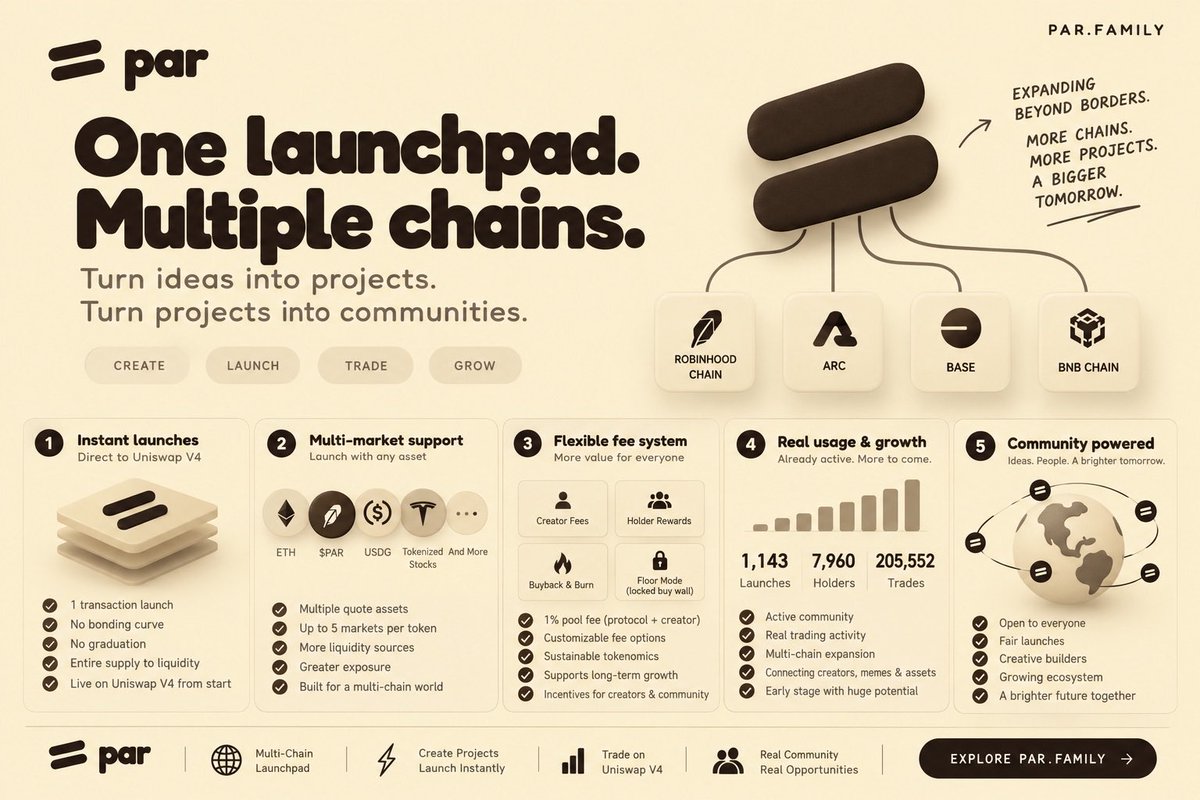
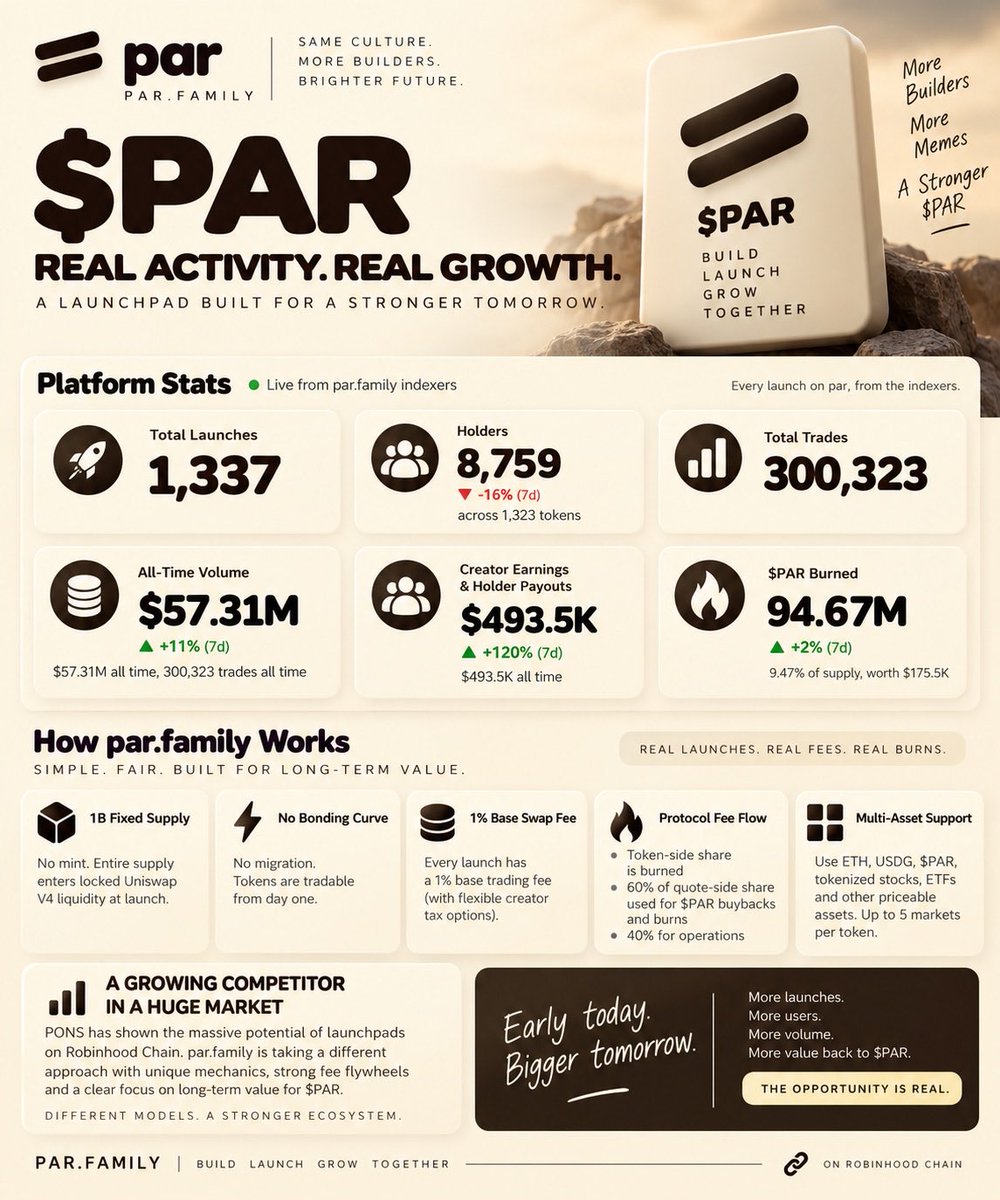
https://t.co/t8ZXZ1MU5p now operates across Robinhood Chain, Arc, Base and BNB Chain. Its SDK describes par as a multi-chain launchpad, while the team says fees from launches on Arc are routed into $PAR buybacks on Robinhood Chain.
Think about what that means.
The launchpad can expand across chains without abandoning the original $PAR value-accrual mechanism.
1️⃣ The architecture is genuinely different
A par launch doesn’t go through a bonding curve → graduation → migration process.
Instead:
1 transaction → token deployed → Uniswap V4 pool created → entire supply placed into liquidity → liquidity permanently locked.
The pool is hookless and tradeable through normal V4 infrastructure from the first block.
That is important because par isn’t creating an isolated trading environment.
It’s creating a standard Uniswap V4 market.
2️⃣ The quote-asset design is the real weapon
A project can launch against:
ETH
USDG
$PAR
tokenized stocks
or essentially any priceable token on the chain.
And one token can have up to five markets through multi-market launches.
That opens a completely different design space.
Imagine a meme launched simultaneously against:
ETH + $PAR + a tokenized stock + another ecosystem token.
The launchpad becomes less like a meme factory and more like market infrastructure.
3️⃣ The fee system creates multiple value paths
Every launch has a 1% pool fee, split between protocol and creator.
Creators can additionally choose:
• creator fees
• fees to holders
• buyback & burn
• Floor Mode
In Floor Mode, creator fees become a locked buy wall; the purchased tokens and fee-side tokens are burned, and the floor can only move upward after fee collection.
That is a fascinating mechanism because the launch itself can potentially create its own fee → liquidity support → burn loop.
4️⃣ And $PAR is still tiny relative to the infrastructure thesis
The latest Phantom data I found puts $PAR around $1.4M market cap with ~$226K 24h volume.
Meanwhile, par’s own ecosystem data had already recorded 1125 launches, 7,960 holders and 205,552 trades on Robinhood Chain by September 18.
Those aren’t predictions.
They’re simply telling us that the underlying machine is already being used.
5️⃣ Then comes the Robinhood Chain effect
Robinhood Chain itself has become one of the fastest-growing new on-chain markets, with roughly $1B TVL and extremely high DEX activity. Analysts have specifically pointed to permissionless launches + tokenized equities + memecoin activity as part of the chain’s growth flywheel.
And par sits directly inside that intersection.
Memes create launches.
Launches create trading.
Trading creates fees.
Fees can flow toward creators, holders, burns or floors.
Protocol activity can feed $PAR.
Now add three additional chains.
That’s where my thesis changes.
I’m not looking at:
“Can $PAR become another meme?”
I’m looking at:
What happens if par becomes one of the permissionless launch layers connecting meme liquidity, tokenized assets and multiple chains?
That’s a much bigger question.
$PAR doesn’t need every launch to succeed.
It needs the launch infrastructure itself to become increasingly valuable.
And that’s the part of the market I think is still being underappreciated
But at roughly $1.4M market cap, the market is currently pricing $PAR like a tiny crypto project.
The interesting thesis is whether it is actually evolving into multi-chain launch infrastructure.
PONS proved how enormous the launchpad market on Robinhood Chain can become.
Now I want to see what happens when par takes that architecture beyond Robinhood Chain.
$PAR | https://t.co/t8ZXZ1MU5p
NFA. Do your own research. ⚠️
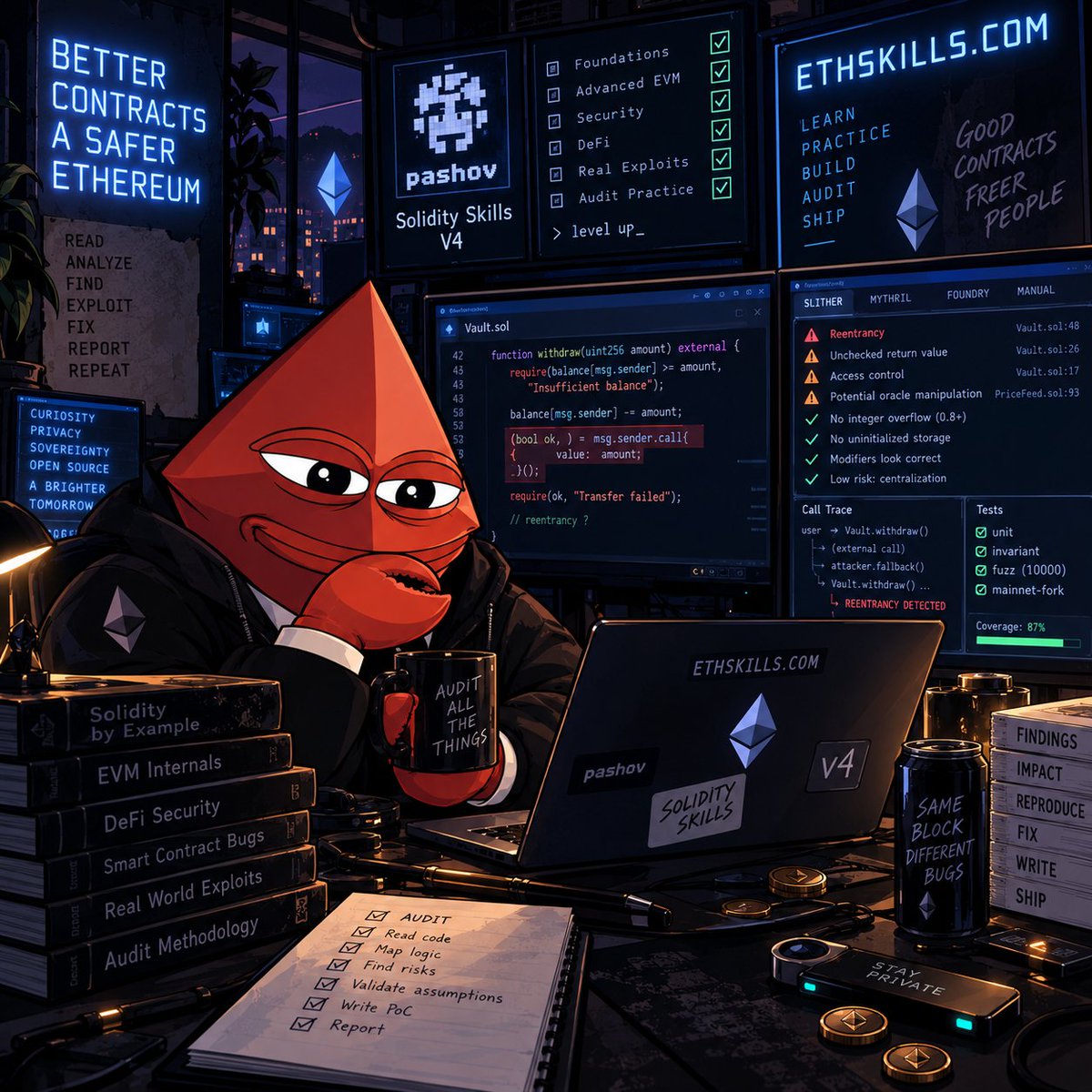
https://t.co/KiTEHw5ldc is now running on @pashov solidity auditor v4
pay 1 usdc and get a state-of-the-art first-pass ai audit
put this in your deployment pipeline and thank me later
you can even https://t.co/duNJH3hRpl and get it free
Hey @austingriffith I am closely following regular developments $CLAWD and buying too. I am not a tech person. Bit confusing, why the price of token is stuck? What is the future growth potential and approx time, if possible 🙏
Some updates since Credence went live 5days ago;
1. Credence is also a fund you can pay into.
Buy the token and its trading fees buy a side of a real Polymarket market.
Or
Skip the curve and send ETH straight to the vault; it goes into the same bet.
Anyone can run the full pipeline as usual. Obviously funds that go thru the robinhood side(credence vault) will auto bbb $pfwa
Why I think $PAR can eventually overtake $PONS for the #1 launchpad position on Robinhood Chain:
1️⃣ Better launch architecture
par launches directly into Uniswap V4 — no bonding curve, no graduation and no migration. The entire 1B supply enters a locked liquidity position from block one.
2️⃣ More than one fee flywheel
$PAR doesn’t depend on a single buyback model. Protocol fees can fund $PAR buybacks/burns, while launches can also direct creator fees to holders, buyback & burn, or Floor Mode.
3️⃣ Floor Mode is a serious differentiator
Fees can create an actual on-chain buy wall underneath the token. As fees accumulate, the floor is recalculated upward; tokens absorbed by the wall are burned. That creates a mechanism PONS doesn’t replicate in the same way.
4️⃣ Permissionless composability
par can use any priceable token on Robinhood Chain as a quote asset, not just a limited set of launch assets. That means the launchpad can potentially become infrastructure for the broader ecosystem.
5️⃣ The current gap is exactly why the upside thesis exists
PONS currently has enormous traction — roughly $2.37B 30-day DEX volume and $31.7M cumulative revenue according to DeFiLlama.
But PONS also shows how powerful the Robinhood launchpad market can become: Bitquery recorded $2.14B in post-graduation trading volume in just 32 days.
So the question isn’t whether the market exists.
It clearly does.
The question is which architecture captures the next wave.
My thesis:
PONS proved the demand.
par can potentially build the infrastructure.
If par converts its superior composability + locked V4 liquidity + fee flywheels + Floor Mode into comparable activity, the $PAR value-accrual model becomes extremely interesting.
That is the battle I’m watching. 👀
$PAR | https://t.co/t8ZXZ1MU5p