Finding parsers and vector databases is easy. Stitching them into a reliable production pipeline is not.
Meibel brings ingestion, cross-document retrieval, agent execution, and governance into one runtime, so your team can build features instead of maintaining glue code.
Boston, we're bringing new stickers!
“From blueprints to AI agents.” “Charts deserve to be seen!”
A little wordplay for real document AI headaches.
Find Kevin and Aaron at the AI & Data Transformation in Construction Summit on Sept 29. Grab a sticker and say hi!
#Meibel
Meibel is heading to #BioTechX USA!
Meet Aaron Aguillard in Boston to discuss verifiable AI for life sciences: source traceability, confidence scoring, and document intelligence built for complex workflows.
Sept 30 | Hynes Convention Center
Attending? Say hi!
#Meibel
In a 148-page test, York IE’s previous stack extracted 32 events. Meibel extracted 469.
Structure, provenance, and confidence matter.
Watch the webinar: https://t.co/jsYvTFkIwD
Next up: Boston.
Meibel will be at the AI & Data Transformation in Construction Summit on September 29.
Construction runs on complex information: specs, drawings, RFIs, submittals, addenda, inspection packages, schedules, and project records.
The challenge is turning all of that into a structured, traceable context that AI systems and agents can actually use.
Our CEO, Kevin McGrath, will be speaking on Track 4:
Unlocking Your Enterprise Data to Build Agents
2:00PM - 3:00PM.
Aaron Aguillard will also be on-site, meeting with construction and technology leaders working through document-heavy AI workflows.
September 29 | Hyatt Regency Boston | Boston, MA
Message us if you’ll be there.
#AMGWorld #AIConstruction #ConstructionTech #EnterpriseAI #Meibel
A table flattened into text can still look complete. The headers, rows, and relationships that give its values meaning may already be gone.
The agent receives whatever the document pipeline preserved. Missing structure becomes missing context, and missing context becomes another result that someone must check by hand.
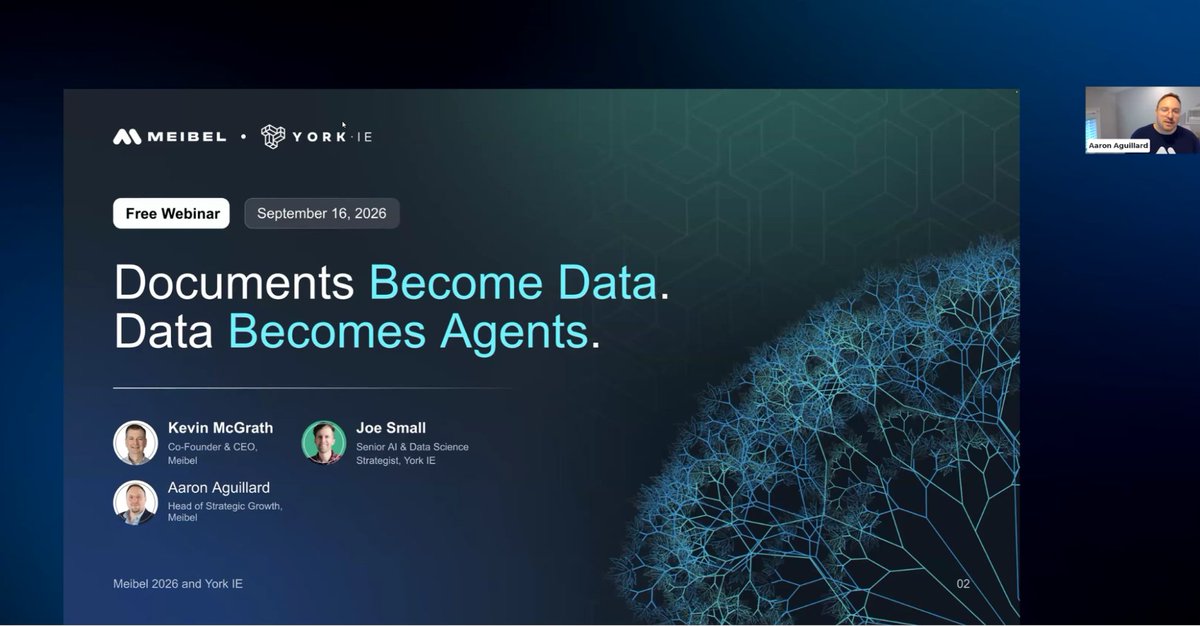
One week from today, Meibel and York IE will show how Document Intelligence turns complex business documents into structured, traceable data for production AI agents.
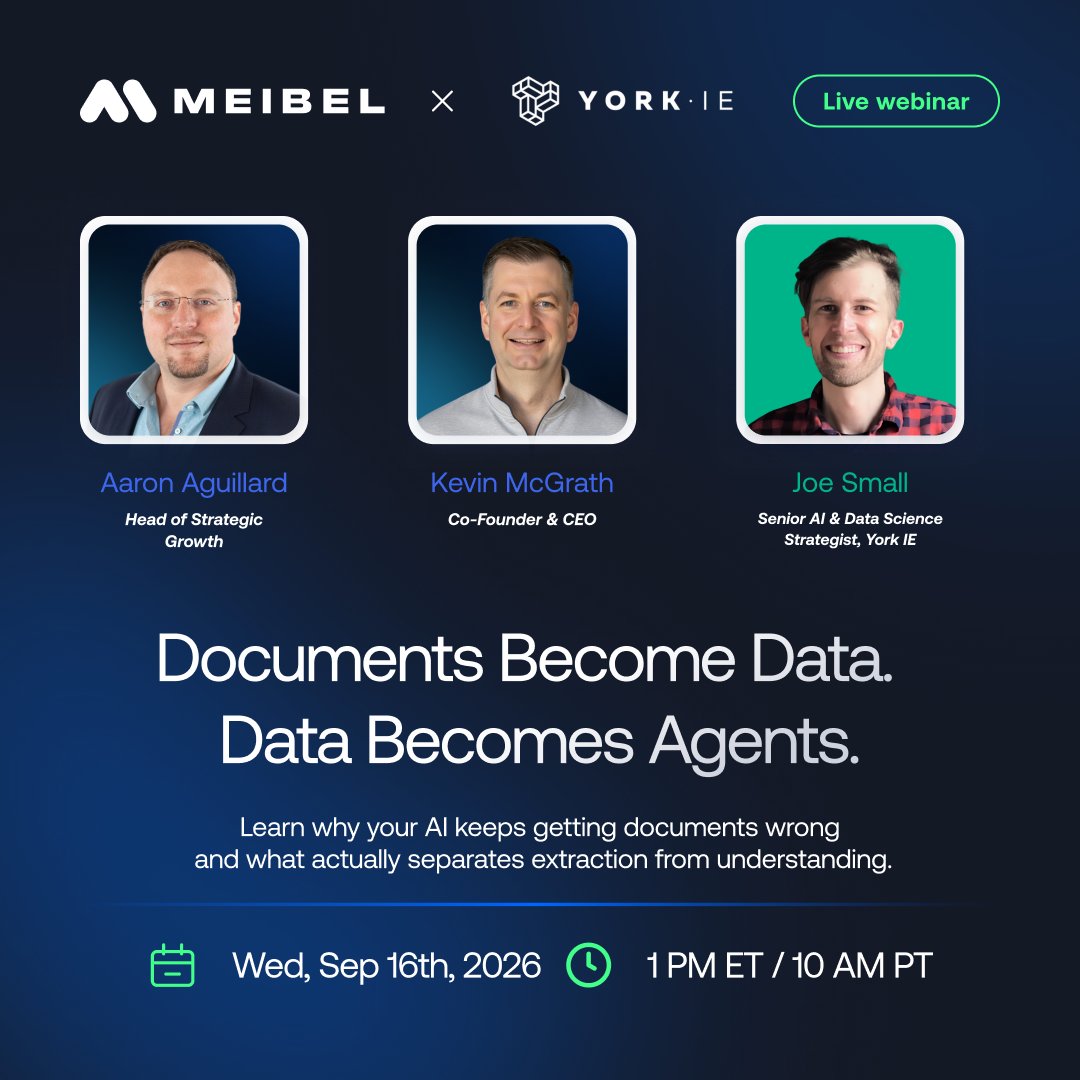
Join Kevin McGrath, Aaron Aguillard, and Joe Small for Documents Become Data. Data Becomes Agents.
September 16, 2026
1 PM ET / 10 AM PT
Free online webinar · 45 minutes, live Q&A included
Register: https://t.co/L8Rab6K75t
Reliable agents start with documents that keep their structure.
On September 16, Meibel and York IE are hosting a live webinar
Documents Become Data. Data Becomes Agents.
Business documents carry meaning through tables, drawings, annotations, captions, and relationships across pages. When extraction flattens those details, the agent starts with an incomplete context.
Kevin McGrath, Aaron Aguillard, and Joseph Small will follow the path from document ingestion to controlled agent action.
We’ll cover structure preservation, source provenance, confidence scoring, execution policies, and real workflows from construction, insurance, and engineering services.
September 16, 2026
1 PM ET
Online
45 minutes, live Q&A included
Register for free: https://t.co/CimoBafpEt
Can’t attend live? Register, and we’ll send the recording.
#DocumentIntelligence #AIAgents #EnterpriseAI #Meibel
An AI agent that can look up one record can usually look up all of them.
Most teams handle this with instructions. Tell the agent what it's allowed to touch, put it in the prompt, hope it holds. That works until someone finds a way to make the agent ignore those instructions. The boundary was never actually there. It was requested.
We built Execution Policies as Hardrails to close that gap. Each agent session runs under a fixed rule enforced outside the model, not a suggestion inside it. One agent can now serve many customers, departments, or teams, each seeing only their own data, without your team maintaining a separate copy of the agent for every permission level.
The result: your engineers maintain one agent. Your security review approves a policy instead of trusting a prompt.
In our latest blog, our Principal Scientist, Spencer Torene, breaks down how enforcement actually works and the questions worth asking when evaluating any AI platform.
Read more: https://t.co/aaD4xDSJMA
Six updates shipped in Meibel in August. Every one of them removes a step between your data and a working agent.
Document to data source in one move. Parse a document and send it straight into a data source, in the console or one API call. No second import.
Whole archives in one action. Upload a ZIP or TAR and Meibel expands it, parses each file, and ingests them as an organized data source.
Stronger guardrails when you build in code. Parse results come back strongly typed in Python, TypeScript, and Go. Tables stay tables. Charts become data. Confidence and provenance travel with every element.
More models to mix and match. Five new models are live with fallback support, so you can pick the right model for the job and your agents keep running when a provider doesn't.
A platform that works for everyone. The core of Meibel is now fully keyboard and screen-reader operable to WCAG 2.2 AA.
And anyone can start today. Self-signup is open. A few clicks and you're building.
Structure preserved, steps removed, more people in the door.
Meibel is now live on AWS Marketplace.
For teams already running on AWS, this changes how you make buying decisions. Meibel applies against your existing cloud commitment: no separate vendor approval, no new procurement cycle. The path from evaluation to production is shorter.
And for teams that need data to stay inside their own environment, Meibel runs in your own AWS account, connects to S3, and your data never leaves.
Find Meibel on AWS Marketplace: https://t.co/sISgGL0KGT
Run one agent across thousands, or millions, of documents in a single job.
Before execution, Meibel gives you a cost estimate and approval gate.
During the run, QA sampling checks output quality. Checkpoint recovery resumes failed batches from the point of failure without reprocessing completed items.
Every result returns in the same structure with a confidence score, so high-confidence outputs can move forward while lower-confidence ones are flagged for review.
When the batch is complete, you get one consolidated dataset.
Build your first agent free: https://t.co/VFBnDMWsx2
If your company already runs its infrastructure on Azure, buying Meibel no longer means opening a new vendor relationship from scratch.
Meibel is now available on the Microsoft Azure Marketplace. Organizations running their cloud infrastructure on Azure can now acquire, deploy, and scale Meibel directly within their existing Microsoft environment.
It also opens a deployment path that matters most in regulated industries. Meibel supports Bring-Your-Own-Cloud on Azure: the platform runs inside your own Azure environment, and your data never leaves it.
For insurance, financial services, manufacturing, and government teams, that question is often the first hurdle before an AI vendor conversation can even start.
None of this changes what Meibel does. 25+ file formats that were never built for automation, PDFs, scanned files, contracts, carrier statements, still become structured, queryable data with a confidence score and source trace on every output. Teams paying $20 to $30 per document for outsourced extraction are replacing that with per-document costs that are a fraction of the manual price.
Meibel replaces up to six fragmented tools, cutting document processing time from minutes to seconds and bringing projects to production in weeks.
If you're on Azure and want to talk deployment models, including BYOC, contact us and we'll set up a private offer for your team: https://t.co/Wn1tA8bN7m
Unfortunately, data comes in various shapes. Fortunately, Meibel can handle them all.
Handwriting, scanned pages, graphs, charts, tables, and blueprints. Moreover, Meibel can take your document automation further and build AI agents on top.
Now, you can simply sign up and test it.
On the free trial, run your files through the same pipeline that powers production: layout and table extraction, plain-language queries with grounded answers, precise numbers from extracted tables, and confidence scores on every field.
See it on your documents. Sign up free: https://t.co/kbhQwqjfqv
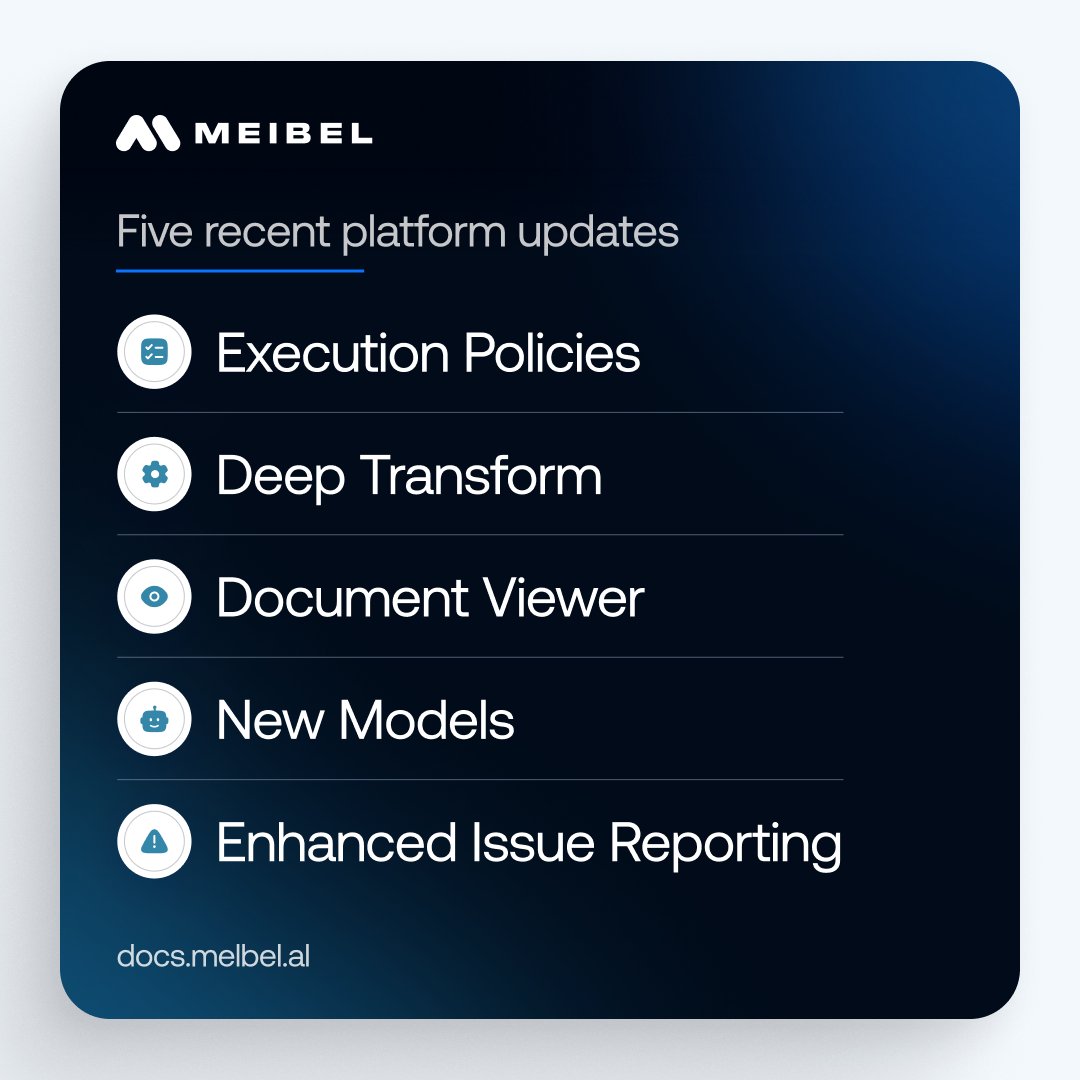
Five recent updates shipped on Meibel.
The common thread is tighter control over what enters the workflow, what an agent session can reach, and how each result traces back to its source.
→ Execution Policies
Enforce access at the platform layer. Filter tables and rows, scope documents, disable tools, and pin parameters without creating a separate agent for every customer.
🔗: https://t.co/JKbNLyvunE
→ Deep Transform
Define a JSON Schema and get structured output with provenance attached to every value, whether the source is three pages or 1,500.
🔗: https://t.co/opFOiRE6bS
→ Document Viewer
Review the source and extraction side by side, with the exact page region behind each value.
→ New Models
Fable 5 and Sonnet 5 are live. Kimi K3, GLM 5.2, DeepSeek V4 Flash, DeepSeek V4 Pro, and gpt-oss are next.
→ Enhanced Issue Reporting
Report failures with categorized options and automatically capture the relevant agent or data source identifiers.
The result is one agent definition with narrower per-session access, structured document outputs with source-level provenance, and a review path tied to the exact input behind each value.
Learn more: https://t.co/P1fi8lI4VX
P.S. Our team is at Ai4 in Las Vegas right now, happy to walk through any of this in person if you're on the floor.
Ai4 - Artificial Intelligence Conferences opened its doors this week to 12,000 people and more AI vendors than most of us have ever seen under one roof.
Buried in all that scale is the industry's real question: which of these systems actually hold up once they leave the demo stage. Our team is on the ground putting that question directly to people running document heavy workflows in production, not just planning to.
Our Kevin McGrath's speaking on that exact problem this afternoon on the AI Agents: Deployment at Scale track with the Scaling AI with Context, Control and Confidence talk - don't miss it live.
Meanwhile, come and meet our team at Booth 408!
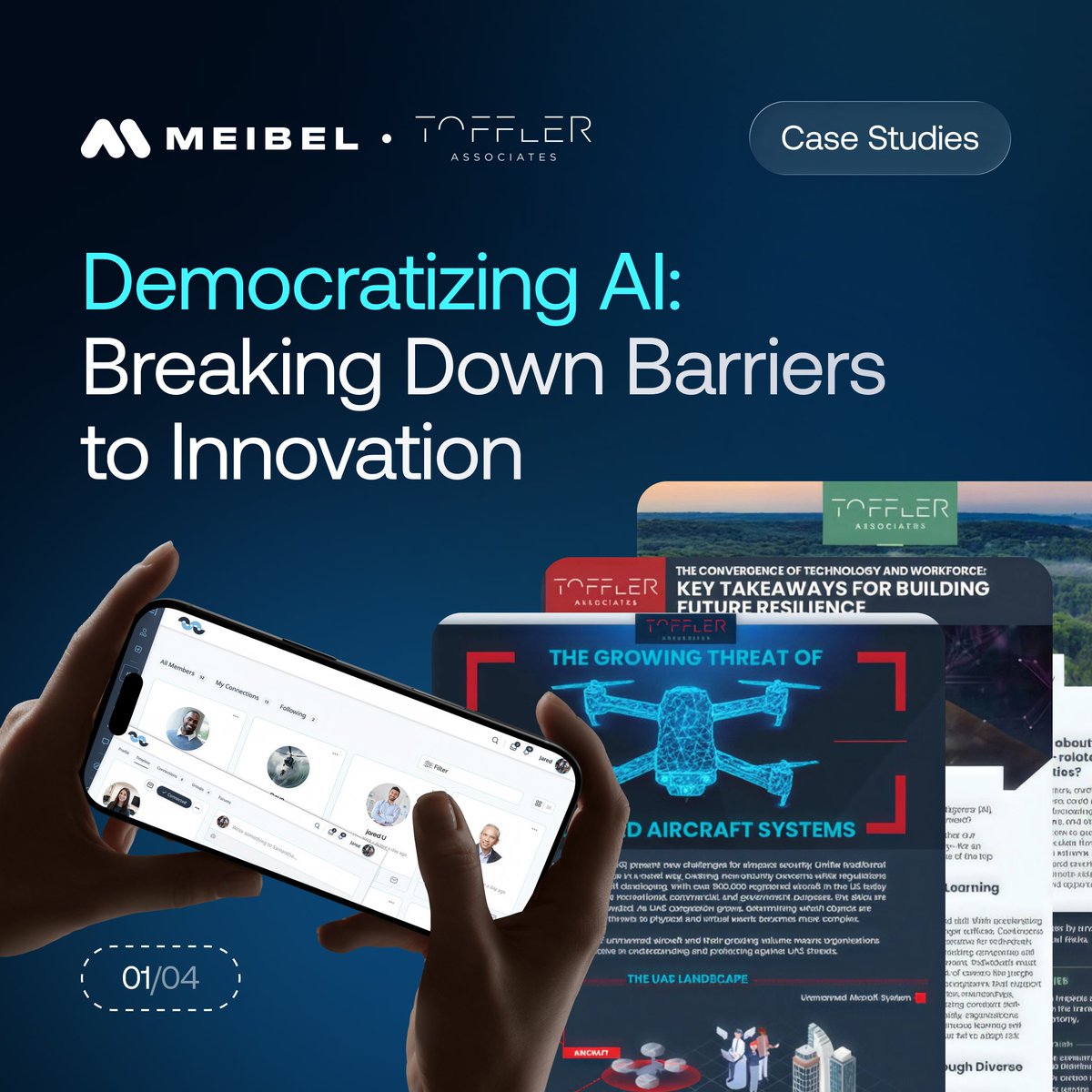
For decades, Toffler Associates helped Fortune 500s and government agencies see disruption before it hit. Their edge was never a document. It was the judgment of their analysts, and that judgment lived in people's heads and static reports.
Their first attempt to scale it with AI looked reasonable on paper: connect a model to their research archive, let it write like their experts. It sounded right. It wasn't reliable.
Same question, different answer each time. No way to measure confidence. No safe way to bring in client-specific data.
So Toffler built SINE on Meibel instead - a system where every analysis ships with its sources, a confidence score, and a full record of how it was produced. Work that took weeks now takes days, and Toffler's analysts spend their time applying insight instead of re-checking the system's homework.
This is the difference between a model that sounds confident and a system you can actually trust while it's running.
Explore full case study: https://t.co/f3WVLV6soI
Most teams stack AI steps in a workflow without ever checking what that combined accuracy actually looks like.
Meibel scores every output along the way, so you know exactly where confidence drops instead of finding out from a customer complaint.
High confidence moves through automatically, low confidence gets flagged for a person to check. That's measuring your AI instead of hoping it's fine.
More data doesn't make AI smarter, it makes it confused.
Feeding a system everything you have instead of what it actually needs is the fastest way to get unreliable answers back.
Meibel structures your documents first, so the right data reaches the right step at the right time instead of one model drowning in all of it.
Tetheree has spent twenty years building software for enterprises that run on complex operations: supply chain, logistics, manufacturing, and increasingly, construction and federal contracting.
One client, a construction firm bidding on federal work, had a bottleneck that had nothing to do with talent: Their best technical writers were spending days searching 300-page RFPs by hand, copying language from prior responses, and manually pulling out dates and requirements. Every hour spent searching was an hour not spent writing a better bid.
Tetheree built two capabilities on Meibel to fix this:
→ One reads federal documents in full, structure and all, and turns requirements into something a proposal author can query in seconds.
→ The other checks a draft response against the original RFP and scores it for completeness and accuracy before it ever gets submitted, flagging anything uncertain for a writer to review.
As a result, work that took weeks now takes days, every extracted value is traceable back to its exact source, and Tetheree's client is pursuing more bids without adding a single person to the team.
Read full case study: https://t.co/vcW53UEOpi
Meibel is heading to Las Vegas for Ai4 2026!
Our Founder and CEO, Kevin McGrath, is speaking in the AI Agents: Deployment at Scale track:
➡️ Scaling AI with Context, Control and Confidence | August 5, 11:20–11:40 AM PDT
The Meibel team will also be onsite at Booth 408, meeting with AI builders and enterprise leaders working on agents, document intelligence, and getting production AI to run reliably at scale.
If you're attending Ai4, come to Kevin's session and meet the team at Booth 408.
August 4–6 | The Venetian, Las Vegas