Jon Hamm's entire life ran a decade behind schedule, and it kept working out.
His mother died when he was 10. His father when he was 20. He spent his 20s waiting tables and teaching drama at his old high school in St. Louis. His agency dropped him. He gave himself until 30 to make it as an actor.
Mad Men found him at 36.
Then came 2015. The show ended, his 18-year relationship ended, and he went through rehab, all within months of each other. The final episode of Mad Men put Don Draper at a retreat in Big Sur, where a young actress played the receptionist who checks him in.
Five years later, they started dating. In June 2023 he married her, at 52, on the exact patch of Big Sur coastline where they filmed that episode.
Now he's expecting his first child at 55, with the woman from the final scene of the show that made him.
# Lp(a) Doesn't Cause Events. It Builds Plaque.
For years we've known that elevated **Lipoprotein(a)** increases cardiovascular risk.
The unanswered question was **how**.
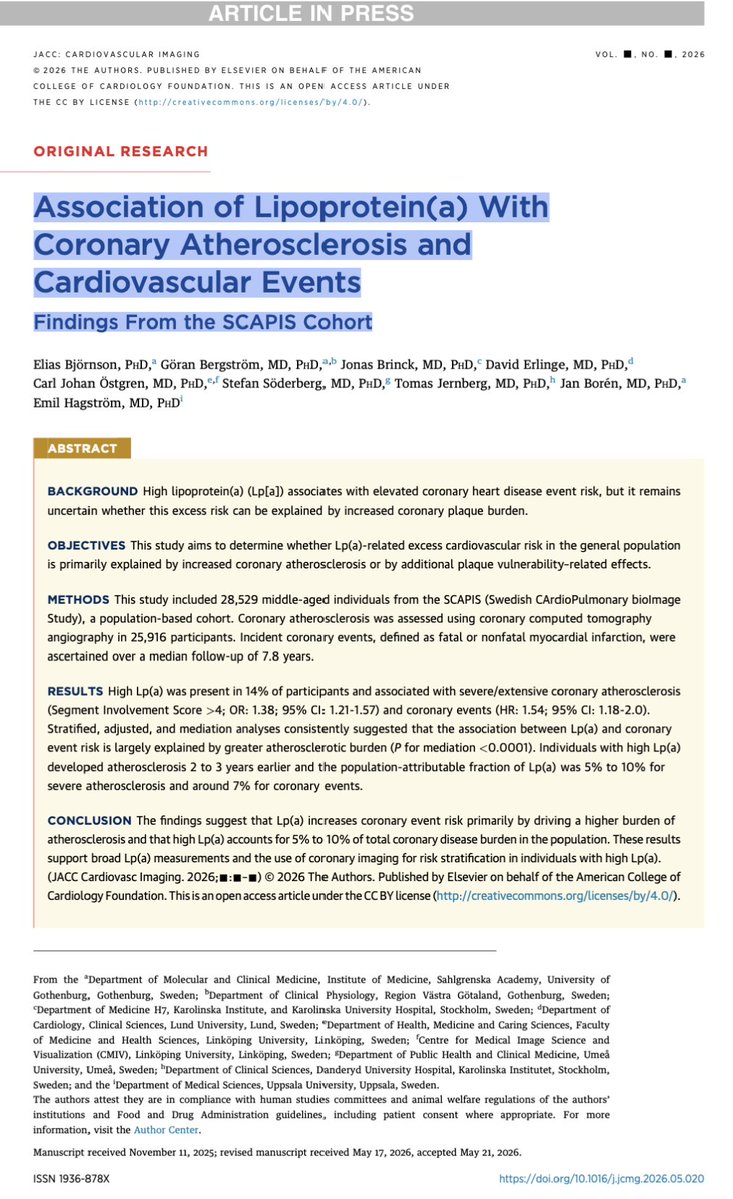
A new *JACC: Cardiovascular Imaging* study from the **SCAPIS** cohort suggests the answer is surprisingly simple.
Among more than **28,000 individuals**, elevated Lp(a) was associated with:
- more extensive coronary atherosclerosis
- more obstructive CAD
- earlier plaque development
- higher rates of coronary events.
But here's the key finding:
Once the analysis accounted for **coronary plaque burden**, most of the excess risk associated with Lp(a) disappeared. Mediation analyses showed that the relationship between Lp(a) and events is largely explained by **more plaque—not necessarily more vulnerable plaque.**
## My Take
This paper reinforces a concept that preventive cardiology is gradually embracing:
**Risk factors matter because they create disease.**
Disease is what causes events.
That's why coronary imaging is becoming indispensable.
The question is no longer:
*"Does this patient have high Lp(a)?"*
It's:
**"What has high Lp(a) already done to this patient's arteries?"**
## Where PCCT Fits
If plaque burden is the real mediator of risk, then the next step is obvious.
Move beyond detecting stenosis.
Start quantifying plaque biology.
This is exactly where **Photon-Counting CT** has the potential to redefine preventive cardiology.
**Treat the plaque. Not the biomarker.**
#LpA #CardiacCT #PhotonCountingCT #PCCT #Atherosclerosis #PreventiveCardiology #TreatThePlaque #CardiovascularImaging