Scientists Brought a 32,000-Year-Old Ice Age Flower Back to Life! 🌸❄️
Imagine finding a plant that has been frozen for 32,000 years and watching it grow, bloom, and produce new seeds. It sounds like something from a science fiction movie, but scientists actually did it!
Deep beneath the frozen ground of Siberia, researchers discovered something extraordinary: ancient squirrel burrows filled with plant material that had survived since the Ice Age. These burrows were buried under nearly 124 feet of permafrost, a layer of ground that remains frozen for thousands of years. The tiny Arctic ground squirrels had stored seeds and fruits in their underground homes long before humans built the first great civilizations.
Among these ancient remains was the fruit of a flowering plant called Silene stenophylla, also known as narrow-leafed campion. Scientists recovered living tissue from inside the 32,000-year-old fruit and used a special laboratory technique to grow it into a complete plant. Rather than simply discovering ancient seeds, they had brought an Ice Age plant back to life!
But the most incredible part came next. The ancient plants grew normally, produced delicate white flowers, and even developed new seeds capable of growing into more plants. Genetic material that had remained preserved beneath the frozen Siberian landscape for tens of thousands of years had produced living, fertile plants once again.
Scientists also noticed small differences between the ancient plants and their modern relatives. These differences offer a rare opportunity to study how plants change over thousands of years and how their characteristics evolve across generations.
This discovery could have important implications for the future. Permafrost acts like a natural freezer, protecting biological material that would normally decay. Studying these ancient plants may help researchers better understand plant evolution, preserve genetic diversity, and explore new possibilities for conservation research.
Think about that for a moment: while mammoths and woolly rhinoceroses roamed the Earth, an Arctic squirrel was storing food in its burrow. Thousands of years later, that ancient hiding place helped scientists bring a long-lost plant back to life.
A tiny flower survived 32,000 years beneath the ice. What other secrets might still be sleeping beneath the frozen ground? 🌎❄️
Source: Yashina, S. et al. (2012). Regeneration of whole fertile plants from 30,000-y-old fruit tissue buried in Siberian permafrost. Proceedings of the National Academy of Sciences, 109(10), 4008–4013.
🚨 Reheated rice can pose a serious risk of food poisoning if it is not stored properly after cooking.
When cooked rice is left at room temperature, Bacillus cereus bacteria can multiply and produce toxins that are not destroyed by reheating.
This illness is often referred to as “fried rice syndrome” and can cause vomiting and diarrhea within hours.
To reduce the risk, rice should be cooled quickly and placed in the refrigerator within one hour of cooking.
When reheating, make sure the rice is steaming hot all the way through and consume it within one day of refrigeration.
Elon Musk: If I wasn't optimistic, I wouldn't be doing the crazy things that I'm doing.
“This is really all just measured in terms of time. What is the time risk associated with something? The one thing you cannot replace is time.
I do have a habit of being optimistic with schedules. If I wasn't optimistic, I wouldn't be doing the crazy things that I'm doing. I'm just pathologically optimistic, I suppose.”
Everyday Astronaut Starbase Tour 2021, August 7, 2021
JUST IN: Google forced to halt work in Finland after illegally clearing 250,000 trees for a new data center, according to the Guardian.
Every tree that occupied the 815-acre site just a few months ago is now gone.
The Finnish Licensing and Supervision Authority (LVV) has ordered Google to stop work on the Muhos and Otanmäki sites after it cut down the trees before the environmental impact assessment was completed.
Google’s Finland manager, Antti Järvinen, has apologized but says they were acting on "the best understanding we had of the legislation at the time."
Muhos and Otanmäki are a $17 billion Google AI project.
President Trump has criticized Google for taking the projects overseas instead of investing in the United States.
The FBI reiterates its warning to the public regarding ongoing widespread fraud schemes in which scammers impersonate US and foreign law enforcement or government officials to extort money or personally identifiable information (PII) from victims.
Scammers primarily contact victims through unsolicited phone calls; however, other methods, including text messages and emails, are also used. Scammers often spoof authentic phone numbers, email addresses, employee names, and credentials of well-known government and law enforcement agencies, including IC3.
Tips to Protect Yourself
*Law enforcement and government authorities will never contact members of the public by telephone or text message to demand any form of payment or to request personal or sensitive information.
*Law enforcement and government officials will never request payment via prepaid cards, cryptocurrency, or courier.
*Never give your personal information to anyone without verifying the person is who they say they are. Ask for credentials and use official, publicly available information to contact the government or law enforcement agency to verify the caller and their credentials; do not use contact information provided by the person contacting you.
*If you are sent any webpage URLs, do not click without reviewing them to ensure they match the official domain of the law enforcement or government agency. Remember, scammers may use URLs closely mirroring official ones, but with slight variations or incorrect domain extensions (.com instead of .gov).
If you or someone you know has fallen victim to these impersonation scams, immediately cease all contact with the scammers and notify your financial institutions to safeguard your financial accounts. Contact your local law enforcement agency and file a report. Also file a complaint with the IC3 at https://t.co/bOWQo9qcbf.
A Turkish construction company just replaced an entire crew with TWO AI ROBOTS costing $67,000 combined. After just one month, the owner claims they completed 3 construction projects and generated 3X more profit.
Now he wants to replace EVERY crew in the company with robots by 2027.
Instead of paying multiple workers, managing schedules, dealing with delays, and losing money to downtime, the company is betting on machines that can work around the clock without getting tired.
The $67,000 investment could be just the beginning. If two robots can outperform an entire crew while dramatically increasing profits, construction companies everywhere will be forced to rethink their business models.
And here's the real question: if AI robots can deliver projects faster and make companies 3X more profitable, how long before human construction crews become the more expensive option?
Would you trust a robot-built house if it cost less and was completed faster?
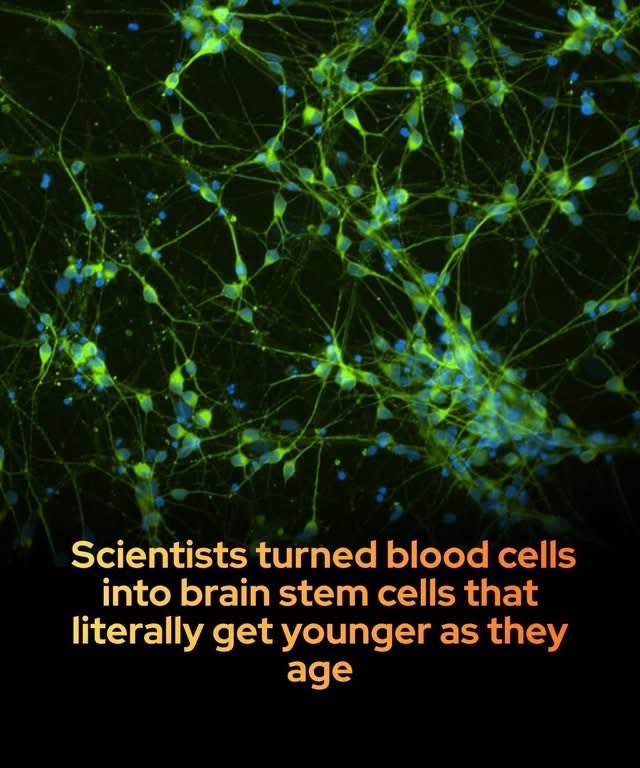
Scientists Turned Human Blood Cells Into Brain Stem Cells—and Reversed Signs of Aging by Decades
What if a simple blood sample could help scientists create new brain cells while turning back some of the biological signs of aging? Researchers are exploring this remarkable possibility with a technique that transforms human blood cell precursors into neural stem cells, which can develop into different types of brain cells.
In a study published in Aging Cell, researchers at the University of Bonn reported a way to convert these blood-forming cells directly into neural stem cells. The secret lies in specialized proteins called transcription factors, which control how cells behave. By using them to change a cell’s identity, the scientists bypassed an intermediate stage commonly used in stem cell research. This could make the process more direct and potentially useful for studying how the human brain develops and ages.
One of the most striking findings involved the age of the donors. The researchers were able to reprogram blood cell precursors from people ranging from newborns to individuals aged 101. Even more remarkably, the process was associated with changes in epigenetic markers linked to biological aging. According to the reported findings, cells from an 80-year-old donor showed molecular age markers corresponding to an age of less than 20 years.
But there is an important distinction: making cells appear younger at the molecular level does not mean the donor’s body has become younger or that age-related diseases have been reversed. Scientists still need to establish how these reprogrammed cells behave over time and whether they can safely help repair damaged human tissue.
If further research proves successful, this technique could open new possibilities for studying conditions such as Alzheimer’s and other neurodegenerative diseases. In the future, researchers may be able to use a patient’s own cells to create neural stem cells for studying disease, testing treatments, and potentially developing personalized therapies.
The most exciting part is that scientists are investigating whether cells from older people can be reprogrammed into a younger biological state without first returning them to a fully pluripotent, embryonic-like state. It is an important step in understanding cellular aging—but turning that discovery into a safe treatment for the human brain will require much more research.
Source: Brüstle, O., et al. (2026). Direct reprogramming of human blood cell precursors into neural stem cells. Aging Cell.
You can carefully filter every glass of water you drink, but what about the water in your shower?
One of the least appreciated uses for water filtration is removing chlorine before you shower.
But choosing which products to use can be confusing. Many are easier to market than they are to justify.
Here I explain the filtration methods I prefer, why I avoid alkaline water filters, and the bottled water brands I've had the best results with:
https://t.co/3aBCiuVYUk
🧠 The Egg Secret That Could Protect Your Brain!
Scientists have uncovered a surprising link: people who eat just 2 or more eggs a week may be far less likely to develop Alzheimer’s dementia. That’s right — a simple breakfast favorite might be doing more than filling your stomach. Researchers found that weekly egg eaters had a 47% lower risk of this devastating brain disease. How could a humble egg make such a difference? Experts think it might be choline, a powerful nutrient in eggs that helps keep your brain sharp.
But there’s a catch — this is an association, not a magic guarantee. Still, it makes you wonder: could the answer to brain health be hiding in your fridge?
Source: Morris, M. C., Evans, D. A., Bienias, J. L., Tangney, C. C., Bennett, D. A., Wilson, R. S., & Schneider, J. A. (n.d.). Egg consumption and risk of Alzheimer’s disease: The Chicago Health and Aging Project. PMC.
Scientists 3D-printed a heart using human cells — and the results could change medicine forever!
Imagine a future where damaged hearts could one day be replaced with organs grown from a patient's own cells. Scientists at Tel Aviv University in Israel took an important step toward that possibility in 2019.
Using human cells and biological materials from fatty tissue, researchers created a miniature, 3D-printed heart complete with chambers and blood vessels. The technology even allowed them to use materials derived from the same patient, potentially helping reduce the risk of immune rejection.
But there's a catch. The tiny heart was not yet capable of pumping blood like a healthy human heart. Scientists still needed to overcome major challenges before such technology could produce fully functional replacement organs.
The ultimate goal? To develop personalized hearts that could one day help address the shortage of donor organs.
Could doctors eventually print a replacement heart for someone who needs one? The breakthrough offers a fascinating glimpse into what future medicine might make possible.
Source:
Cohen, J. (2019, April 15). Scientists create world's first 3D-printed heart using human cells. NBC News.