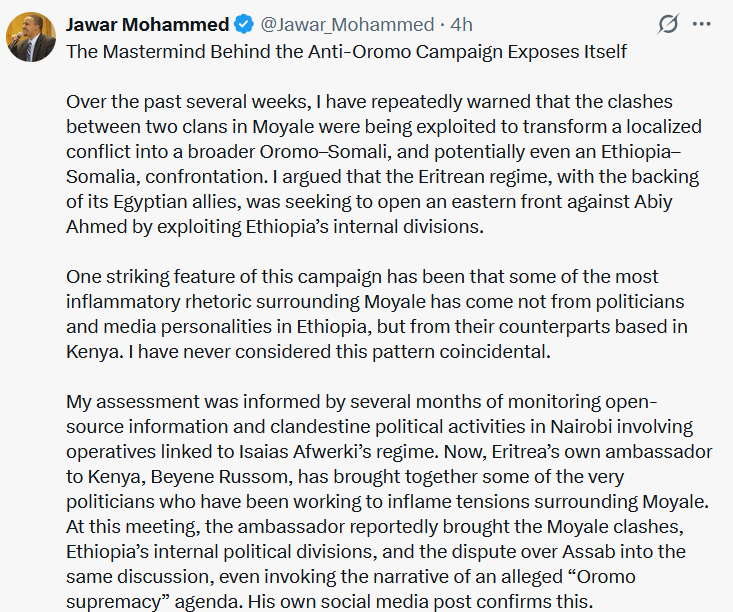
J-WAR is at it again this morning. Today, he is blaming the #Eritrean Ambassador to #Kenya for the latest inter-ethnic conflict that erupted in #Moyale a few weeks ago.
My favourite statement from his absurd diatribe is this:
“My assessment was informed by several months of monitoring open-source information and clandestine political activities in Nairobi involving operatives linked to Isaias Afwerki regime.”
This is the technic he uses to sound legitimate investigator, while the only evidence he presents to support this extraordinary accusation? An X post by Ambassador Beyene Russom, published himself just two days ago, showing him meeting with prominent politicians and scholars to discuss pertinent regional matters.
Talk about comedy writing itself! Coming from a man who has anointed himself as someone capable of creating political earthquakes across the Horn of #Africa,using his social-media magic skills, this is nothing more than lame political propaganda that cannot convince anyone.
It is an insult to the #Oromo and #Somali people, who are suffering on the ground, for J-WAR to blame anyone other than the Abiy's government, which bears primary responsibility for the security of its own citizens. All experts are pointing to the regional military forces of Somali and Oromia who bears responsibility for the violence and subsequent escalation.
What is even more laughable is his accusation that #Eritreans have waged campaigns to degrade the Oromo people for centuries. Unlike the opportunist J-WAR, the people of Eritrea have consistently stood alongside oppressed people in Ethiopia (including the people of Oromo) and throughout the region, not merely through words but through actions.
But let me share a short clip of Ambassador Beyene Russom in 2016, speaking out in defence of the oppressed Oromo people while they were being killed by the EPRDF regime. In the same clip, we hear the #Ethiopian Ambassador, who is now serving the Abiy regime, denying that there were even Oromo protests, let alone acknowledging the killings of #Oromo people.
J-WAR is nothing more than an opportunist desperately trying to manoeuvre his way into power by inciting violence and promoting war between #Ethiopia and Eritrea.
He must be stopped, and he will be stopped.
@StalinTeklu@mamamesay@EIshmael_@HabtamuAyalew21@milkessam@Meconneno@tesfanews@tykahsay@BeyeneRussom@Yehdavid@hadnetkeleta@EliasAmare
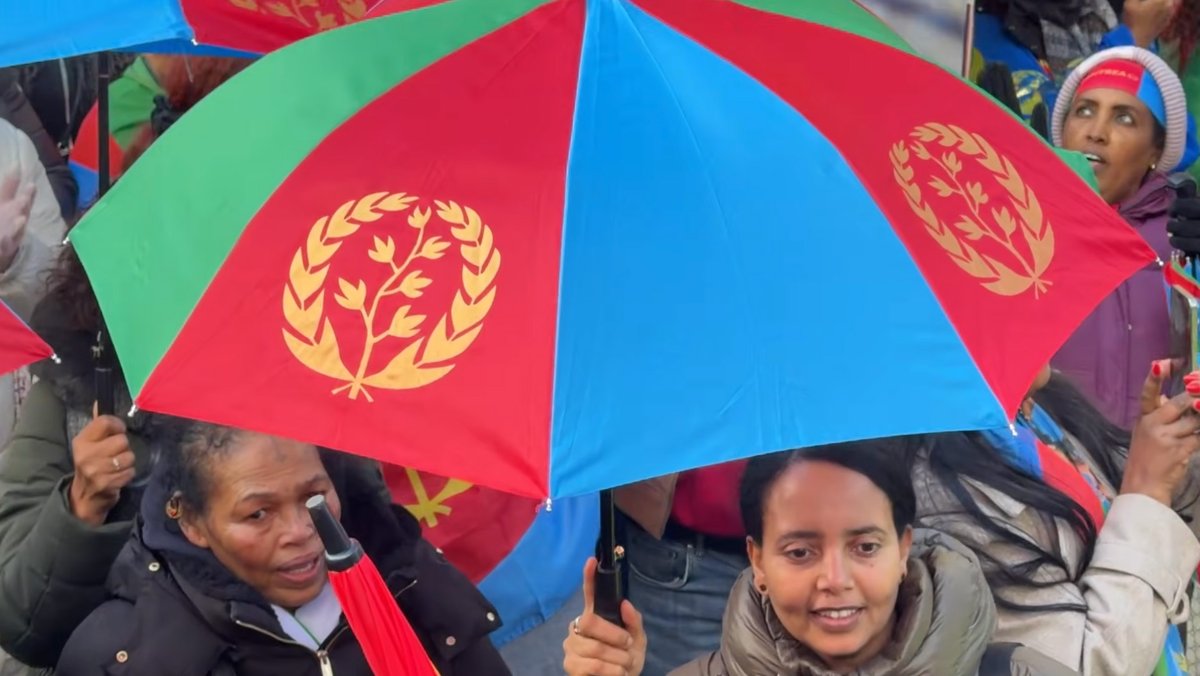
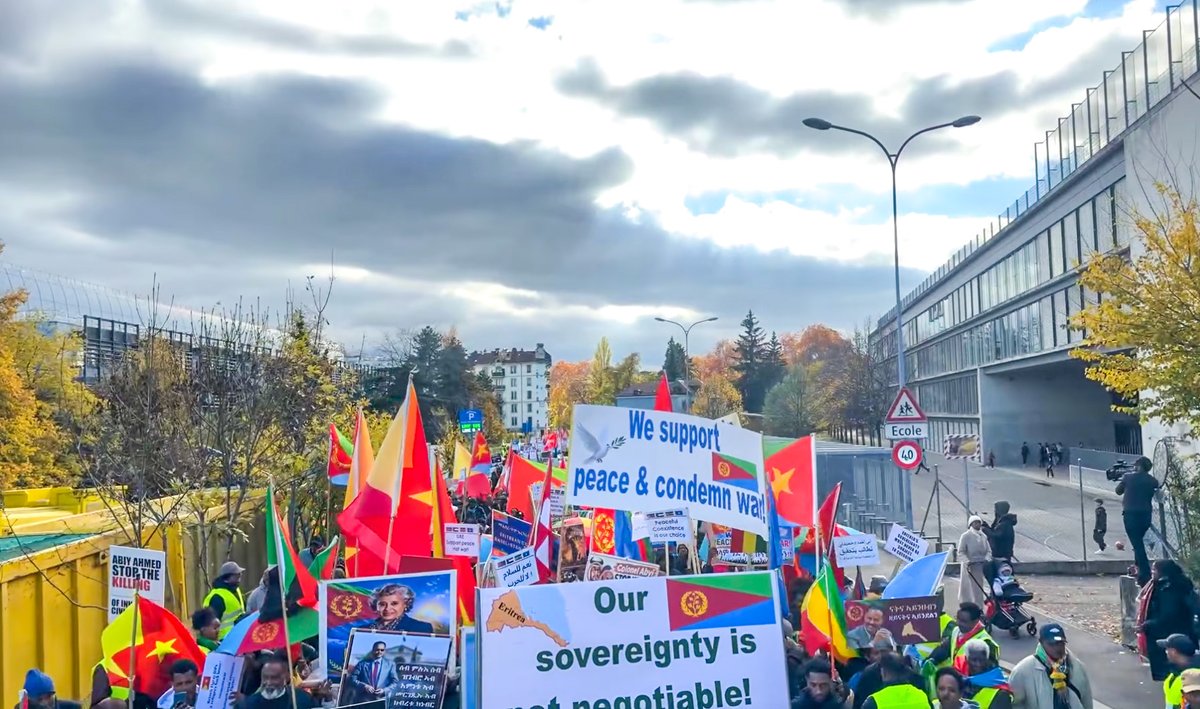
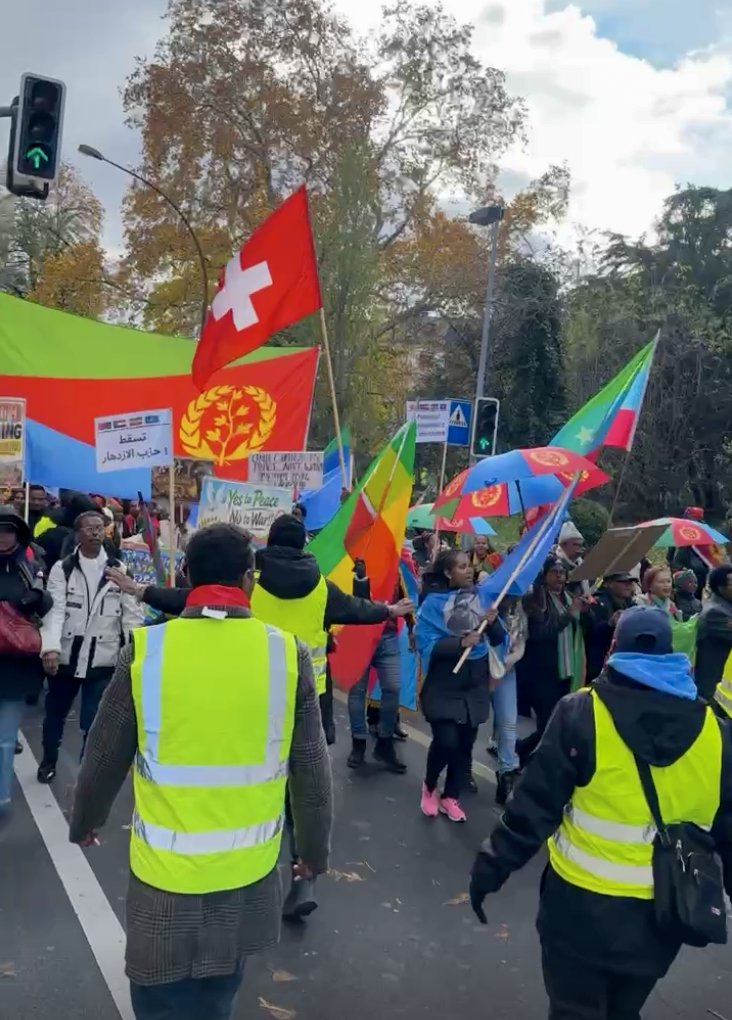
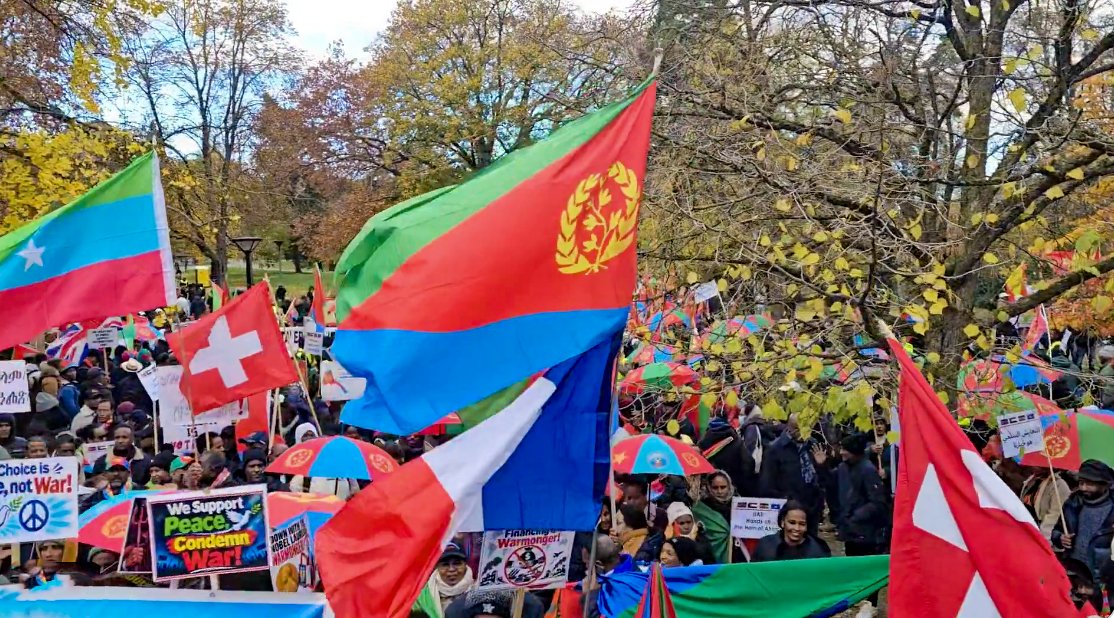
Eritrean voices rise for peace outside the United Nations in Geneva. For peace. For justice. Against war. Sovereignty and territorial integrity must be respected.
#Eritrea#Peace@HornofAfrica
ERITREA: ANCIENT AND NEW
A Thursday Reflection
#Eritrea is mourning the passing of His Grace Abune Lucas, Administrator of the Office of the Patriarch, Member of the Holy Synod of the Eritrean Orthodox Tewahdo Church and Archbishop of the Southern Region, Adi-Keih. His passing is a moment of sorrow for the faithful and the wider Eritrean community.
It also draws attention to the enduring place of the Church, its spiritual institutions and their custodians in our country's history. Debre #Libanos, where he was laid to rest, is not simply a burial place. Like Debre Bizen, Debre Sima and other ancient monasteries across Eritrea, it forms part of a much older inheritance of faith, learning, memory and cultural continuity.
There is something profoundly revealing about standing before an ancient monastery in #Eritrea. Perched on a mountain, overlooking valleys and landscapes that have witnessed centuries of human history, these institutions seem almost indifferent to the passage of time. Their stone walls, manuscripts, traditions and accumulated memories speak of generations long gone, yet remain very much present.
I was fortunate enough to visit Debre Libanos some years ago. I remember the mummies discovered there and the arrangements governing access to the main building, where women were not permitted. I was content to remain with the women in the smaller church midway up the ascent, taking in the beautiful scenery and reflecting on the history surrounding us. It is an experience that has stayed with me.
Debre #Bizen, traditionally dated to the fourteenth century, became an important centre of monastic scholarship and manuscript preservation. Debre Libanos, associated with the early Christian monastic tradition of Semenawi Bahri, is linked to an older religious heritage.
Debre #Sima and other ecclesiastical institutions form part of a landscape in which religious, cultural and intellectual life developed over many centuries. Their significance lies not only in their age, but in their endurance. Through changing political authorities, successive administrations, wars and invasions, they have preserved an inheritance that cannot be confined to the chronology of any modern state.
#Eritrea's historical depth is also reflected in its archaeological landscapes, ancient settlements, languages, diverse communities, maritime connections and cultural traditions. Archaeological discoveries at Sembel, in the greater #Asmara area, reveal settled communities dating back to the first millennium BCE.
Further evidence from Adulis, the ancient Red Sea port city where recent excavations have uncovered even earlier traces of human activity, illustrates how these lands were connected to wider African, Arabian and Mediterranean worlds through centuries of trade and cultural exchange. Eritrea's history is not the story of one civilization, religion, community or period. It is a tapestry woven from diverse peoples, cultures, beliefs and experiences.
And then there is #Asmara, Eritrea's beautiful capital, where history, culture and architecture come together in a city unlike any other. Anyone who has walked its streets cannot fail to be struck by its magnificent architecture: elegant façades, imposing public buildings, broad avenues, cinemas, theatres, churches, mosques and carefully planned urban spaces. Different periods, influences and styles have come together to create an extraordinary architectural landscape.
In 2017, UNESCO inscribed Asmara on the World Heritage List as Asmara: A Modernist African City, recognizing its exceptional modernist architecture and urban planning, particularly from the Italian colonial period of the 1930s and 1940s. UNESCO's recognition did not create Asmara's heritage; it acknowledged an exceptional legacy that had endured long before its inscription.
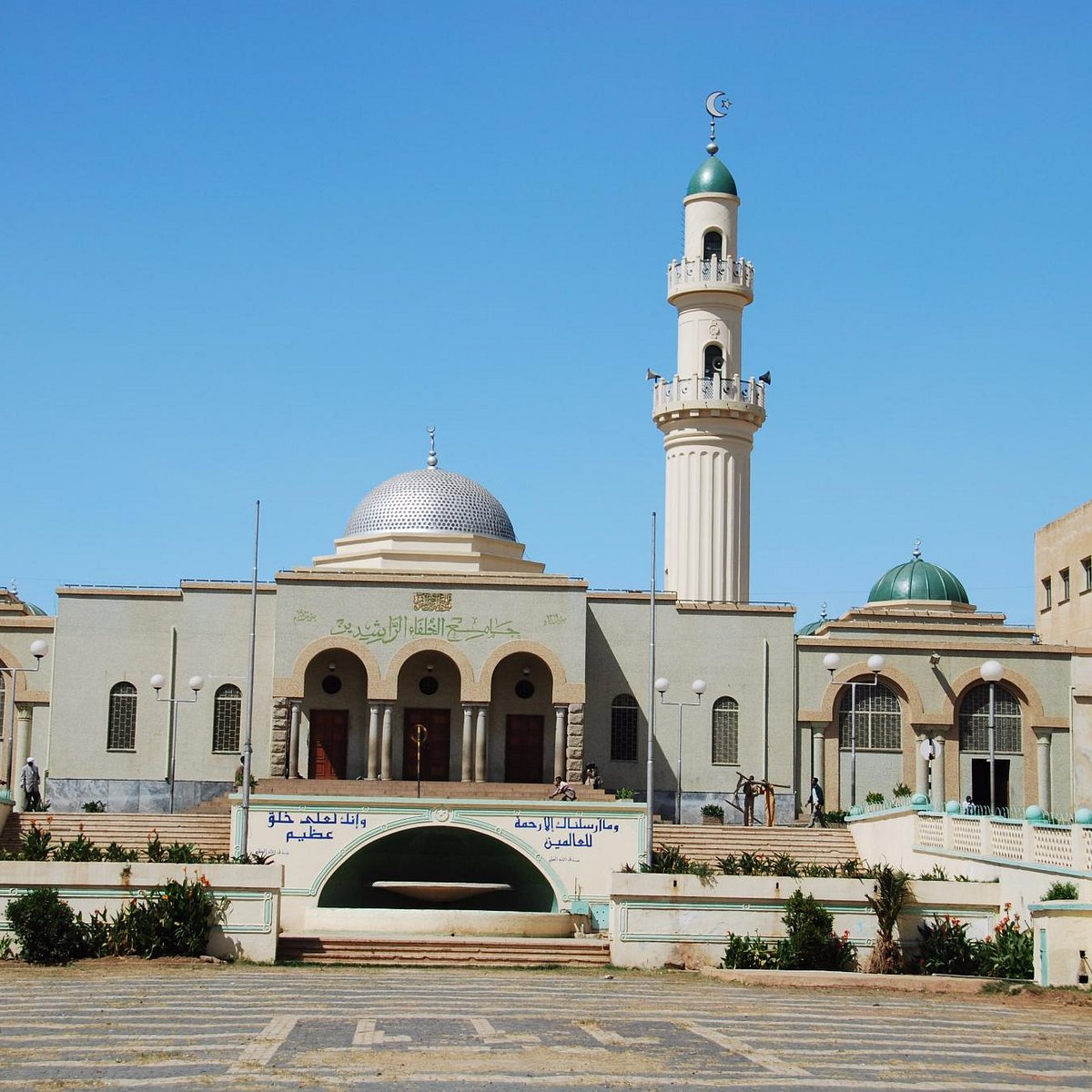
The Cathedral at the centre of Asmara, completed in 1922, is now more than a century old. Its imposing bell tower and Lombard Romanesque character have become defining features of the city's skyline. The Church of Our Lady of the Rosary, the Al Khulafa Al Rashiudin Mosque, the former Fiat Tagliero building, Cinema Impero and countless other structures contribute to Asmara's distinctive architectural identity. But there is something important to remember when admiring these buildings… the buildings predate Eritrea's independence. The people of Asmara and their history predate them.
Before modernist architecture transformed the city, there were already communities, families, neighborhoods, markets, places of worship and established social and cultural life. Asmara was not an empty landscape upon which an architectural experiment was imposed. It was an inhabited place with a history of its own.
The architecture we admire reflects a particular period in the city's development; it does not mark the beginning of Asmara or the history of its people. Colonial architecture can be preserved and appreciated for its historical and artistic value without confusing the legacy of colonial construction with the origins of the city and its inhabitants.
The same distinction applies beyond Asmara. Successive foreign powers that occupied or administered Eritrea constructed buildings, roads, fortifications, military installations, administrative centres and other infrastructure across the country. Some remain visible today and form part of Eritrea's built heritage.
They tell us about the ambitions and priorities of those who built them, but their presence does not make Eritrean history begin with their arrival, nor does it make the history of the country the history of its occupiers. An occupying power may leave its mark on the landscape; it does not thereby become the author of the land's history.
And then there is #Assab. Today, Assab is discussed in terms of strategic geography, maritime access and the economic requirements of landlocked #Ethiopia. Yet, long before it became the subject of contemporary geopolitical calculations or the site of a modern deep-water port, people lived in this region, sustained communities and livelihoods, and maintained their own social and political institutions.
#Assab was not an empty coastline awaiting European discovery. It was home to established Afar communities, including the Ankala, whose old settlement at Assab Saghir and traditional presence across the wider Dankalia coast are documented in historical sources. These communities were part of the wider Afar world, with established connections across the Red Sea and surrounding territories.
#Assab was #Eritrean under the 1952 federal arrangement. Its subsequent annexation by #Ethiopia, following the unilateral termination of the federation in November 1962, must be understood in that historical context. Annexation did not erase the identity of the region or the history of its inhabitants. Assab's strategic importance cannot be separated from its history, and its history cannot be reduced to the interests of those who may wish to use it.
#Assab's history begins with its people, not its port. Its strategic importance, infrastructure development and commercial potential do not alter its historical identity or its place within #Eritrea. A port can be constructed, a harbor modernized and infrastructure developed to transform a town's commercial importance. None of these developments creates the historical existence of the people who live there or establishes sovereignty over the surrounding territory. Building a port, a road or other infrastructure does not confer sovereignty over the land on which it stands. Construction is not a deed to sovereignty.
Eritrea is ancient and new at the same time. Ancient in its peoples, civilizations, cultures and historical roots; new as a modern sovereign state, born of a long struggle for self-determination and internationally recognized in 1993. Independence did not begin the history of the Eritrean people; it opened a new chapter in it. Eritreans did not come into existence with the end of colonial rule, the termination of the federation, liberation in 1991 or the 1993 referendum. These were milestones in the political history of the modern state, not the origins of the people who made it possible.
Long before modern statehood, our forefathers built communities, cultivated the land, worshipped, traded and crossed the seas. The modern Eritrean state emerged through a turbulent history of Italian colonialism, British administration, federation with Ethiopia, its unilateral termination and the annexation of Eritrea in 1962.
The liberation struggle was the assertion of the people's right to determine their own future. 1993 marked the emergence of #Eritrea as an internationally recognized sovereign state, not the creation of the #Eritrean people or their historical identity.
#Eritrean identity is not a recent discovery, our historical presence is not a diplomatic invention, and our sovereignty is not a concession granted by anyone else. Our monasteries, archaeological sites, historic cities and coastal communities bear witness to the depth and diversity of our historical experience. They remind us that while Eritrea is a young sovereign state, the society and people it represents have much older roots.
#Eritreans did not fight for independence to become a people. They fought for independence because they were a people, with a history, an identity and the right to determine their own future. That history continues through their independence and theirsovereign statehood…
#ThrowbackThursday #ThursdayThoughts #Thursdaywisdom
Only few weeks back, J-War was saying " Because Abiy is illiterate, he can't look further than tomorrow, and he looks at things in a simplistic form. With his current capacity, Abiy is in no position to fight against Eritrea or Tigrayan forces except a cowards courage. Abiy has sold Ethiopia's souveignity to the UAE and what we witness today is he is being forced to wage war by his handlers and bosses.' #Eritrea #Ethiopia
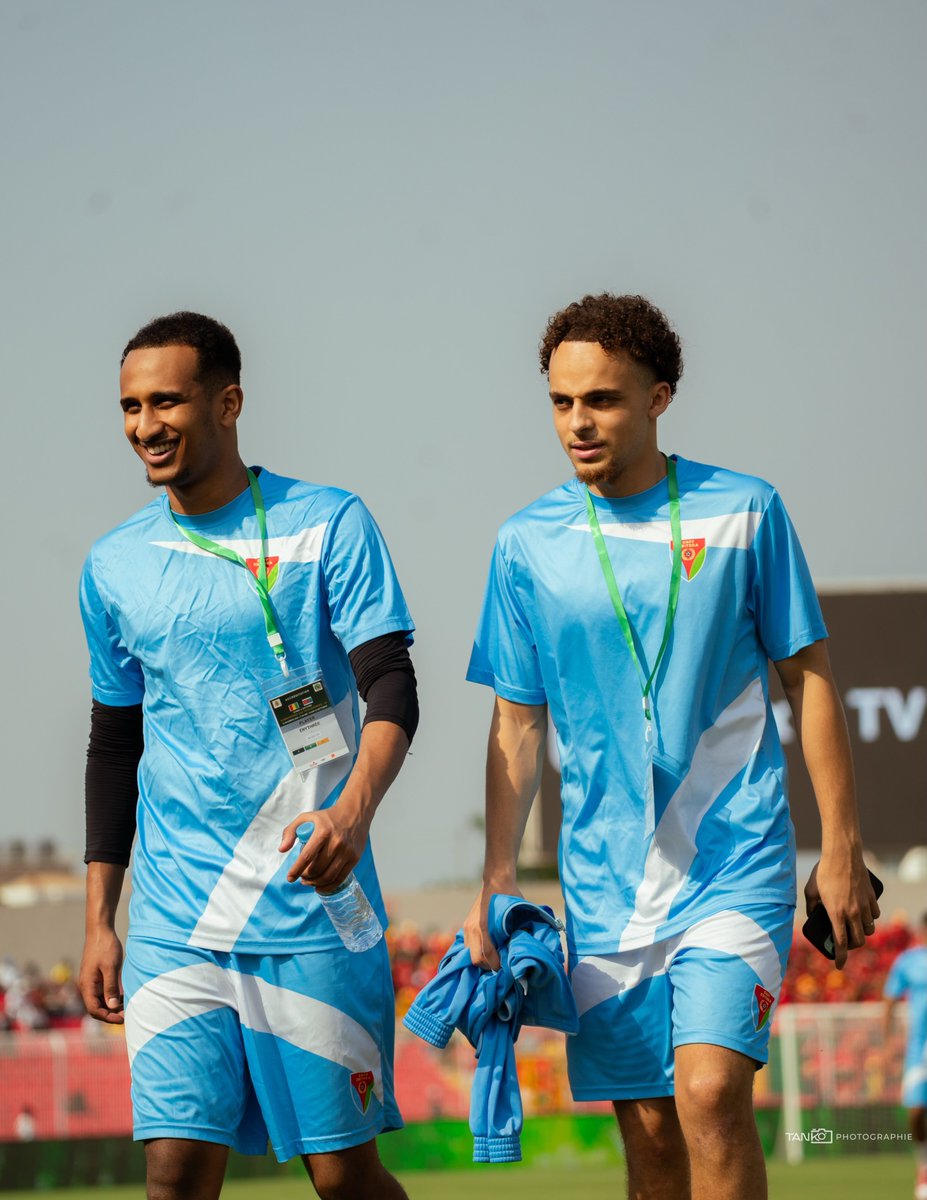
VIVA ERITREA! እልል በላ ኣዴታታ!! :: ኮቦሮ! ኮቦሮ! Eritrean athletes Goitom finished 6th and Dejen finished 8th in the Kobe Marathon 2026 which was held in Japan today エリトリア#Eritrea
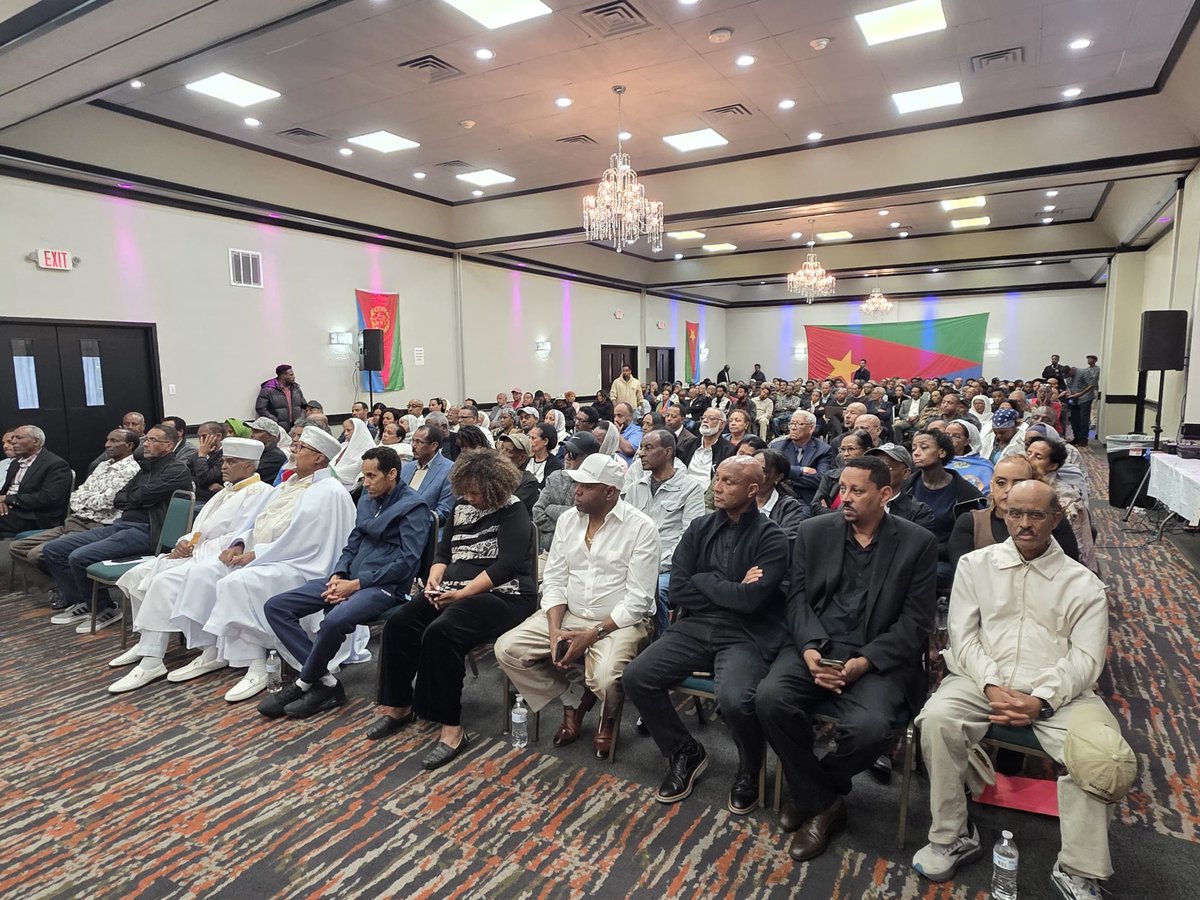
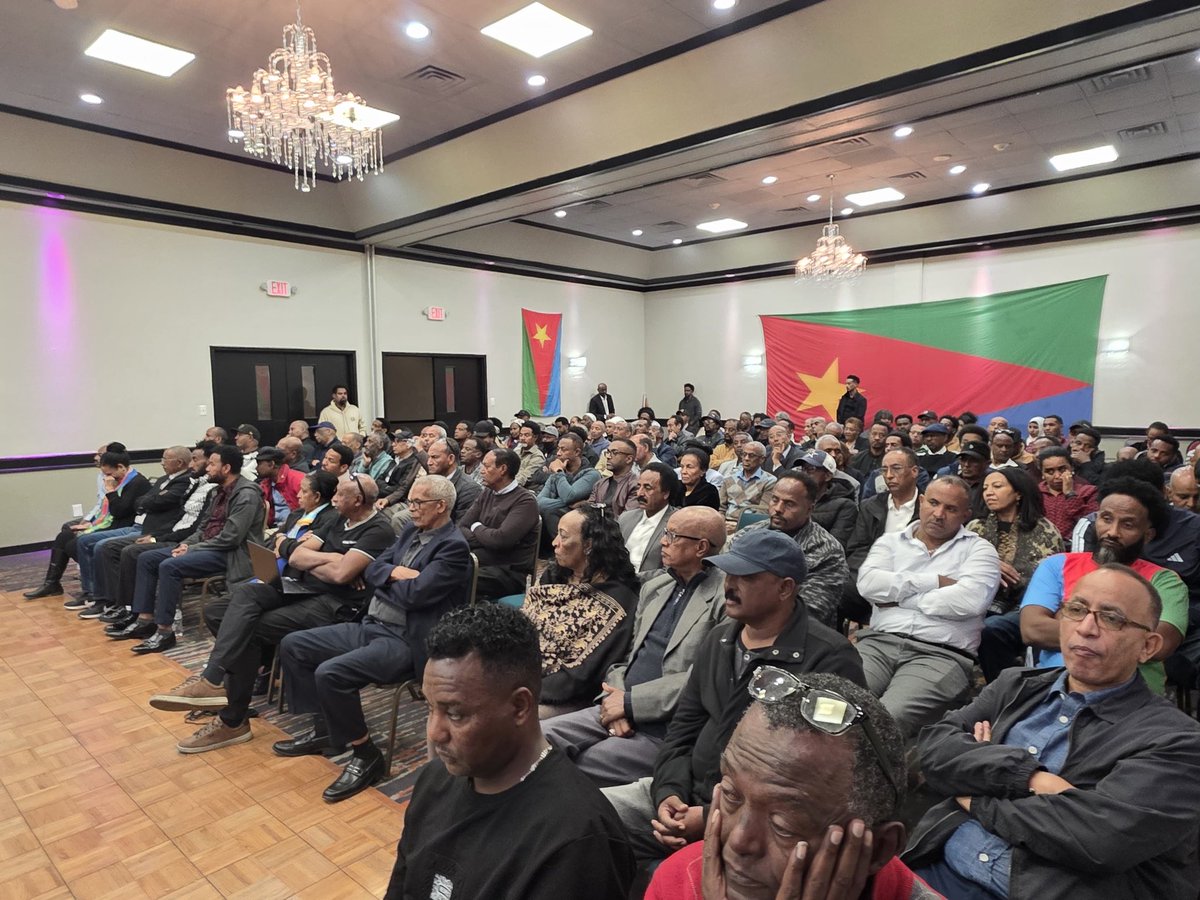
Public seminar on the issue of preserving the sovereignty & territorial integrity of #Eritrea is being held in Dallas. People are voicing their solidarity with their government & defense forces. The need for preserving peace in our region is also discussed. On the way, almost quarter a million raised (more than 200k) for our defense forces.
Horn of Africa communities stand united.
One region. Shared futures. A clear call: lasting peace, genuine coexistence, and full sovereignty for every people of the Horn.
Together we rise. Together we protect what is ours. Together we build a future no longer defined by division.
Honourable @Ed_Miliband, the #Ethiopian Foreign Minister you have just shaken hands with was training to operate a Kalashnikov just a week before attending COP31. see attached pictures
His government has also purchased 12 Russian SU-35 fighter jets and S-400 air defence systems at a cost of $4 billion. Meanwhile, Ethiopia is in the midst of one of the worst civil wars in its history, with government forces killing their own citizens using drones and artillery, while committing atrocities amounting to genocide in the Amhara region.
The paradox of cyber General J-WAR who is gunning to unseat the #Eritrean government using his amazing oratory and AI military authoring skills. Drinking beer when it suits you and being ultra religious when not.
Welcomed Mr. Guang Cong, @UN Secretary-General’s @antonioguterres Special Envoy for the Horn of Africa, during his introductory courtesy visit to @Eritrea_UN. His vast experience and deep understanding of regional dynamics will be invaluable in promoting #peace, #stability, and #cooperation in the #Horn of #Africa.
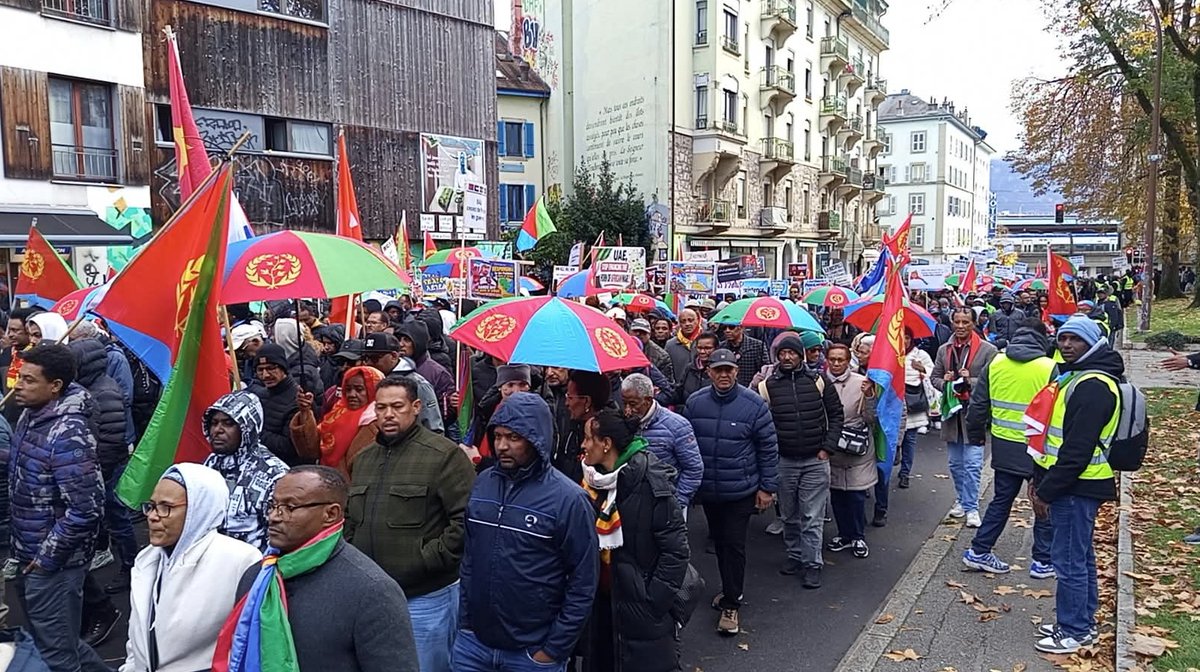
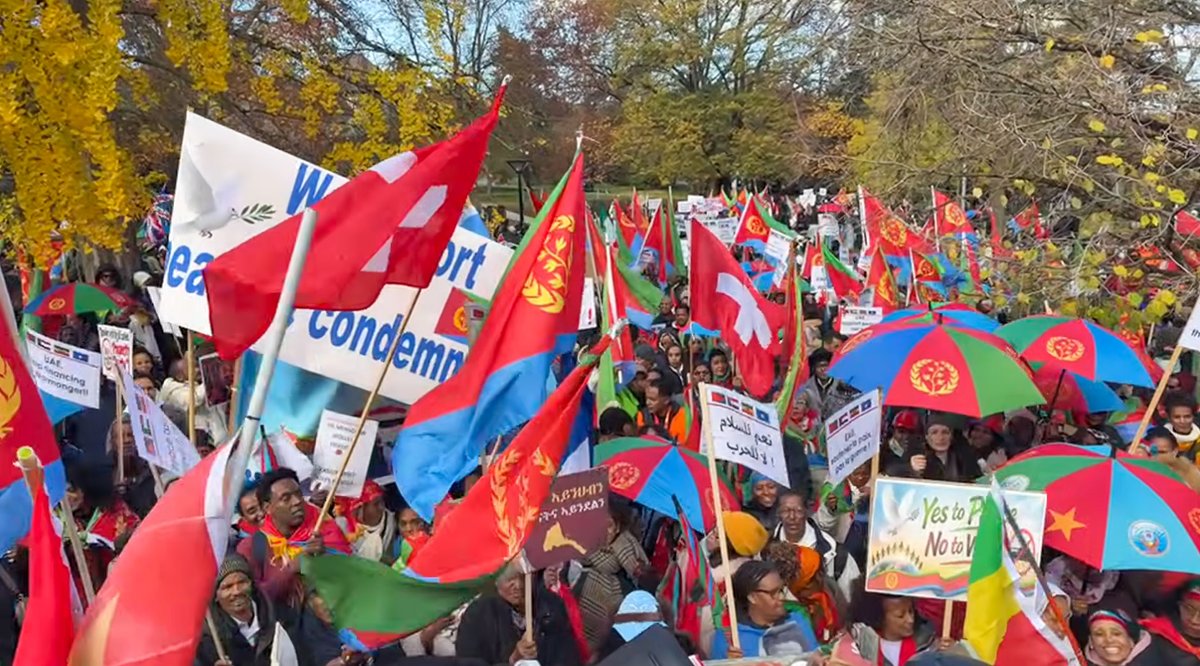
Peaceful demonstration in Geneva
A peaceful demonstration involving Eritrean nationals from across Europe, as well as Sudanese, Ethiopian, and Somali nationals, was held in Geneva on 13 November under the banner “Yes for Peace – No for War”.
The participants, who gathered from Switzerland, Germany, the UK, Italy, the Netherlands, Belgium, Sweden, and Denmark, called for peace and submitted a petition signed by all participants to the office of the United Nations Human Rights Council.
Mr. Mihreteab Malik, chairman of the national committee of Eritreans, said that the petition submitted to the UN was in response to war rhetoric directed against Eritrea and neighboring countries by Ethiopia’s ruling Prosperity Party. He stated that such rhetoric undermines the independence, sovereignty, and territorial integrity of these countries and violates the fundamental principles of the UN Charter.
Mr. Mihreteab further said that the petition called for the unconditional implementation of the provisions enshrined in the UN Charter and urged the UN to assume its responsibility and take the necessary action to ensure respect for the sovereignty and territorial integrity of all states.
At the event, representatives of countries in the Horn of Africa, as well as friends of the Eritrean people, delivered messages of solidarity. #Eritrea