$MELAPS IS LIVE !!
CA: 0x49b5a9fcd24ca5083fa05f9136e7d04564647621
MELAPS is building a neocloud infrastructure platform designed to support the growing computational demands of artificial intelligence. From high-performance GPU computing to flexible resource allocation, our focus remains on providing accessible infrastructure for AI development.
As MELAPS continues to develop its infrastructure and services, $MELAPS represents a new milestone in the project's journey.
Website: https://t.co/cFqJ1B8zLK
Github: https://t.co/x4mQF8sGae
Accurate resource monitoring begins with consistent data collection.
MELAPS documentation describes GPU telemetry sampling at one-second intervals, including the structure of collected metrics and their delivery through WebSocket streams.
These technical details help developers understand how infrastructure data is collected and accessed.
Not every workload requires uninterrupted execution.
MELAPS documentation explains how batch workloads are scheduled and what happens when a job is preempted.
Understanding these conditions helps developers prepare their workloads and plan computational tasks more effectively.
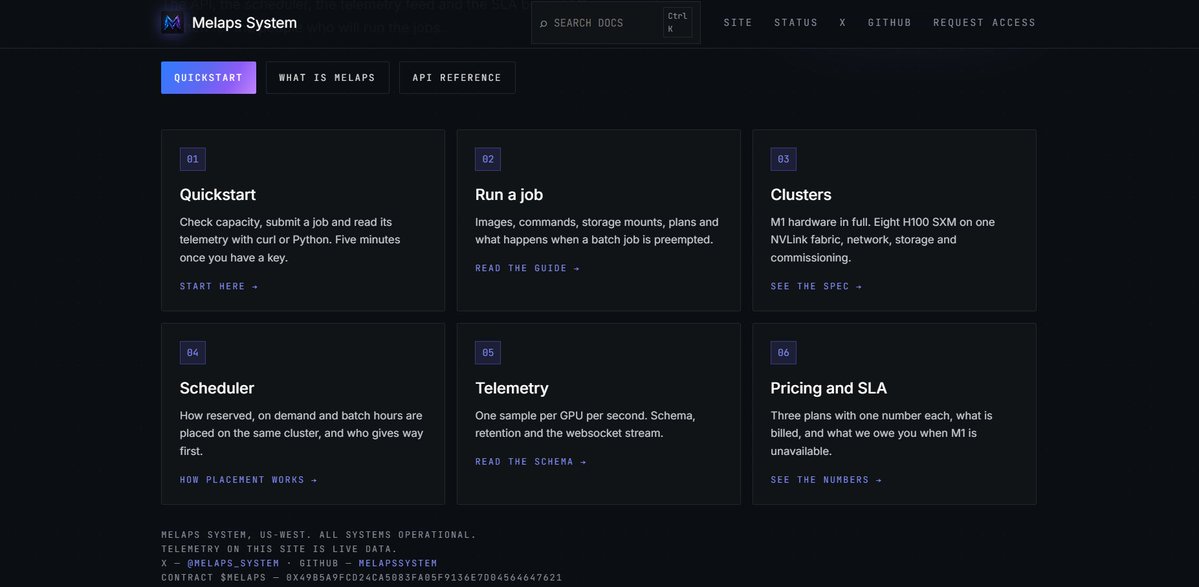
Beyond workload execution, MELAPS documentation also covers telemetry, cluster specifications, and service-level policies.
These resources provide technical information on infrastructure monitoring, operational conditions, and service expectations.
Explore the complete documentation:
https://t.co/FdxjaQQwmq
For developers getting started with MELAPS, the Quickstart guide provides an introduction to checking cluster capacity, submitting computational jobs, and accessing telemetry through cURL or Python.
It serves as the starting point for understanding how to interact with MELAPS infrastructure.
Once the initial setup is complete, developers can explore how workloads are executed and scheduled.
The documentation explains job configuration, storage mounts, and scheduling behavior across On-Demand, Reserved, and Batch workloads, providing a clearer understanding of resource allocation.
Understanding your infrastructure starts with clear and accessible documentation.
MELAPS provides technical resources covering cluster specifications, workload execution, scheduling, telemetry, and service policies.
From initial setup to managing computational workloads, our documentation helps developers understand how the platform operates and how its components work together.
Explore the MELAPS documentation and learn more about the technology behind our infrastructure.
https://t.co/FdxjaQPYwS
Getting started with MELAPS begins with a simple access request.
Developers and organizations can submit their computing requirements, including team size, workload type, and estimated monthly usage, directly through our website.
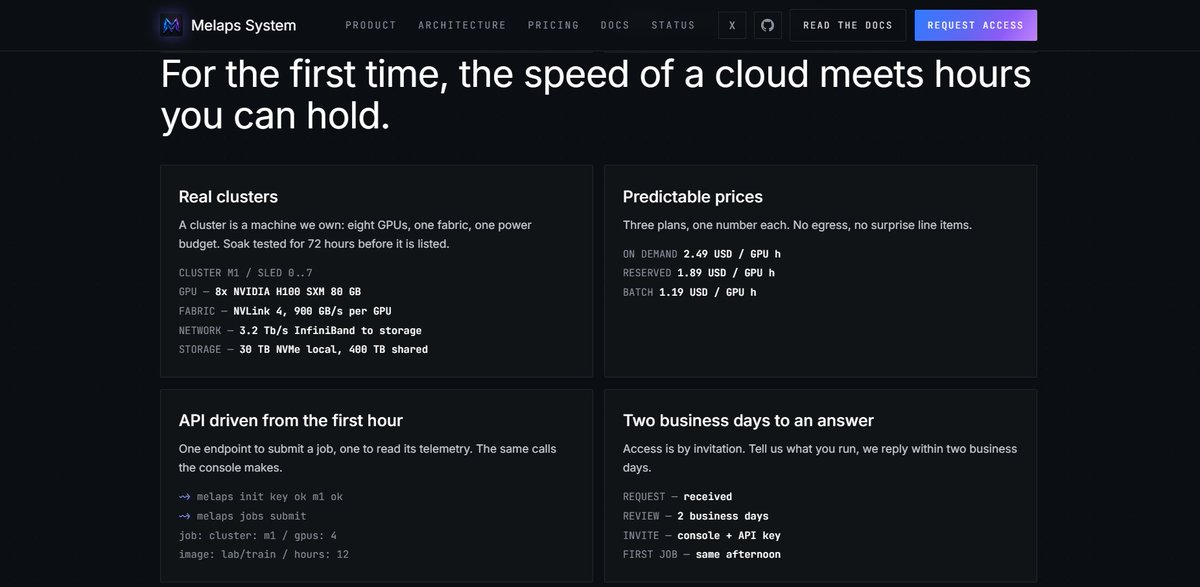
Each request is reviewed to assess infrastructure availability, with a response provided within two business days.
Once approved, teams receive access to the MELAPS console and API credentials, allowing them to begin preparing their computing workloads.
Real infrastructure. Clear expectations.
At MELAPS, every cluster is built around dedicated computing resources and undergoes 72 hours of testing before being listed.
From transparent pricing to API-driven workload management, our approach is designed to make GPU computing more straightforward for developers and teams.
We believe accessing computing infrastructure should come with clear information about the resources, costs, and processes involved.
Effective GPU cluster operations require structured workload execution and continuous access to operational information.
MELAPS Agent is a component focused on telemetry collection and job execution within the MELAPS computing environment.
The repository provides insight into the technical components involved in supporting workload operations and collecting infrastructure-related data.
Application development requires reliable integration between software and computing infrastructure.
The MELAPS Python SDK is designed to facilitate interaction with the MELAPS API, providing developers with a Python-based interface for incorporating platform services into their applications.
Through this repository, developers can examine the SDK implementation and explore its role in supporting programmatic access to MELAPS infrastructure.
Efficient infrastructure management begins with the right development tools.
MELAPS CLI is a command line interface designed to support interaction with MELAPS GPU clusters directly through the terminal.
This repository provides developers with access to the CLI implementation, offering a technical foundation for exploring command-line infrastructure management within the MELAPS ecosystem.
Explore MELAPS CLI on GitHub:
https://t.co/kWrYvyyyrz
Interested in running your workloads on MELAPS?
The platform provides a request access process for developers and teams looking to explore its computing services.
Visit the website to learn about the available infrastructure, review the platform's capabilities, and submit an access request.
Getting started begins with understanding what resources your project needs.
https://t.co/cFqJ1B8zLK
Large AI workloads don't just need processing power. They also need somewhere to store datasets, checkpoints, and the files produced during training.
The MELAPS M1 cluster includes local NVMe storage and shared storage capacity to support data-intensive computing tasks.
Compute and storage work together, and both play an important role in keeping AI workloads organized.
https://t.co/cFqJ1B8zLK
Knowing what's happening across your infrastructure is just as important as running the workloads themselves.
MELAPS provides access to operational metrics and monitoring capabilities, helping teams keep track of resource activity and understand how their computing environment is performing.
Better visibility means fewer unknowns when managing demanding workloads.
https://t.co/cFqJ1B97Bi
Training a model from scratch and fine-tuning an existing one are two very different processes, but both depend on having the right computing resources.
MELAPS supports GPU-intensive workloads, giving teams the infrastructure needed to work with large models, run training sessions, and refine their results.
Whether you're building something new or improving an existing model, the compute behind it matters.
MELAPS SYSTEM is now on FOMO.
We've created our official profile on FOMO to expand our presence and make it easier for the community to stay connected with MELAPS.
This is another step toward building a stronger community, sharing updates, and keeping everyone informed as the project continues to grow.
Follow our journey and connect with us on FOMO.
https://t.co/ZvFAme9gfn