🚩Fouad Makhzoumi: My position is unambiguous: I support this framework. For the first time in seventy years, Lebanon holds a text signed by the United States, Israel, and Lebanon, in which Israel declares it has no claim to Lebanese territory and wants the Lebanese Army controlling the ground. Hezbollah’s entire case for the arsenal rested on one claim: Israel never leaves. The framework calls that bluff with a signature.
And what did the weapons deliver? Makhzoumi counted it: eleven hills under Israeli control, fifty-seven villages wiped off the map, more than a million Lebanese displaced, tens of billions in destruction. The arsenal that promised protection produced occupation. The tell is where the party looks for rescue: Islamabad and the Iran file, not Washington, where Lebanon’s own signature sits. That answers Makhzoumi’s question. The position is Iranian, not Lebanese.
The solution exists: pilot zones. The Army deploys, Hezbollah withdraws, Israel pulls back in parallel, and the state follows with schools, hospitals, and investment, so the southerner’s future belongs to Lebanon, not Tehran’s payroll.
Makhzoumi’s challenge stands: reject Lebanon’s first direct negotiation in seventy years, and leave the government you feed from. When the Army enters the first pilot zone, we will learn what the weapons were for.
Most of western media reporting from Beirut is in fact biased or naive. Very few reporters are willing to make the effort to dig deep and talk to people, not just interview them.
It’s a pity because Lebanon is a country that is going through major shifts and most journalists can’t see it, or maybe don’t want to. Read this👇
Two thumbs down, @NPR
I almost veered off the road driving to work this morning, as I listened to an especially slanted @MorningEdition report out of #Beirut on the #Lebanon-#Israel “framework agreement” signed in Washington last Friday.
Here’s what I mean: The 3-minute segment was set up as a preview of expected US-#Iran talks in #Doha, with an emphasis on why the Iranians may be coming to these negotiations in a foul mood. After explaining the lack of trust between the two sides, NPR ‘s Beirut-based correspondent @RSherlock then said Tehran was “furious” about the Lebanon-Israel agreement brokered by the USG. Asked to explain why the Iranians were unhappy, Sherlock replied:
“Well, Israel is fighting #Hezbollah, the militia in Lebanon, which is heavily supported by Iran. And the deal says Hezbollah would be disarmed. And crucially, it makes Israel's full withdrawal from the large amounts of land it's occupying now here actually conditional on Hezbollah first disarming. Hezbollah was never part of the agreement and has outright rejected it, calling it a surrender of sovereignty.”
So far, so good. But then, for some inexplicable reason, Sherlock turned in a wildly different direction, relaying anonymously sourced critiques of the agreement itself instead of explaining why it may complicate the Doha talks.
“And this, though, has also been widely criticized by independent experts who say the problem here is the Lebanese army, who would disarm Hezbollah, is quite weak and is simply unable to do this. And therefore, this agreement essentially cedes Lebanese territory to Israel.”
Whoa… The correspondent could have explained that the Iranians are angry because the democratically elected Lebanese government decided to break free from decades of Iranian interference in Lebanese domestic affairs and take a chance on an historic agreement that holds the prospect of reclaiming full sovereignty over their country and building real peace with Israel.
But instead, she pivoted to relaying a critique of the agreement itself by unnamed “independent” experts – whatever that means. And she ended the paragraph with a damning and wholly unsubstantiated assertion, implicitly ascribed to those same “experts,” that “this agreement essentially cedes Lebanese territory to Israel.” (It does not, by the way.)
It gets worse.
With the original theme of the segment – a preview of the Doha talks -- now discarded, the conversation then turned to a discussion of how ordinary Lebanese view the agreement with Israel. But instead of asking THAT reasonable question, host @rachelnpr focused solely on how displaced people from southern Lebanon view the deal. Following the “garbage in/garbage out” principle, it is not surprising that Sherlock didn’t offer a nuanced response that reflects Lebanon’s political, economic, ethnic, and religious complexities. Instead, we hear the voice of Hezbollah.
“MARTIN: You've also been speaking to some of the people displaced from these southern areas. What are you hearing from them?
“SHERLOCK: You know, people here told us they feel sold out by the Lebanese government over this deal. Many are from areas that are now controlled by Israel. Israel says it's weakened Hezbollah enough that the Lebanese army can now take over these southern border areas and oversee disarmament. But there is still support for Hezbollah in these areas by people who see them as a protector from Israel. Lebanon is a country of many religions with a long history of sectarian violence.
“I spoke with Ali Chaito (ph), who's a mechanical engineering student who's displaced. He now lives in a tent in Beirut. And he warned that if the Lebanese army tries to remove Hezbollah's weapons, it could push the country to civil war.
“ALI CHAITO: To have a war between each other, not with another country. No one could take the weapon of Hezbollah.”
Then, Sherlock closed the segment this way:
“Lebanon's president insists that the Lebanese army will deploy to the southern border. Israel has agreed to withdraw initially from a couple of towns in the south that are going to be called pilot zones, where the Lebanese army would deploy and disarm Hezbollah. But as I said, many Lebanese are really worried about all this.”
In other words:
- The displaced engineering student who repeated Hezbollah’s talking point about civil war gets named and a direct spoken-to-microphone quote, evoking empathy among listeners, but not the president of Lebanon, who doesn’t even get named.
- The only “ordinary” Lebanese we hear from is a Hezbollah-sympathizer. We did not hear from any supporter of the largest political party in the Lebanese parliament, the Christian-based “Lebanese Forces,” whose leader, @DrSamirGeagea, enthusiastically embraced the agreement. Nor did we hear from Sunni supporters of the deal, such as backers of the popular Sunni parliamentarian @fmakhzoumi, who is a strong advocate of the agreement. Nor did we hear from anyone else in the broad coalition of Lebanese – including Shiites – who are fed up with Iran’s local agents dragging them into wars they don’t want and who welcome this agreement as a chance to reclaim Lebanon’s independence and sovereignty.
- The segment concluded with one of the oldest journalistic tricks in the book, use of the term “many,” as in “Many Lebanese are really worried” about the agreement. How many is “many” - 20 percent? 40 percent? 60 percent? 80 percent? It makes a huge difference. Answering that question, however, would have required talking to lots more people that the correspondent evidently did.
Bottom line: what started as a preview of the Doha talks ended as a one-sided attack on the Lebanon-Israel agreement. To borrow from Siskel and Ebert (may they rest in peace) -- two thumbs down, NPR.
If you want to check my quotes, the full transcript of the segment can be found here: https://t.co/JN39rYr2yt
Mon dernier édito dans la @RevuePol: « Pourquoi l’Iran est en train de perdre »👇
👉🏻 « Alors que les négociateurs iraniens avaient placé le Liban au sommet de leurs priorités, en faisant de la préservation du Hezbollah et du cessez-le-feu au Liban l’un des quatorze points de l’accord-cadre, afin d’en maintenir le rôle de levier de pression non seulement contre Israël, mais également contre les États-Unis, ils viennent d’être privés de cet atout diplomatique majeur.
(…)
👉🏻L’Iran est perdant y compris dans le cadre des quatorze points qu’il a lui-même définis. Le détroit d’Ormuz, qu’il cherche à contrôler, n’est pas seulement un sujet de contentieux avec les États-Unis, mais aussi avec les Européens, qui rejettent toute remise en cause de la liberté de navigation et refusent l’instauration d’un droit de péage.
(…)
👉🏻 sur les plans stratégique et militaire, Téhéran a essuyé des revers majeurs depuis plusieurs années. La chute du régime de Bachar el-Assad en Syrie lui a fait perdre une profondeur stratégique essentielle. À cela s’ajoutent l’affaiblissement des Houthis ainsi que le recul de l’emprise du Hezbollah sur le Liban.
Les regards se tournent désormais vers l’Irak. C’est là que le Premier ministre Ali Al Zaïdi intensifie ses actions contre plusieurs figures et réseaux liés à l’influence iranienne. »
And more 👇
https://t.co/PpL7BGG7DI
Les Libanais anti-accord font beaucoup de bruit, mais ils ne représentent pas la majorité. Comme souvent, la communauté proche du Hezbollah est très visible et très vocale.
Une majorité de Libanais aspire à la paix avec Israël.
Votre « spécialiste de terrain » ne peut parler qu’en son nom. Pour comprendre la réalité libanaise, il faut venir vivre ici, pas quelques jours, mais plusieurs mois…
En attendant merci de ne pas parler au nom des libanais ….
Pedro Sánchez se ríe porque puede y tiene plena capacidad de hacerlo. El bloque de investidura está cautivo del PSOE por motivos muy variopintos: Junts está preso por y para la amnistía de Puigdemont, el PNV gobierna con el PSE en Euskadi, Bildu y ERC viven de “lo otro será peor”. Es decir, que ninguno de sus apoyos tiene ya realmente nada que ver con lo que aprueba o no el Gobierno (sin sacar adelante unos presupuestos hace 3 años), de las políticas que cambian la vida de la gente o de los múltiples escándalos judiciales. Y en su partido, ya nadie le puede echar, aunque en las federaciones paniquen por ir a municipales antes que generales y darse una castaña. Sánchez modificó el reglamento del PSOE cuando ganó las primarias de 2017 para laminar el poder del comité federal, los barones, y ya solo le pone o quita la militancia. Es decir, un sector mucho más escorado que cualquier ciudadano de a pie.
Se ríe porque puede hacerlo, repito.
No es culpa suya. Que no se victimicen los socios, que sean consecuentes.
"Cuando el gobernante se declara dueño de la verdad y no admite debate alguno, convoca a los senadores no para escuchar opiniones sino para imponer la suya. Y así, la grandeza natural del Senado degenera en espectáculo de servidumbre".
(Juvenal. Sátiras)
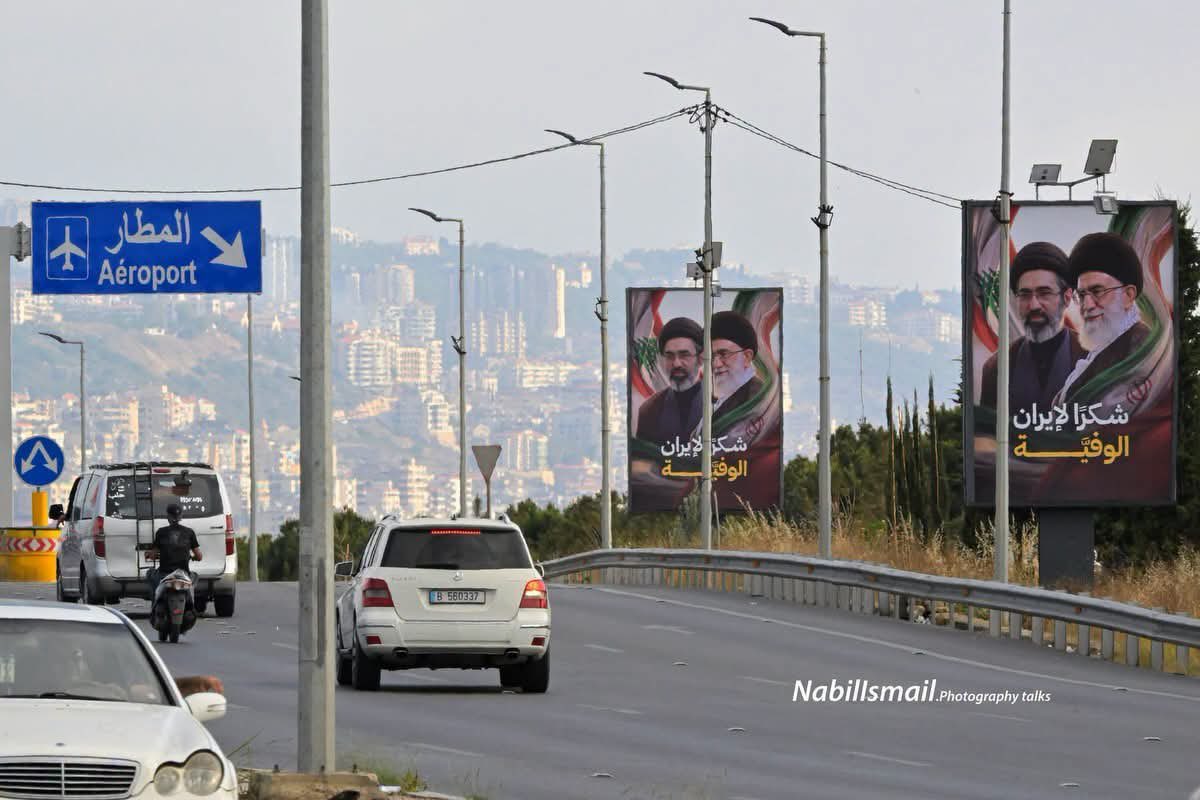
Le Liban avait réussi, après l’élection de Joseph Aoun, à faire disparaître toute forme d’affichage partisan, en particulier les panneaux liés au Hezbollah, sur l’autoroute menant à l’aéroport.
La donne a changé après la signature du MoU. Le Hezbollah fait son retour sur cet axe avec des affiches montrant Khamenei, père et fils, accompagnées du slogan : « Merci à l’Iran fidèle ».
🚩Fouad Makhzoumi: “No serious alternative exists.” Washington is the only table where Lebanon negotiates as a state, not as a chip in Tehran’s bargain.
Any other talks Hezbollah tries to push for, whether indirect or in Switzerland, are not defending sovereignty or the Lebanese. They are surrendering it to the Iranian regime that wants Lebanon weak to stay relevant.
Peace you don’t author isn’t peace. The state negotiates, or it gets negotiated.
Lebanon cannot reclaim its sovereignty and independent national decision-making as long as Hezbollah’s weapons remain outside the authority of the state, and as long as decisions of war and peace are made outside the country’s legitimate institutions.
I call on the Lebanese state to deploy the Lebanese Army throughout the Nabatieh region and along the areas adjacent to positions that remain under Israeli control, in order to prevent any military actions or provocations that could provide Israel with additional pretexts to expand its military presence, in parallel with an Israeli withdrawal from occupied Lebanese territory and the deployment of the Lebanese Army in those areas.
The restoration of state authority begins in the South, through ensuring that all arms are exclusively in the hands of the Lebanese Army and the legitimate security forces, and through extending the authority of the state across its entire territory.
There can be no genuine sovereignty except through one state, one army, and one national decision.
🚩Dr. Samir Geagea to Vice President JD Vance: “only the Lebanese state has the standing to negotiate for Lebanon”
The same demand comes from the top of the state, in one voice: President Joseph Aoun, Prime Minister Nawaf Salam, Beirut MP Fouad Makhzoumi, and Geagea himself, who leads both the largest Christian party and the largest bloc in parliament.
Yet Hezbollah and Iran stand against every one of them, fighting all of Lebanon to keep Tehran, not Beirut, running the negotiation. Not to protect Lebanon. To protect the regime. And Washington unfortunately, is choosing for now, to let it grow.
Contradictions Libanaises 🇱🇧 :
👉🏻Le Président de la République sépare courageusement le dossier des négociations directes avec Israël de celui des négociations de l’Iran avec les USA. Cependant, le chef de l’armée Rodolphe Haykal a visité Islamabad avant la signature du MoU sans que l’objectif de son voyage ne soit précisé. Le Président Aoun a reçu un appel d’Aragchi, MAE iranien, juste après la signature du MoU. Appel saugrenu d’autant plus que l’ambassadeur iranien au Liban est persona non grata. Ambivalence ou peur?
👉🏻Pendant que le Hezbollah perd militairement face à Israël, le « deep state » continue à harceler journalistes, penseurs et activistes. Ce pays qui prétend imposer des réformes, maintient un tribunal militaire liberticide qui émet des mandats d’arrêt contre toute personne critique du Hezbollah ou visible sur des médias Israéliens.
👉🏻Alors qu’un 3e cycle de négociations Liban-Israël s’annonce à Washington, le dossier libanais est discuté en Suisse. De quoi discuteront alors les négociateurs à Washington si le volet sécuritaire est traité à Bürgenstock?
🚩Lebanon’s ceasefire is the first thing on the table in Switzerland, a table Lebanon isn’t sitting at.
That table belongs to Tehran and Washington. Iran showed up using Hezbollah’s fire as a bargaining chip, trading Lebanon’s quiet for sanctions relief and the Strait of Hormuz. Beirut has answered with statements. It keeps declaring its sovereignty on paper while that sovereignty is sold in someone else’s deal.
Lebanon has two moves it refuses to make: take real tangible charge of its own track in Washington, and send the army south. Washington has held four rounds of talks. Even Israel deals through Washington. Only Beirut waits to be saved, expecting someone else to do the state’s and the army’s job. A country others negotiate over isn’t a player. It’s the price.
@elmundoes Yo os lo explico, analfabetos. Soy médico intensivista. En mi servicio hay compañeros con hijos que se cogen las vacaciones cuando tienen a los niños en casa. Durante julio y agosto somos un 60% de la plantilla habitual. Si hago huelga en verano, te mueres, tampoco es plan.
🔴 Ayer empecé a atender niños en Urgencias a las 7:45 de la mañana. Seguí viendo niños a las 3:00 de la tarde. A las 10:00 de la noche continué atendiendo pacientes. A las 3:30 de la mañana seguía haciendo el mismo trabajo que empecé 20 horas antes.
Esto en España se llama guardia médica y ningún otro país en Europa lo sigue permitiendo. Se juntan 3 turnos y un solo médico hace el trabajo de 3 médicos. Se ahorra dinero y se ahorra personal.
Los turnos de tarde, de noche y de fin de semana se pagan peor que el turno de mañana (porque cuando esto se diseñó así hace décadas se suponía que estabas de guardia a la expectativa de trabajar…), no computan como parte de tu jornada ordinaria (por eso al día siguiente a diferencia de un bombero o un policía tienes que volver a trabajar) y tampoco computan como tiempo trabajado para tu jubilación (a pesar de que terminarás trabajando 3-4 años más en forma de guardias).
En España si trabajas en la sanidad pública estas obligado a hacer guardias médicas hasta las 55 años en número de 4-5 al mes. Guardias que ponen en riesgo tu salud física y mental y la integridad de los pacientes a los que atendemos.
Los que han aprobado este Estatuto Marco que perpetúa este sistema de guardias son los mismos que hace unos años prometían abolirlo. A los sindicatos que tienen una representación nula entre los médicos les da absolutamente igual y no han hecho nada por cambiarlo.
Por eso el enfado y la decepción entre los médicos es tan grande. Por eso están rotos todos los puentes. Por eso todo esto acabará con una huelga indefinida.
🚩The Iranian regime wrote Lebanon into its own memorandum, turning Hezbollah’s arsenal into a bargaining chip it controls, pegged to Tehran’s 60-day clock.
This is why Fouad Makhzoumi’s point matters: the Washington track, in parallel, keeps the arms a binding Lebanese mechanism, not solely a clause in Tehran’s deal, converting a reversible chip into an irreversible commitment. Any track that sidelines the Lebanese state strengthens Hezbollah’s, and forfeits the sovereign momentum President Joseph Aoun is building in Washington.
This is the real battle: the Lebanese state versus a militia that holds the country’s fate hostage. Sovereignty means war and peace are decided in Beirut, never again by Hezbollah.
Spare us the theatrical declarations about “pillars of resistance” and “valiant struggles.” Your regime’s idea of “powerful diplomacy” is smuggling rockets into Lebanon, turning its southern villages into launch pads, and sacrificing Lebanese blood to advance Iranian hegemony. That is not solidarity. It is cynical exploitation dressed up in revolutionary slogans.
Lebanon does not need your “guarantees.” What it desperately needs is to be rid of the Iranian backed militia that has hijacked its state, ruined its economy, and dragged it into wars it never chose. While you lecture the world about Israeli “warmongering,” Iranian proxies have helped reduce Lebanon to a bankrupt, divided, and bleeding country.
So here is some straightforward advice. Go clean the monumental mess in your own house first. Fix the suffocating dictatorship, the collapsing rial, the mass executions, the systematic oppression of your own people, and the international isolation your regime has earned through decades of terrorism, nuclear deceit, and regional arson. Lebanon is not your property, nor is it a forward operating base for the IRGC. Take your “resistance” rhetoric and your weapons shipments back to Tehran, and let the Lebanese decide their own fate without your bloody fingerprints all over their country.
The Lebanese people deserve sovereignty, not servitude to Iranian ambitions. Stop using their land as fuel for your endless wars.
It’s quite disturbing to see the media’s obsession with the possibility of a « civil war » in Lebanon. Lebanese people reject violence and conflict. The last thing they want is a civil war. Only Hezbollah promotes such a narrative in order to maintain its psychological grip on Lebanon.
https://t.co/sP4yIrWRMS