I think the problem with a lot of pension discourse is that it gets into the details too soon – arguing about spend to gdp and sustainability of the program first.
The first question should be: what are we trying to do?
Are we trying to create a social safety net so that no retiree has to live in poverty? Well in Canada we are doing a bad job at that.
Are we trying to provide UBI for old people? Well in Canada we are doing a great job at that, but I don't think most would event want this at all.
Are we trying to replace earnings? This is the mistake we make in comparing our pension spend to other countries. Countries like France have decided to fund earnings replacements through general taxpayers vs making workers save for it themselves.
Obviously a silly thing to do. But you can't just compare overall pension spend to poor-performing countries and say we're doing a good job when we're trying to accomplish different things, and there are good and bad models for these different things.
The crazy thing about countries like France is that they've decided they are going to make taxpayers fund earnings replacement for retirees.
That's different than saying taxpayers should fund a social safety net for the poorest retirees.
It'd be like saying Canadian taxpayers should fund a retiree's CPP. Crazy! No wonder their costs are exploding.
Though I would never let Canada off the hook so easily. For whatever reason, we've decided to let taxpayers fund UBI for anyone over the age of 65.
Compare this with countries like Australia where taxpayer money is much more focused on actually funding a social safety net targeting low income seniors.
The crazy thing about countries like France is that they've decided they are going to make taxpayers fund earnings replacement for retirees.
That's different than saying taxpayers should fund a social safety net for the poorest retirees.
It'd be like saying Canadian taxpayers should fund a retiree's CPP. Crazy! No wonder their costs are exploding.
The most important article of 2026 is this piece by @jburnmurdoch, building overwhelming evidence on the unsustainability of the pension systems in many countries and the broken intergenerational contract.
To me this is the single underlying problem explaining the inability of many countries (incluiding my two, UK and Spain) to invest and grow and the malaise in their youth. Every future oriented policy, education, innovation, investment in infrastructure, is being sacrificed to increase pensioners living standards.
But the problem is political, and some countries have solved it. E.g. in Denmark the retirement age increases (years later) semi automatically with life expectancy. See the result in the last graph.
https://t.co/d7hradlHyY
Today is the LAST DAY to verify your identity and TOMORROW is the last day to vote for the next Ontario Liberal Leader.
Don’t wait until the last minute!
In that spirit, here are two predictions about the results:
1) I believe @LFairclo will win on the third ballot. I expect it to be close. If you supported me, I’d encourage you to rank her first!
2) People will be surprised by how well @dylanmarando performs. I predict he will surprise, and he’s earned it!
Remember to vote!
1. Sure seems like not a bad idea. But in my opinion, immigration should be focused on economic prosperity of our country, and I’m not sure how this gets us closer to that.
2. Not sure what the criticism is. Yes, it’s normal for people to come in on a temporary basis before granting permanent residency.
3. What does turning back the taps on mean? RBC is predicting modest population growth https://t.co/S8ydChO0wK
4. I agree this could be a problem though I’d be curious if we’ll see things readjust as family reunification happens with this cohort in the future. What has the historical pattern been?
A timeline of immigration, how data shapes policy, and how targets can negatively shape behaviour:
2024:
Recall, after a few years of unprecedented international student growth, the federal government set targets to reduce temporary residents to 5% of the population and grant permanent residency to 380,000 people per year.
For context, TR population at the time was ~6-7% and PR grants were ~500k a year.
The thinking was that by lowering overall PR targets, it would be harder for temporary workers in the country to have a viable path to permanent residency, and many would voluntarily leave.
2025 - early 2026:
StatsCan population data seemed to suggest that this was working! There were steady drops in TRs every quarter. Earlier this year, it seemed like our population would actually decrease this year.
September 2026:
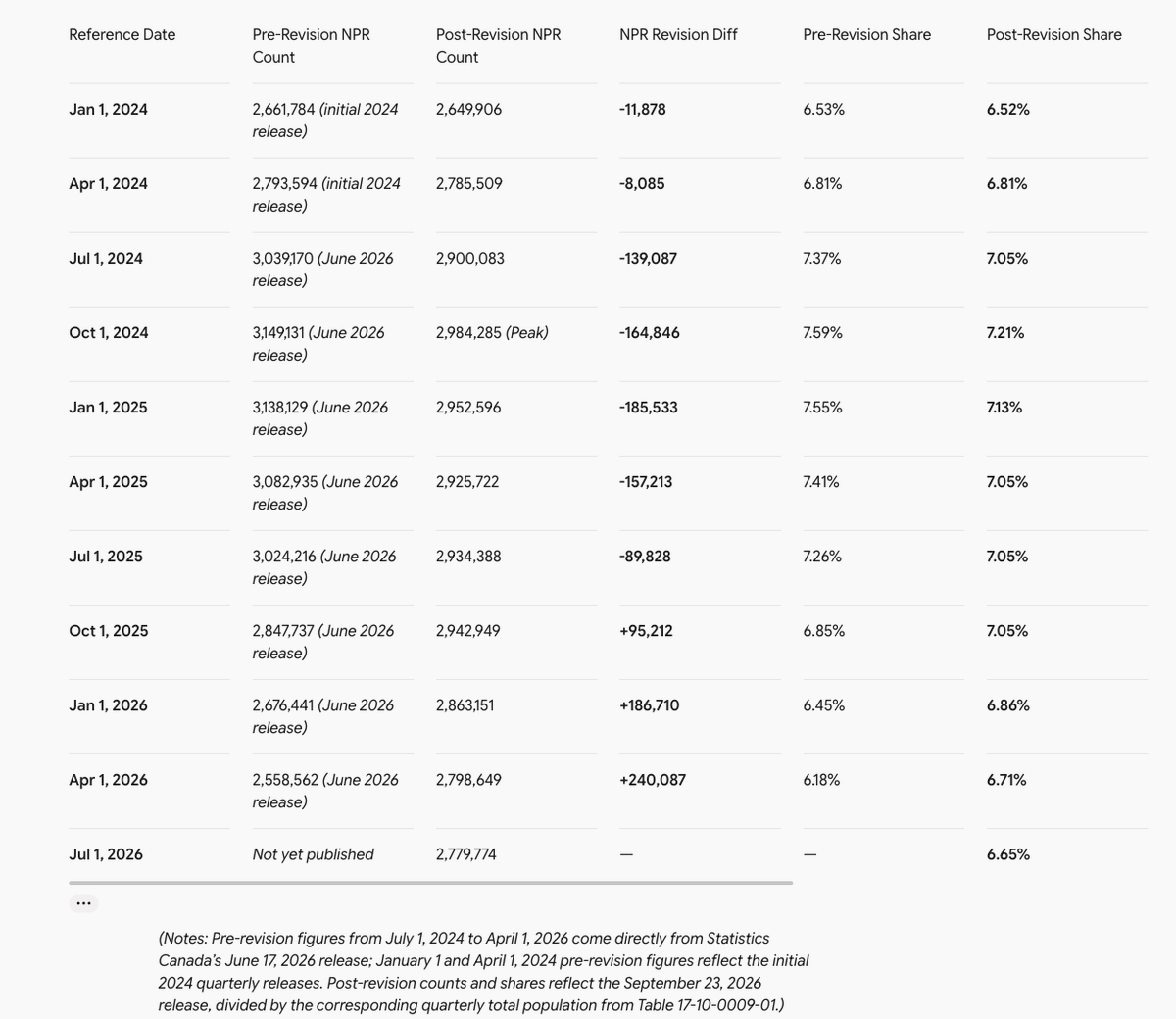
Curveball – StatsCan issues a major revision. They update their population counting methodology to include Canada Border Services Agency (CBSA) data, ie counting people who actually crossed the border.
It turns out that we have 240,000 more temporary residents still in the country than previously thought.
This is because permit holders whose documents were expiring had applied for extensions, and were still legally in Canada while awaiting a decision. Previously, they they were assumed to have just left.
These 240k extra people meant that the feds were further from the 5% target than they thought (see image).
November 2026:
The new immigration plan is released. The feds continue to hold the course on targeting 5% TR population and granting 380k PRs per year.
Except! There's an additional 200k PRs being given out. This is a time-limited measure and is separate from the main PR target. It also lines up pretty well with the 240k extra people in the country...
---
So I think we can now deduce why this was done. There are about 200k more TRs in the country than previously thought. We can:
1. Do nothing. Let them move through the system, qualifying for a PR or leaving voluntarily eventually. But, this would mean that the 5% target will take much longer to achieve.
2. Convert them to PRs. This will reduce the proportion of TRs in the country, allowing us to get closer to the 5% target. These people are already here, we just need to change their immigration status. But this would drastically increase the "380k PRs per year" target.
3. Convert them to PRs, but through a separate accounting measure. This lets all the "topline" targets stay the same and keep progress towards them.
For the record, I think this separate time-limited target is bad. What we need to have above all is understanding in the system.
But I also think that if all critics are going to focus on are certain numbers, well, you get what you ask for.
@InsiderTakes Curious what are some examples of specific criticisms?
(I am not a defender of the current immigration system fwiw. But I also think a lot of criticisms miss the mark.)
@InsiderTakes For the record, I wish we did #1, but when all critics can do is focus on the population of TRs, well play stupid games win stupid prizes
That we can't easily agree on what is even happening – how many people are here, in what status – is perhaps the biggest problem with the system right now
Okay, let's do that. Here's the actual numbers for inflows. There were 495,000 in total, along with 584,000 outflows. That's nowhere near the net -445,000 in the Levels Plan.
@Sorcerer0fEld Now that you mention it, it's interesting, Indian food in London is pretty spicy and they don't default to spice levels – just like in India.
Some thoughts on London as someone visiting from Toronto:
1. I truly do not understand how young people make it here without family wealth. Housing and food are so expensive and salaries are lower to boot.
2. Globalism has made it extremely easy to eat "authentic" cuisines in any decently-sized city around the world. As such, I have no interest in eating "really good Vietnamese". I have that at home. What's the thing I can only eat here? What actually makes you unique in this world?
3. British food gets a worse rap than it deserves. When it's good it's great. Full english breakfasts, meat pies, pasties, Sunday roasts. The problem is that it's easy to make, and frequently experienced, as mediocre.
4. They consistently know how to make good potatoes here. Crispy on the outside, soft on the inside.
5. I truly believe that you have experience things yourself to really understand it. For example, you might hear someone say "the beans really bring the whole thing together" and nod along, but it's not until you eat a proper full english breakfast that you're like "mm yes the beans really do bring the whole thing together."
6. It's incredibly grounding to be surrounded by layers and layers and layers of history. So much has come before us to bring us to where we are.
7. It is quite a moving place to be around Remembrance Day. To visit the war museum, see sites of historical importance, watch the ceremonies. The poppy takes on an entirely different meaning. Not only is it to commemorate veterans, but its a symbol of unity. Two sides of an ocean, Canadians and Brits wear poppies, remembering that our countries fought side-by-side, from the very beginning, together.
8. The urbanism is fantastic. Pedestrian-friendly, mature tree-lined streets, beautiful facades. Canadians may wave this away and say, "These cities were built before cars." But even new neighbourhoods like Canary Wharf are very pleasantly designed. Planning in Toronto is very broken. The guidelines and rules we've set lead to bad results. And the frustrating this is that it's all a choice.
9. It is wonderful to be able to pick two neighbourhoods on a map and have a decent transit connection between them.
10. You never see anti-social behaviour on transit. They are constantly running these PSAs over the speakers to text a number if you see anything. "See it. Say it. Sorted." I love it so much. Particularly the "sorted" and the accountability that the system takes on. Interestingly, I also heard a PSA that was like, "If someone asks you for money, donate to a charity instead." Extremely based to encourage the public to deter this behaviour.
11. There is no consensus for if pedestrians should walk on the right or the left. Maddening.
12. I do not understand how Brits get the reputation for loving to queue. I had some downright egregious experiences. Canadians are way more polite and respectful.
13. I have yet to see a child glued to a device. On transit, they're looking out the window, reading, or drawing. Curious if anyone knows why?
@itsyusufahmed No, I think it's because the UK drives on the left but they tell people to stand on the right of an escalator it's weird there's no consistency
@Ramsey_Kilani I agree, I don't think more PSAs will solve the problem here.
What I like about their PSAs is that there's clear accountability. Their PSAs say they will handle any issues ("sorted"), and indeed, there are no issues. This is how you create trust in the system.