@joodalooped@jlongster Stripe's design system components accept a css prop, bound to design system tokens and supporting custom plugins. Under the hood it's (now) powered by stylex.
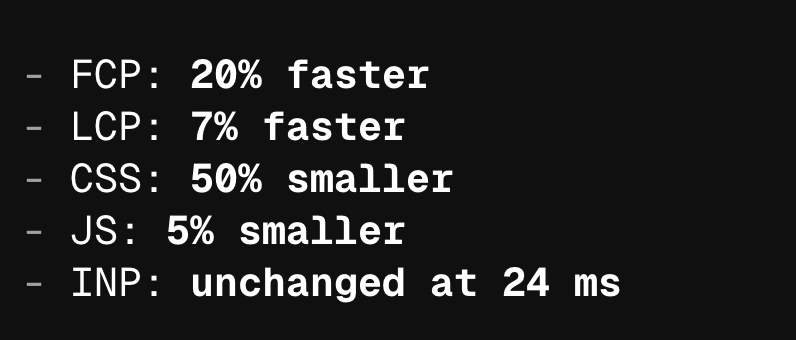
Over 1000 PRs later, Linear migrated from styled-components to @stylexjs.
What began as performance optimization gave us better defaults for humans and agents alike.
Our engineer @kenneth_skovhus on what we learned:
https://t.co/FRMUeWg8Ta
@setimmediate@naman34@stylexjs Nobody believed me when I said how good it was. Everyone kind of looked at me funny and was like "but all of these other css-in-JS solutions are meh, why is stylex any better?"
But now everyone sees. Everyone knows. I convinced my company to migrate.
Stylex is so good.
we've been saying this from day 1 when the dialogue was on "in-distribution tech"!
codegen is no longer the bottleneck, verification is. the value of a programming abstraction is increasingly how well it constrains and validates generated code (via type safety, determinism, etc)
After about a ~decade with atomic CSS frameworks (BuzzFeed Solid, Basscss, and then finally Tailwind), I think I'm convinced now that Stylex is superior for agents.
Stylex constraints lead to greater consistency and correctness as your codebase grows. I do still think Tailwind is the ideal human DSL for styling, but in a world where I'm barely touching CSS/class names by hand, the tradeoffs have changed. Again, if I were still hand writing code, Tailwind still wins, but we're not doing that anymore.
It’s interesting seeing some high profile tweets talking about moving from Tailwind to StyleX due to being supposedly better for agents.
It gives me hope that, as the dust settles on AI usage patterns, we’re not simply locked into whichever tools are currently most popular.
@jaredpalmer@gabegreenberg yes!! we are 100% StyleX now for Cursor and Grok Bot and it’s great. agents need constraints and the type safety is really nice
After about a ~decade with atomic CSS frameworks (BuzzFeed Solid, Basscss, and then finally Tailwind), I think I'm convinced now that Stylex is superior for agents.
Stylex constraints lead to greater consistency and correctness as your codebase grows. I do still think Tailwind is the ideal human DSL for styling, but in a world where I'm barely touching CSS/class names by hand, the tradeoffs have changed. Again, if I were still hand writing code, Tailwind still wins, but we're not doing that anymore.
New post: why and how @linear is moving to @stylexjs.
Codemods and agents are doing the heavy lifting. Humans still have to perform detective work on cursed hover states.
https://t.co/lSnDvJwTvL
🚀 Introducing Astryx from Meta – an open source design system that’s AI fluent and fully customizable without dependencies. 150+ accessible components, brand-level theming, ship-ready templates, and a CLI. Built at Meta over 8 years, now yours. Astryx Design → https://t.co/rBHFBYS76h and GitHub → https://t.co/OyHbxy4Jrl
🚀 Introducing Astryx from Meta – an open source design system that’s AI fluent and fully customizable without dependencies. 150+ accessible components, brand-level theming, ship-ready templates, and a CLI. Built at Meta over 8 years, now yours. Astryx Design → https://t.co/rBHFBYS76h and GitHub → https://t.co/OyHbxy4Jrl
Keeping a running list now:
- pretty much any web surface at Meta
- FB/IG Quest apps via RSD
- Figma
- Snowflake
- Hubspot
- Linear
- Polar
- Mixcloud
- co/core (new launch)
We've moved more than 50% of Linear to StyleX so far.
It's given us more control over how components compose, what can be overridden, and improved render performance too.