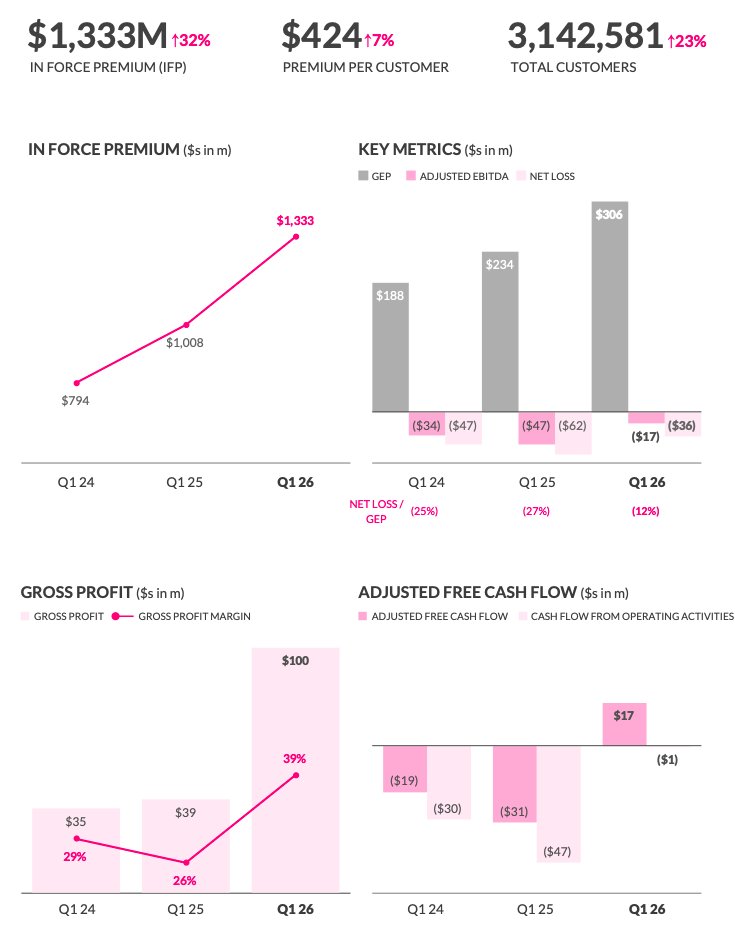
$LMND 🍋 Q1 2026 Earnings are Up! Here is the Letter to Shareholders:
https://t.co/z9XmHsSvi2
I will be posting analysis here in this thread as well as doing a video this morning on it.
Following future rollout of FSD V14 Lite for HW3 vehicles in the US, we plan on expanding V14 Lite to additional international markets.
This update ensures that HW3 vehicle owners will continue to benefit from ongoing software updates.
Since international rollout is subject to several factors (completion of technical verification, regional adaptation & relevant regulatory approvals), we can't provide definitive dates at the moment, but will provide updates on a rolling basis
Some thoughts on $TSLA
I don’t usually write about $TSLA after earnings, but this is one of those quarters where you need to slow down and actually think it through. Not because anything dramatic happened, but because the surface level looks fine while the story is changing in a meaningful way. With a company like this, the difference between what you see and what actually matters is where most investors get tripped up.
On the surface, it was a clean quarter. Revenue grew about 16%, earnings came in ahead of expectations, and the business is still operating at real scale with strong liquidity. Nothing here is broken, but nothing here is surprising either. It looks like a company that is executing, just no longer in that phase where every quarter forces the market to reset expectations higher.
What stood out to me is not what happened, but what did not happen. There is no clear reacceleration in the core auto business, margins are still under pressure, and demand is no longer pulling the company forward the way it once did. Pricing is maintaining volume, and that always comes with tradeoffs. When you step back, the auto segment is starting to look less like a high growth engine and more like a scaled, competitive, capital intensive business being managed carefully.
And that is not a criticism, it is actually intentional because $TSLA is no longer running the auto business purely for profit optimization. It is being run as “infrastructure”, where more vehicles on the road means more data, more miles, and eventually more supply for a robotaxi network. The goal is no longer just to sell cars, it is to build a fleet.
The heavy investment in AI, the push into custom chips, and the focus on autonomy, robotics, and energy are all connected. None of this is about maximizing the current business, it is about funding and accelerating a future one that does not exist in the financials yet.
Because today you still have a business producing tens of billions in revenue with global scale and serious cash generation. At the same time, you have a second business that the market is really paying for, and that business is still mostly a vision. Autonomy is improving, robotaxis are being tested in limited markets, and Optimus is progressing, but none of it is meaningfully contributing to revenue or profit today. So you are effectively owning two companies at once.
One is a mid teens growth auto and energy business facing competition and margin pressure. The other is a potential AI driven autonomy and robotics platform that could look nothing like a traditional manufacturer if it works. The challenge is the first one has to carry the second one until it proves itself, and that creates a dynamic that does not show up in earnings.
There is also a timing element here that I think is under appreciated. Most investors are not debating whether autonomy or robotics will exist, they are debating when they will matter. If robotaxis scale in the next couple of years, the current setup can work very well and the stock will explode perhaps to an unprecedented level. If it takes five or ten years, you are sitting in a business where the present looks increasingly ordinary while the future keeps getting pushed out.
At the same time, the cost of getting there is rising. Capex is increasing meaningfully as $TSLA invests in AI infrastructure, manufacturing, robotics, and energy. That is rational given the ambition, but it also means near term cash flow will feel pressure and even turn negative. This is not a software company yet, it is a company spending heavily today in order to become one tomorrow.
Earlier in the story, the risk was whether the company could survive and scale. Today, the risk is whether it can deliver the future fast enough to justify how much of that future is already priced in the stock. That is a very different problem, and in some ways a harder one, because nothing along the way looks obviously broken.
1/