1/ Thrilled to share our new paper, out today in @Nature: "Non-invasive profiling of the tumour microenvironment with spatial ecotypes".
Paper (open access): https://t.co/EujZFqU7wi
MultiGATE: integrative analysis and regulatory inference in spatial multi-omics data via graph representation learning | Nature Communications https://t.co/C6td2waFQz
A really nice paper out today from the Wang lab describing OmiCLIP, a visual–omics foundation model linking H&E images and transcriptomics, and the associated Loki analysis toolkit. https://t.co/LSe29Ll2gQ
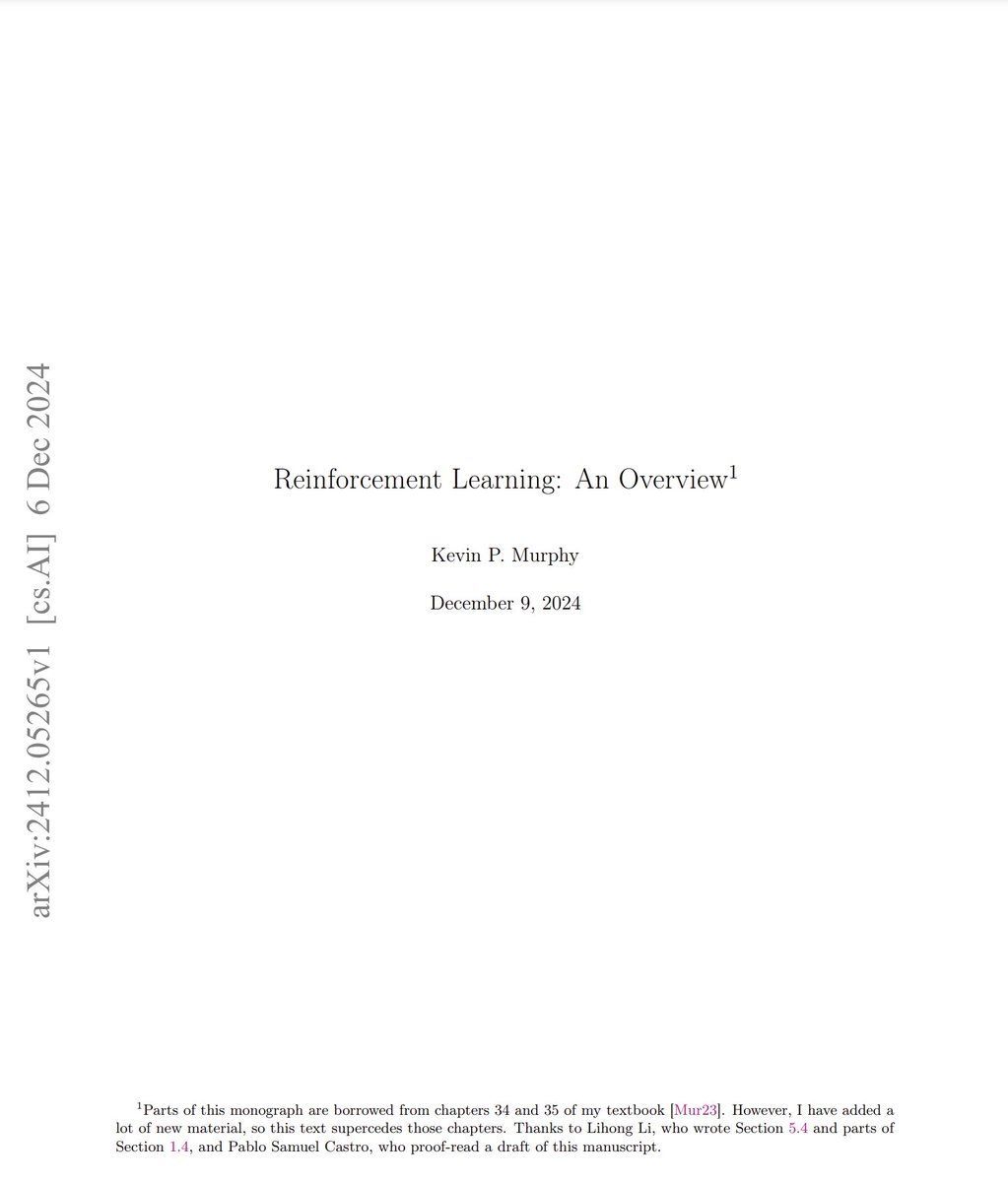
Must-read on RL by Google DeepMind's Research Scientist Kevin Murphy dropped on ArXiv.
It gives a clear, updated overview of deep RL and sequential decision-making, with examples.
Fast and Low-Cost Genomic Foundation Models via Outlier Removal
1. GERM is a new genomic foundation model that tackles a key problem in transformer-based genomics models: outliers in attention layers that hinder efficient adaptation and quantization. By removing these outliers, GERM becomes significantly more robust and lightweight.
2. Unlike traditional models like DNABERT-2, GERM replaces the standard attention mechanism with an outlier-free layer inspired by associative memory. This leads to a dramatic improvement in fine-tuning and post-training quantization, especially in resource-constrained environments.
3. GERM achieves up to 64.34% improvement in quantization robustness and 37.98% better performance in low-rank adaptation compared to DNABERT-2. It also reduces average kurtosis by 92.14% and the maximum infinity norm by 82.77%, key indicators of outlier suppression.
4. To make the model more accessible, the authors also introduce GERM-T, a continual learning approach that avoids retraining from scratch while still significantly reducing outliers and improving performance on low-end hardware.
5. GERM is efficient enough to fine-tune in 5 minutes on a single RTX 2080 Ti GPU. Even in extreme settings like 4-bit quantization, GERM retains competitive performance, unlike DNABERT-2 which collapses under such compression.
6. The study includes extensive benchmarking across 27 datasets, various quantization strategies (e.g., SmoothQuant, OmniQuant), and fine-tuning techniques (LoRA, QLoRA, LoftQ), showing that GERM consistently outperforms baseline models in both accuracy and hardware efficiency.
7. GERM can also generalize to other genomic foundation models like the Nucleotide Transformer, achieving over 50% improvement in low-rank adaptation and nearly 70% improvement in quantization robustness.
8. This work paves the way for deploying genomic foundation models on edge devices, making advanced sequence modeling more accessible to biomedical researchers without requiring massive computing infrastructure.
💻Code: https://t.co/6rCfecNL7t
📜Paper: https://t.co/WFyQiHoJr2
#Genomics #TransformerModels #Quantization #LoRA #Bioinformatics #FoundationModels #MachineLearning #AI4Science #ComputationalBiology
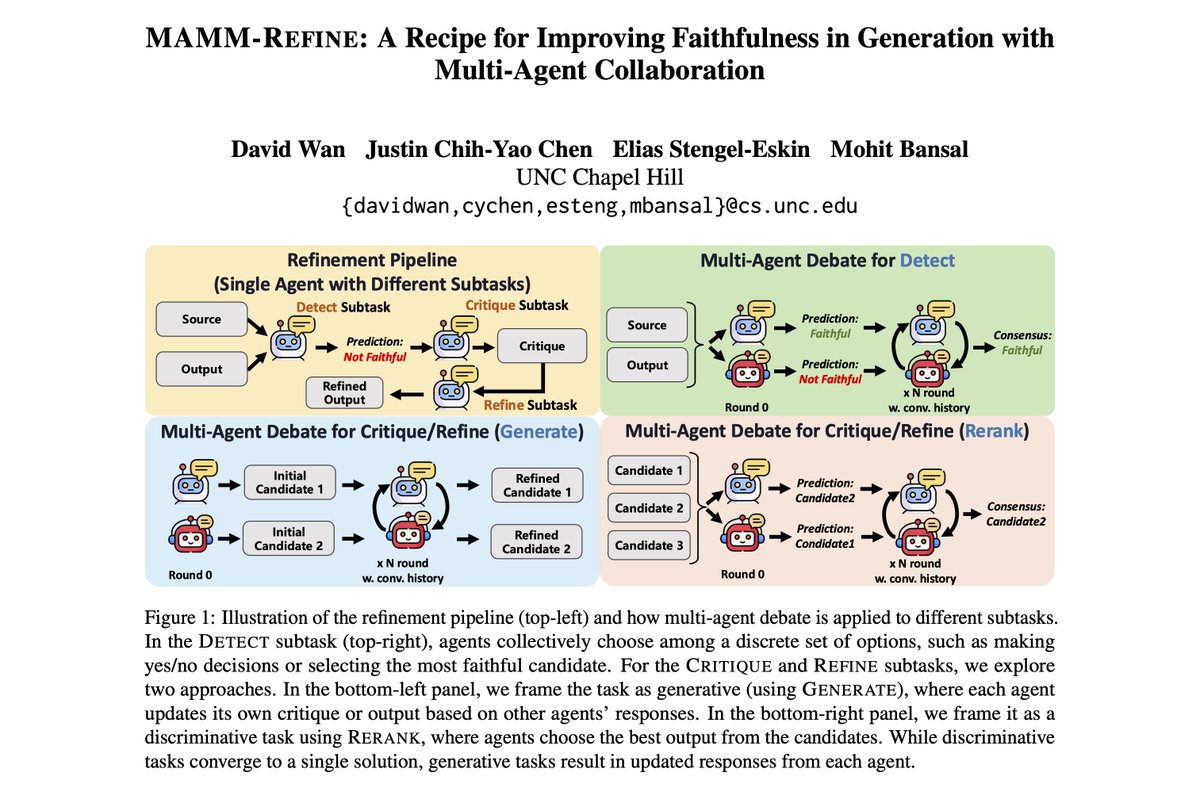
🎉 Our paper "MAMM-Refine" on Multi-Agent × Multi-Model Refinement for Faithful Generation will be presented at #NAACL2025!
We introduce a recipe for improving model faithfulness through multi-agent and multi-model (e.g. GPT-4o, Claude-3.5, Gemini-1.5) refinement.
Key takeaways:
1. Multi-agent and multi-model are important to improve output diversity, thereby enabling more faithful generations.
2. Discriminative tasks benefit more from multi-agent than generative ones.
3. Our recipe generalizes across different generation tasks (summarization, long-form QA).
📅 May 1 @ 14:00-15:30, Hall 3, Session H (Poster Session 5)
Thread👇
Our model is under MIT license
it's small
it's capable
it's easily fine-tuned/RL’d even on modest GPUs.
It’s also a fantastic source of high-quality reasoning traces.
SFT model: https://t.co/oLr4CcTxIe
SFT+RL model: https://t.co/9CURV4qc2J
Co-Design Protein Sequence and Structure in Discrete Space via Generative Flow
1. This paper presents CoFlow, a generative model that jointly designs protein sequences and backbone structures in discrete space using a novel discrete flow framework, addressing the limitations of unidirectional or decoupled design in prior methods.
2. CoFlow integrates a bidirectional generative flow for both sequence and structure tokens, leveraging a modified ESM3 architecture with Fourier time features to iteratively sample from masked inputs—supporting unconditional and conditional design modes.
3. In unconditional generation, CoFlow achieves consistency scores eight times higher than ESM3, based on scRMSD comparisons between generated sequences and AlphaFold2-predicted structures—indicating superior sequence-structure compatibility.
4. Unlike diffusion models that rely on continuous noise, CoFlow operates entirely in token space with a linear interpolation scheme between noise and structure/sequence tokens, using a Markov chain to model the denoising process.
5. The structure component of CoFlow utilizes VQ-VAE tokens from ESM3 to discretize 3D backbone geometry, allowing unified modeling alongside amino acid sequences via a shared transformer.
6. In motif-scaffolding tasks, CoFlow solves 20 out of 24 benchmark problems, outperforming ESM3 and ProteinMPNN pipelines. Generated scaffolds achieve <1 Å RMSD on motifs while maintaining structural integrity.
7. In zero-shot folding and inverse folding, CoFlow consistently outperforms ESM3, achieving lower RMSD in structure prediction and higher native sequence recovery (NSR = 0.56 vs. 0.50).
8. CoFlow supports variable-length protein generation up to 512 residues, with consistent performance across long sequences (400–500 residues), unlike prior models which degrade beyond 300 residues.
9. An ablation study confirms the effectiveness of asynchronous sampling (alternating sequence/structure generation), and increasing sampling steps improves pTM scores and entropy convergence, indicating robust generative dynamics.
10. Despite its smaller model size, CoFlow sets a new state-of-the-art in discrete joint protein design, offering a modular and scalable alternative to diffusion models and LLMs, with future potential in side-chain design and multimeric complexes.
💻Code: https://t.co/Bqq4Z0Ok1r
📜Paper: https://t.co/F52IUGu2gJ
#ProteinDesign #CoDesign #DiscreteFlow #ProteinSequence #ProteinStructure #ESM3 #VQVAE #GenerativeModel #Bioinformatics #AI4Science #ComputationalBiology
TransAgent: Dynamizing Transcriptional Regulation Analysis via Multi-omics-Aware AI Agent
1. TransAgent is a large language model (LLM)-driven AI agent that automates complex transcriptional regulation analysis by integrating over 30 bioinformatics tools, 20+ data sources, and a multi-modal execution framework with intelligent memory control.
2. It supports three operational modes—Planning, Execution, and Automatic—that allow users to design, control, or fully automate transcriptional regulation workflows, accommodating tasks from super-enhancer annotation to regulator-target gene network construction.
3. TransAgent enhances reproducibility and interpretability by capturing the complete “thinking-tool call-result” chain in standardized JSON format, while dynamic memory management allows fine-grained control over interaction history for long or branching tasks.
4. The agent supports seamless integration of new tools via Model Context Protocol (MCP) services, packaged as Docker containers, enabling scalable deployment across local and cloud systems with secure, permission-controlled environments.
5. Its multi-omics knowledge base spans enhancers, eRNAs, TF binding sites, GWAS SNPs, eQTLs, and chromatin accessibility from databases like GTEx, ENCODE, TCGA, ATACdb, and SEdb, supporting comprehensive regulatory annotation and inference.
6. In an esophageal squamous cell carcinoma (ESCC) case study, TransAgent reconstructed a super-enhancer-driven regulatory circuit using tools like ROSE, CRCMapper, and BETA—accurately identifying known master regulators such as TP63, SOX2, and KLF5.
7. In a cardiomyocyte differentiation study, TransAgent predicted key transcription factors (GATA4, TBX5, NKX2-5), inferred target genes using iterative BETA calls, and confirmed their regulatory roles using expression data from GTEx and functional enrichment analysis.
8. The system enables zero-code operation for wet-lab biologists while offering advanced control and memory toggling for bioinformatics experts—bridging the usability gap in complex epigenomics and transcriptomics workflows.
9. Unlike prior agents like CellAgent or BioAgents, which offer task-specific pipelines, TransAgent dynamically plans, executes, and revises multi-omics analyses in response to real-time input, using ReAct-style reasoning and memory optimization.
10. TransAgent exemplifies the next generation of scientific agents—interpretable, expandable, and dialogue-driven—designed not just to automate bioinformatics but to rethink it through an LLM-native interface for personalized genomic exploration.
💻Code: https://t.co/1e264JxDru
📜Paper: https://t.co/0ojY65miqc
#TranscriptionalRegulation #LLMAgent #Epigenomics #MultiOmics #Bioinformatics #AI4Science #GeneRegulation #SuperEnhancers #Cardiogenesis #CancerBiology #ComputationalBiology