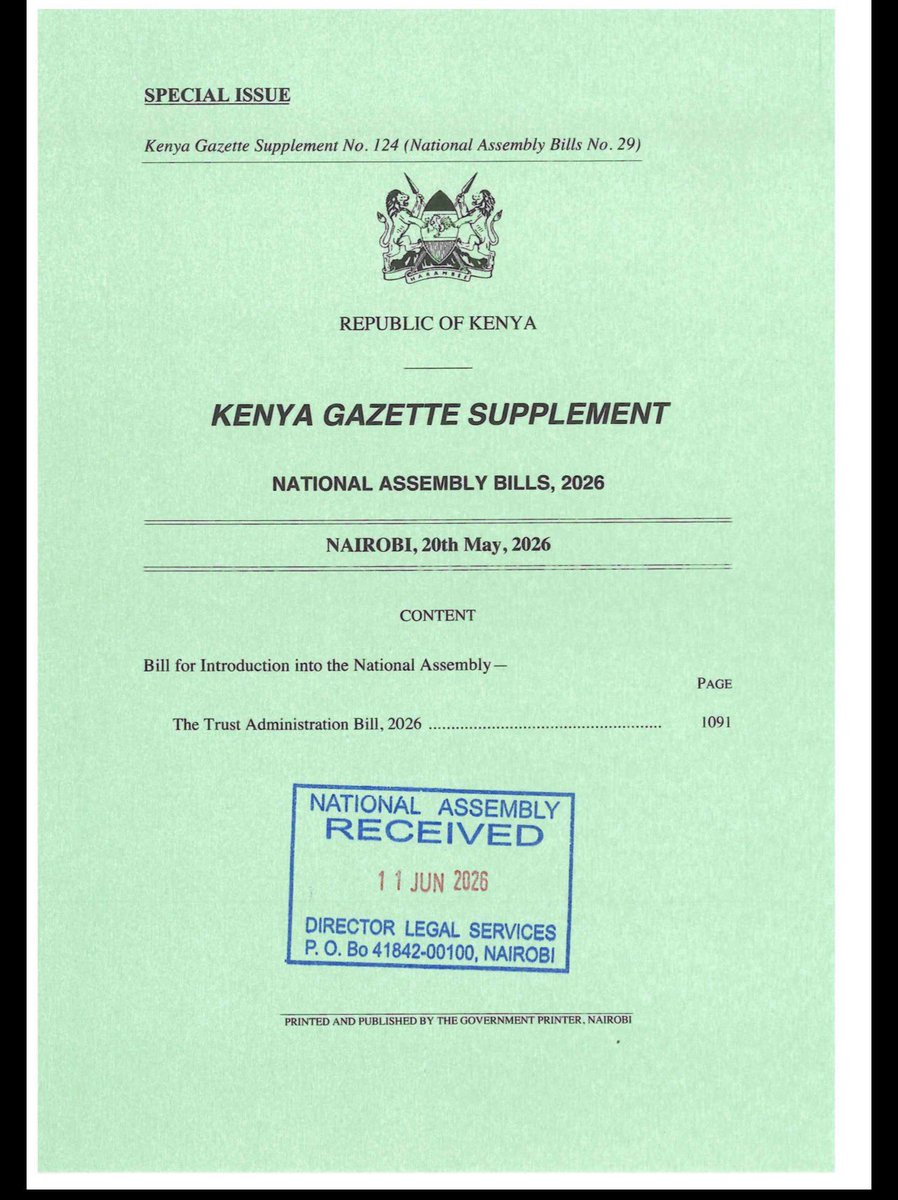
🚨 A new law now forces trusts to reveal the real people who ultimately benefit from them, and it is aimed squarely at money laundering and Kenya's push to escape the global dirty money grey list. Here is what it means.
The President has signed the Trust Administration Bill, 2026 into law. A trust is a legal arrangement in which one person transfers assets to a trustee, who holds and manages them for the benefit of others. For decades, trusts in Kenya were governed mainly by the old Trustees (Perpetual Succession) Act, which did not require disclosure of who truly benefited, making them an attractive vehicle for concealing wealth behind layers of legal ownership.
What the new law requires. Trusts must now identify and register their beneficial owners, the actual natural persons who ultimately own or control the trust or benefit from it, not just the names on the paperwork. Trustees must maintain accurate and up-to-date records of these beneficial owners, including details such as the trustees' residence and the assets held or managed, and make that information available to the relevant authorities on request. Crucially, trusts created before the law came into force are given a transition window: they must lodge a register of beneficial owners with the Registrar within 24 months.
Why this is happening. The driver is Kenya's inclusion, in February 2024, on the Financial Action Task Force grey list, the global watchdog's list of jurisdictions under increased monitoring for weaknesses in fighting money laundering and terrorism financing. One of the specific gaps flagged was exactly this: opaque trust ownership. Grey-listing carries real economic cost, higher transaction costs, reduced investor confidence, and tighter scrutiny of Kenyan money in international markets, so exiting the list is a national priority, and closing the trust-transparency loophole is part of the price of admission.
Trusts serve many entirely legitimate purposes, family succession planning, protecting minors and vulnerable beneficiaries, charitable giving, and privacy is a real and lawful value, protected by Article 31 of the Constitution. The new transparency duties engage that privacy interest. But the law reflects a deliberate policy judgment that, for trusts, the public interest in preventing the concealment of criminal proceeds outweighs the interest in secrecy, and that legitimate trusts have nothing to fear from disclosing their true beneficiaries to the authorities. The balance to watch is how securely this sensitive ownership data is held and who may access it.
The practical takeaway. Trustees should begin compiling accurate beneficial-ownership records now, and existing trusts must register within the 24-month window. Transparency is no longer optional, and a trust that conceals its true beneficiaries is now on the wrong side of the law.
👉 Follow @Lexken_EMSLaw for practical legal insights on trusts, anti-money-laundering compliance and regulatory law.
ChatGPT has quietly built a file on you. You've never seen most of what's in it.
Every message you send feeds it. It studies your patterns to map your personality and habits, things you never actually told it.
Here are 7 prompts to pull up everything it has on you, and wipe what you never agreed to:
𝗣𝘂𝗯𝗹𝗶𝗰 𝗡𝗼𝘁𝗶𝗰𝗲
In accordance with Section 894 (1) of the Companies Act, the Registrar of Companies has formed a reasonable belief that the listed companies on https://t.co/VuxikmWfvo may not be conducting business or in operation.
Call 011 112 7000
𝗣𝘂𝗯𝗹𝗶𝗰 𝗡𝗼𝘁𝗶𝗰𝗲
In accordance with Section 894 (1) of the Companies Act, the Registrar of Companies has formed a reasonable belief that the listed companies on https://t.co/VuxikmVHFQ may not be conducting business or in operation. ^OO
𝗔𝘄𝗮𝗿𝗱
BRS received an award today at the First Anniversary of the eCitizen Directorate, for excellence in digitization & outstanding contribution towards digital innovation.
Our digitization projects have been achieved with the support of @IFCAfrica@giz_gmbh@FSDKe
🙏
ChatGPT generates fake references to papers that don't exist.
So, researchers at Stanford built Storm.
It's an AI-powered app that generates well-researched articles with references to published sources.
Here's how to use it: