ajudando empresas agroindustriais, com planejamento e economia de escala, a adquirir insumos com mais eficiência e, portanto, mais lucros 🏆💵 SCA BRASIL
Estou muito orgulhoso, honrado e agradecido!
Fiquei entre os 3 melhores profissionais de Compras, na categoria Agronegócio, indicado para receber o Prêmio INBRASC 2022!
Vamos juntos!
#inbrasc#premioinbrasc#compras
https://t.co/Iqx41GRODn
Granular #phosphates remain supported by an acute lack of availability and record-high #sulphur prices, with delivered sulphur prices into China now as high as $1,100/t CFR. #Sulphuric acid prices gained more ground in Europe, Brazil, India and Indonesia (3/3) #fertilizer
Brazil sits on a metal that the modern world cannot run without.
This ad from 1988 made a promise about it that sounds impossible.
Brazil will not run out of niobium until the year 2700.
The company that ran the ad is CBMM, based in a small town called Araxá.
They were not bluffing.
Eight years later, in 1996, the man in this video was warning his whole country about the same metal.
His name was Dr. Enéas Carneiro.
He spent his airtime on national TV saying almost all of the world's niobium sits under Brazilian soil.
His famous line was that Brazil sold this metal to other nations "for the price of a banana."
People treated him like a clown.
He was right.
Niobium is the reason much of modern life holds together.
You add a tiny bit to steel (around 0.05%) and that steel becomes about 30% stronger.
That stronger steel builds pipelines, bridges, car frames, and jet engines.
The metal also goes into rocket nozzles and the magnets inside MRI machines.
There is no good replacement for it.
And Brazil controls the supply.
The country produces close to 90% of all the niobium on Earth.
Europe now buys about 92% of its niobium from Brazil alone.
CBMM makes most of the world's supply by itself.
The largest economies saw the risk and moved fast.
In 2011, steel giants from China, Japan, and South Korea paid around 3.9 billion dollars for just 30% of CBMM.
The United States and Europe were left out of that deal.
So the 1988 ad told the truth.
The supply really will last for centuries.
And the man warning everyone in 1996 told the truth too.
Brazil quietly controls one of the most important metals of this century, and the capital that understands this early tends to act before the headlines do.
Most still have not noticed.
Brazil should be one of the richest countries on Earth.
It has more fresh water, more farmland, and more clean energy than almost any other country.
It sits on huge amounts of the metals the world will need next.
So why is it still stuck?
The answer is in how the country is run.
In Brazil, money is some of the most expensive on Earth.
After you take out inflation, the real cost of borrowing is roughly 10%.
That price kills any long project: a mine, a railway, a factory.
So why is money so expensive?
Because the government can barely move its own budget.
More than 90% of its spending is locked in by law.
It cannot cut that spending, so it keeps borrowing.
The debt grows, and rates stay high to keep lenders calm.
That one trap holds the whole economy down.
But people built that trap.
Which means people can take it apart.
Free up the budget, and the cost of money could fall toward 3 or 4%.
Cheap money would finally build the roads, factories, and schools Brazil keeps putting off.
Now, the honest part.
Even that fix would not solve everything.
It would not erase deep poverty, or push organized crime out of the ports.
And Brazil is growing old fast, with about 15 years to act.
Still, this country has beaten the impossible before.
In the 1990s, it crushed prices that rose almost half every month.
It turned dead soil into some of the best farmland on Earth.
The deeper fix is harder, but it is not a fantasy.
I broke down exactly how it could work here:
https://t.co/rSVhHnRbK8
Raizen reached an out-of-court restructuring agreement with the majority of its creditors, marking a key step in the Brazilian sugar-and-ethanol producer’s efforts to rework its debt, according to sources https://t.co/90AXrbd7D8
Brazil is the largest soybean producer and exporter on Earth.
The largest producing state is called Mato Grosso, in the center of the country.
A farm in Sorriso, the largest soybean municipality in Mato Grosso, sits about 2,170 kilometers from the Port of Santos in São Paulo.
For 50 years, that was the route.
Trucks carried grain south, day and night, on a single highway.
Most American allocators still picture the Brazilian soybean trade flowing south.
In 2025, that picture stopped being true.
A different group of ports has taken over.
Brazilians call it the Arco Norte, the Northern Arc.
It runs across the top of the country, from Itacoatiara on the Amazon to Itaqui in Maranhão.
The corridor runs on a mix of trucks, river barges, and rail.
A truck from Sorriso drops grain at Miritituba, a river port on the Tapajós, after about ~1,100 kilometers on BR-163.
Barges then carry it 1,000 kilometers down the Amazon to Barcarena.
From the MATOPIBA region in the east, trucks feed rail terminals on the Ferrovia Norte-Sul, and the trains run straight to Itaqui in São Luís.
The Port of Itaqui in São Luís shipped 20 million tons of corn and soybeans in 2024.
That is up from 11 million tons in 2020.
Itaqui grew 80 percent in four years.
In 2025, the Arco Norte handled 36 percent of all Brazilian soybean exports and 48 percent of all corn exports.
The economic advantage is the ocean leg.
São Luís sits at 2 degrees south of the equator. Santos sits at 24 degrees south.
The ship leaves Itaqui roughly 2,300 kilometers closer to Europe and the U.S. East Coast.
This is the largest quiet shift in global agricultural logistics over the past decade.
The Brazilians figured this out a decade ago. The market is still catching up.
Brazil has six biomes.
Most people can name one.
Everyone knows the Amazon rainforest.
Almost no one outside Brazil knows the Caatinga.
The Caatinga is the only biome on Earth found entirely inside Brazil.
It covers about 10 percent of the country and more than half of the Northeast region.
The name comes from an Indigenous word meaning "white forest."
It is a dry land of thorn trees, cactus, and red rock that turns green after a single rain.
Around 27 million people live inside it.
That makes it the most densely populated semi-arid region on Earth.
Hundreds of its plant and animal species exist nowhere else on the planet.
For most of history the world wrote off this land as a wasteland.
Then the world learned what the sky above it is worth.
The Caatinga interior gets about 6.5 kilowatt hours of sun per square meter every day.
That puts it on par with the Australian outback and well above Germany or Spain.
Solar farms here run at 20 to 25 percent capacity, while European farms run at 11 to 15 percent.
One of the largest solar parks in Latin America sits in Piauí, inside this biome.
The state of Bahia alone holds the highest solar build-out potential in the country.
The land everyone called empty turned out to be one of the best power sources in the Western Hemisphere.
Most foreign investors have never heard the word Caatinga.
Klabin is one of Brazil's oldest publicly traded industrial companies.
The company was founded in 1899 in São Paulo by Lithuanian Jewish immigrant Maurício Klabin, his brothers, and his cousin Miguel Lafer.
The Klabin and Lafer families have continuously controlled the company for over 125 years through five generations of ownership.
Today Klabin is Brazil's largest producer and exporter of packaging paper, the leading segment that includes kraftliner, paperboard, corrugated boxes, and industrial sacks.
The company runs over 20 industrial plants across Brazil and Argentina.
Klabin manages 911,000 hectares of forests, with 41 percent of that area preserved as native forest.
Annual production capacity reaches 2.9 million tons of paper and 1.6 million tons of pulp.
The company is the only producer in Brazil that integrates short-fiber, long-fiber, and fluff pulp from a single forest base.
Klabin trades publicly on the Brazilian stock exchange under the ticker KLBN11.
Current market capitalization is approximately R$22 billion, equivalent to roughly $4.4 billion at today's exchange rate.
Klabin has compounded through more than 125 years of currency regimes, hyperinflation, military dictatorships, two impeachments, four constitutional changes, and multiple global commodity cycles.
The company has been a component of the Dow Jones Sustainability Index for five consecutive years, present in both the World and Emerging Markets portfolios.
Klabin is the only Brazilian pulp and paper company present in both portfolios simultaneously.
Most American capital allocators have never heard the name.
The Brazilian industrial economy is a 125 year old compounding machine that international capital has not yet bothered to read.
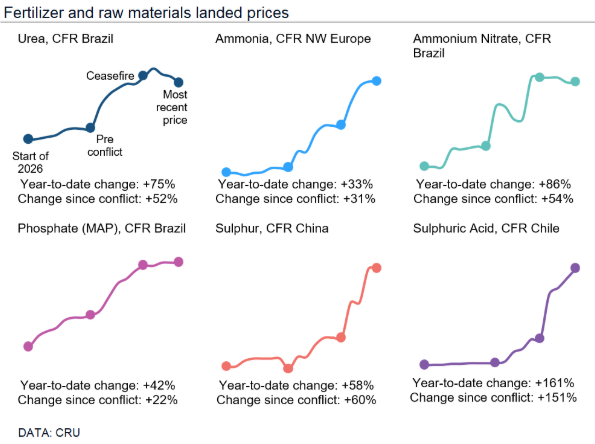
Our chart of the week shows #fertilizer and raw material price movements this year. While oil and gas prices swing wildly with the news flows, other commodities remain stubbornly high and more closely reflect fundamentals #urea#phosphate#ammonia#sulphur#nitrogen
Everyone saying the futures curve predicts Hormuz reopening soon —
that’s not how this works.
The curve is being misread. Here’s why it’s an inventory signal, not a geopolitical forecast 🧵👇
Brazilian agribusiness can do five things no other country on Earth can replicate.
The first: two harvests on the same land in the same year.
About 40% of Brazil's soybean fields are immediately replanted with corn after the soy harvest.
In Mato Grosso, irrigated farms are now growing three crops per year on the same hectare.
The second: eucalyptus that matures in 6 to 7 years.
Pine in the U.S. South takes 22 to 40 years.
Pine in Canada and Scandinavia takes 60 to 100 years.
The third: cattle finished primarily on grass.
About 78% of Brazilian beef still comes from grazing systems.
In the United States, almost all beef cattle pass through feedlots in their final phase.
The fourth: sugarcane that produces both sugar and ethanol on the same crushing run.
Brazilian flex plants switch the output ratio between sugar and ethanol based on which price is higher.
The fifth: coffee, soy, beef, cellulose, and orange juice all grown on the same continental landmass.
Brazil is the world's largest producer or exporter in every single one of those categories.
Brazil functions as an agricultural civilization.
Climate, soil, and decades of breeding research at Embrapa built it.
Three structural advantages no other country can replicate.
The world's quiet bread basket is operating at a scale most investors have never measured.
Exxon CEO Darren Woods on Venezuela.
From (Jan 9, 2026) "univestable"
to (May 1, 2026) "... Venezuela is a huge resource that's now opened up more freely to the world [...] I think we'll be uniquely positioned and play an important role in bringing those barrels to market..."