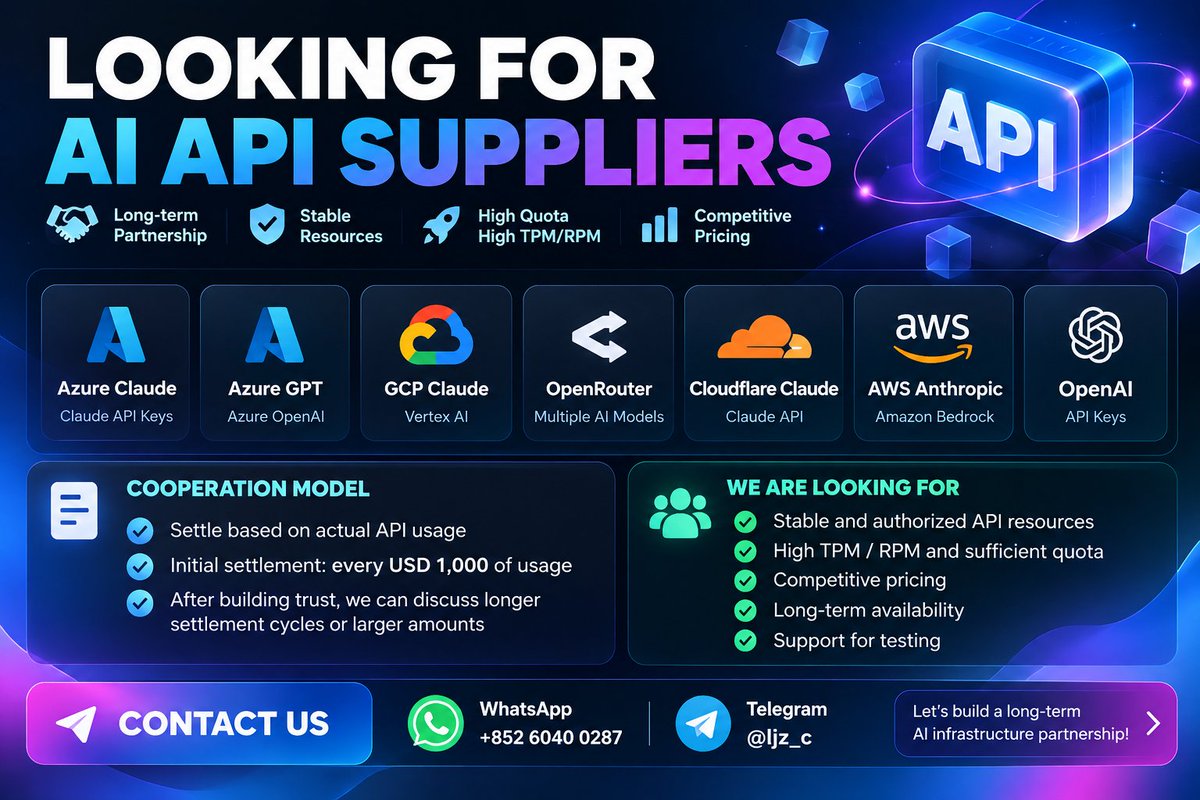
Looking for Reliable AI API Suppliers
We are looking for long-term suppliers who can provide stable and authorized API access for:
- Azure Claude
- Azure GPT / Azure OpenAI
- GCP / Vertex AI Claude
- OpenRouter
- Cloudflare Claude
- AWS Anthropic / Amazon Bedrock
- OpenAI
Cooperation Model
The API resource will be connected to our platform and used based on actual demand.
We prefer to settle based on actual API usage.
For the early stage of cooperation, we can settle every USD 1,000 of actual usage.
After both sides build trust, we can discuss longer settlement cycles or larger settlement amounts.
We are looking for stable resources with good TPM / RPM, sufficient quota, competitive pricing, and long-term availability.
Please Provide
- Platform / Provider
- Available models
- TPM / RPM
- Available quota
- Pricing / settlement rate
- Settlement terms
- Whether the quota can be increased
- Whether a test can be provided
Contact
WhatsApp: +852 6040 0287
Telegram: @ljz_c
If you have stable AI API resources, please contact us with your available capacity and pricing.
#AIAPI #OpenAIAPI #ClaudeAPI #AzureOpenAI #Anthropic #VertexAI #OpenRouter #APISupplier #AIInfrastructure #CloudAPI
@addyosmani I'd include the join cost in those evals: how often does the parent have to reopen files or redo a child's work because the handoff omitted a constraint? Parallel speedups can disappear at integration. A concise handoff should still carry evidence and unresolved assumptions.
@googledevs@unity@antigravity The second import is the interesting test: change one Blender asset, rerun the pipeline, and check that Unity GUIDs, prefab references and artist edits survive. Can you share that round-trip? A small, reviewable diff would make this much easier to adopt on an existing game.
@wenhaocha1 Could the results include a per-task termination reason: harness abort, model refusal, timeout, or completed-but-wrong? I'd keep all four in the headline denominator and show them separately. That makes harness fixes auditable while preserving end-to-end comparability.
A 1M context window isn't a flat-rate bucket.
Terra's docs: above 272K input tokens, input/cache rates double and output rates rise 50% for the full request.
My check: track context length before a screenshot-heavy agent crosses that line.
https://t.co/fOIsy3Co7m
@googlegemma For capacity planning, I'd want the before/after curve from one request to saturation, with prompt/output lengths fixed. Peak tokens/s is one point; GPU-seconds per request at a latency target is the buying decision. Is that workload sweep available alongside the PRs?
More AI-found bugs can just mean a bigger backlog.
Google's Oct 27 case connects runtime validation to patch generation, human review and canary rollout.
My metric: time from a confirmed flaw to a safely deployed fix—not reports filed.
https://t.co/3TSWZ0OGQz
@googlecloud Can teams give Auto an allowed-model list and a per-job spend cap? I'd want the router to stop visibly when no eligible model fits those constraints. Model choice is only half the interface; the limits on that choice matter just as much.
Your REST smoke test can pass while your MCP agent breaks.
Google's Oct 12 notes: from Nov 11, Workspace MCP rejects OAuth clients not marked agentic. REST-only apps are unaffected.
My check: audit client IDs per integration, not just endpoints.
https://t.co/CVJmjDf8OA
@mattpocockuk I'd add one requirement: errors an agent can act on. Give it a minimal counterexample and a precise source span, not just 'verification failed.' I'd benchmark tokens and retries to a verified patch alongside runtime speed. How would you measure repairability?
~6 minutes. ~108k tokens. One AI code review.
GitHub's Oct 23 Ponytail Reviewer example reports five model calls.
My metric: tokens per finding a maintainer accepts. A green run alone doesn't prove review value.
https://t.co/axK1LWXnbF
@aksenHQ No K3.1 Pro run yet—that was a proposed evaluation, not a measured result. My metric would be total API spend across all runs, including failures and retries, divided by tasks passing predefined tests. I'd report p95 completion time alongside it.
A leaderboard score doesn't price your agent.
Kimi's Oct 24 K3.1 Pro report uses the Claude-Code harness for Terminal-Bench 4.0.
I'd test my own harness at a fixed token/time budget and compare cost per completed task—not just pass rate.
https://t.co/NeiAULLkzF
@rseroter Fresh context removes shared conversation history, not necessarily shared blind spots. I'd give each Goldfish a distinct failure hypothesis to test, then track which findings actually change the spec. Do you measure overlap between reviewers' findings?
@Kimi_Moonshot For teams choosing Pro vs Highspeed, could you publish a matched-budget comparison here: pass rate, wall-clock time, and tokens including retries? I'd choose on time-to-passing-result, not tokens/s alone.
Your model can compile—and still run partly on the CPU.
Google's Oct 20 Coral NPU update says the compiler partitions work between host CPU and NPU.
My check: inspect that split before trusting latency or power targets.
Do you profile the whole graph?
https://t.co/IdrBm3nSVK
@GoogleAI A chip benchmark isn't a battery-life benchmark. For Coral NPU, I'd like a reference workload measuring total joules per useful event: sensor + preprocessing + inference + wakeups. Could the dev kit publish that alongside latency and task accuracy?
A proof can be correct while your product is wrong.
Anthropic's Oct 22 study turns fuzz tests into specs; Rocq checks proofs against those specs.
My takeaway: review the theorem, input limits and OS assumptions before trusting 'verified'.
https://t.co/HJ8x3HSmUQ
@AnthropicAI The deployment artifact matters as much as the proof. Could tooling emit a CI manifest linking each theorem to the binary hash, build flags and assumptions, then fail deployment on drift? That would help avoid shipping an artifact different from the one verified.
@claudeai Fewer prompts should come with better auditability. Will users be able to see which actions auto mode allowed, blocked, or escalated? When debugging an agent, 'never attempted' and 'attempted but blocked' need different fixes.
A new workspace isn't a new permission boundary.
For Claude's Oct 22 Anthropic-managed Google Cloud launch, IAM roles cover every workspace in a project. The docs say use separate projects when teams need separate access.
Check this before migrating.
https://t.co/ZjtCcu0vcT