Its very limiting that a big set of very hard problems that we have just lying around are Erdos problems. Don’t get me wrong, they are quite cool, but we really need hard problems repositories for many fields, including areas that have less specified answers & require judges.
Yes, math is the easiest field in which to do verified work, but it is also an area where direct implications of increasing AI ability on everyday life are less clear. We need more types of problems (complex engineering problems, large data sets in economics, physics, biology), for people to turn AI loose on, including speciations of how to evaluate them.
@tokumin I feel that the trend towards training models to autonomously go off and try to do everything themselves is anti-human.
We should, IMO, be training LLMs to support humans in their learning, creativity, and iterative experimentation.
My friend @JanosGabler is hiring an AI researcher / research engineer. If you are interested in teaching and open-source software development in the AI space, you should apply!
View the job posting here: https://t.co/Qh9JBtx2OK
Find his LinkedIn post below👇
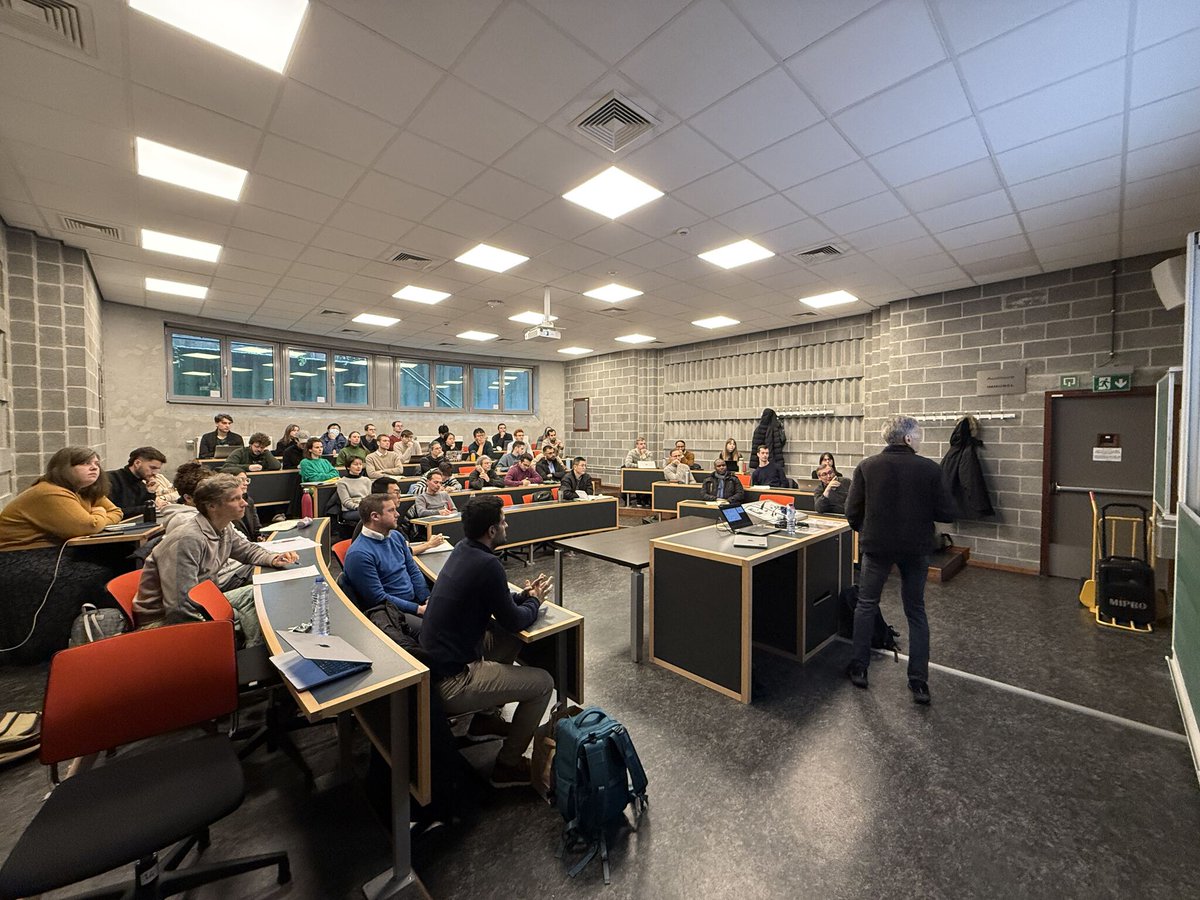
🆕 Season of ECORES PhD lectures! 🎓
Today features an insightful presentation by @JacksonmMatt@Stanford on the critical role of networks in economics.
These lectures are a joint initiative of @LeuvenEconomics, @ecares_ulb, and @LIDAM_UCLouvain.
🔗 https://t.co/e98YS9pte5
Fixed effect estimation just like using the fixest R package, but in Python!!
I really enjoyed @s3alfisc presentation at this years @EuroSciPy of his pyfixest package.
If you need to run (high-dimensional) fixed effect regressions in Python, be sure to check it out (link below)
My favorite talk this year!
@optimagic is a wrapper library that provides a common API to around 60 opzimizers implemented in Python.
Particularly enjoyed how much thought & effort the package authors (@JanosGabler & @MensingerTim) put into designing a user friendly API!
Check out my new working paper joint with my amazing coauthors @JanosGabler, Sebastian Gsell, and Mariam Petrosyan!
We propose a new optimization algorithm that works particularly well for problems that arise during method of simulated moments estimation.
Check out my new working paper joint with my amazing coauthors @JanosGabler, Sebastian Gsell, and Mariam Petrosyan!
We propose a new optimization algorithm that works particularly well for problems that arise during method of simulated moments estimation.
Discover the Tranquilo algorithm: A game-changer for economists utilizing the method of simulated moments. Say goodbye to tweaking optimizers. Tranquilo is designed with you in mind and makes optimization easier and faster.
"How Gender Role Attitudes Shape Maternal Labor Supply" by @c_zimpelmann and @MensingerTim is now available: https://t.co/p1orLeMY1R
Interview with @c_zimpelmann is now available: https://t.co/IihNI443qu
Announcing uv: an extremely fast Python package installer and resolver, written in Rust.
uv is designed as a drop-in alternative to pip, pip-tools, and virtualenv.
With a warm cache, uv installs are near-instant. Here, it's > 75x faster than pip and pip-tools.
@larsweisbrod Falls du auch ein minimales Theorieverständis suchst kann ich mir vorstellen, dass Sec. 1 & 2 aus https://t.co/XDHMzExhN1 für dich passen könnten. Ist jetzt nicht super rigoros, aber sollte für einen Start erstmal reichen. Und es hat auch genügend Anwendungsbeispiele mit Code.
JMP 🧵🎉
What drives maternal labor supply - a key factor for labor market inequalities?
Gender role attitudes!
We use reduced form and structural methods to show that they are of first-order importance, both directly and through the mediation of policies (w/ @MensingerTim)