The Golden Bridge Event is now officially live on Sl8 🔥
https://t.co/CNqdFN1FjF
The event marks the next stage of Sl8’s multichain expansion. With new bridge integrations across Arc, Solana and Base, users now have more ways to bring supported assets into Sl8 and use them across the platform. Additional networks are already in development.
To celebrate this expansion, we are launching a month-long staking event for USDC, USDT, SOL, XRP and RLUSD, with increased APY rates and several reward programs running in parallel.
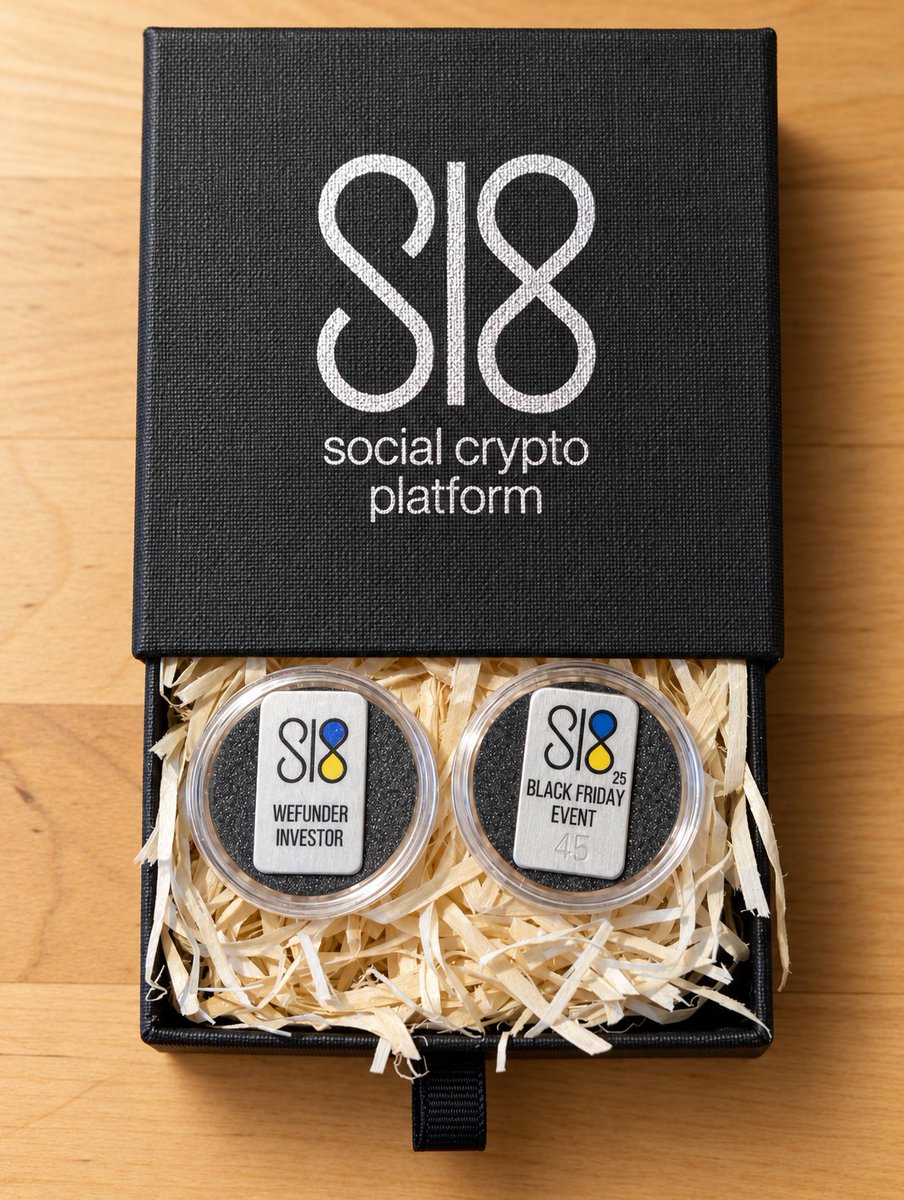
Commemorative Badges:
All participants may receive exclusive commemorative badges made of pure precious metals if they stake $USDC, $USDT, $SOL, $XRP, $RLUSD for 180 or 360 days:
1) 999 fine Silver badge for staking tokens equivalent to 1,500 USDC or more
The badge is made from a 10g pure Silver bar.
2) 9999 fine Gold badge for staking tokens equivalent to 15,000 USDC or more
The badge is made from a 10g pure Gold bar.
Each badge will have a unique serial number. The participant who stakes the largest amount will receive Badge #1. The badge will also be visible on your Sl8 profile and alongside each of your posts.
Additional APY rates for $USDC, $USDT, $SOL, $XRP, $RLUSD:
- 30 days: 22.4% APY
(18.4% current rate + 4% Golden Bridge Event bonus)
- 90 days: 36.4% APY
(30.4% current rate + 6% Golden Bridge Event bonus)
- 180 days: 48% APY
(40% current rate + 8% Golden Bridge Event bonus)
- 360 days: 62.6% APY
(52.6% current rate + 10% Golden Bridge Event bonus)
Top 50 participants of the Golden Bridge Event will share a prize pool of CST tokens for $100,000:
1 place: $15,000 reward
2 place: $10,000 reward
3 place: $8,500 reward
4 place: $7,000 reward
5 place: $6,000 reward
6 place: $5,000 reward
7 place: $4,500 reward
8 place: $4,000 reward
9 place: $3,500 reward
10 place: $3,000 reward
11-20 places: $1,100 reward
21-30 places: $900 reward
31-40 places: $750 reward
41-50 places: $600 reward
Top 10 participants of the day will get:
1 place: 0.3 of 1 oz Gold Britannia coin (approx. $1330 worth)
2 place: 0.2 of 1 oz Gold Britannia coin (approx. $888 worth)
3 place: 0.1 of 1 oz Gold Britannia coin (approx. $444 worth)
4 place: 2.5g Geiger Gold Bar coin (approx. $369 worth)
5 place: 2.5g Geiger Gold Bar coin (approx. $369 worth)
6 place: 2.5g Geiger Gold Bar coin (approx. $369 worth)
7 place: 1 oz Silver Coca Cola coin (approx. $140 worth)
8 place: 1 oz Silver Coca Cola coin (approx. $140 worth)
9 place: 1 oz Silver Coca Cola coin (approx. $140 worth)
10 place: 1 oz Silver Coca Cola coin (approx. $140 worth)
How to participate?
1) Register on Sl8 if you’re not already a user:
https://t.co/VXekdex89e
2) Activate your Sl8 wallet.
3) Top up your wallet with eligible tokens through the supported network.
4) Stake your assets for 30, 90, 180 or 360 days before the end of the event.
The Golden Bridge Event starts on September 29, 2026 at UTC and runs through October 29, 2026 at UTC.
It is not only a staking campaign. It reflects the direction in which Sl8 is moving: toward a broader multichain financial infrastructure where users can access more networks, more assets and more opportunities within a single ecosystem.
Full event details, current rankings and staking conditions are available here:
https://t.co/CNqdFN1FjF
Golden Bridge Event is live!
Sl8 offers several ways to earn rewards. One of them is the 6-level referral system.
It is not limited only to users you invite personally. If your referrals invite other people, and those users bring in new participants, the structure can expand up to 6 levels.
Reward distribution:
• Level 1: 6%
• Level 2: 5%
• Level 3: 4%
• Level 4: 3%
• Level 5: 2%
• Level 6: 1%
An important part of the program is connected to staking. When a user within your referral structure opens a staking position, you receive a reward based on your level. The more active participants you have in your structure, the more opportunities there are to receive such rewards.
All referral rewards are credited to the Payout section. This is also where other funds earned in Sl8 are collected, including tips, payments for paid content, USDC / SSLX rewards for likes, and other earnings.
To receive referral rewards, you must successfully complete KYC verification and have paid reserves in place to avoid wallet deactivation.
The cost of KYC is $2. You can use a passport, ID card, or driver’s license for verification. The document must contain information in Latin characters. If the information is provided only in Cyrillic, Arabic, Chinese, or another non-Latin writing system, a certified translation will be required.
About data security 🔐
Sl8 does not verify documents directly. Verification is carried out through Sumsub, a specialized international service that confirms users’ identities and stores and processes the data required for KYC.
Invite your friends and contacts, grow your referral structure, and make the most of the opportunities available on Sl8! 🚀
The Senate failed to advance the CLARITY Act today.
Disappointing, but a procedural setback still leaves room for a better deal. Resolve the remaining disputes, refine the text and build broader support.
America needs lasting crypto rules. Keep working.
#CLARITYAct
A key procedural vote on the CLARITY Act is expected in the U.S. Senate today, September 15. Here’s what matters 👇
- 60 votes needed to advance. This is a procedural hurdle, not final passage.
- Republicans released a revised draft with 126 changes they say Democrats requested.
- Trump accepted additional crypto ethics restrictions, but Democratic opposition remains.
- Updated #DeFi provisions clarify when #CFTC registration and anti-money-laundering obligations apply.
- Support remains uncertain. Even a Senate win would still require House approval of the revised text.
An important test for U.S. crypto regulation.
#CLARITYAct #Crypto
Article about @The_DTCC and Tokenized Securities: What Changes in October 2026
In October, the institution at the center of American securities markets plans to give Wall Street a new way to move some of its most familiar assets. Shares in major companies, index funds and U.S. government debt will be eligible for a service that connects traditional custody with blockchain networks.
For banks and investment firms, that could change how securities are transferred, financed and used as collateral. For everyone watching the #tokenization story, October will offer something more concrete than another announcement: an opportunity to see whether the technology becomes part of everyday market operations.
The organization is the Depository Trust and Clearing Corporation, or DTCC. Through its subsidiaries, it helps process the transactions that take place after investors agree to buy or sell securities. Its depository subsidiary, DTC, reported $114 trillion in securities under custody and servicing for 2025. Across DTCC's subsidiaries, annual securities transaction processing reached $4.7 quadrillion.
That enormous figure requires context. It measures transactions processed over a year, including repeated activity involving the same assets. It is not a pool of money scheduled to enter cryptocurrency markets. The October launch concerns a defined service for eligible securities, with adoption driven by participating firms.
The eligible universe includes Russell 1000 stocks, exchange-traded funds tracking major indexes, and U.S. Treasury bills, notes and bonds. Participation is voluntary. Firms will decide which eligible holdings to convert into tokenized form.
The first real transactions have already happened. On July 15, DTCC reported production trades involving more than 30 firms. The activity included collateral pledges, securities lending, Treasury financing and equity transactions. Assets were converted using DTCC's private Besu network and the Canton Network.
October is the planned broader service launch following that limited production activity. The distinction matters: a successful day of transactions establishes that a process can work. A continuing service must demonstrate that it can work reliably as more firms adopt it.
The mechanics begin with securities already held at DTC. When a participant requests tokenization, DTC moves the corresponding position into a dedicated account on its existing ledger and issues a token to a registered wallet. That token represents the participant's security entitlement. To return to conventional book-entry form, DTC destroys the token and credits the securities back to the participant's account.
DTCC says the tokenized form preserves the rights and investor protections of the traditional holding. The underlying securities remain registered in the name of DTC's nominee, Cede and Company. Investors continue to rely on the established custody framework.
In December 2025, @SECGov staff issued a conditional no-action letter covering the service for three years after the preliminary version launches. The SEC describes a voluntary pilot with operational limits, meaning a commercial launch can proceed within a limited regulatory framework.
The business case centers on making assets easier to use. Consider a firm holding Treasury securities while needing to post collateral elsewhere. If it can transfer an eligible tokenized position efficiently, and the receiving institution accepts it, the firm may be able to meet that obligation with fewer operational steps. Across large portfolios, even modest improvements could reduce costs and make existing holdings more useful.
DTCC points to collateral mobility and capital efficiency as potential benefits. The practical question is how much improvement survives the demands of real operations: compliance checks, funding arrangements, system integration and the willingness of counterparties to accept the assets.
There are boundaries. Under the initial no-action framework, tokenized entitlements receive no collateral or settlement value within DTC's own risk-management calculations. Firms can explore collateral uses outside those calculations, but tokenization does not automatically expand their capacity inside DTC.
DTCC also describes transfers between registered participant wallets on approved networks operating around the clock. That capability alone cannot make every stock market, broker or cash-payment system available twenty-four hours a day. Completing a purchase still requires arrangements for both the security and the money.
Controls remain central to the design. Transfers are restricted to registered wallets, and DTCC's token controls include freezing assets and reversing transfers when necessary. For institutions, the appeal is the ability to use blockchain while retaining mechanisms for compliance and recovery.
The network strategy is also broader than a single blockchain. July's transactions used Besu and Canton. DTCC has separately announced a connection with @StellarOrg, with DTC-tokenized assets expected there in the first half of 2027. That is a later milestone on the published timetable.
@Ripple Prime appears in DTCC's industry working group, too. That participation does not establish ripple:native as the service's settlement asset. Institutional involvement and demand for a particular cryptocurrency are separate questions, and investors should look for evidence connecting them.
As October approaches, the useful measures will be operational: whether the service launches on schedule, which firms use it repeatedly, how much value remains in tokenized form, and whether transfers produce measurable savings. Announced capacity matters less than sustained use.
For most individual investors, the first changes may occur behind the brokerage screen. Over time, successful adoption could influence the services their brokers offer and the cost of delivering them. Those outcomes will depend on execution and competition.
October gives Wall Street a chance to turn a demonstrated capability into a working business service. Its significance will become clearer in the months that follow, as firms decide whether tokenized securities are useful enough to become routine.
Reporting notes and sources
Source 1. DTCC, May 4, 2026: service timeline, eligible assets, industry participants and 2025 scale figures.
https://t.co/ufb6UNyaWE
Source 2. SEC staff no-action letter, December 11, 2025: token mechanics, legal structure, operating limits and duration.
https://t.co/Hq3rV7iS4n
Source 3. DTCC, July 15, 2026: completed production transactions, participating firms, networks and October plans.
https://t.co/yDSnRvwnEI
Source 4. DTCC Tokenization Service: rights, registered-wallet transfers and token controls.
https://t.co/gMYFiuFzhF
Source 5. SEC Commissioner Hester Peirce, December 11, 2025: voluntary pilot, registered wallets and operational limitations.
https://t.co/S74khmefHc
Source 6. DTCC and Stellar Development Foundation, May 27, 2026: expected Stellar availability in the first half of 2027.
https://t.co/8NoXuk0hgA
Our bridge between @StellarOrg and @XRPLF is live 🚀
Next: @circle CCTP integration to teleport your #USDC across chains right in Sl8 🚀
Then: bridges to #BTC, #ETH, #Solana, #Arbitrum & more
Then: bug fixes and our #RWA platform launch
Stay tuned!
A few important updates from the Sl8 and Cassator ecosystem:
1) Our Ukraine Independence Day Event will be extended for another two weeks, giving everyone more time to compete, stake, invite friends, and move up the leaderboard.
2) The CST token will also be launching soon. As a reminder, the top participants in the event will receive substantial additional prizes in CST tokens. More information about CST, its role in the ecosystem, and the final prize distribution will be announced separately.
3) Development of bridges between Stellar and other major blockchains continues. The first integration will be with the XRP Ledger, followed by additional chains. This will be an important step toward making the Sl8 Wallet a truly multichain product.
4) We are also preparing to pitch Cassator to the Central Texas Angel Network and during LvlUp Ventures’ Power of the Pitch Week. At the same time, we continue discussions with several other angel investors and investment groups.
5) Another major development is the SEC’s proposed “Regulation Crypto Assets.” If adopted, it would introduce a purpose-built framework for certain crypto investment contracts, including a startup exemption for offerings of up to $5 million over four years and a separate fundraising exemption allowing qualifying issuers to raise up to $75 million within a 12-month period.
The proposal would also introduce a conditional safe harbor allowing a crypto asset to separate from its original investment contract once the issuer has completed or permanently ceased the promised essential managerial efforts. It is still only a proposal, with public comments open until October 20, but it could become one of the most important regulatory developments for responsible token issuers in the United States.
6) The XRP ecosystem is also gaining momentum. U.S. spot XRP ETFs recently recorded 11 consecutive trading sessions of net inflows, attracting approximately $170 million during that period and bringing cumulative inflows since launch to roughly $1.68 billion.
Ripple has also received full MiCA authorization in the EU, while XRP Ledger 3.3.0 introduces major infrastructure improvements, including atomic batch transactions, confidential token transfers, granular permission delegation, and the ability for platforms to sponsor users’ account reserves and transaction fees.
A lot is happening at the same time. More updates are coming soon.