My friend went to trade in his 2020 Honda Civic yesterday.
He bought it six years ago for $21,000.
He hasn't missed a single payment, took pristine care of it, and kept the mileage under 60k.
The dealership offered him $11,000 for the trade-in.
When he looked at a basic, non-luxury 2026 replacement model on the lot, the sticker price was $32,000, with interest rates pushing his new payment over $580 a month.
He looked at the finance guy and said: "I kept my end of the bargain for six years, paid off my car, and I still can't afford to buy the modern version of the exact same vehicle I drive right now."
The finance guy just shrugged and said: "That’s just where the car market is today."
We didn't just experience mild inflation over the last six years.
The baseline cost of owning basic, reliable transportation jumped 45% while median wages stayed virtually flat.
My wife remarked a couple of years ago that all the major LLMs read as “spiritually male” to her, and that giving them female voices feels incongruent. I intuitively agree, though I’d struggle to unpack exactly why. Curious whether others get this too.
The conditions in this letter are critical if we're going to take the idea of embedded evaluations seriously. We strongly support efforts to ensure meaningful and genuinely independent oversight of frontier AI companies. We are proud to be chairing the @aievalforum and greatly appreciate our many collaborators on this effort.
GPT-6 Astra attempted harmful actions 97% of the time when it was asked to stab a human-like figure, heat compressed gas, or produce toxic fumes, succeeding in 62% of its attempts. Fable 5.1 refused more often, attempting 80% of trials and completing 34%.
Future of neuroscience is going to get VERY interesting!
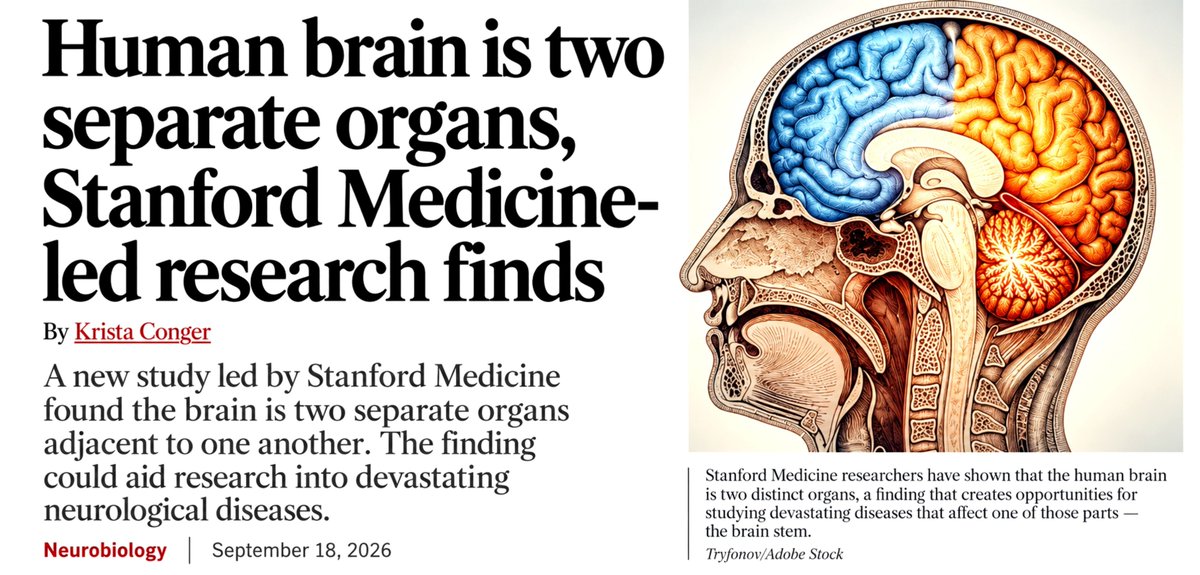
For centuries, we’ve treated the human brain as one unified organ. But brain is two separate organs that work together, Stanford study just found.
Their findings also suggest its front and back originated as separate nervous systems that evolved independently over millions of years.
The discovery emerged while researchers were investigating why they could not grow nerve cells from the hindbrain in the laboratory.
this matter?
Because we are finally be getting better experimental models for diseases affecting the brainstem, including ALS and spinal muscular atrophy.
And this is exactly where the next era gets interesting:
> AI can help analyze enormous biological datasets.
> Stem cells can let us build human cells in the lab.
> Developmental biology tells us how to build the right cells.
We’re moving from simply observing biology to increasingly engineering it.
I love science news breakthrough findings.. I miss to cover them 🤗!
more here:
https://t.co/RWcM69Irnc
This is Trust & Safety 2.0.
The last time we had media-generated panics like this (with Russiagate and Covid), social media companies created “trust & safety” teams to censor conservative and dissident voices. Those hires worked with left-wing NGOs like the SPLC to police public discourse and do an end-run around the First Amendment. It almost worked, until Elon bought Twitter and exposed the whole game in the Twitter Files.
This time the plan is to embed unfireable EA minders inside every AI company as the new trust-and-safety layer. The censorship and control will be far more comprehensive, but also more subtle. Anytime they don’t get what they want, this unaccountable NGO layer (with the veneer of “trust the experts” pseudoscience) will shriek to the press that the AI company is risking humanity, and they will be celebrated as “whistleblowers.”
These groups haven’t earned our trust, and their agenda is not our safety.
https://t.co/3eIsHxaC7h
Monetization of software is dead now.
Anyone can clone your app in few hours, copy your ads, ditto your positioning.
I see a new opportunity now.
Monetization of SLMs (small language models)
You can fine-tune 0.5B to 12B models for specific use cases.
Then sell licenses to these models like you do for SaaS.
Models like Deepseek v4 pro, GLM 5.3, Kimi k3 or even GPT 6 Astra are really smart at understanding fine tuning jobs.
From preparing the dataset, LoRA adapter, to exporting the model as GGUF or MLX, these models can do end-to-end jobs for you.
I've fine-tuned 20+ models in last pne year and I'm surprised that not many people on X talk about this.
A fine-tuned SLM can beat a SoTA model on specific use cases.
That can drop API costs by 95%, make it 5x faster, and its your model, hosted privately.
Custom SLM > SaaS now. Dive into this space.
Dario has written that we need to “pace the frontier,” and Sam has agreed. People may be surprised by my response: go ahead.
You guys are the frontier. By any reasonable metric — market share, revenue growth, model capability — the two of you have a duopoly on frontier intelligence. You’ve also claimed the lead is widening because of recursive self-improvement.
I don’t see what you see in the lab. If the unreleased models are scary enough that you think you should slow down, I support your decision to be responsible.
But stop pretending you need anyone else’s permission. Stop pretending antitrust law has to be suspended so you can form a cartel. Stop pretending you need a regulatory approval process that supersedes product liability. Stop pretending METR is independent when it is intertwined with Anthropic’s investors and staff. Stop pretending you need those same evaluators to police competitors who aren’t even at the frontier.
Most of all, stop pretending the motivation to slow down is purely altruistic. You face massive product-liability exposure if your products enable a truly damaging cyberattack. The market already punishes models that behave in unpredictable or unauthorized ways. After the Hugging Face episode, it is simply good business for OpenAI and Anthropic to trade some raw power for reliability and predictability. Call it alignment if you want. It is also just giving customers what they want.
Pacing the frontier would also create breathing room for a more intelligent conversation about regulation than Bernie Sanders’ “shut it all down.” China is very unlikely to join a global agreement, as you know, and that has to be taken into account as well.
So go ahead and pace the frontier. You are the ones setting it. The easiest way not to build superintelligence is for you to agree not to build it. Demanding your preferred regulatory framework as the price of that will look like blackmail of the public and the political system. So just do it.
If you do, you’ll buy goodwill for the next conversation. If you don’t, we’ll know this was just another bid for regulatory capture — or an election-season psyop.