Hoy se cumple un año de qué con @meri2013 adoptamos a este sujeto.
Yo venía de exactamente 10 años de no tener perro, y jamás uno tan chiquito (4kg de pura furia canina)
Simplemente nos lleno de cariño y ternura.
Gracias por este primer año Hulkito
@ChefPacoAlmeida@CopaAirlines El cartero que parece de cera pero es humano y te hace cag@r en las patas xq jamás pensas que se va a mover sigue? Jajajaja
Anesthesiologists around the world have become aware of a rare genetic variant found in some patients of Venezuelan lineage, which can result in severe neurologic complications after general anesthesia.
Find up-to-date information here: https://t.co/i31cjGrJtu
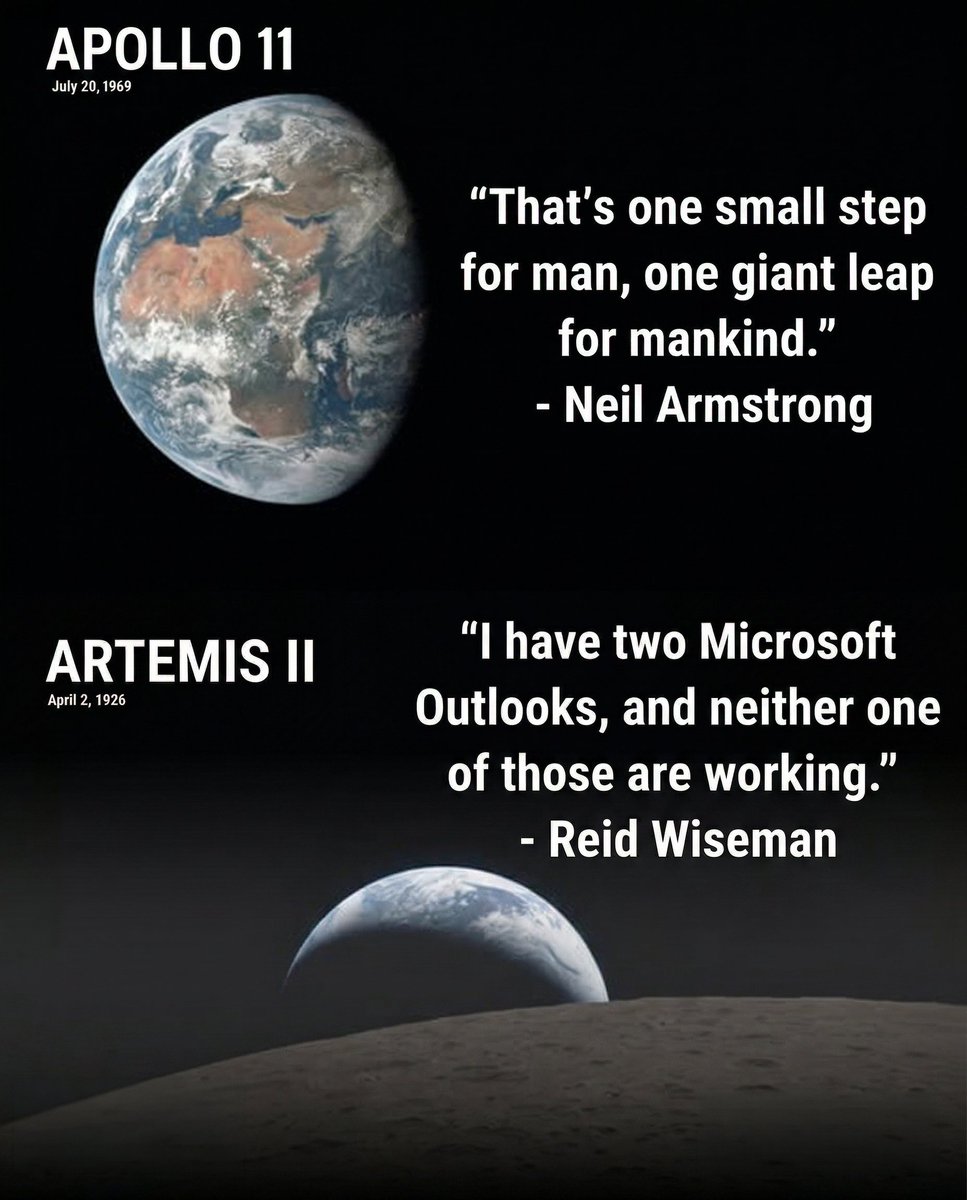
Reid Wiseman told his two teenage daughters where to find his will before he got on this rocket. He’s raised them alone since their mom died of cancer six years ago. Right now, he is 252,757 miles from home, farther from Earth than any human being has ever been.
Wiseman grew up outside Baltimore. Got rejected from the Naval Academy, went to Rensselaer Polytechnic Institute instead, studied computer engineering. Became a Navy fighter pilot, flew F-14 Tomcats (the jet from Top Gun) on combat missions over Iraq and Afghanistan. Two Middle East deployments by his mid-twenties. He saw a Space Shuttle launch in person in 2001 and couldn’t let go of it. Applied to NASA while at sea on the aircraft carrier USS Dwight D. Eisenhower. They picked him. Nine people out of 3,500 applicants. His astronaut class, nicknamed “The Chumps,” included Jeremy Hansen, the Canadian who’s floating next to him right now.
Wiseman’s first trip to space was 165 days on the Space Station in 2014. Two spacewalks. Thirteen hours outside the hull in nothing but a suit. He climbed all the way up to Chief of the Astronaut Office, the person who decides which astronauts fly and which ones sit. Then he gave it up in 2022 to put himself back on the flight list.
His wife Carroll was a nurse in a newborn intensive care unit. She got cancer. Fought it five years. Died in May 2020 at 46. His mother died from Alzheimer’s just weeks before that. Wiseman raised both daughters by himself after that. NASA’s own bio says he considers being a single parent his hardest challenge and the best part of his life. Even while she was dying, Carroll told Reid not to step back from his career. She made him keep going. His brother is a Navy SEAL. His father is 83 and battling cancer too. The old man told reporters he wanted to stay alive long enough to see his son launch.
Before liftoff, Wiseman’s daughters snuck homemade cookies into his flight bag. He posted a photo with them in front of the rocket and wrote “I’m boarding that rocket a very proud father.”
The previous distance record from Earth belonged to the Apollo 13 crew. 248,655 miles, set in April 1970, and it was an accident. An oxygen tank blew up and the emergency route home happened to swing them farther out than anyone before. Wiseman broke that record by 4,100 miles, and his distance is on purpose. Today he flies within 4,600 miles of the Moon, photographs stretches of the far side that were too dark or at the wrong angle for any of the 24 Apollo astronauts to see, and watches a solar eclipse that nobody on Earth can see, only the four people inside that capsule.
Then he turns around and spends four days flying home to his girls.
🧠We’ve been treating ICP… but ignoring the waveform.
For decades, neurocritical care has focused on:
👉 Absolute ICP values
👉 Fixed intervention thresholds
But what if we’ve been missing the most important signal?
->New insight: ICP is not just a number, it’s a waveform
This review highlights a major paradigm shift:
➡️ From static ICP thresholds
➡️ To dynamic intracranial compliance assessment
->What the waveform tells you
A single ICP value = a snapshot
The waveform = physiology in motion
👉 Key parameters:
P2/P1 ratio → compliance status
Mean pulse amplitude → compensatory reserve
Pulse shape index (AI-based) → early deterioration
When P2 > P1:
⚠️ The brain is losing its buffering capacity
⚠️ Decompensation may already be underway
->Why this matters
You can have:
✅ “Normal ICP”
❌ But severely impaired compliance
👉 Meaning:
The patient is already at risk…
before ICP even rises.
->The real shift
We are moving toward:
🧠 Physiology-driven neurocritical care
Instead of reacting to ICP spikes, we can:
Detect early deterioration
Optimize CPP and ventilation
Individualize interventions
Prevent secondary brain injury
->Even more interesting…
Non-invasive technologies are emerging:
👉 Devices that detect skull micro-deformations
👉 Provide real-time waveform surrogates
👉 Correlate with invasive ICP metrics
🤓Key takeaway
ICP alone is not enough.
👉 The future is:
Waveform + compliance + autoregulation = true brain monitoring
Bottom line
Stop treating numbers.
Start understanding physiology.
📃Reference
Brasil S, Taccone FS. Critical Care Science, 2026.
https://t.co/aY4UlRpgap
🤓🫀We keep asking: “What’s the cardiac output?”
But maybe the better question is:
“How efficiently is the heart working?”
In septic shock, we often focus on:
Preload
Cardiac output
MAP
But we forget something fundamental:
👉 The heart doesn’t work alone.
👉 It works against the arterial system.
1. The missing concept: Ventriculo–arterial coupling (LVAC)
LVAC = interaction between:
Ees → contractility
Ea → arterial load
👉 Expressed as Ea / Ees
This ratio reflects:
How efficiently the heart converts energy into forward flow
2. What is “normal”?
LVAC ≈ 0.5 → optimal efficiency
LVAC ≈ 1 → maximal stroke work
LVAC > 1 → uncoupling (inefficient system)
But here’s the twist:
👉 In septic shock, LVAC is often >1
👉 Not just due to vasodilation—but also myocardial dysfunction
3. Why this matters clinically
Two patients can have:
Same MAP
Same CO
But completely different physiology:
✔ One → efficient coupling
❌ One → energy wasted, poor flow generation
4. The key insight
Septic shock is NOT just:
❌ “low preload”
❌ “vasodilation”
It is:
👉 A mismatch between heart and arterial system
5. Therapy changes the balance
Fluids → may improve coupling (↓ LVAC)
Norepinephrine → can improve OR worsen coupling
Inotropes → target Ees
Important:
👉 Increasing MAP ≠ improving flow
👉 Increasing pressure can worsen afterload
6. The most interesting part
From the data:
LVAC >1 can predict response to norepinephrine
But improving LVAC ≠ guaranteed tissue perfusion and outcomes follow a U-shaped curve
👉 Both too high AND too low LVAC can be harmful
7. The limitation we must respect
Even if you “optimize” LVAC:
👉 Microcirculation may still be impaired
👉 Lactate may still rise
👉 Shock may persist
Because: Macro ≠ micro
🤓Final message
We need to move from:
❌ “Fix the blood pressure”
To:
✅ “Optimize the interaction between heart and vessels”
LVAC doesn’t replace hemodynamics.
It completes it.
📃Reference
Caicedo Ruiz JD et al. Journal of Critical Care, 2026. https://t.co/1ZNMHqwBl4